
Coconut Product Market Report: Trends, Forecast and Competitive Analysis to 2035

Key data points: The market size in 2035 = $58 billion, growth forecast = 8.2% annually for the next 8 years. Scroll below to get more insights. This market report covers trends, opportunities and forecasts in coconut product market to 2035 by product type (coconut oil, coconut water, coconut milk, desiccated coconut, and others), form (solid, liquid, and powder), distribution channel (business to business and business to consumer), application (cosmetics, food & beverage, and others), and region (North America, Europe, Asia Pacific, and the Rest of the World)

Publisher: Lucintel Last Updated: July 2026
See Pricing

Download Sample Report

| ✨ New Download Sample report — Get instant insights! | ✨ New Download Sample report — Get instant insights!

Coconut Product Market Report: Trends, Forecast and Competitive Analysis to 2035

Coconut Product Market

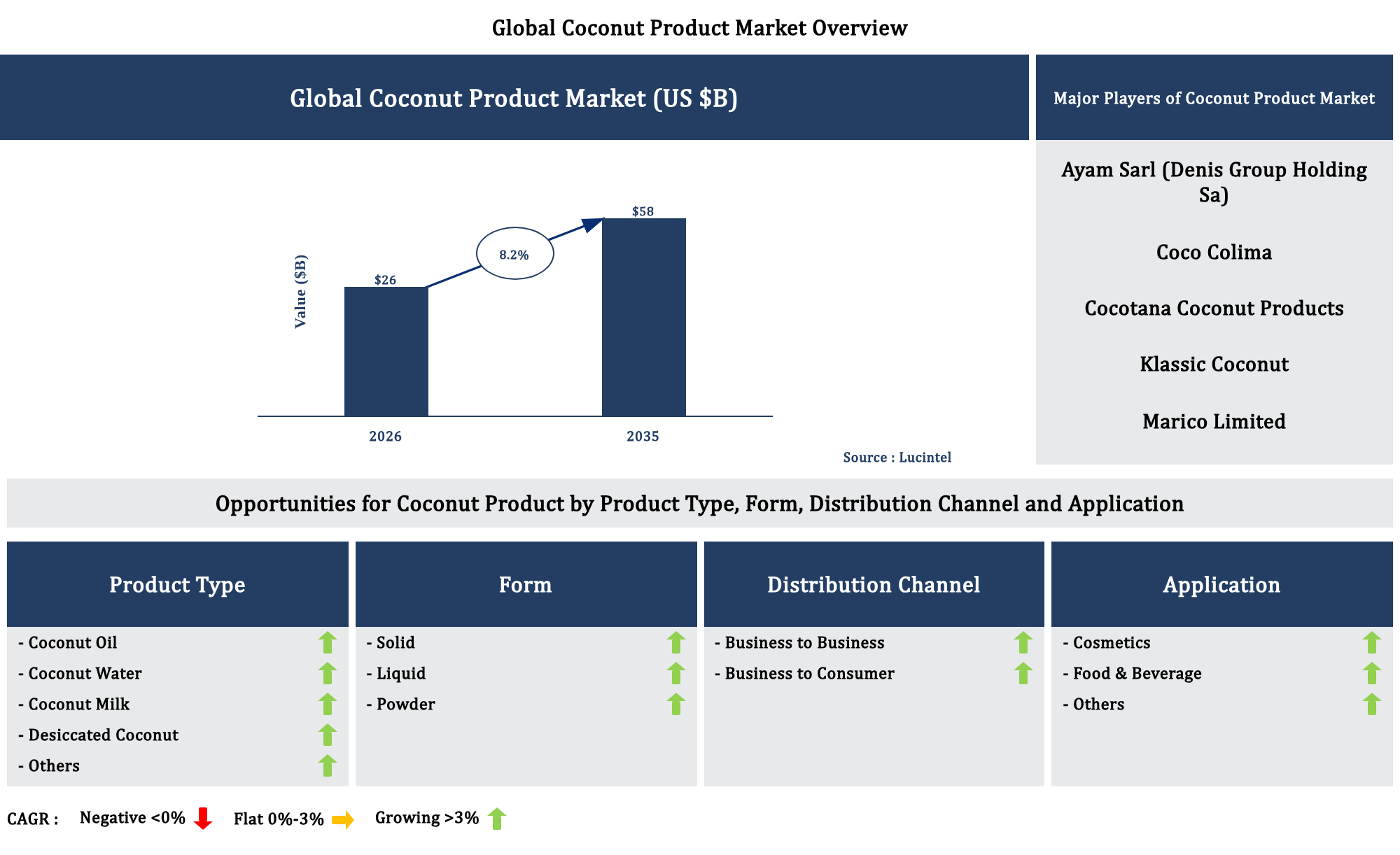
The future of the global coconut product market looks promising with opportunities in the cosmetic and food & beverage markets. The global coconut product market is expected to reach an estimated $58 billion by 2035 with a CAGR of 8.2% from 2026 to 2035. The major drivers for this market are the increasing demand for coconut water as healthy beverage, the growing demand for use of coconut oil in cooking & wellness, and the rising demand for use of coconut ingredients in bakery.

  • Lucintel forecasts that, within the product type category, coconut oil is expected to witness the highest growth over the forecast period due to rising demand for on-the-go healthy snacking options.
  • Within the application category, food & beverage is expected to witness the highest growth due to increasing retail shelf availability and consumer accessibility.
  • In terms of regions, APAC is expected to witness the highest growth over the forecast period due to strong fitness trends and convenient breakfast consumption habits.

Gain valuable insights for your business decisions with our comprehensive 150+ page report. Sample figures with some insights are shown below.
Coconut Product Market

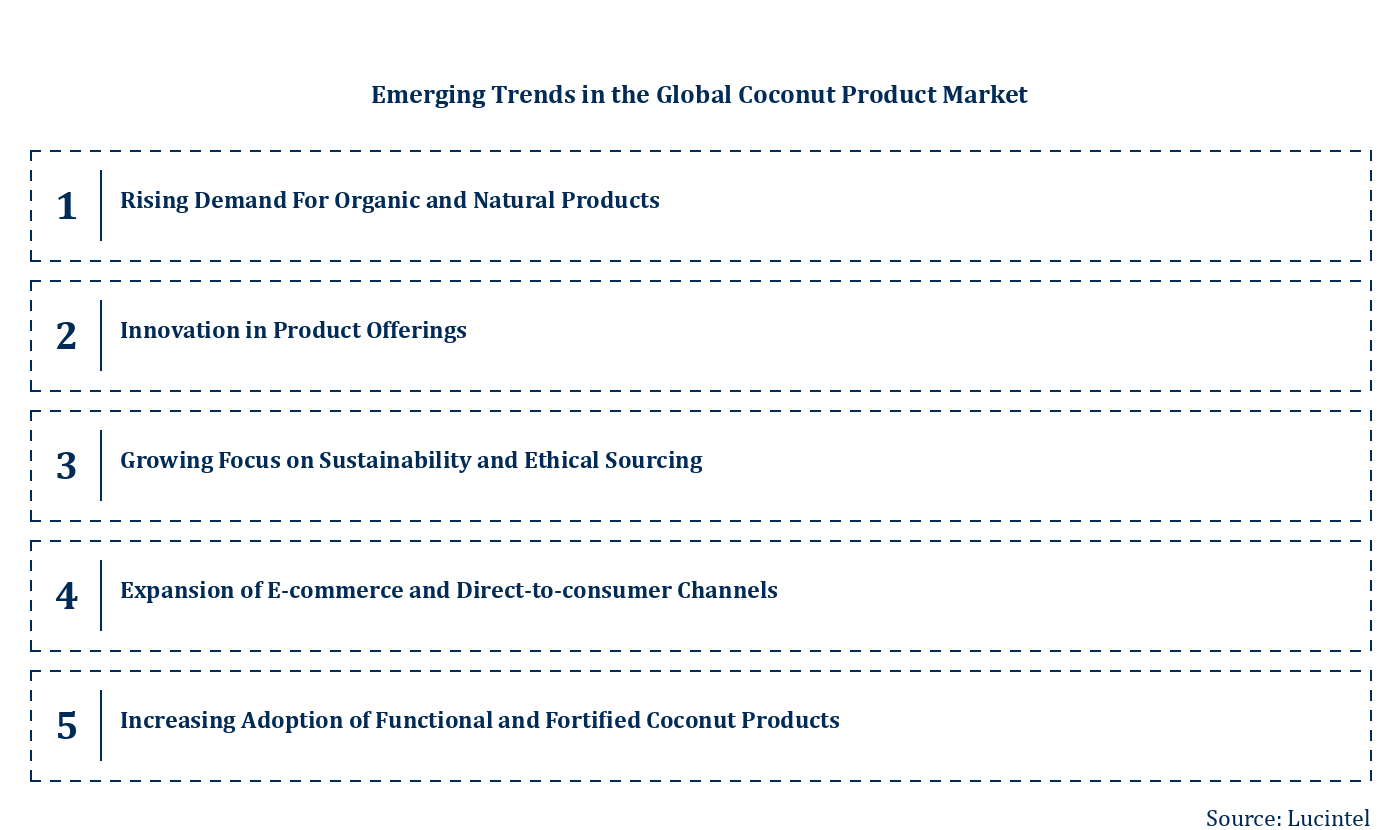
Emerging Trends in the Coconut Product Market

The coconut product market is experiencing rapid growth driven by increasing consumer awareness of health benefits, sustainability concerns, and innovative product development. As consumers seek natural, versatile, and eco-friendly options, the market is evolving with new product offerings and technological advancements. These trends are shaping the future landscape, influencing supply chains, marketing strategies, and product innovation. Companies are focusing on sustainability, health benefits, and convenience to meet changing consumer preferences. This dynamic environment presents growth opportunities but also challenges related to supply chain management and regulatory compliance. Understanding these emerging trends is crucial for stakeholders aiming to capitalize on market potential.

  • Rising Demand for Organic and Natural Products: Consumers are increasingly prioritizing organic and natural coconut products due to health consciousness and environmental concerns. This trend drives demand for organic coconuts, virgin coconut oil, and natural coconut-based snacks, encouraging producers to adopt sustainable farming practices. The shift towards organic products enhances market value and promotes eco-friendly cultivation, appealing to health-conscious consumers seeking chemical-free options. This trend also influences marketing strategies, emphasizing transparency and purity, which boosts consumer trust and loyalty.
  • Innovation in Product Offerings: The market is witnessing a surge in innovative coconut-based products such as coconut water, coconut milk, coconut flour, and coconut-based snacks. Companies are developing new formulations to cater to diverse consumer needs, including plant-based diets and gluten-free options. These innovations expand market reach and create new revenue streams. Additionally, product packaging and flavor enhancements are being optimized for convenience and taste, making coconut products more appealing to a broader audience. This trend fosters differentiation and competitive advantage in a crowded marketplace.
  • Growing Focus on Sustainability and Ethical Sourcing: Sustainability is a key driver shaping the coconut product market. Consumers and companies are emphasizing eco-friendly farming practices, fair trade certification, and ethical sourcing to reduce environmental impact and support local communities. Initiatives such as organic farming, water conservation, and fair wages are gaining prominence. This focus enhances brand reputation and appeals to socially conscious consumers. Companies investing in sustainable practices are also mitigating risks related to supply chain disruptions and regulatory pressures, ensuring long-term market stability.
  • Expansion of E-commerce and Direct-to-Consumer Channels: The rise of online retail platforms is transforming how coconut products are marketed and sold. E-commerce offers a wider reach, convenience, and access to niche markets, enabling brands to connect directly with consumers. Digital marketing strategies, including social media and influencer collaborations, are boosting brand visibility. Subscription models and online-exclusive products are also gaining popularity. This trend allows companies to gather consumer data for personalized marketing and product development, fostering stronger customer relationships and accelerating market penetration.
  • Increasing Adoption of Functional and Fortified Coconut Products: Consumers are seeking coconut products with added health benefits, such as functional foods and fortified options. These include coconut products infused with vitamins, minerals, or probiotics aimed at enhancing immunity, digestion, and overall wellness. This trend aligns with the growing health and wellness movement, encouraging product innovation and differentiation. Manufacturers are investing in research to develop scientifically backed functional coconut products, which command premium pricing and cater to health-conscious demographics. This shift is significantly expanding the market scope and consumer base.

These emerging trends—ranging from organic and innovative products to sustainability and digital expansion—are fundamentally reshaping the coconut product market. They are driving product diversification, enhancing consumer engagement, and emphasizing eco-friendly practices, ultimately fostering a more dynamic, sustainable, and consumer-centric industry landscape.
Coconut Product Market by country

Recent Developments in the Coconut Product Market

The coconut product market has experienced significant growth driven by increasing consumer demand for natural, healthy, and sustainable products. Innovations in processing and expanding product varieties have opened new avenues for market expansion. Rising awareness of health benefits associated with coconut-based items and the global shift towards plant-based diets further fuel this growth. Additionally, emerging markets and e-commerce platforms are playing crucial roles in broadening access and consumer reach. These developments collectively shape a dynamic landscape with promising opportunities for industry stakeholders.

  • Growing Demand for Natural and Organic Coconut Products: Increasing consumer preference for health-conscious, organic, and minimally processed coconut items is boosting market growth. This trend is driven by rising awareness of health benefits, such as improved immunity and skin health, leading to higher consumption of coconut oils, water, and snacks. Manufacturers are investing in organic certifications and sustainable sourcing to meet this demand, which enhances brand credibility and market share. The shift towards clean-label products is expected to continue expanding the market.
  • Innovation in Coconut-Based Product Offerings: Companies are developing new coconut products, including flavored waters, dairy alternatives, and snack foods, to cater to diverse consumer preferences. These innovations are creating new revenue streams and expanding market segments. Advanced processing techniques improve product shelf life and nutritional value, attracting health-conscious consumers. The introduction of functional coconut products with added vitamins and minerals further enhances their appeal. This continuous innovation sustains consumer interest and drives market expansion.
  • Expansion Into Emerging Markets: Developing regions such as Asia-Pacific, Africa, and Latin America are witnessing increased adoption of coconut products due to rising disposable incomes and urbanization. Local producers are expanding their product portfolios to meet growing demand, while international brands are entering these markets. Government initiatives promoting coconut cultivation and export are also supporting growth. This expansion offers significant opportunities for market players to tap into large, underserved populations, thereby increasing global market penetration and revenue.
  • E-commerce and Digital Marketing Influence: The rise of online retail platforms and social media marketing has made coconut products more accessible to consumers worldwide. E-commerce enables brands to reach niche markets and offer a wider variety of products directly to consumers, reducing distribution costs. Digital marketing strategies enhance brand visibility and consumer engagement, fostering loyalty. The convenience of online shopping and targeted advertising are accelerating sales growth, especially among younger demographics, and are expected to continue shaping market dynamics.
  • Focus on Sustainability and Eco-Friendly Practices: Consumers are increasingly prioritizing environmentally sustainable products, prompting companies to adopt eco-friendly sourcing, packaging, and production methods. Certification schemes like Fair Trade and Organic are gaining importance, influencing purchasing decisions. Sustainable practices reduce environmental impact and enhance brand reputation, attracting eco-conscious consumers. This focus on sustainability is driving innovation in biodegradable packaging and renewable energy use, positioning coconut products as environmentally responsible choices and fostering long-term market growth.

The overall impact of these developments is a robust, expanding coconut product market characterized by innovation, sustainability, and increased global reach. Consumer preferences for health and eco-friendly products are fueling demand, while technological advancements and market expansion strategies are broadening access. These factors collectively create a competitive landscape with significant growth potential, benefiting producers, retailers, and consumers alike.

Strategic Growth Opportunities in the Coconut Product Market

The coconut product market is experiencing rapid expansion driven by increasing consumer demand for natural, healthy, and sustainable products. Innovations in processing and a rising global awareness of health benefits are fueling growth across various applications. Market players are exploring new product lines and expanding into emerging markets to capitalize on this trend. Strategic investments and partnerships are further accelerating market development, creating numerous opportunities for growth and diversification in the coconut product industry.

  • Growing Demand for Organic and Natural Coconut Products: The increasing consumer preference for organic, non-GMO, and natural products is boosting the demand for organic coconut oils, waters, and snacks. This trend is driven by health consciousness and environmental concerns, prompting producers to adopt sustainable farming practices. As consumers seek cleaner labels and transparency, companies investing in organic certification and sustainable sourcing are positioned for significant growth in premium segments.
  • Expansion of Coconut-Based Health and Wellness Products: The rising awareness of coconut’s health benefits, such as its antioxidant properties and healthy fats, is driving innovation in health-focused products. These include dietary supplements, functional foods, and beverages infused with coconut ingredients. The trend towards clean-label, functional nutrition is encouraging brands to develop new formulations, expanding market reach among health-conscious consumers seeking natural wellness solutions.
  • Increasing Adoption of Coconut Ingredients in The Food and Beverage Industry: Coconut ingredients like shredded coconut, coconut flour, and coconut milk are increasingly incorporated into mainstream food and beverage products. This is due to their unique flavor, nutritional profile, and versatility. Food manufacturers are leveraging coconut’s appeal to create innovative, gluten-free, and plant-based products, thereby expanding their product portfolios and attracting a broader consumer base seeking healthier, plant-based options.
  • Rising Demand for Coconut-Based Personal Care and Cosmetic Products: Coconut derivatives such as coconut oil and extracts are highly valued in skincare, haircare, and cosmetic formulations for their moisturizing, antimicrobial, and antioxidant properties. The trend towards natural beauty products is fueling growth in this segment. Companies are developing a wide range of products, including lotions, shampoos, and serums, capitalizing on coconut’s natural appeal and consumer preference for chemical-free, eco-friendly beauty solutions.
  • Development of Sustainable and Eco-Friendly Coconut Farming Practices: As environmental concerns grow, there is a focus on sustainable cultivation and harvesting of coconuts. Innovations in eco-friendly farming, water conservation, and waste management are gaining importance. These practices not only reduce environmental impact but also enhance product quality and brand reputation. Market players investing in sustainable supply chains are likely to gain a competitive advantage and meet the increasing consumer demand for ethically sourced coconut products.

The overall market outlook is positively influenced by these growth opportunities, fostering innovation, sustainability, and diversification. Companies that strategically capitalize on these trends will strengthen their market position, meet evolving consumer preferences, and drive long-term growth in the coconut product industry.

Coconut Product Market Drivers and Challenges

The coconut product market is influenced by a variety of technological, economic, and regulatory factors that shape its growth and sustainability. Innovations in processing technologies enhance product quality and diversify offerings, while economic trends such as rising consumer health consciousness drive demand. Regulatory frameworks concerning food safety and sustainable sourcing impact operational practices and market entry. Additionally, global trade policies and environmental concerns influence supply chains and market expansion. Navigating these multifaceted drivers and challenges is essential for stakeholders aiming to capitalize on opportunities and mitigate risks within this dynamic industry.

The factors responsible for driving the coconut product market include:

  • Increasing Consumer Health Awareness: Growing awareness about the health benefits of coconut products, such as coconut oil, water, and flour, has significantly boosted demand. Consumers are shifting towards natural, organic, and plant-based products, which positions coconut items as healthy alternatives. This trend is supported by the rising prevalence of health issues like obesity and cardiovascular diseases, prompting consumers to seek nutritious options. Manufacturers are responding by innovating and expanding their product lines, which further fuels market growth. The increasing popularity of vegan and gluten-free diets also contributes to higher consumption of coconut-based products, making health consciousness a key driver.
  • Technological Advancements in Processing: Innovations in extraction, preservation, and packaging technologies have improved the quality, shelf life, and safety of coconut products. For example, cold-pressed extraction methods retain more nutrients, appealing to health-conscious consumers. Advanced packaging solutions extend product freshness and reduce spoilage, enabling longer distribution channels. Automation and automation-driven quality control enhance efficiency and reduce costs, making products more competitive. These technological improvements facilitate product diversification, such as flavored coconut waters and organic coconut oils, thereby expanding market reach and consumer appeal.
  • Growing Demand in Emerging Markets: Rapid urbanization, increasing disposable incomes, and changing dietary preferences in emerging economies like India, China, and Southeast Asian countries are driving demand for coconut products. These regions have rich coconut cultivation traditions, and consumers are increasingly adopting coconut-based foods and beverages as part of their daily diets. The expanding middle class seeks healthier and natural food options, creating a substantial market opportunity. Additionally, local manufacturers are investing in branding and distribution channels to capture this growing demand, which significantly contributes to global market expansion.
  • Expansion of Product Applications: Coconut products are increasingly used across various sectors, including food and beverages, cosmetics, and personal care. Coconut oil is popular in cooking, skincare, and haircare products, while coconut water is a trendy hydration beverage. The versatility of coconut derivatives allows manufacturers to innovate and develop new products, such as coconut-based snacks, dairy alternatives, and health supplements. This diversification broadens the consumer base and opens new revenue streams, thereby propelling market growth. The expanding application scope underscores the coconut markets adaptability to evolving consumer preferences.
  • Rising Focus on Sustainable Sourcing and Organic Products: Consumers and regulatory bodies are emphasizing sustainability and eco-friendly practices. Demand for organic, non-GMO, and sustainably sourced coconut products is increasing, prompting companies to adopt environmentally responsible cultivation and harvesting methods. Certification standards like Fair Trade and Organic boost consumer confidence and brand loyalty. Sustainable sourcing also helps mitigate supply chain risks associated with environmental degradation and climate change. This focus on sustainability not only enhances brand reputation but also aligns with global efforts to reduce ecological footprints, thereby influencing market dynamics positively.

The challenges facing this Market include:

  • Fluctuations in Raw Material Supply and Prices: The coconut industry is highly dependent on climatic conditions, which can cause variability in crop yields. Droughts, storms, and other weather-related events disrupt supply chains, leading to shortages and price volatility. These fluctuations impact profit margins for producers and can hinder consistent product availability in the market. Additionally, price instability discourages long-term investments and complicates pricing strategies, affecting overall market stability. Managing supply chain risks and ensuring steady raw material availability remain critical challenges for industry stakeholders.
  • Regulatory Hurdles and Compliance Costs: Stringent food safety standards, labeling requirements, and import-export regulations pose significant barriers. Compliance with diverse regional regulations increases operational costs and complexity, especially for small and medium-sized enterprises. Non-compliance can result in product recalls, legal penalties, and damage to brand reputation. Moreover, evolving regulations related to organic certification and sustainability claims require continuous monitoring and adaptation. Navigating these regulatory landscapes demands substantial resources, which can impede market entry and expansion, particularly in emerging markets with less developed regulatory frameworks.
  • Environmental Concerns and Climate Change Impacts: The coconut industry faces mounting pressure from environmental issues such as deforestation, habitat destruction, and water resource depletion. Climate change exacerbates these problems by affecting crop yields and increasing the frequency of extreme weather events. These environmental challenges threaten the sustainability of coconut cultivation, potentially leading to supply shortages and increased costs. Addressing these concerns requires adopting sustainable farming practices and investing in climate-resilient crops, which can be resource-intensive. Failure to mitigate environmental impacts could undermine the long-term viability of the coconut product market.

The coconut product market is driven by health-conscious consumer trends, technological innovations, emerging market opportunities, product diversification, and sustainability initiatives. However, it faces challenges such as raw material supply fluctuations, regulatory complexities, and environmental impacts. These factors collectively influence market growth, requiring stakeholders to adopt adaptive strategies. Embracing technological advancements, sustainable practices, and regulatory compliance will be crucial for capitalizing on growth opportunities while mitigating risks. Overall, the markets future depends on balancing innovation with responsible sourcing and environmental stewardship to ensure long-term sustainability and profitability.

List of Coconut Product Market Companies

Companies in the market compete on the basis of product quality offered. Major players in this market focus on expanding their manufacturing facilities, R&D investments, infrastructural development, and leverage integration opportunities across the value chain. Through these strategies coconut product market companies cater increasing demand, ensure competitive effectiveness, develop innovative products & technologies, reduce production costs, and expand their customer base. Some of the coconut product market companies profiled in this report include-

  • Ayam Sarl (Denis Group Holding Sa)
  • Coco Colima
  • Cocotana Coconut Products
  • Klassic Coconut
  • Marico Limited
  • Metshu Exports (Pvt) Ltd.
  • NDC Exports (Pvt.) Ltd.
  • Nestlé S.A.
  • Pulau Sambu Singapore Pte. Ltd.
  • Renuka Foods PLC

Coconut Product Market by Segment

The study includes a forecast for the global coconut product market by product type, form, distribution channel, application, and region.

  • Coconut Product Market by Product Type [Value from 2019 to 2035]:
    • Coconut Oil
    • Coconut Water
    • Coconut Milk
    • Desiccated Coconut
    • Others
  • Coconut Product Market by Form [Value from 2019 to 2035]:
    • Solid
    • Liquid
    • Powder
  • Coconut Product Market by Distribution Channel [Value from 2019 to 2035]:
    • Business to Business
    • Business to Consumer
  • Coconut Product Market by Application [Value from 2019 to 2035]:
    • Cosmetics
    • Food & Beverage
    • Others
  • Coconut Product Market by Region [Value from 2019 to 2035]:
    • North America
    • Europe
    • Asia Pacific
    • The Rest of the World

Country Wise Outlook for the Coconut Product Market

The coconut product market has experienced significant growth and innovation driven by increasing consumer demand for natural, sustainable, and health-oriented products. Advances in processing technologies, expanding product varieties, and rising awareness of health benefits have shaped market dynamics across major economies. Governments and the private sector are investing in sustainable sourcing and eco-friendly practices, further influencing market trends. As consumer preferences shift towards organic and ethically produced goods, countries are adopting new strategies to capitalize on this expanding market. The following summaries highlight recent developments in the coconut product market within the United States, China, Germany, India, and Japan.

  • United States: The US market has seen a surge in demand for coconut-based health products, including oils, water, and snacks. Innovative packaging and organic certifications have boosted consumer confidence. Major brands are expanding product lines to include non-GMO and sustainably sourced options. E-commerce platforms have played a crucial role in increasing accessibility and sales, while health and wellness trends continue to drive growth. Additionally, coconut ingredients are increasingly used in beauty and personal care products, reflecting cross-sector expansion.
  • China: China’s coconut product market is rapidly expanding, driven by rising health consciousness and urbanization. Local brands are investing in quality improvements and branding to compete with imported products. Coconut water and oil are particularly popular among young consumers. E-commerce and social media marketing have accelerated market penetration. The government’s support for sustainable agriculture has encouraged eco-friendly sourcing practices. Moreover, the growing middle class is seeking premium and organic coconut products, fostering innovation and diversification in the sector.
  • Germany: The German market emphasizes organic and fair-trade coconut products, aligning with consumer preferences for sustainability. There is increasing demand for coconut oil, water, and snacks, especially among health-conscious consumers. Retailers are expanding their organic sections, and specialty stores are offering a wider range of coconut-based products. The focus on eco-friendly packaging and ethical sourcing has gained importance. Germany also sees a rise in vegan and plant-based diets, boosting coconut-based alternatives in food and cosmetics. Innovation in product formulations and certifications continues to shape market growth.
  • India: India remains a major producer and consumer of coconut products, with a focus on traditional uses and local markets. Recent developments include the adoption of modern processing techniques to improve quality and shelf life. The government’s initiatives to promote coconut cultivation and value addition have supported industry growth. There is a rising demand for coconut oil, desiccated coconut, and coir products domestically and for export. Small-scale farmers are increasingly adopting sustainable practices, and local brands are expanding their product offerings. The market is also witnessing a shift towards organic and premium coconut products to meet global standards.
  • Japan: Japan’s coconut product market is characterized by a focus on health, beauty, and premium quality. Coconut water and oil are popular among health-conscious consumers, with a preference for organic and sustainably sourced options. Innovative product formats, such as ready-to-drink beverages and skincare items, are gaining popularity. Japanese consumers value transparency and certifications, which influence purchasing decisions. The market is also influenced by trends in veganism and natural beauty products. Retailers are emphasizing eco-friendly packaging and ethical sourcing, contributing to the market’s steady growth and diversification.

Features of the Coconut Product Market

  • Market Size Estimates: Coconut product market size estimation in terms of value ($B).
  • Trend and Forecast Analysis: Market trends (2019 to 2025) and forecast (2026 to 2035) by various segments and regions.
  • Segmentation Analysis: Coconut product market size by various segments, such as by product type, form, distribution channel, application, and region in terms of value ($B).
  • Regional Analysis: Coconut product market breakdown by North America, Europe, Asia Pacific, and Rest of the World.
  • Growth Opportunities: Analysis of growth opportunities in different product types, forms, distribution channels, applications, and regions for the coconut product market.
  • Strategic Analysis: This includes M&A, new product development, and competitive landscape of the coconut product market.
  • Analysis of competitive intensity of the industry based on Porter’s Five Forces model.

Top 5 Companies

  • Ayam Sarl (Denis Group Holding Sa)
  • Coco Colima
  • Cocotana Coconut Products
  • Klassic Coconut
  • Marico Limited

Table of Contents

1. Executive Summary
15.1 Competitive Analysis Overview

List of Figures

Figure 9.1: Trends and Forecast for the North American Coconut Product Market (2019-2035) Figure 9.2: North American Coconut Product Market by Product Type in 2019, 2025, and 2035 Figure 9.3: Trends of the North American Coconut Product Market ($B) by Product Type (2019-2025) Figure 9.4: Forecast for the North American Coconut Product Market ($B) by Product Type (2026-2035) Figure 9.5: North American Coconut Product Market by Form in 2019, 2025, and 2035 Figure 9.6: Trends of the North American Coconut Product Market ($B) by Form (2019-2025) Figure 9.7: Forecast for the North American Coconut Product Market ($B) by Form (2026-2035) Figure 9.8: North American Coconut Product Market by Distribution Channel in 2019, 2025, and 2035 Figure 9.9: Trends of the North American Coconut Product Market ($B) by Distribution Channel (2019-2025) Figure 9.10: Forecast for the North American Coconut Product Market ($B) by Distribution Channel (2026-2035) Figure 9.11: North American Coconut Product Market by Application in 2019, 2025, and 2035 Figure 9.12: Trends of the North American Coconut Product Market ($B) by Application (2019-2025) Figure 9.13: Forecast for the North American Coconut Product Market ($B) by Application (2026-2035) Figure 9.14: Trends and Forecast for the United States Coconut Product Market ($B) (2019-2035) Figure 9.15: Trends and Forecast for the Mexican Coconut Product Market ($B) (2019-2035) Figure 9.16: Trends and Forecast for the Canadian Coconut Product Market ($B) (2019-2035)
Figure 10.1: Trends and Forecast for the European Coconut Product Market (2019-2035) Figure 10.2: European Coconut Product Market by Product Type in 2019, 2025, and 2035 Figure 10.3: Trends of the European Coconut Product Market ($B) by Product Type (2019-2025) Figure 10.4: Forecast for the European Coconut Product Market ($B) by Product Type (2026-2035) Figure 10.5: European Coconut Product Market by Form in 2019, 2025, and 2035 Figure 10.6: Trends of the European Coconut Product Market ($B) by Form (2019-2025) Figure 10.7: Forecast for the European Coconut Product Market ($B) by Form (2026-2035) Figure 10.8: European Coconut Product Market by Distribution Channel in 2019, 2025, and 2035 Figure 10.9: Trends of the European Coconut Product Market ($B) by Distribution Channel (2019-2025) Figure 10.10: Forecast for the European Coconut Product Market ($B) by Distribution Channel (2026-2035) Figure 10.11: European Coconut Product Market by Application in 2019, 2025, and 2035 Figure 10.12: Trends of the European Coconut Product Market ($B) by Application (2019-2025) Figure 10.13: Forecast for the European Coconut Product Market ($B) by Application (2026-2035) Figure 10.14: Trends and Forecast for the German Coconut Product Market ($B) (2019-2035) Figure 10.15: Trends and Forecast for the French Coconut Product Market ($B) (2019-2035) Figure 10.16: Trends and Forecast for the Spanish Coconut Product Market ($B) (2019-2035) Figure 10.17: Trends and Forecast for the Italian Coconut Product Market ($B) (2019-2035) Figure 10.18: Trends and Forecast for the United Kingdom Coconut Product Market ($B) (2019-2035)
Figure 11.1: Trends and Forecast for the APAC Coconut Product Market (2019-2035) Figure 11.2: APAC Coconut Product Market by Product Type in 2019, 2025, and 2035 Figure 11.3: Trends of the APAC Coconut Product Market ($B) by Product Type (2019-2025) Figure 11.4: Forecast for the APAC Coconut Product Market ($B) by Product Type (2026-2035) Figure 11.5: APAC Coconut Product Market by Form in 2019, 2025, and 2035 Figure 11.6: Trends of the APAC Coconut Product Market ($B) by Form (2019-2025) Figure 11.7: Forecast for the APAC Coconut Product Market ($B) by Form (2026-2035) Figure 11.8: APAC Coconut Product Market by Distribution Channel in 2019, 2025, and 2035 Figure 11.9: Trends of the APAC Coconut Product Market ($B) by Distribution Channel (2019-2025) Figure 11.10: Forecast for the APAC Coconut Product Market ($B) by Distribution Channel (2026-2035) Figure 11.11: APAC Coconut Product Market by Application in 2019, 2025, and 2035 Figure 11.12: Trends of the APAC Coconut Product Market ($B) by Application (2019-2025) Figure 11.13: Forecast for the APAC Coconut Product Market ($B) by Application (2026-2035) Figure 11.14: Trends and Forecast for the Japanese Coconut Product Market ($B) (2019-2035) Figure 11.15: Trends and Forecast for the Indian Coconut Product Market ($B) (2019-2035) Figure 11.16: Trends and Forecast for the Chinese Coconut Product Market ($B) (2019-2035) Figure 11.17: Trends and Forecast for the South Korean Coconut Product Market ($B) (2019-2035) Figure 11.18: Trends and Forecast for the Indonesian Coconut Product Market ($B) (2019-2035)

List of Tables

Methodology

Lucintel has been in the business of market research and management consulting since 2000 and has published over 1000 market intelligence reports in various markets / applications and served over 1,000 clients worldwide. This study is a culmination of four months of full-time effort performed by Lucintel's analyst team. The analysts used the following sources for the creation and completion of this valuable report:

  • In-depth interviews of the major players in this market
  • Detailed secondary research from competitors' financial statements and published data
  • Extensive searches of published works, market, and database information pertaining to industry news, company press releases, and customer intentions
  • A compilation of the experiences, judgments, and insights of Lucintel's professionals, who have analyzed and tracked this market over the years.

Extensive research and interviews are conducted across the supply chain of this market to estimate market share, market size, trends, drivers, challenges, and forecasts. Below is a brief summary of the primary interviews that were conducted by job function for this report.

Lucintel's methodology for market research

Thus, Lucintel compiles vast amounts of data from numerous sources, validates the integrity of that data, and performs a comprehensive analysis. Lucintel then organizes the data, its findings, and insights into a concise report designed to support the strategic decision-making process. The figure below is a graphical representation of Lucintel's research process.

Primary interviews by job function

Buy Now

Choose a license that fits your team. Instant PDF delivery.

Market Report

1 User PDF

$4,850
Buy Now

Market Report

2-5 Users PDF

$6,700
Buy Now

Market Report

Corporate PDF

$8,850
Buy Now

Market Report

Global PDF

$10,000
Buy Now

Prices exclude taxes. Instant delivery. Custom licensing available on request.

Frequently Asked Questions

What is the coconut product market size?
The global coconut product market is expected to reach an estimated $58 billion by 2035.
What is the growth forecast for coconut product market?
The global coconut product market is expected to grow with a CAGR of 8.2% from 2026 to 2035.
What are the major drivers influencing the growth of the coconut product market?
The major drivers for this market are the increasing demand for coconut water as healthy beverage, the growing demand for use of coconut oil in cooking & wellness, and the rising demand for use of coconut ingredients in bakery.
What are the major segments for coconut product market?
The future of the coconut product market looks promising with opportunities in the cosmetic and food & beverage markets.
Who are the key coconut product market companies?

Some of the key coconut product companies are as follows:

  • Ayam Sarl (Denis Group Holding Sa)
  • Coco Colima
  • Cocotana Coconut Products
  • Klassic Coconut
  • Marico Limited
  • Metshu Exports (Pvt) Ltd.
  • NDC Exports (Pvt.) Ltd.
  • Nestlé S.A.
  • Pulau Sambu Singapore Pte. Ltd.
  • Renuka Foods PLC
Which coconut product market segment will be the largest in future?
Lucintel forecasts that, within the product type category, coconut oil is expected to witness the highest growth over the forecast period.
In coconut product market, which region is expected to be the largest in next 5 years?
In terms of region, APAC is expected to witness the highest growth over the forecast period.
Do we receive customization in this report?
Yes, Lucintel provides 10% customization without any additional cost.

Key Questions

  • What are some of the most promising, high-growth opportunities for the coconut product market by product type (coconut oil, coconut water, coconut milk, desiccated coconut, and others), form (solid, liquid, and powder), distribution channel (business to business and business to consumer), application (cosmetics, food & beverage, and others), and region (North America, Europe, Asia Pacific, and the Rest of the World)?
  • Which segments will grow at a faster pace and why?
  • Which region will grow at a faster pace and why?
  • What are the key factors affecting market dynamics? What are the key challenges and business risks in this market?
  • What are the business risks and competitive threats in this market?
  • What are the emerging trends in this market and the reasons behind them?
  • What are some of the changing demands of customers in the market?
  • What are the new developments in the market? Which companies are leading these developments?
  • Who are the major players in this market? What strategic initiatives are key players pursuing for business growth?
  • What are some of the competing products in this market and how big of a threat do they pose for loss of market share by material or product substitution?
  • What M&A activity has occurred in the last 7 years and what has its impact been on the industry?
Why Choose Us

The Lucintel Advantage

Trusted partner for strategic intelligence and business growth

25+ Years Excellence

25+ Years Excellence

Quarter century of proven expertise in management consulting and market research across global markets.
Game-Changer Ideas

Game-Changer Ideas

Innovative strategies and actionable insights that help clients become the smartest in their industry.
Global Reach

Global Reach

Extensive coverage across 50+ industries and markets worldwide with localized expertise.
Start Your Growth Journey

Get Your Free
Market Intelligence
Briefing

Receive a complimentary market analysis tailored to your industry. Our analysts will identify key growth opportunities and competitive dynamics specific to your business.

Custom Market Snapshot

Market size, growth rate, and key trend analysis for your specific sector.

Competitive Landscape Overview

Top competitor positioning and market share analysis.

Growth Opportunity Identification

Strategic recommendations backed by data-driven insights.

Subscribe

Subscribe to our Newsletter

Get curated market intelligence and competitive moves straight to your inbox.

By subscribing, you agree to receive our monthly insights. Unsubscribe anytime.

Industry Trends Market Signals Opportunities Competitor Moves