
Market Report · July 15, 2026

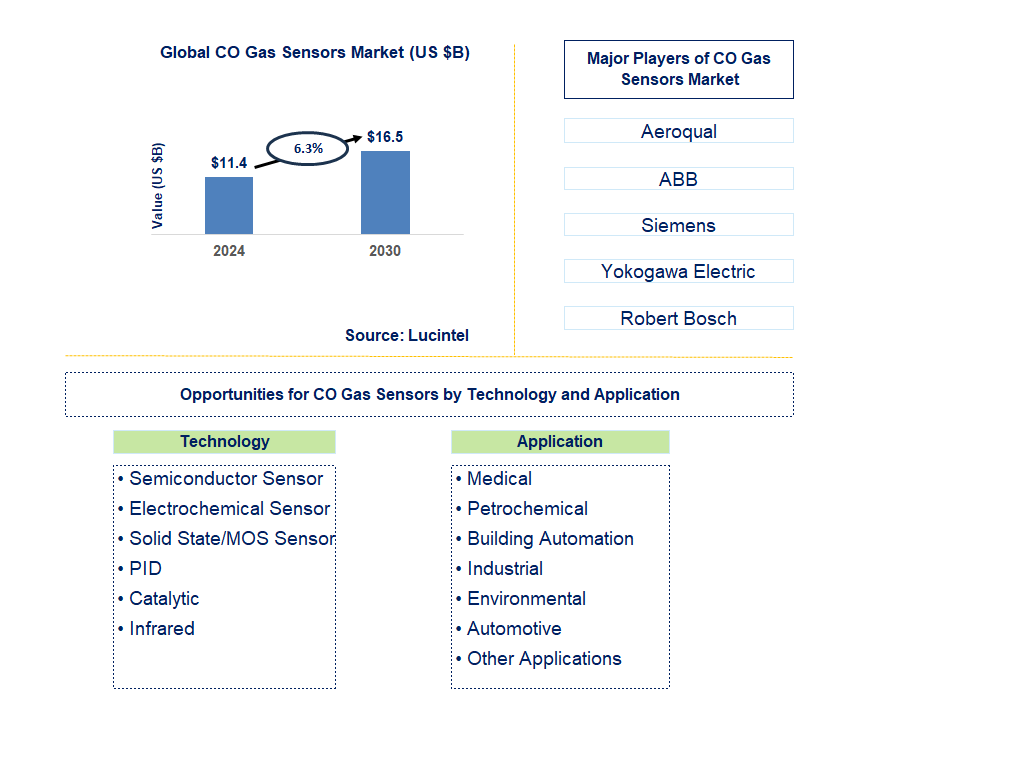
Key data points: The market size in 2030 = $16.5 billion, growth forecast = 6.3% annually for the next 6 years. Scroll below to get more insights. This market report covers trends, opportunities, and forecasts in the global co gas sensors market to 2030 by technology (semiconductor sensor, electrochemical sensor, solid state/MOS sensor, PID, catalytic, and infrared), application (medical, petrochemical, building automation, industrial, environmental, automotive, and other applications), and region (North America, Europe, Asia Pacific, and the Rest of the World)
We'll send your sample report shortly.
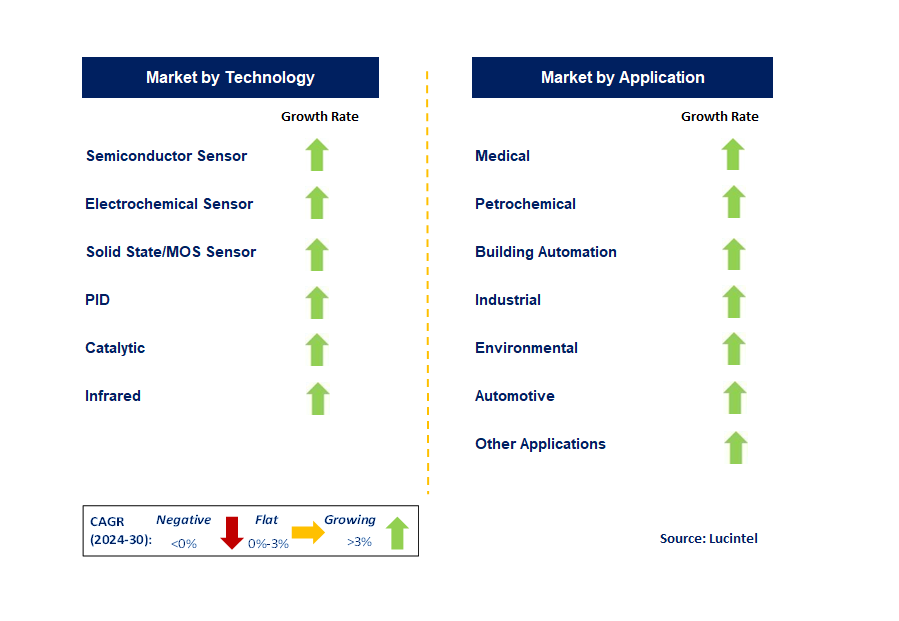
• Lucintel forecasts that, within the technology category, electrochemical sensor will remain the largest segment over the forecast period due to its quick response time and good accuracy.
• Within the application category, automotive will remain the largest segment due to increasing requirement to set up carbon monoxide gas detectors in automobile industry.
• In terms of regions, North America will remain the largest region over the forecast period due to growing incidents of CO poisoning in the region. Gain valuable insights for your business decisions with our 150+ page report.
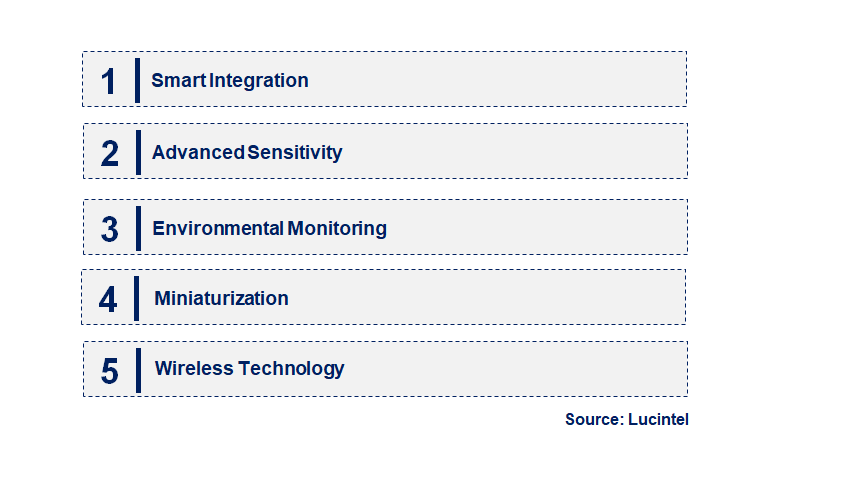
• Smart Integration: Increasing use of IoT and smart technologies to enable real-time monitoring and remote management of CO levels.
• Advanced Sensitivity: Development of sensors with enhanced sensitivity and accuracy for improved detection and safety.
• Environmental Monitoring: Growing integration of CO sensors with other environmental monitoring systems to provide comprehensive data.
• Miniaturization: Trend towards smaller, more compact sensors that can be easily integrated into various applications.
• Wireless Technology: Adoption of wireless communication technologies to enhance connectivity and data transmission.
• Regulatory Compliance: Innovations driven by stricter safety and environmental regulations worldwide. Emerging trends in the CO gas sensors market emphasize smart technology integration, advanced sensitivity, and environmental monitoring, driven by technological advancements and regulatory requirements.
• Smart Features: Integration of IoT and wireless connectivity for real-time monitoring and remote management.
• Enhanced Accuracy: Development of CO sensors with improved sensitivity and reliability for diverse applications.
• Regulatory Adherence: Innovations driven by stringent safety and environmental regulations.
• Cost-Effectiveness: Introduction of more affordable sensors to meet growing market demands.
• Environmental Integration: Integration with other environmental monitoring systems for comprehensive data analysis.
• Technological Advancements: Advances in sensor materials and manufacturing processes enhancing performance and durability. Recent developments in the CO gas sensors market focus on smart technology, enhanced accuracy, and regulatory compliance, reflecting technological advancements and market needs.
• Smart Home Systems: Integration of CO sensors into smart home systems for enhanced safety and monitoring.
• Industrial Applications: Growth in demand for CO sensors in industrial settings for improved safety and compliance.
• Automotive Industry: Increasing use of CO sensors in vehicles to ensure safety and meet regulatory standards.
• Environmental Monitoring: Opportunities in integrating CO sensors with broader environmental monitoring systems.
• Emerging Markets: Expansion into emerging markets with tailored solutions to meet local needs and regulatory requirements.
• Technological Innovations: Investment in new sensor technologies and materials to improve performance and reduce costs. Strategic growth opportunities for CO gas sensors lie in smart home integration, industrial applications, and emerging markets, driven by technological advancements and evolving industry needs.
• Technological Advancements: Innovations in sensor technology, including smart features and enhanced accuracy.
• Regulatory Compliance: Stricter safety and environmental regulations driving demand for reliable CO detection.
• Smart Technology: Integration with IoT and smart systems enhancing functionality and user convenience.
• Industrial Safety: Increased focus on safety in industrial settings fueling demand for CO sensors.
• Environmental Awareness: Growing concern about air quality and environmental health promoting sensor adoption. Challenges in the CO gas sensors market are:
• Cost Factors: High development and production costs affecting affordability and market penetration.
• Market Competition: Intense competition among manufacturers leading to pricing pressures and innovation demands.
• Regulatory Variability: Navigating diverse regulations across different regions and markets.
• Technological Obsolescence: Rapid technological advancements leading to potential obsolescence of existing models.
• Supply Chain Issues: Disruptions in supply chains impacting the availability and cost of materials and components.
• Maintenance Needs: Ongoing maintenance and calibration requirements affecting operational efficiency and costs. The CO gas sensors market is driven by technological advancements, regulatory compliance, and smart technology, while facing challenges related to cost, competition, and supply chain issues.
• Aeroqual
• ABB
• Siemens
• Yokogawa Electric
• Robert Bosch
• GfG
• Alphasense
• Dynament
• NGK Insulators
• Trolex
• Semiconductor Sensor
• Electrochemical Sensor
• Solid State/MOS Sensor
• PID
• Catalytic
• Infrared
• Medical
• Petrochemical
• Building Automation
• Industrial
• Environmental
• Automotive
• Other Applications
• North America
• Europe
• Asia Pacific
• The Rest of the World
• USA: In the USA, the CO gas sensors market is advancing with a focus on smart technology integration and regulatory compliance. Major players like Honeywell and Figaro Engineering are developing sensors with enhanced accuracy and reliability for residential and industrial applications. There is a growing trend toward the incorporation of IoT and wireless connectivity in CO gas sensors, allowing for real-time monitoring and remote management. Additionally, increased awareness about indoor air quality and stricter safety regulations are driving innovations and adoption of advanced CO sensors across various sectors, including residential, commercial, and automotive industries.
• China: China’s CO gas sensors market is expanding rapidly, driven by the country's industrial growth and increasing environmental awareness. Major Chinese companies like Beijing Zhongke Huitian and Shanghai Senso are advancing CO sensor technologies to meet the growing demand for industrial and residential applications. There is a notable push toward developing cost-effective and high-performance sensors that comply with international standards. The Chinese government’s initiatives to improve air quality and safety standards are also contributing to the growth of the CO gas sensors market. Innovations include the integration of CO sensors with smart technologies for enhanced functionality and user convenience.
• India: In India, recent developments in the CO gas sensors market are influenced by increasing urbanization and rising awareness about air quality. Companies such as Gas Sensing Solutions and Emtec Instruments are introducing CO sensors tailored to the needs of residential and industrial applications. The Indian market is seeing a growing adoption of CO sensors in smart home systems and commercial buildings, driven by the need for improved safety and environmental monitoring. Additionally, there is a focus on affordability and accessibility to cater to the diverse needs of the Indian market, with advancements in sensor technology and manufacturing processes.
• Japan: Japan’s CO gas sensors market is characterized by high technological advancements and a focus on precision and reliability. Japanese companies like Figaro Engineering and Sharp are developing advanced CO sensors with improved sensitivity and response times. There is significant demand for CO sensors in various applications, including automotive, industrial, and residential sectors. Japan’s emphasis on safety and environmental sustainability is driving innovations in CO sensor technology, including the integration of sensors with smart systems and advanced data analytics. Additionally, there is a strong focus on developing compact and energy-efficient sensors to meet the needs of diverse applications.


• Aeroqual
• ABB
• Siemens
• Yokogawa Electric
• Robert Bosch
• GfG
• Alphasense
• Dynament
• NGK Insulators
• Trolex Q6. Which CO gas sensors market segment will be the largest in future? Answer: Lucintel forecasts that electrochemical sensor will remain the largest segment over the forecast period due to its quick response time and good accuracy. Q7. In CO gas sensors market, which region is expected to be the largest in next 5 years? Answer: North America will remain the largest region over the forecast period due to growing incidents of CO poisoning in the region. Q.8 Do we receive customization in this report? Answer: Yes, Lucintel provides 10% customization without any additional cost.


Choose a license that fits your team. Instant PDF delivery.
Prices exclude taxes. Instant delivery. Custom licensing available on request.
Market Report · July 15, 2026
Market Report · July 13, 2026
Market Report · July 13, 2026
Trusted partner for strategic intelligence and business growth


Receive a complimentary market analysis tailored to your industry. Our analysts will identify key growth opportunities and competitive dynamics specific to your business.

Market size, growth rate, and key trend analysis for your specific sector.

Top competitor positioning and market share analysis.

Strategic recommendations backed by data-driven insights.
Get curated market intelligence and competitive moves straight to your inbox.
By subscribing, you agree to receive our monthly insights. Unsubscribe anytime.
Receive a complimentary market analysis tailored to your industry. Our analysts will identify key growth opportunities and competitive dynamics specific to your business.
Market size, growth rate, and key trend analysis for your specific sector.
Top competitor positioning and market share analysis.
Strategic recommendations backed by data-driven insights.
Get curated market intelligence, emerging trends, and competitive moves straight to your inbox each month.
By subscribing, you agree to receive our monthly insights. Unsubscribe anytime.
We'll send your sample report shortly.