
Market Report · July 31, 2026

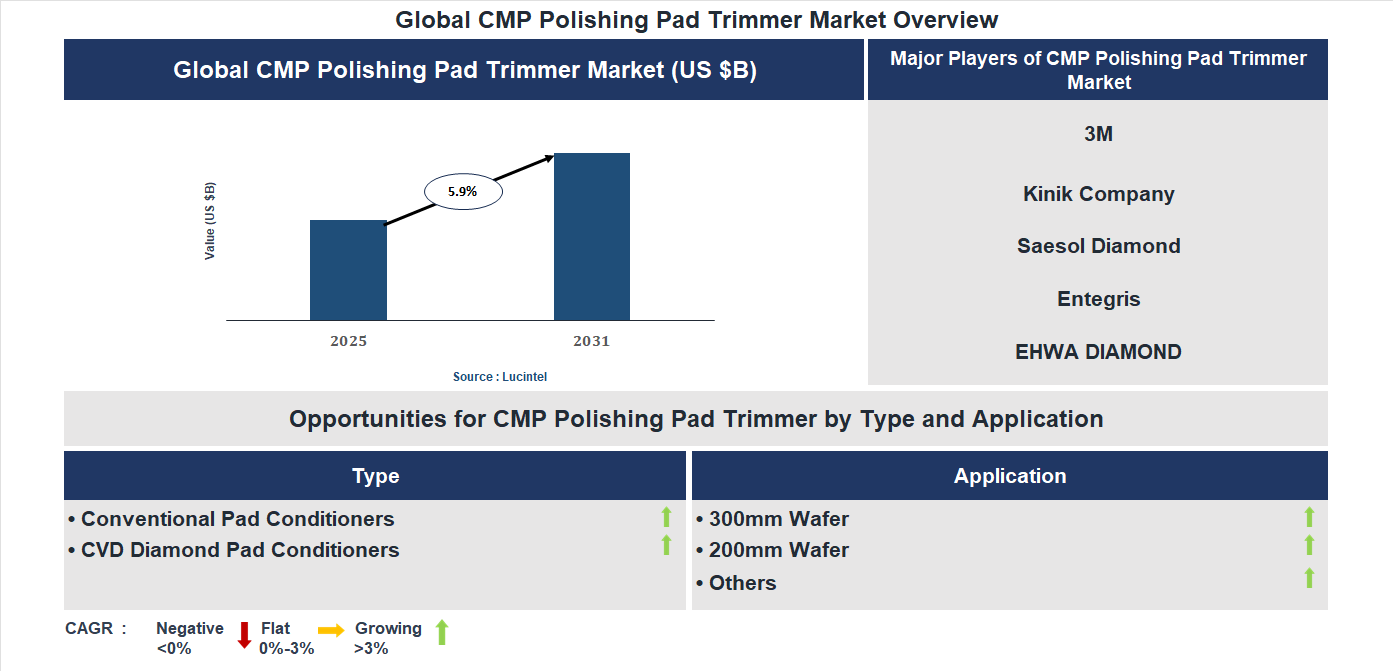
Key data points: The growth forecast = 5.9% annually for the next 7 years. Scroll below to get more insights. This market report covers trends, opportunities and forecasts in CMP polishing pad trimmer market to 2031 by type (conventional pad conditioners and CVD diamond pad conditioners), application (300mm wafer, 200mm wafer, and others), and region (North America, Europe, Asia Pacific, and the Rest of the World)
We'll send your sample report shortly.
• Lucintel forecasts that, within the application category, 300mm wafer is expected to witness higher growth over the forecast period.
• Within the type category, CVD diamond pad conditioner is expected to witness the highest growth.
• In terms of region, APAC is expected to witness the highest growth over the forecast period. Gain valuable insights for your business decisions with our comprehensive 150+ page report. Sample figures with some insights are shown below.
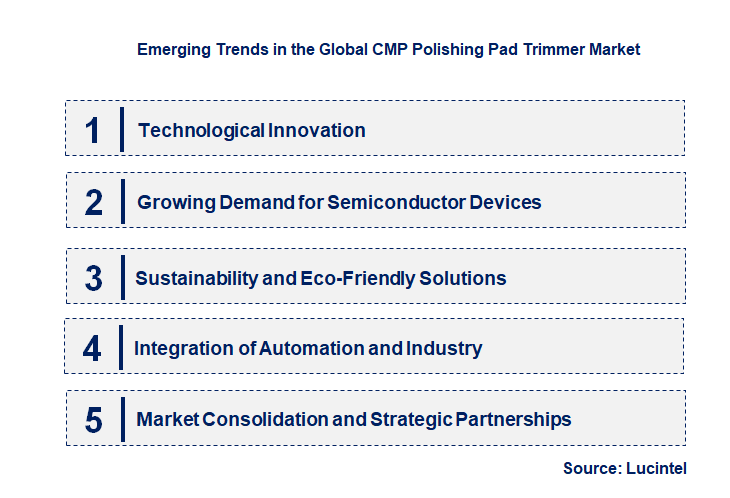
• Technological Innovation: The market is witnessing significant advancements in trimming technologies, including automation and precision control. New equipment incorporates AI and machine learning to optimize trimming processes, reduce waste, and improve consistency. These innovations enhance the quality of polishing pads, leading to better semiconductor device performance. As technology evolves, manufacturers are able to offer more sophisticated, user-friendly solutions that meet the increasing demands for miniaturization and high precision in semiconductor manufacturing.
• Growing Demand for Semiconductor Devices: The surge in demand for consumer electronics, automotive electronics, and IoT devices is fueling the need for high-quality polishing pads. As semiconductor devices become smaller and more complex, the requirement for precise polishing increases. This demand drives the need for efficient trimming solutions that can handle high-volume production while maintaining quality. The market is thus expanding rapidly, with manufacturers investing in advanced trimming equipment to meet the rising production requirements.
• Sustainability and Eco-Friendly Solutions: Environmental concerns are prompting market players to develop greener trimming processes. This includes the use of eco-friendly materials, the reduction of waste, and energy-efficient machinery. Companies are adopting sustainable practices to comply with regulations and meet customer expectations for environmentally responsible products. These initiatives not only reduce the environmental footprint but also lower operational costs, making them attractive to manufacturers seeking sustainable growth.
• Integration of Automation and Industry: Automation is transforming the CMP polishing pad trimmer market by enabling higher throughput, consistency, and reduced labor costs. Industry 4.0 concepts, such as IoT connectivity and real-time data analytics, are being integrated into trimming equipment. This allows for predictive maintenance, process optimization, and enhanced quality control. The adoption of automation is crucial for meeting the high-volume, precision requirements of modern semiconductor manufacturing, leading to increased efficiency and competitiveness.
• Market Consolidation and Strategic Partnerships: The market is witnessing consolidation through mergers and acquisitions, as companies aim to strengthen their technological capabilities and expand their market share. Strategic partnerships are also forming to develop innovative solutions and access new markets. This trend enhances R&D capabilities, accelerates product development, and fosters competitive advantages. As a result, the market is becoming more dynamic, with a focus on collaboration to address complex technological challenges and meet evolving customer needs. In summary, these trends are collectively reshaping the CMP polishing pad trimmer market by driving technological innovation, increasing demand, emphasizing sustainability, integrating automation, and fostering strategic collaborations. These developments are leading to more efficient, sustainable, and high-precision solutions, ultimately transforming the landscape of semiconductor manufacturing and related industries.
• Introduction of Automated Trimming Systems: The market has seen the emergence of fully automated CMP pad trimmers that enhance precision and reduce manual labor. These systems utilize advanced sensors and AI algorithms to optimize trimming processes, resulting in higher consistency and reduced waste. The automation trend improves operational efficiency and minimizes human error, leading to cost savings and faster turnaround times. This development is particularly impactful for high-volume semiconductor manufacturing, where precision and speed are critical.
• Adoption of Eco-Friendly Materials and Processes: Companies are increasingly focusing on sustainable practices by developing eco-friendly trimming materials and reducing chemical usage. Innovations include biodegradable abrasives and water-based cleaning solutions that lower environmental impact. This shift not only aligns with global sustainability goals but also reduces operational costs associated with waste management and chemical disposal. The adoption of green technologies is enhancing brand reputation and compliance with environmental regulations, thereby expanding market opportunities.
• Integration of IoT and Data Analytics: The incorporation of Internet of Things (IoT) devices and data analytics into trimming equipment has revolutionized process monitoring and control. Real-time data collection enables predictive maintenance, minimizes downtime, and improves process accuracy. This integration allows manufacturers to optimize trimming parameters dynamically, leading to better pad lifespan and performance. The impact is a significant boost in productivity, reduced operational costs, and enhanced quality control, making the market more competitive and responsive to customer needs.
• Development of High-Precision Trimming Technologies: Advances in high-precision trimming techniques, such as laser-based and ultrasonic methods, have improved the accuracy of CMP pad trimming. These technologies enable finer control over pad dimensions and surface quality, essential for advanced semiconductor nodes. The increased precision reduces defect rates and enhances device performance, which is crucial for high-end applications. This development positions the market to meet the stringent quality standards of next-generation semiconductor devices, fostering innovation and growth.
• Expansion of Regional Markets and Strategic Collaborations: The market has experienced growth through regional expansion and strategic partnerships between key players. Emerging markets in the Asia-Pacific and other regions are witnessing increased investments in CMP pad trimming solutions. Collaborations and joint ventures facilitate technology transfer, local manufacturing, and customized solutions tailored to regional needs. These efforts boost market penetration, diversify supply chains, and accelerate adoption rates, ultimately driving overall market growth and competitiveness. In summary, recent developments in the CMP polishing pad trimmer market are centered around automation, sustainability, technological innovation, precision, and regional expansion. These trends are collectively enhancing process efficiency, environmental compliance, and product quality. As a result, the market is experiencing accelerated growth, increased competitiveness, and a stronger focus on sustainable and high-precision solutions, positioning it well for future advancements and industry demands.
• Enhanced Precision and Yield Improvement: The demand for high-quality CMP polishing pads necessitates precise trimming to ensure uniformity and surface quality, leading to higher yields and reduced defect rates in semiconductor fabrication.
• Miniaturization and Performance Optimization: As consumer devices become smaller and more powerful, trimming solutions help achieve optimal pad dimensions, improving device performance and manufacturing efficiency.
• Reliability and Durability Enhancement: The automotive sector requires durable polishing pads for high-reliability applications, and trimming technologies contribute to consistent quality, supporting safety and longevity standards.
• Cost-Effective Production Scaling: The need for large-scale, cost-efficient wafer processing is driving the adoption of trimming solutions that streamline production, reduce waste, and lower overall manufacturing costs.
• Innovation in Material and Process Development: R&D activities benefit from advanced trimming techniques that enable experimentation with new materials and processes, fostering innovation in semiconductor technology. These growth opportunities are significantly impacting the CMP polishing pad trimmer market by driving technological advancements, expanding application scopes, and increasing overall market size. As industries demand higher precision and efficiency, companies that leverage these opportunities will lead market growth and innovation.
• Technological Innovation: The rapid evolution of semiconductor manufacturing processes necessitates advanced polishing solutions. Innovations in pad trimming technology improve efficiency, precision, and yield, making them indispensable for manufacturers aiming to meet stringent quality standards. The development of automated and AI-driven trimming systems further enhances productivity and reduces human error, fostering market growth. As technology continues to advance, the demand for sophisticated trimming equipment is expected to rise, supporting the overall expansion of the market.
• Growing Semiconductor Industry: The global surge in demand for semiconductors across sectors such as consumer electronics, automotive, and industrial applications significantly propels the CMP polishing pad trimmer market. Increased production capacities and technological upgrades in semiconductor fabrication plants require high-quality polishing and trimming tools. This growth is driven by trends like 5G, IoT, and AI, which demand smaller, more efficient chips, thereby boosting the need for precise polishing solutions and expanding market opportunities.
• Environmental Regulations and Sustainability Initiatives: Stricter environmental standards and sustainability goals influence the design and operation of polishing equipment. Manufacturers are adopting eco-friendly materials and waste reduction techniques to comply with regulations, which in turn drives innovation in trimming technology. The focus on reducing chemical usage and energy consumption aligns with global sustainability efforts, creating a demand for more efficient and environmentally compliant CMP polishing pad trimmers.
• Increasing Automation and Industry 4.0 Adoption: The integration of automation, robotics, and Industry 4.0 principles in semiconductor manufacturing enhances process control and productivity. Automated trimming systems reduce manual intervention, improve consistency, and lower operational costs. This technological shift encourages manufacturers to upgrade their equipment, fueling market growth. The adoption of smart sensors and data analytics further optimizes trimming processes, making automation a key driver in the market’s expansion.
• Rising Investment in Semiconductor Manufacturing: Significant investments by governments and private entities in semiconductor fabrication facilities worldwide bolster the demand for CMP polishing pad trimmers. These investments aim to meet the increasing global demand for advanced chips, prompting upgrades and new installations of polishing equipment. The expansion of manufacturing capacities in regions like the Asia-Pacific and North America directly correlates with increased market opportunities for trimming solutions. The challenges facing this Market include:
• High Capital and Operational Costs: The advanced technology required for CMP polishing pad trimming involves substantial capital investment in equipment and infrastructure. Operational costs, including maintenance, consumables, and skilled labor, further add to financial burdens. These high costs can limit adoption, especially among smaller manufacturers or in regions with economic constraints, potentially slowing market growth and innovation.
• Rapid Technological Obsolescence: The fast-paced nature of semiconductor technology leads to frequent updates and new process requirements. Trimming equipment must continually evolve to keep pace, risking obsolescence of existing machinery. This rapid change can result in increased capital expenditure for upgrades and replacements, creating financial and operational challenges for manufacturers and suppliers.
• Regulatory and Environmental Compliance Challenges: Stringent environmental regulations regarding waste disposal, chemical usage, and emissions pose compliance challenges for manufacturers. Developing environmentally friendly trimming solutions that meet diverse regional standards can be complex and costly. Non-compliance risks legal penalties and reputational damage, while the need for sustainable practices may slow innovation and increase product development timelines. In summary, the CMP polishing pad trimmer market is shaped by technological advancements, industry growth, and regulatory pressures that create opportunities for innovation and expansion. However, high costs, rapid technological changes, and compliance challenges pose significant hurdles. The interplay of these drivers and challenges will determine the market’s future trajectory, requiring stakeholders to adapt strategically. Embracing technological innovation and sustainability while managing costs and compliance will be crucial for sustained growth and competitiveness in this evolving landscape.
• 3M
• Kinik Company
• Saesol Diamond
• Entegris
• EHWA DIAMOND
• Nippon Steel & Sumikin Materials
• Shinhan Diamond
• Conventional Pad Conditioners
• CVD Diamond Pad Conditioners
• 300mm Wafer
• 200mm Wafer
• Others
• North America
• Europe
• Asia Pacific
• The Rest of the World
• United States: The US market has seen innovations in automation and precision trimming technologies, with major players investing in R&D to improve process accuracy and reduce waste. The focus is on integrating AI-driven systems for real-time monitoring and control, boosting productivity and quality standards. Additionally, collaborations between tech firms and semiconductor manufacturers are fostering advanced solutions tailored to high-performance chips.
• China: China continues to expand its manufacturing capabilities, emphasizing cost-effective and scalable CMP polishing pad trimmer solutions. Recent developments include the adoption of eco-friendly materials and energy-efficient processes to meet environmental regulations. The government’s support for semiconductor industry growth has accelerated local innovation, leading to the emergence of domestic suppliers offering competitive products.
• Germany: Known for its engineering excellence, Germany has advanced the precision and durability of CMP polishing pad trimmers. Innovations focus on enhancing equipment longevity and reducing maintenance downtime. German firms are also integrating Industry 4.0 technologies, such as IoT and data analytics, to optimize trimming processes and improve overall operational efficiency.
• India: India’s market is witnessing rapid growth driven by increasing domestic semiconductor manufacturing and export ambitions. Recent developments include the adoption of modular and scalable trimmer systems suitable for small to medium-sized fabs. The emphasis is on cost-effective solutions that do not compromise on quality, supported by government initiatives to boost semiconductor production.
• Japan: Japan remains a leader in high-precision CMP polishing pad trimmers, with recent advancements in nanotechnology and material science. Japanese companies are focusing on developing ultra-fine trimming capabilities to meet the demands of advanced semiconductor nodes. Innovations also include energy-efficient designs and integration with smart manufacturing systems to enhance process control and sustainability.


• 3M
• Kinik Company
• Saesol Diamond
• Entegris
• EHWA DIAMOND
• Nippon Steel & Sumikin Materials
• Shinhan Diamond Q5. Which CMP polishing pad trimmer market segment will be the largest in future? Answer: Lucintel forecasts that, within the application category, 300mm wafer is expected to witness higher growth over the forecast period. Q6. In CMP polishing pad trimmer market, which region is expected to be the largest in next 5 years? Answer: In terms of region, APAC is expected to witness the highest growth over the forecast period. Q7. Do we receive customization in this report? Answer: Yes, Lucintel provides 10% customization without any additional cost.


Choose a license that fits your team. Instant PDF delivery.
Prices exclude taxes. Instant delivery. Custom licensing available on request.
Market Report · July 31, 2026
Market Report · July 31, 2026
Market Report · July 31, 2026
Trusted partner for strategic intelligence and business growth


Receive a complimentary market analysis tailored to your industry. Our analysts will identify key growth opportunities and competitive dynamics specific to your business.

Market size, growth rate, and key trend analysis for your specific sector.

Top competitor positioning and market share analysis.

Strategic recommendations backed by data-driven insights.
Get curated market intelligence and competitive moves straight to your inbox.
By subscribing, you agree to receive our monthly insights. Unsubscribe anytime.
Receive a complimentary market analysis tailored to your industry. Our analysts will identify key growth opportunities and competitive dynamics specific to your business.
Market size, growth rate, and key trend analysis for your specific sector.
Top competitor positioning and market share analysis.
Strategic recommendations backed by data-driven insights.
Get curated market intelligence, emerging trends, and competitive moves straight to your inbox each month.
By subscribing, you agree to receive our monthly insights. Unsubscribe anytime.
We'll send your sample report shortly.