
Report Feature
Civil Aerospace Training and Simulation Market Trends and Forecast
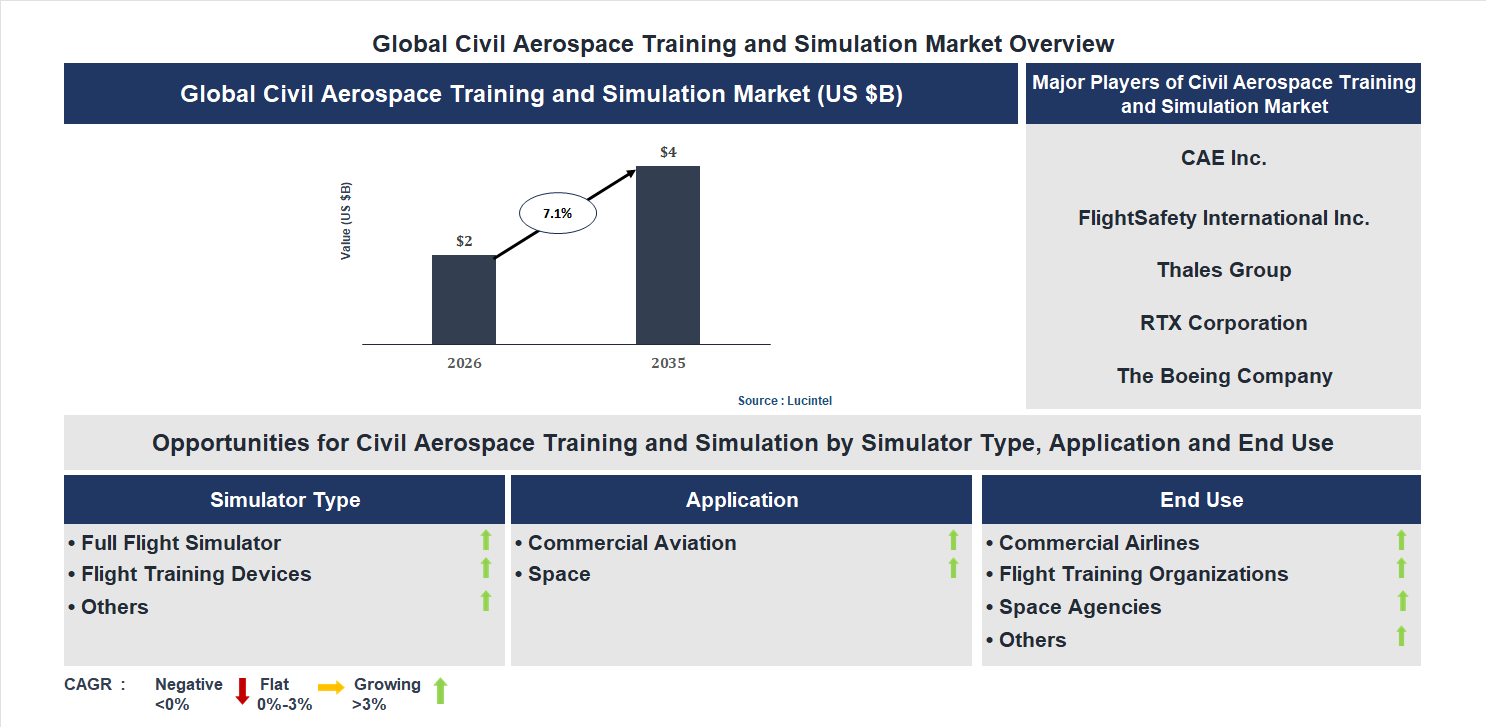
The future of the global civil aerospace training and simulation market looks promising with opportunities in the commercial airline, flight training organization, and space agency markets. The global civil aerospace training and simulation market is expected to reach an estimated $4 billion by 2035 with a CAGR of 7.1% from 2026 to 2035. The major drivers for this market are the increasing demand for pilot training programs, the rising air passenger traffic driving training needs, and the growing adoption of advanced simulation technologies.• Lucintel forecasts that, within the simulator type category, full flight simulator is expected to witness higher growth over the forecast period.
• Within the end use category, commercial airline is expected to witness the highest growth.
• In terms of region, APAC is expected to witness the highest growth over the forecast period. Gain valuable insights for your business decisions with our comprehensive 150+ page report. Sample figures with some insights are shown below.
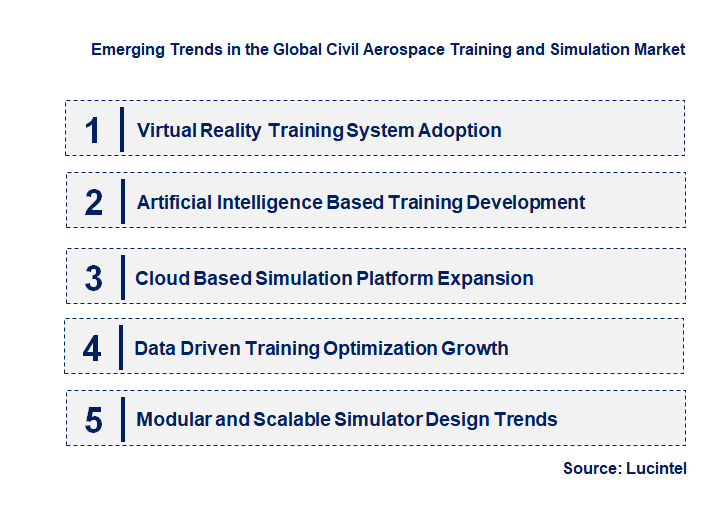
Emerging Trends in the Civil Aerospace Training and Simulation Market
The civil aerospace training and simulation market is being shaped by digital transformation and increasing demand for efficient training solutions. Advances in simulation technologies are enabling more immersive and flexible learning experiences. These trends reflect a shift toward intelligent, scalable, and cost-effective training systems for modern aviation.• Virtual Reality Training System Adoption: Use of virtual reality is enhancing training immersion and realism. These systems provide flexible and cost-effective training solutions.
• Artificial Intelligence Based Training Development: Integration of artificial intelligence is improving training personalization and performance analysis. These systems enhance learning outcomes.
• Cloud Based Simulation Platform Expansion: Cloud technologies are enabling remote access to simulation systems. This supports scalable and accessible training solutions.
• Data Driven Training Optimization Growth: Use of data analytics is improving training efficiency and effectiveness. These systems support better decision making.
• Modular And Scalable Simulator Design Trends: Development of modular simulators is enabling flexible deployment and customization. These systems support diverse training needs. These emerging trends are reshaping the civil aerospace training and simulation market by enhancing flexibility, efficiency, and accessibility. Continuous innovation is supporting the development of advanced training solutions aligned with modern aviation requirements.
Recent Developments in the Civil Aerospace Training and Simulation Market
The civil aerospace training and simulation market is experiencing steady advancements driven by technological innovation and increasing training demands. Developments focus on improving simulation accuracy, expanding accessibility, and enhancing training efficiency across aviation sectors.• Advanced Full Flight Simulator Development: Development of high-fidelity simulators is improving training realism and effectiveness. These systems support comprehensive pilot training.
• Integration With Digital Training Platforms Growth: Simulation systems are being integrated with digital platforms to enhance learning experiences.
• Enhanced Visual And Motion System Innovations: Improvements in visual and motion technologies are increasing simulation realism. These systems support better training outcomes.
• Remote Training Capability Expansion: Development of remote training solutions is improving accessibility and flexibility.
• Integration Of Real Time Data Systems: Use of real-time data is enhancing simulation accuracy and relevance. These systems support effective training. These developments are strengthening the capabilities of aerospace training and simulation systems. Continuous innovation is enhancing realism, accessibility, and efficiency, supporting the evolving needs of modern aviation training.
Strategic Growth Opportunities in the Civil Aerospace Training and Simulation Market
The civil aerospace training and simulation market presents strong growth opportunities driven by increasing demand for skilled aviation professionals. Expansion across key applications is creating new avenues for innovation and market development. Stakeholders are focusing on specialized segments to capture emerging demand.• Pilot Training Program Expansion Opportunity: Growing demand for pilots is driving need for advanced training systems. These systems support skill development.
• Cabin Crew Training System Growth Opportunity: Increasing focus on service quality and safety is driving demand for crew training solutions.
• Maintenance And Technical Training Opportunity: Demand for skilled technicians is creating opportunities for simulation-based training systems.
• Regional Aviation Training Center Development Opportunity: Expansion of regional aviation is driving demand for localized training infrastructure.
• Digital And Remote Training Solution Opportunity: Increasing adoption of digital platforms is creating opportunities for remote training solutions. Strategic growth opportunities are expanding across multiple training applications. Focus on advanced technologies and scalable solutions is supporting continued market development and innovation.
Civil Aerospace Training and Simulation Market Driver and Challenges
The civil aerospace training and simulation market is influenced by technological advancements, economic factors, and regulatory requirements. These elements drive innovation while also presenting challenges that impact adoption and implementation across aviation sectors. The factors responsible for driving the civil aerospace training and simulation market include:• Increasing Demand For Skilled Aviation Professionals: Growing air traffic is driving need for trained personnel. These systems support workforce development.
• Advancements In Simulation Technologies: Continuous innovation is improving simulation accuracy and effectiveness. These advancements support modern training needs.
• Growth In Aviation Infrastructure Development: Expansion of aviation infrastructure is supporting demand for training systems.
• Focus On Safety And Regulatory Compliance: Strict safety standards are driving adoption of advanced training solutions.
• Adoption Of Digital Training Platforms: Increasing use of digital tools is enhancing training efficiency and accessibility. The challenges facing the civil aerospace training and simulation market include:
• High Cost Of Advanced Simulation Systems: Development and deployment of simulators require significant investment.
• Complex Integration With Existing Systems: Integrating new technologies with existing training systems presents challenges.
• Stringent Regulatory Certification Requirements: Compliance with aviation standards impacts development and deployment timelines. The civil aerospace training and simulation market is shaped by strong demand for advanced training solutions alongside notable challenges. While technological advancements and increasing training needs drive growth, addressing cost, integration, and regulatory complexities remains essential for sustained market development and broader adoption of simulation technologies.
List of Civil Aerospace Training and Simulation Companies
Companies in the market compete on the basis of product quality offered. Major players in this market focus on expanding their manufacturing facilities, R&D investments, infrastructural development, and leverage integration opportunities across the value chain. With these strategies civil aerospace training and simulation companies cater increasing demand, ensure competitive effectiveness, develop innovative products & technologies, reduce production costs, and expand their customer base. Some of the civil aerospace training and simulation companies profiled in this report include-• CAE Inc.
• FlightSafety International Inc.
• Thales Group
• RTX Corporation
• The Boeing Company
• TRU Simulation + Training Inc.
• Indra Sistemas S.A.
• FRASCA International, Inc.
• ALSIM EMEA
• Redbird Flight Simulations
Civil Aerospace Training and Simulation Market by Segment
The study includes a forecast for the global civil aerospace training and simulation market by simulator type, application, end use, and region.Civil Aerospace Training and Simulation Market by Simulator Type [Value from 2019 to 2035]:
• Full Flight Simulator
• Flight Training Devices
• Others
Civil Aerospace Training and Simulation Market by Application [Value from 2019 to 2035]:
• Commercial Aviation
• Space
Civil Aerospace Training and Simulation Market by End Use [Value from 2019 to 2035]:
• Commercial Airlines
• Flight Training Organizations
• Space Agencies
• Others
Civil Aerospace Training and Simulation Market by Region [Value from 2019 to 2035]:
• North America
• Europe
• Asia Pacific
• The Rest of the World
Country Wise Outlook for the Civil Aerospace Training and Simulation Market
The civil aerospace training and simulation market is advancing as airlines and training organizations adopt digital technologies to enhance pilot readiness and operational safety. Increasing air traffic and demand for skilled personnel are driving investments in advanced simulators, virtual environments, and data-driven training systems. Countries are focusing on improving training efficiency, reducing costs, and ensuring regulatory compliance across aviation ecosystems.• United States: The market is driven by widespread adoption of full flight simulators, virtual reality training, and AI-based learning systems. Developments focus on enhancing realism, integrating data analytics, and expanding simulator networks. Strong presence of aviation training providers is supporting innovation in pilot and crew training programs.
• China: Rapid growth in aviation is driving demand for advanced training infrastructure. Developments emphasize domestic simulator manufacturing, expansion of training centers, and integration of digital technologies. Focus on scaling pilot training capacity is supporting market growth.
• Germany: Engineering excellence is supporting development of high-fidelity simulation systems. Focus areas include advanced simulator technologies, integration with digital platforms, and collaboration within European aviation programs. These efforts are enhancing training quality and standardization.
• India: Expanding aviation sector is driving demand for pilot training and simulation systems. Developments include increased adoption of simulators and growth of training institutes. Government support for aviation infrastructure is strengthening market expansion.
• Japan: Technological advancements are driving innovation in simulation systems and training methodologies. Focus is on high-precision simulators, integration of digital tools, and improving training efficiency. Applications span pilot, crew, and maintenance training.

Features of the Global Civil Aerospace Training and Simulation Market
Market Size Estimates: Civil aerospace training and simulation market size estimation in terms of value ($B). Trend and Forecast Analysis: Market trends (2019 to 2025) and forecast (2026 to 2035) by various segments and regions. Segmentation Analysis: Civil aerospace training and simulation market size by simulator type, application, end use, and region in terms of value ($B). Regional Analysis: Civil aerospace training and simulation market breakdown by North America, Europe, Asia Pacific, and Rest of the World. Growth Opportunities: Analysis of growth opportunities in different simulator types, applications, end uses, and regions for the civil aerospace training and simulation market. Strategic Analysis: This includes M&A, new product development, and competitive landscape of the civil aerospace training and simulation market. Analysis of competitive intensity of the industry based on Porter’s Five Forces model.
FAQ
Q1. What is the civil aerospace training and simulation market size? Answer: The global civil aerospace training and simulation market is expected to reach an estimated $4 billion by 2035. Q2. What is the growth forecast for civil aerospace training and simulation market? Answer: The global civil aerospace training and simulation market is expected to grow with a CAGR of 7.1% from 2026 to 2035. Q3. What are the major drivers influencing the growth of the civil aerospace training and simulation market? Answer: The major drivers for this market are the increasing demand for pilot training programs, the rising air passenger traffic driving training needs, and the growing adoption of advanced simulation technologies. Q4. What are the major segments for civil aerospace training and simulation market? Answer: The future of the civil aerospace training and simulation market looks promising with opportunities in the commercial airline, flight training organization, and space agency markets. Q5. Who are the key civil aerospace training and simulation market companies? Answer: Some of the key civil aerospace training and simulation companies are as follows:• CAE Inc.
• FlightSafety International Inc.
• Thales Group
• RTX Corporation
• The Boeing Company
• TRU Simulation + Training Inc.
• Indra Sistemas S.A.
• FRASCA International, Inc.
• ALSIM EMEA
• Redbird Flight Simulations Q6. Which civil aerospace training and simulation market segment will be the largest in future? Answer: Lucintel forecasts that, within the simulator type category, full flight simulator is expected to witness higher growth over the forecast period. Q7. In civil aerospace training and simulation market, which region is expected to be the largest in next 8 years? Answer: In terms of region, APAC is expected to witness the highest growth over the forecast period. Q8. Do we receive customization in this report? Answer: Yes, Lucintel provides 10% customization without any additional cost.
Table of Contents
List of Figures
List of Tables
Methodology
- In-depth interviews of the major players in this market
- Detailed secondary research from competitors’ financial statements and published data
- Extensive searches of published works, market, and database information pertaining to industry news, company press releases, and customer intentions
- A compilation of the experiences, judgments, and insights of Lucintel’s professionals, who have analyzed and tracked this market over the years.


Buy Now
Choose a license that fits your team. Instant PDF delivery.
Prices exclude taxes. Instant delivery. Custom licensing available on request.
Key Questions
- • What are some of the most promising, high-growth opportunities for the civil aerospace training and simulation market by simulator type (full flight simulator, flight training devices, and others), application (commercial aviation and space), end use (commercial airlines, flight training organizations, space agencies, and others), and region (North America, Europe, Asia Pacific, and the Rest of the World)?
- • Which segments will grow at a faster pace and why?
- • Which region will grow at a faster pace and why?
- • What are the key factors affecting market dynamics? What are the key challenges and business risks in this market?
- • What are the business risks and competitive threats in this market?
- • What are the emerging trends in this market and the reasons behind them?
- • What are some of the changing demands of customers in the market?
- • What are the new developments in the market? Which companies are leading these developments?
- • Who are the major players in this market? What strategic initiatives are key players pursuing for business growth?
- • What are some of the competing products in this market and how big of a threat do they pose for loss of market share by material or product substitution?
- • What M&A activity has occurred in the last 5 years and what has its impact been on the industry? For any questions related to Civil Aerospace Training and Simulation Market, Civil Aerospace Training and Simulation Market Size, Civil Aerospace Training and Simulation Market Growth, Civil Aerospace Training and Simulation Market Analysis, Civil Aerospace Training and Simulation Market Report, Civil Aerospace Training and Simulation Market Share, Civil Aerospace Training and Simulation Market Trends, Civil Aerospace Training and Simulation Market Forecast, Civil Aerospace Training and Simulation Companies, write Lucintel analyst at email: helpdesk@lucintel.com. We will be glad to get back to you soon.


