
Report Feature
Civil Aerospace Simulation and Training Market Trends and Forecast
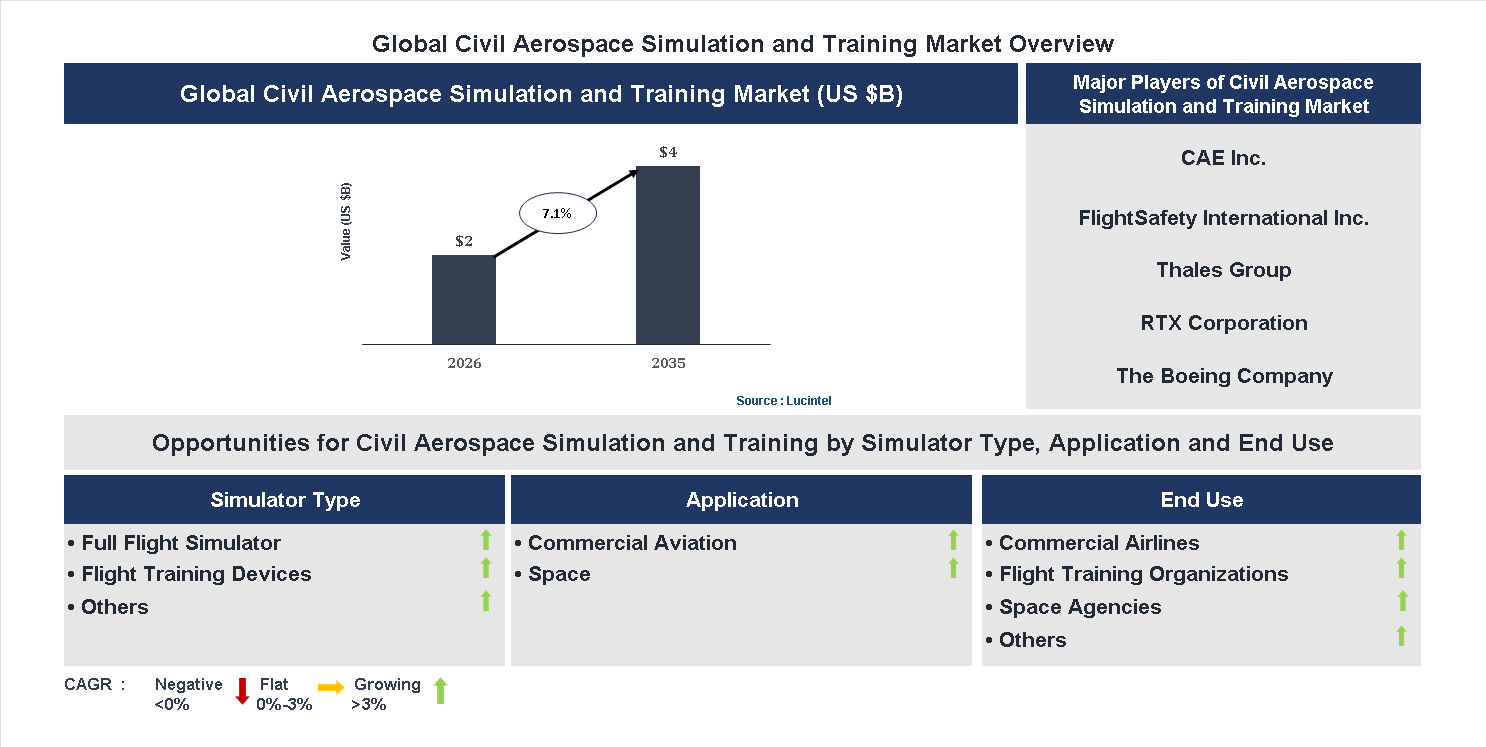
The future of the global civil aerospace simulation and training market looks promising with opportunities in the commercial airline, flight training organization, and space agency markets. The global civil aerospace simulation and training market is expected to reach an estimated $4 billion by 2035 with a CAGR of 7.1% from 2026 to 2035. The major drivers for this market are the increasing demand for advanced pilot training programs, the rising use of simulation in civil aviation training, and the growing need for cost efficient training solutions.• Lucintel forecasts that, within the simulator type category, full flight simulator is expected to witness higher growth over the forecast period.
• Within the end use category, commercial airline is expected to witness the highest growth.
• In terms of region, APAC is expected to witness the highest growth over the forecast period. Gain valuable insights for your business decisions with our comprehensive 150+ page report. Sample figures with some insights are shown below.
Emerging Trends in the Civil Aerospace Simulation and Training Market
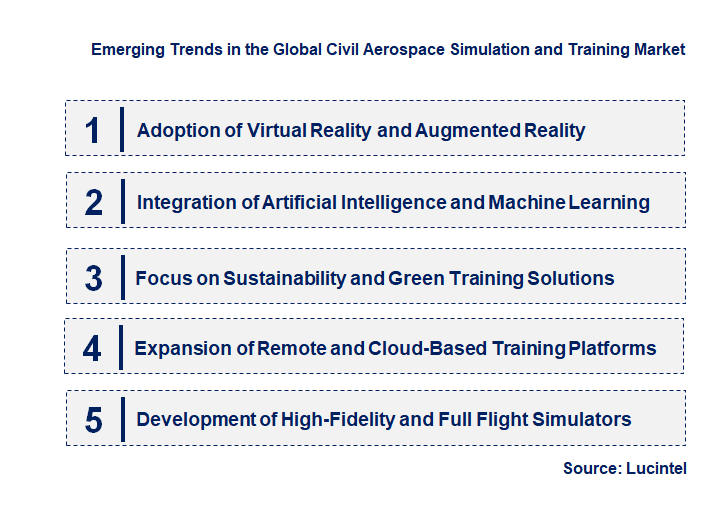
The civil aerospace simulation and training market is experiencing rapid evolution driven by technological advancements, regulatory changes, and increasing demand for safety and efficiency in air travel. As airlines and manufacturers seek to optimize pilot training and aircraft operation, innovative solutions are emerging to meet these needs. These developments are not only enhancing training effectiveness but also reducing costs and improving safety standards across the industry. The markets future will be shaped by these key trends, which are transforming traditional approaches and opening new opportunities for stakeholders.• Adoption of Virtual Reality and Augmented Reality : Virtual and augmented reality technologies are revolutionizing pilot training by providing immersive, realistic simulation environments. These tools enable trainees to experience complex scenarios without the risks associated with real flight, improving skill acquisition and decision-making. They also reduce training costs and time, making high-quality training more accessible. As VR/AR technology becomes more affordable and sophisticated, its integration into simulation centers is expected to grow, offering enhanced engagement and better preparedness for pilots.
• Integration of Artificial Intelligence and Machine Learning : AI and machine learning are increasingly being incorporated into simulation systems to personalize training programs, analyze performance data, and predict potential errors. These intelligent systems can adapt scenarios in real-time based on trainee responses, providing targeted feedback and optimizing learning outcomes. AI-driven analytics help identify skill gaps and tailor training modules accordingly, leading to more efficient and effective pilot preparation. This trend is set to improve safety standards and operational efficiency across the aerospace industry.
• Focus on Sustainability and Green Training Solutions : As environmental concerns intensify, the aerospace industry is emphasizing sustainable training practices. This includes developing eco-friendly simulators that consume less energy and utilize sustainable materials. Virtual training modules reduce the need for fuel-consuming flight hours, lowering carbon footprints. Additionally, training programs are increasingly incorporating modules on eco-efficient flying techniques, preparing pilots to operate more sustainably. These initiatives align with global efforts to reduce aviations environmental impact while maintaining high safety and training standards.
• Expansion of Remote and Cloud-Based Training Platforms : Cloud technology enables remote access to simulation and training modules, facilitating flexible learning environments. This trend allows trainees to access high-quality training resources from anywhere, reducing the need for physical infrastructure and travel. Cloud-based platforms also support real-time updates, collaborative learning, and data sharing, enhancing the overall training experience. The COVID-19 pandemic accelerated adoption, and this shift towards remote training is expected to continue, making pilot training more scalable, cost-effective, and accessible worldwide.
• Development of High-Fidelity and Full Flight Simulators : Advances in hardware and software are leading to the creation of highly realistic, full-flight simulators that closely mimic actual aircraft behavior. These simulators provide comprehensive training for complex maneuvers, emergency procedures, and system failures, significantly improving pilot readiness. The increased fidelity enhances safety by allowing pilots to practice rare or dangerous scenarios in a controlled environment. As technology progresses, these simulators are becoming more affordable and widespread, supporting regulatory compliance and boosting confidence in pilot training programs. These emerging trends are fundamentally reshaping the civil aerospace simulation and training market by making training more immersive, personalized, sustainable, accessible, and realistic. They are driving improvements in safety, efficiency, and environmental impact, positioning the industry for a more innovative and resilient future.
Recent Development in the Civil Aerospace Simulation and Training Market
The civil aerospace simulation and training market is experiencing rapid growth driven by technological advancements, increasing safety regulations, and rising air travel demand. As airlines and manufacturers seek cost-effective, realistic training solutions, the industry is adopting innovative simulation technologies. This expansion is creating new opportunities for market players to develop advanced training modules, improve safety standards, and expand into emerging markets. The evolving landscape underscores the importance of strategic investments and technological integration to capitalize on these developments.• Growing Adoption of Virtual Reality (VR) and Augmented Reality (AR): The integration of VR and AR in simulation training enhances realism and immersion, leading to better pilot preparedness. These technologies reduce training costs and time while increasing safety by providing risk-free environments for complex scenarios. As VR/AR become more affordable and sophisticated, their adoption is expected to accelerate, transforming traditional training methods and expanding market reach across global aviation hubs.
• Increasing Focus on Safety and Regulatory Compliance: Stricter safety standards and regulatory requirements are driving airlines and manufacturers to invest heavily in advanced simulation training. These solutions ensure pilots meet rigorous certification criteria and improve overall safety performance. The demand for compliant training modules is fostering innovation in simulation software and hardware, leading to more effective and standardized training programs that reduce accident risks and enhance industry credibility.
• Rising Demand for Pilot Training in Emerging Markets: Rapid air traffic growth in regions like Asia-Pacific and the Middle East is fueling demand for comprehensive pilot training solutions. Local airlines and training centers are investing in state-of-the-art simulators to meet international safety standards and expand their fleets. This trend opens new revenue streams for market players and encourages regional development of tailored training programs, fostering global market expansion and increased competition.
• Technological Advancements in Simulator Hardware: Innovations such as motion systems, high-fidelity visuals, and realistic cockpit replicas are improving the quality of simulation experiences. These advancements enable more precise training for complex aircraft systems and emergency procedures. Enhanced hardware capabilities are attracting more clients, including private operators and military agencies, broadening the market scope and encouraging continuous R&D investments to stay ahead in a competitive landscape.
• Integration of Artificial Intelligence (AI) and Data Analytics: AI-driven analytics optimize training programs by providing personalized feedback and performance assessments. These technologies facilitate predictive maintenance and scenario planning, improving training efficiency and safety outcomes. The adoption of AI and data analytics is transforming traditional training paradigms, enabling real-time adjustments and continuous improvement, which ultimately enhances pilot competence and operational safety across the civil aerospace sector. These developments are significantly transforming the civil aerospace simulation and training market by increasing efficiency, safety, and accessibility. They are fostering innovation, expanding market reach, and setting new standards for pilot preparedness. As a result, the industry is poised for sustained growth, with technological integration playing a pivotal role in shaping its future trajectory.
Strategic Growth Opportunities in the Civil Aerospace Simulation and Training Market
The civil aerospace simulation and training market is experiencing rapid growth driven by technological advancements, increasing safety standards, and rising air travel demand. Airlines and aerospace manufacturers are investing heavily in advanced simulators to enhance pilot training, reduce costs, and improve safety. The integration of virtual reality, augmented reality, and AI-driven solutions is transforming training methodologies. Expanding global aviation networks and regulatory requirements further propel market expansion, creating significant opportunities for innovative simulation solutions across various applications and sub-segments.• Enhanced Pilot Training Through Advanced Simulation Technologies: The adoption of high-fidelity simulators, including full-flight and part-task trainers, offers realistic training environments that improve pilot proficiency. Virtual reality and augmented reality are providing immersive experiences, reducing training costs, and minimizing risks associated with real-flight training. These innovations enable airlines to meet stringent safety standards while offering scalable, cost-effective solutions for pilot skill development across commercial, cargo, and regional aircraft segments.
• Growing Demand for Cost-Effective and Safe Training Solutions: Airlines and aerospace companies seek simulators that reduce operational costs and enhance safety. The development of portable and networked simulators allows for flexible training locations and remote instruction, decreasing travel and infrastructure expenses. Additionally, AI-powered analytics optimize training programs by identifying skill gaps, leading to more targeted and efficient pilot assessments. This trend supports the expansion of simulation training in emerging markets and smaller operators.
• Integration of Virtual and Augmented Reality for Immersive Learning: Virtual and augmented reality technologies are revolutionizing aerospace training by providing highly immersive, interactive experiences. These solutions enable pilots to practice complex scenarios, emergency procedures, and system troubleshooting in a safe environment. The ability to simulate rare or dangerous events enhances preparedness and decision-making skills. As VR/AR hardware becomes more affordable and sophisticated, adoption is expected to accelerate across flight schools, military training, and OEMs.
• Expansion of Sub-Segment Applications in Maintenance and Cabin Crew Training: Beyond pilot training, simulation solutions are increasingly used for aircraft maintenance, cabin crew procedures, and emergency response training. These applications improve operational efficiency, safety, and compliance with regulatory standards. For example, virtual maintenance trainers help technicians practice repairs without aircraft downtime, while cabin crew simulators prepare staff for passenger safety and service protocols. This diversification broadens market opportunities across the aerospace training ecosystem.
• Adoption of Artificial Intelligence and Data Analytics for Personalized Training: AI-driven platforms analyze pilot performance data to customize training modules, ensuring targeted skill development. Machine learning algorithms identify patterns and predict training needs, enabling proactive interventions. Data analytics facilitate continuous improvement of training programs, reduce training time, and enhance safety outcomes. The integration of AI in simulation systems supports scalable, adaptive learning environments, appealing to both large airlines and smaller operators seeking efficient, personalized training solutions. These growth opportunities are set to significantly transform the civil aerospace simulation and training market by fostering innovation, improving safety standards, and reducing costs. The integration of advanced technologies like VR, AR, and AI will enable more immersive, efficient, and personalized training experiences. As the industry evolves, these opportunities will drive market expansion, support regulatory compliance, and meet the increasing demand for skilled aviation professionals worldwide.
Civil Aerospace Simulation and Training Market Driver and Challenges
The civil aerospace simulation and training market is influenced by a variety of technological, economic, and regulatory factors. Rapid advancements in simulation technology, increasing safety standards, and growing demand for pilot training are key drivers. Economic factors such as rising air travel and airline fleet expansions further propel market growth. Conversely, regulatory challenges, high costs of simulation equipment, and technological integration issues pose significant hurdles. Understanding these drivers and challenges is essential for stakeholders to navigate the evolving landscape effectively and capitalize on emerging opportunities while addressing potential risks. The factors responsible for driving the Civil Aerospace Simulation and Training Market include:• Technological Innovation: The continuous development of advanced simulation systems, including virtual reality and augmented reality, enhances training effectiveness. These innovations reduce costs and improve safety by providing realistic, risk-free environments for pilots. As technology becomes more sophisticated and affordable, airlines and training institutions are increasingly adopting these solutions, leading to market expansion. The integration of artificial intelligence and machine learning further personalizes training programs, making them more efficient and tailored to individual needs. This technological evolution is a primary driver, enabling more comprehensive and immersive training experiences that meet stringent safety standards.
• Rising Air Travel and Fleet Expansion: The global increase in air travel demand is fueling the need for more trained pilots and crew members. Airlines are expanding their fleets to meet passenger demand, which necessitates extensive pilot training programs. This growth directly impacts the simulation and training market, as airlines prefer cost-effective, scalable, and safe training solutions. The expansion of low-cost carriers and increased international travel further amplify this demand. As a result, the market benefits from a steady influx of investment in simulation infrastructure to support the growing number of flights and crew training requirements, ensuring safety and operational efficiency.
• Regulatory and Safety Standards: Stringent aviation safety regulations and certification requirements drive the adoption of advanced simulation training. Regulatory bodies such as the FAA and EASA mandate rigorous pilot training and recurrent assessments, which simulation-based training can efficiently fulfill. These standards push airlines and training providers to invest in high-fidelity simulators that meet certification criteria. The need to comply with evolving safety protocols and reduce accident risks encourages continuous upgrades and adoption of the latest simulation technologies. This regulatory environment acts as a catalyst for market growth, ensuring that training remains aligned with international safety standards.
• Cost-Effectiveness and Efficiency: Simulation-based training offers significant cost savings over traditional flight training, reducing fuel, maintenance, and aircraft wear and tear. It allows for repetitive practice of complex scenarios without risking actual aircraft or personnel. As airlines seek to optimize training budgets, the economic benefits of simulation become increasingly attractive. Additionally, simulators enable training in diverse scenarios, including emergency procedures, which are difficult to replicate in real flights. This efficiency not only lowers operational costs but also accelerates training timelines, making simulation a preferred choice for airlines aiming to enhance safety and reduce expenses.
• Growing Adoption of E-Learning and Remote Training: The shift towards digital and remote training platforms is transforming the simulation market. E-learning modules, virtual classrooms, and remote simulator access enable flexible, scalable, and cost-effective training solutions. This trend is driven by technological advancements and the need for continuous training amid global disruptions like the COVID-19 pandemic. Remote training reduces logistical challenges and allows airlines to train personnel across multiple locations simultaneously. The integration of cloud-based platforms and online assessments enhances training accessibility and effectiveness, broadening the market reach and supporting ongoing skill development in the civil aerospace sector. The challenges facing the civil aerospace simulation and training market include:
• High Capital Investment: The initial cost of acquiring and maintaining high-fidelity simulators is substantial. Advanced simulation systems require significant capital expenditure, which can be a barrier for smaller airlines and training providers. Ongoing costs for software updates, maintenance, and calibration further add to financial burdens. This high investment risk can limit market growth, especially in regions with economic constraints or fluctuating airline profitability. Balancing cost with technological benefits remains a critical challenge for market participants seeking sustainable growth.
• Technological Integration and Obsolescence: Rapid technological advancements pose challenges related to integrating new systems with existing infrastructure. Upgrading simulators to incorporate the latest features can be complex and costly, risking obsolescence of current equipment. Additionally, ensuring compatibility across different platforms and maintaining cybersecurity are ongoing concerns. The pace of innovation can lead to frequent upgrades, creating a cycle of continuous investment. Managing technological obsolescence while maintaining operational efficiency is a significant challenge for stakeholders in the simulation and training market.
• Regulatory and Certification Delays: While regulations drive market growth, lengthy certification processes can hinder timely deployment of new simulation technologies. Achieving compliance with evolving safety standards involves extensive testing and validation, which can delay product launches and upgrades. Regulatory delays also impact the ability of training providers to offer cutting-edge solutions promptly. Navigating complex approval procedures requires significant resources and expertise, potentially slowing market innovation and adoption rates. Ensuring regulatory agility without compromising safety remains a delicate balance for industry players. The Civil Aerospace Simulation and Training Market is shaped by technological advancements, increasing air travel, regulatory requirements, cost efficiencies, and digital transformation. These drivers foster growth by enhancing training quality, safety, and accessibility. However, high capital costs, technological integration challenges, and regulatory delays pose significant hurdles. The interplay of these factors influences market dynamics, requiring stakeholders to innovate strategically and adapt to evolving standards. Overall, the markets future depends on balancing technological progress with cost management and regulatory compliance, ensuring sustainable growth and improved safety standards across the civil aerospace sector.
List of Civil Aerospace Simulation and Training Companies
Companies in the market compete on the basis of product quality offered. Major players in this market focus on expanding their manufacturing facilities, R&D investments, infrastructural development, and leverage integration opportunities across the value chain. With these strategies civil aerospace simulation and training companies cater increasing demand, ensure competitive effectiveness, develop innovative products & technologies, reduce production costs, and expand their customer base. Some of the civil aerospace simulation and training companies profiled in this report include-• CAE Inc.
• FlightSafety International Inc.
• Thales Group
• RTX Corporation
• The Boeing Company
• TRU Simulation + Training Inc.
• Indra Sistemas S.A.
• FRASCA International, Inc.
• ALSIM EMEA
• Redbird Flight Simulations, Inc.
Civil Aerospace Simulation and Training Market by Segment
The study includes a forecast for the global civil aerospace simulation and training market by simulator type, application, end use, and region.Civil Aerospace Simulation and Training Market by Simulator Type [Value from 2019 to 2035]:
• Full Flight Simulator
• Flight Training Devices
• Others
Civil Aerospace Simulation and Training Market by Application [Value from 2019 to 2035]:
• Commercial Aviation
• Space
Civil Aerospace Simulation and Training Market by End Use [Value from 2019 to 2035]:
• Commercial Airlines
• Flight Training Organizations
• Space Agencies
• Others
Civil Aerospace Simulation and Training Market by Region [Value from 2019 to 2035]:
• North America
• Europe
• Asia Pacific
• The Rest of the World
Country Wise Outlook for the Civil Aerospace Simulation and Training Market
The civil aerospace simulation and training market has experienced significant growth driven by technological advancements, increasing safety regulations, and rising air travel demand worldwide. Countries are investing heavily in innovative simulation technologies to enhance pilot training, reduce costs, and improve safety standards. The markets evolution is also influenced by the integration of virtual reality, augmented reality, and artificial intelligence, which are transforming training methodologies. As the aviation industry recovers from recent disruptions, these developments are crucial for maintaining high safety and efficiency standards. The following summarizes recent key developments in the United States, China, Germany, India, and Japan.• United States: The US market has seen substantial investments in advanced flight simulators, with major players like Boeing and Lockheed Martin expanding their training centers. There is a growing adoption of virtual reality-based training modules, and regulatory agencies are updating standards to incorporate new simulation technologies. The focus is on enhancing pilot proficiency and safety, especially for commercial and military aviation sectors.
• China: China is rapidly expanding its aerospace training infrastructure, with government initiatives supporting domestic aircraft manufacturing and pilot training programs. The country is investing in high-fidelity simulators and integrating AI-driven training solutions to improve efficiency. Recent collaborations with international firms aim to upgrade China’s simulation capabilities and meet increasing demand for commercial aviation growth.
• Germany: Germanys aerospace simulation market is characterized by innovation and high-quality standards, driven by companies like Airbus and Lufthansa. The country is focusing on developing eco-friendly and cost-effective simulation solutions, including hybrid training systems. Germany also emphasizes research collaborations to incorporate augmented reality and machine learning into pilot training programs.
• India: India is witnessing a surge in demand for civil aviation training due to expanding airline fleets and increasing pilot requirements. The government and private sector are investing in modern simulators and establishing new training academies. Recent developments include the adoption of simulation-based training for low-cost carriers and efforts to align with international safety standards.
• Japan: Japans market is driven by technological innovation and a focus on safety. The country is integrating advanced simulation technologies, such as haptic feedback and AI, into pilot training programs. Japanese aerospace firms are also collaborating with global companies to develop next-generation simulators, aiming to enhance training efficiency and safety standards amid rising domestic and international air travel.

Features of the Global Civil Aerospace Simulation and Training Market
Market Size Estimates: Civil aerospace simulation and training market size estimation in terms of value ($B). Trend and Forecast Analysis: Market trends (2019 to 2025) and forecast (2026 to 2035) by various segments and regions. Segmentation Analysis: Civil aerospace simulation and training market size by simulator type, application, end use, and region in terms of value ($B). Regional Analysis: Civil aerospace simulation and training market breakdown by North America, Europe, Asia Pacific, and Rest of the World. Growth Opportunities: Analysis of growth opportunities in different simulator types, applications, end uses, and regions for the civil aerospace simulation and training market. Strategic Analysis: This includes M&A, new product development, and competitive landscape of the civil aerospace simulation and training market. Analysis of competitive intensity of the industry based on Porter’s Five Forces model.
FAQ
Q1. What is the civil aerospace simulation and training market size? Answer: The global civil aerospace simulation and training market is expected to reach an estimated $4 billion by 2035. Q2. What is the growth forecast for civil aerospace simulation and training market? Answer: The global civil aerospace simulation and training market is expected to grow with a CAGR of 7.1% from 2026 to 2035. Q3. What are the major drivers influencing the growth of the civil aerospace simulation and training market? Answer: The major drivers for this market are the increasing demand for advanced pilot training programs, the rising use of simulation in civil aviation training, and the growing need for cost efficient training solutions. Q4. What are the major segments for civil aerospace simulation and training market? Answer: The future of the civil aerospace simulation and training market looks promising with opportunities in the commercial airline, flight training organization, and space agency markets. Q5. Who are the key civil aerospace simulation and training market companies? Answer: Some of the key civil aerospace simulation and training companies are as follows:• CAE Inc.
• FlightSafety International Inc.
• Thales Group
• RTX Corporation
• The Boeing Company
• TRU Simulation + Training Inc.
• Indra Sistemas S.A.
• FRASCA International, Inc.
• ALSIM EMEA
• Redbird Flight Simulations, Inc. Q6. Which civil aerospace simulation and training market segment will be the largest in future? Answer: Lucintel forecasts that, within the simulator type category, full flight simulator is expected to witness higher growth over the forecast period. Q7. In civil aerospace simulation and training market, which region is expected to be the largest in next 8 years? Answer: In terms of region, APAC is expected to witness the highest growth over the forecast period. Q8. Do we receive customization in this report? Answer: Yes, Lucintel provides 10% customization without any additional cost.
Table of Contents
List of Figures
List of Tables
Methodology
- In-depth interviews of the major players in this market
- Detailed secondary research from competitors’ financial statements and published data
- Extensive searches of published works, market, and database information pertaining to industry news, company press releases, and customer intentions
- A compilation of the experiences, judgments, and insights of Lucintel’s professionals, who have analyzed and tracked this market over the years.


Buy Now
Choose a license that fits your team. Instant PDF delivery.
Prices exclude taxes. Instant delivery. Custom licensing available on request.
Key Questions
- • What are some of the most promising, high-growth opportunities for the civil aerospace simulation and training market by simulator type (full flight simulator, flight training devices, and others), application (commercial aviation and space), end use (commercial airlines, flight training organizations, space agencies, and others), and region (North America, Europe, Asia Pacific, and the Rest of the World)?
- • Which segments will grow at a faster pace and why?
- • Which region will grow at a faster pace and why?
- • What are the key factors affecting market dynamics? What are the key challenges and business risks in this market?
- • What are the business risks and competitive threats in this market?
- • What are the emerging trends in this market and the reasons behind them?
- • What are some of the changing demands of customers in the market?
- • What are the new developments in the market? Which companies are leading these developments?
- • Who are the major players in this market? What strategic initiatives are key players pursuing for business growth?
- • What are some of the competing products in this market and how big of a threat do they pose for loss of market share by material or product substitution?
- • What M&A activity has occurred in the last 5 years and what has its impact been on the industry? For any questions related to Civil Aerospace Simulation and Training Market, Civil Aerospace Simulation and Training Market Size, Civil Aerospace Simulation and Training Market Growth, Civil Aerospace Simulation and Training Market Analysis, Civil Aerospace Simulation and Training Market Report, Civil Aerospace Simulation and Training Market Share, Civil Aerospace Simulation and Training Market Trends, Civil Aerospace Simulation and Training Market Forecast, Civil Aerospace Simulation and Training Companies, write Lucintel analyst at email: helpdesk@lucintel.com. We will be glad to get back to you soon.


