
Market Report · July 15, 2026

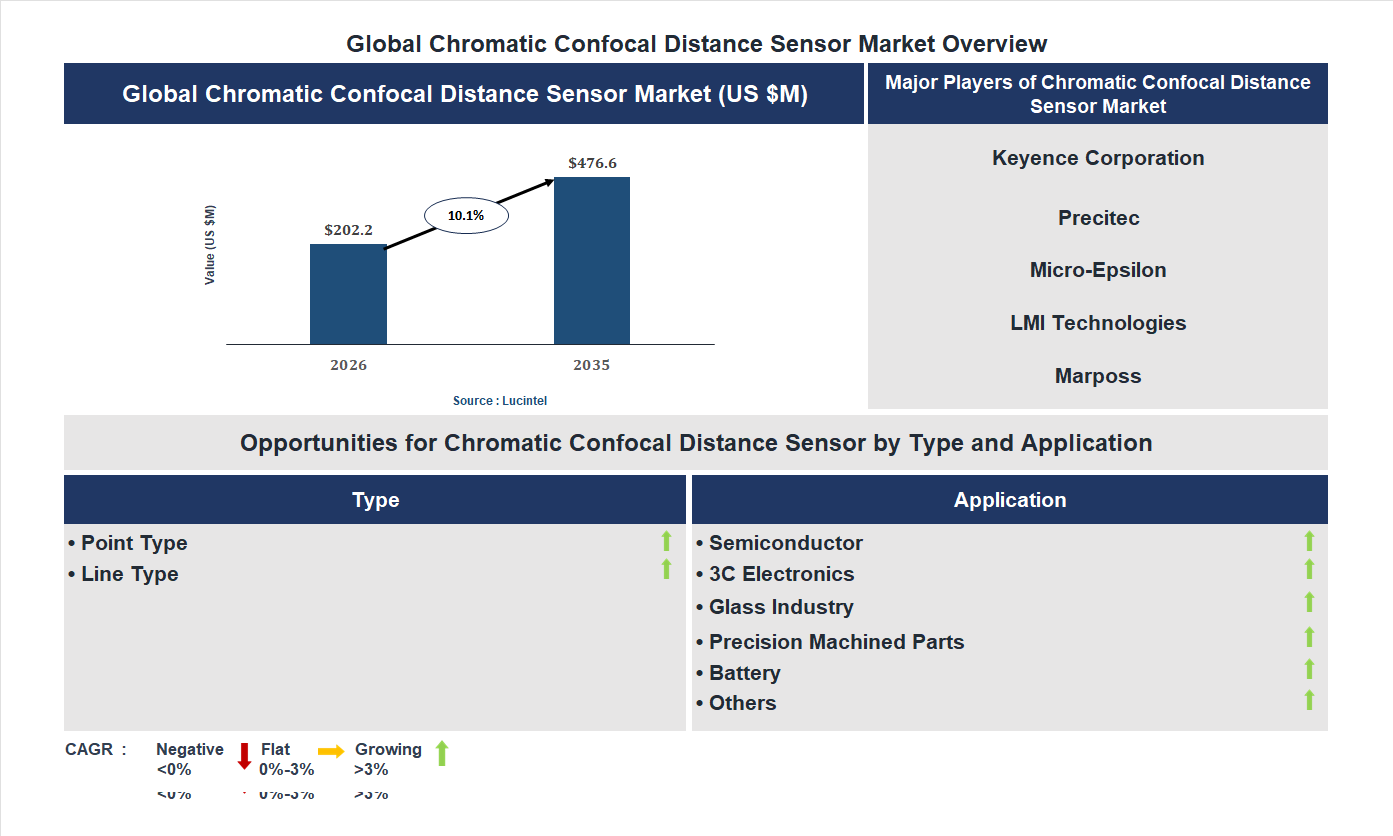
Key data points: The market size in 2035 = $476.6 million, growth forecast = 10.1% annually for the next 8 years. Scroll below to get more insights. This market report covers trends, opportunities and forecasts in chromatic confocal distance sensor market to 2035 by type (point type and line type), application (semiconductor, 3c electronics, glass industry, precision machined parts, battery, and others), and region (North America, Europe, Asia Pacific, and the Rest of the World)
We'll send your sample report shortly.
• Lucintel forecasts that, within the type category, point type is expected to witness higher growth over the forecast period.
• Within the application category, semiconductor is expected to witness the highest growth.
• In terms of region, APAC is expected to witness the highest growth over the forecast period. Gain valuable insights for your business decisions with our comprehensive 150+ page report. Sample figures with some insights are shown below.
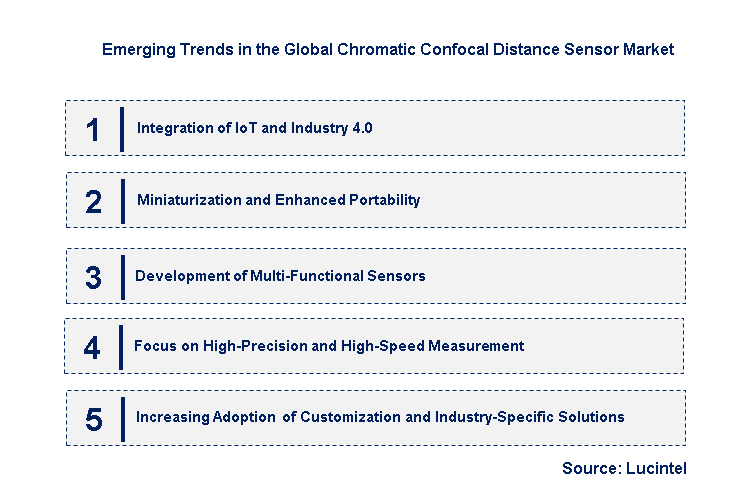
• Integration of IoT and Industry 4.0: The incorporation of Internet of Things (IoT) technology and Industry 4.0 principles is transforming chromatic confocal sensors into smart devices. These sensors now feature wireless connectivity, real-time data transmission, and remote monitoring capabilities, enabling seamless integration into automated systems. This trend enhances operational efficiency, predictive maintenance, and data analytics, leading to smarter manufacturing processes. As industries move towards digitalization, the demand for intelligent sensing solutions that can communicate and adapt in real-time is expected to surge, making this integration a pivotal trend.
• Miniaturization and Enhanced Portability: Advances in miniaturization are making chromatic confocal sensors more compact and portable without compromising performance. Smaller sensors facilitate integration into tight spaces and complex machinery, broadening their application scope. This trend is driven by the need for lightweight, space-saving solutions in robotics, medical devices, and consumer electronics. Enhanced portability also allows for easier installation and maintenance, reducing downtime and costs. As industries seek versatile and unobtrusive measurement tools, miniaturized sensors are becoming increasingly vital, fostering innovation and expanding market reach.
• Development of Multi-Functional Sensors: The market is witnessing a shift towards multi-functional chromatic confocal sensors capable of measuring multiple parameters simultaneously, such as distance, surface profile, and material properties. These versatile sensors reduce the need for multiple devices, saving space and cost. They are particularly valuable in complex manufacturing processes requiring comprehensive quality control. The integration of advanced signal processing and AI algorithms enhances their accuracy and adaptability. This trend is driving the adoption of more sophisticated sensing solutions, enabling industries to achieve higher precision and efficiency in their operations.
• Focus on High-Precision and High-Speed Measurement: There is a growing demand for sensors that offer ultra-high precision and rapid measurement capabilities. These sensors are essential in applications like semiconductor manufacturing, aerospace, and precision engineering, where even minute inaccuracies can be costly. Technological innovations are enabling faster data acquisition and processing, reducing measurement time significantly. High-speed, high-precision sensors improve productivity, quality control, and process optimization. As industry standards become more stringent, the emphasis on precision and speed is expected to intensify, pushing the development of next-generation chromatic confocal sensors.
• Increasing Adoption of Customization and Industry-Specific Solutions: Customization is becoming a key trend, with manufacturers offering tailored chromatic confocal sensors designed to meet specific industry requirements. This approach allows for better integration into existing systems and addresses unique measurement challenges. Industry-specific solutions enhance performance, reliability, and user experience, fostering greater adoption across sectors such as automotive, electronics, and healthcare. The trend towards customization reflects a shift from one-size-fits-all products to specialized, application-oriented sensing solutions, driving market growth and competitive differentiation. These emerging trends are significantly reshaping the chromatic confocal distance sensor market by fostering smarter, more compact, versatile, and precise sensing solutions. The integration of digital technologies, miniaturization, multi-functionality, and customization is expanding application possibilities and improving operational efficiencies. As these trends continue to evolve, they will drive innovation, increase market competitiveness, and open new avenues for growth across various industries.
• Growing Adoption in Industrial Automation: The increasing need for precise, non-contact measurement in manufacturing processes is driving demand for chromatic confocal sensors. These sensors offer high accuracy and fast response times, making them ideal for quality control, process monitoring, and automation systems. As industries move toward smart factories, the integration of these sensors enhances efficiency, reduces errors, and enables real-time data collection, thereby expanding their market presence.
• Technological Advancements Improving Sensor Performance: Recent developments focus on enhancing sensor accuracy, resolution, and durability. Innovations such as miniaturization and improved optical components have increased sensor reliability in challenging environments. These advancements enable applications in delicate measurements, biomedical devices, and complex industrial settings. Improved performance broadens the scope of use cases, attracting more industries to adopt chromatic confocal distance sensors and fueling market growth.
• Rising Demand in Healthcare and Biomedical Applications: The precision and non-invasive nature of chromatic confocal sensors make them suitable for medical diagnostics, tissue analysis, and biomedical research. Their ability to measure small distances accurately without contact is crucial in sensitive environments. As healthcare industries seek advanced diagnostic tools, the market for these sensors is expanding, driven by the need for high-resolution imaging and precise measurement in medical applications.
• Integration with Automation and IoT Systems: The trend toward Industry 4.0 and IoT integration is boosting the use of chromatic confocal sensors. These sensors provide real-time data essential for automated quality control, predictive maintenance, and smart manufacturing. Their compatibility with digital systems enhances operational efficiency and data analytics capabilities. This integration is expected to accelerate market growth as industries seek interconnected, intelligent measurement solutions.
• Increasing Focus on Miniaturization and Portability: The demand for compact, portable sensors is rising across sectors such as electronics, robotics, and medical devices. Miniaturized chromatic confocal sensors enable integration into small-scale systems without compromising accuracy. This trend supports the development of wearable devices, portable diagnostic tools, and embedded systems, expanding market opportunities. The focus on size reduction and ease of use is driving innovation and adoption in diverse applications. The overall impact of these developments is a robust expansion of the chromatic confocal distance sensor market, characterized by enhanced performance, broader application scope, and increased integration with emerging technologies. These factors collectively contribute to a dynamic market environment, promising sustained growth and innovation in the coming years.
• Expansion into the Automotive Industry: The automotive sector increasingly adopts chromatic confocal sensors for quality control, assembly line automation, and surface inspection. These sensors enable precise, non-contact measurements of complex geometries, ensuring high standards in manufacturing processes. As automotive manufacturers focus on safety, efficiency, and innovation, the demand for advanced distance sensors grows, creating opportunities for market players to develop tailored solutions that meet industry-specific needs and enhance production workflows.
• Growing Adoption in Electronics Manufacturing: Electronics manufacturing requires meticulous measurement of tiny components and circuit boards. Chromatic confocal sensors offer high-resolution, contactless measurement capabilities suitable for these delicate tasks. The trend toward miniaturization and increased complexity in electronic devices fuels demand for accurate, fast, and reliable sensing solutions. Market growth is driven by electronics manufacturers seeking to improve quality assurance, reduce defects, and streamline assembly processes through advanced distance measurement technologies.
• Increasing Use in Industrial Automation and Robotics: The integration of chromatic confocal sensors into automation and robotic systems enhances precision and efficiency in manufacturing. These sensors facilitate real-time surface profiling, thickness measurement, and object detection, enabling smarter, more adaptable automation solutions. As industries move toward Industry 4.0, the need for intelligent sensing components grows, presenting opportunities for sensor manufacturers to develop compact, robust, and versatile products that support autonomous operations and improve overall productivity.
• Rising Demand in Medical and Healthcare Applications: The medical sector leverages chromatic confocal sensors for non-invasive diagnostics, tissue analysis, and device calibration. Their high accuracy and contactless operation make them ideal for sensitive applications requiring precise measurements without physical contact. As healthcare technology advances, the market for specialized sensors expands, driven by the need for improved diagnostic tools, surgical instruments, and medical device manufacturing, opening avenues for innovation and growth within this niche.
• Expansion into Aerospace and Defense Sectors: Aerospace and defense industries utilize chromatic confocal sensors for structural inspection, material testing, and component alignment. The demand for high-precision, reliable measurement solutions in these sectors is driven by safety standards and performance requirements. Growing investments in aircraft maintenance, space exploration, and defense systems create opportunities for sensor providers to develop rugged, high-performance products tailored to extreme environments, thereby expanding their market footprint and supporting critical applications. The overall market growth is propelled by technological innovation, expanding application areas, and increasing industry adoption. These opportunities collectively enhance the market’s potential, encouraging companies to innovate and diversify their offerings. As industries prioritize precision and automation, the chromatic confocal distance sensor market is set to experience sustained expansion, shaping the future of high-accuracy measurement solutions across multiple sectors.
• Technological Advancements: The rapid development of optical and sensor technologies enhances measurement accuracy, speed, and reliability. Innovations like miniaturization and integration with IoT enable sensors to be more versatile and easier to deploy across various applications, from industrial automation to healthcare. These advancements reduce costs and improve performance, making chromatic confocal sensors more attractive to end-users. As technology continues to evolve, the market is expected to see increased adoption driven by improved functionalities and integration capabilities.
• Growing Industrial Automation: The increasing adoption of automation in manufacturing, automotive, and aerospace sectors is a major driver. Precise distance measurement is critical for quality control, robotic navigation, and process optimization. Chromatic confocal sensors offer non-contact, high-resolution measurements, making them ideal for these applications. The push towards Industry 4.0 and smart factories accelerates demand, as companies seek reliable sensors to enhance productivity, reduce errors, and ensure safety standards.
• Rising Demand in Healthcare and Life Sciences: The healthcare industry’s need for accurate, non-invasive measurement tools is fueling market growth. Chromatic confocal sensors are used in medical imaging, diagnostics, and laboratory automation. Their ability to provide precise measurements without physical contact minimizes patient discomfort and contamination risks. As healthcare facilities increasingly adopt advanced diagnostic tools, the demand for these sensors is expected to rise, driven by technological improvements and regulatory approvals.
• Increasing Focus on Quality Control and Inspection: Industries such as electronics, automotive, and consumer goods require rigorous quality control processes. Chromatic confocal sensors enable detailed surface and dimensional inspections, ensuring products meet strict standards. Their high accuracy and speed facilitate real-time monitoring, reducing waste and rework costs. The emphasis on quality assurance and compliance with international standards propels market growth, as manufacturers seek reliable measurement solutions to maintain competitive advantage. The challenges in the chromatic confocal distance sensor market are:
• High Cost of Implementation: Despite technological benefits, the initial investment for chromatic confocal sensors can be substantial. Costs associated with high-precision components, integration, and calibration can be prohibitive for small and medium-sized enterprises. This limits widespread adoption, especially in cost-sensitive markets. Overcoming this challenge requires ongoing efforts to reduce manufacturing costs and develop more affordable solutions without compromising performance.
• Technological Complexity and Expertise Requirements: The sophisticated nature of chromatic confocal sensors demands specialized knowledge for installation, calibration, and maintenance. Lack of skilled personnel can hinder deployment and effective utilization. Additionally, integrating these sensors into existing systems may require significant customization, increasing complexity and operational costs. Addressing this challenge involves developing user-friendly interfaces and providing comprehensive training to facilitate broader adoption.
• Regulatory and Standardization Barriers: The market faces challenges related to regulatory approvals and standardization across different regions. Variations in safety, quality, and environmental standards can delay product launches and increase compliance costs. Navigating these regulatory landscapes requires significant effort and resources, potentially slowing market growth. Harmonizing standards and streamlining approval processes are essential to facilitate global expansion and adoption. The chromatic confocal distance sensor market is driven by technological innovations, industrial automation, healthcare needs, and quality control demands. However, high costs, technological complexity, and regulatory hurdles pose significant challenges. These factors collectively influence market dynamics, requiring stakeholders to focus on cost reduction, skill development, and regulatory compliance. Successfully addressing these drivers and challenges will determine the pace and extent of market growth, shaping the future landscape of optical sensing solutions across diverse industries.
• Keyence Corporation
• Precitec
• Micro-Epsilon
• LMI Technologies
• Marposs (STIL)
• SICK
• OMRON
• Hypersen Technologies
• Shenzhen LightE-Technology
• Pomeas Precision Instrument
• Point Type
• Line Type
• Semiconductor
• 3C Electronics
• Glass Industry
• Precision Machined Parts
• Battery
• Others
• North America
• Europe
• Asia Pacific
• The Rest of the World
• United States: The U.S. market has seen significant advancements with increased adoption in the automotive and aerospace industries. Leading companies are developing high-precision sensors integrated with AI for real-time measurements. Government grants support R&D efforts, fostering innovation. The focus is on miniaturization and enhanced durability for industrial applications, with startups entering the space to disrupt traditional solutions.
• China: China is rapidly expanding its chromatic confocal sensor capabilities, driven by the manufacturing and electronics sectors. Major investments are directed toward developing cost-effective, high-performance sensors to support automation and smart manufacturing. Local companies are forming strategic alliances with global players to enhance technological expertise. The government’s focus on Industry 4.0 initiatives accelerates market growth, with a particular emphasis on integrating sensors into robotics and automation systems.
• Germany: Germany remains a leader in precision engineering and industrial automation, with the market emphasizing high accuracy and reliability. Innovations include integrating sensors with IoT platforms for predictive maintenance and quality control. Several research institutions collaborate with industry giants to develop next-generation sensors. The focus is on sustainable manufacturing practices and improving sensor robustness in harsh environments.
• India: The Indian market is witnessing rapid growth due to expanding manufacturing and automotive sectors. Local companies are adopting chromatic confocal sensors for quality inspection and process control. Government initiatives promoting Make in India and digital transformation are fueling demand. R&D activities are increasing, with a focus on developing affordable sensors suitable for small and medium enterprises to enhance productivity.
• Japan: Japan continues to innovate with a focus on miniaturization and integration into robotics and automation systems. Leading firms are investing in advanced sensor technologies to improve precision and speed. The market benefits from strong government support for technological development and collaborations with global tech firms. Emphasis is also placed on developing sensors capable of operating reliably in extreme conditions, supporting automotive and electronics manufacturing sectors.


• Keyence Corporation
• Precitec
• Micro-Epsilon
• LMI Technologies
• Marposs (STIL)
• SICK
• OMRON
• Hypersen Technologies
• Shenzhen LightE-Technology
• Pomeas Precision Instrument Q5. Which chromatic confocal distance sensor market segment will be the largest in future? Answer: Lucintel forecasts that, within the type category, point type is expected to witness higher growth over the forecast period. Q6. In chromatic confocal distance sensor market, which region is expected to be the largest in next 5 years? Answer: In terms of region, APAC is expected to witness the highest growth over the forecast period. Q7. Do we receive customization in this report? Answer: Yes, Lucintel provides 10% customization without any additional cost.


Choose a license that fits your team. Instant PDF delivery.
Prices exclude taxes. Instant delivery. Custom licensing available on request.
Market Report · July 15, 2026
Market Report · July 13, 2026
Market Report · July 13, 2026
Trusted partner for strategic intelligence and business growth


Receive a complimentary market analysis tailored to your industry. Our analysts will identify key growth opportunities and competitive dynamics specific to your business.

Market size, growth rate, and key trend analysis for your specific sector.

Top competitor positioning and market share analysis.

Strategic recommendations backed by data-driven insights.
Get curated market intelligence and competitive moves straight to your inbox.
By subscribing, you agree to receive our monthly insights. Unsubscribe anytime.
Receive a complimentary market analysis tailored to your industry. Our analysts will identify key growth opportunities and competitive dynamics specific to your business.
Market size, growth rate, and key trend analysis for your specific sector.
Top competitor positioning and market share analysis.
Strategic recommendations backed by data-driven insights.
Get curated market intelligence, emerging trends, and competitive moves straight to your inbox each month.
By subscribing, you agree to receive our monthly insights. Unsubscribe anytime.
We'll send your sample report shortly.