
Close Lucintel Chat
Didn't Find What You're Looking for?
Call us at +1972 636 5056 or write at helpdesk@Lucintel.com
Ask an Expert Provide Custom Requirements Download Sample Report Search Available Reports
  • helpdesk@Lucintel.com
  • |
  • Call Lucintel +1 972 636 5056
  • |
  • Login
  • |
  • Register
  • |
  • Search
  • |
'
...

The Impact of COVID-19 is included in Chitosan Derivative Market Report. Buy it today to get an advantage.

Request the impact of COVID-19 on your product or industry


Chitosan Derivative Market Trends and Forecast

The future of the global chitosan derivative market looks promising with opportunities in the medical, health food, cosmetics, agriculture, and water treatment markets. The global chitosan derivative market is expected to grow with a CAGR of 6.2% from 2025 to 2031. The major drivers for this market are the increasing demand in pharmaceutical and medical applications, the rising use in food preservation & packaging, and the growing adoption in cosmetics & personal care products.

• Lucintel forecasts that, within the type category, chitosan oligosaccharide is expected to witness the highest growth over the forecast period.
• Within the application category, medical is expected to witness the highest growth.
• In terms of region, APAC is expected to witness the highest growth over the forecast period.
Gain valuable insights for your business decisions with our comprehensive 150+ page report. Sample figures with some insights are shown below.
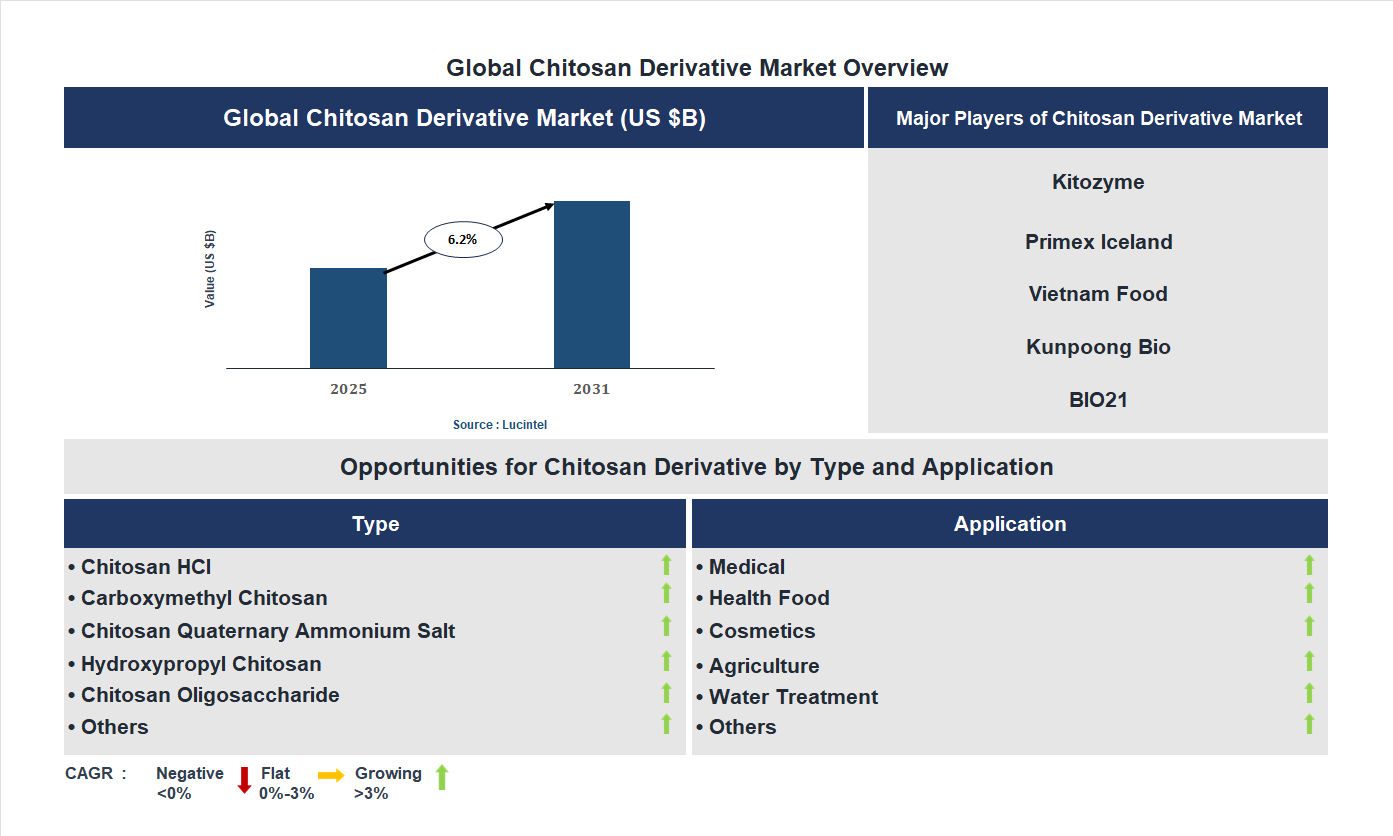
Chitosan Derivative Market Trends and Forecast

Emerging Trends in the Chitosan Derivative Market

The chitosan derivative market is experiencing rapid growth driven by technological advancements, increasing demand across various industries, and a focus on sustainable and biodegradable materials. As industries such as healthcare, agriculture, food, and water treatment seek eco-friendly solutions, the market is evolving with innovative derivatives and applications. These developments are not only expanding the market size but also transforming traditional practices, leading to more efficient, sustainable, and versatile uses of chitosan derivatives. Understanding these emerging trends is crucial for stakeholders aiming to capitalize on new opportunities and stay competitive in this dynamic landscape.

• Growing Demand in Healthcare: Increasing use of chitosan derivatives in wound healing, drug delivery, and tissue engineering. These derivatives offer biocompatibility, biodegradability, and antimicrobial properties, making them ideal for medical applications. The rising prevalence of chronic wounds and the need for advanced drug delivery systems are fueling this trend, leading to significant investments in research and development. This expansion is expected to improve patient outcomes and reduce healthcare costs, positioning chitosan derivatives as essential materials in biomedical fields.
• Expansion in Agriculture and Food Industry: Use of chitosan derivatives as biopesticides, plant growth promoters, and food preservatives. Their natural origin and safety profile appeal to organic farming and clean-label food products. The derivatives enhance crop yield, protect against pests, and extend shelf life, aligning with consumer preferences for sustainable and chemical-free solutions. This trend is driving collaborations between biotech firms and agricultural companies, fostering innovation in eco-friendly farming practices and food preservation techniques.
• Innovations in Water Treatment: Increasing application of chitosan derivatives in removing heavy metals, dyes, and other pollutants from wastewater. Their chelating properties and biodegradability make them effective and environmentally friendly alternatives to conventional chemicals. Governments and industries are investing in advanced water purification technologies, boosting demand for these derivatives. This trend supports global efforts to improve water quality, reduce environmental impact, and comply with stringent regulations, positioning chitosan derivatives as vital components in sustainable water management.
• Development of Functional and Modified Derivatives: Focus on creating tailored chitosan derivatives with enhanced solubility, stability, and specific functionalities. These modifications enable targeted applications in pharmaceuticals, cosmetics, and packaging. Advances in chemical and enzymatic modification techniques are facilitating the production of derivatives with improved performance characteristics. This trend is expanding the versatility of chitosan derivatives, opening new markets and applications, and encouraging innovation in product development across multiple sectors.
• Rising Emphasis on Sustainability and Eco-Friendly Solutions: Growing awareness of environmental issues is driving demand for biodegradable, renewable, and non-toxic materials. Chitosan derivatives fit this paradigm by offering sustainable alternatives to synthetic polymers. Companies are investing in green extraction and modification processes to reduce environmental footprints. This trend aligns with global sustainability goals, influencing regulatory policies and consumer preferences. It is reshaping the market by prioritizing eco-conscious products, fostering innovation, and encouraging the adoption of sustainable practices across industries.

In summary, these emerging trends are significantly reshaping the chitosan derivative market by promoting sustainability, expanding application areas, and fostering innovation. They are driving market growth, encouraging eco-friendly practices, and opening new avenues for research and commercial development, ultimately transforming the landscape of biopolymer applications worldwide.
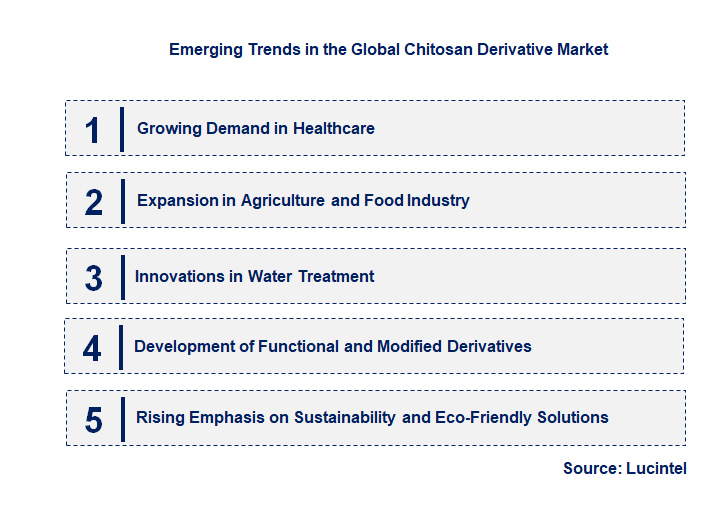
Emerging Trends in the Chitosan Derivative Market

Recent Development in the Chitosan Derivative Market

The chitosan derivative market has experienced significant growth driven by advancements in biotechnology, increasing demand across various industries, and innovations in product formulations. As industries seek sustainable and biodegradable solutions, chitosan derivatives have gained prominence due to their versatile applications. Recent developments reflect a shift towards more efficient production methods, expanded application areas, and enhanced product functionalities. These trends are shaping the market landscape, making it more competitive and innovative. Understanding these key developments is essential for stakeholders aiming to capitalize on emerging opportunities and navigate the evolving market dynamics effectively.

• Technological Innovations in Production: New extraction and modification techniques have improved yield and purity, reducing costs and environmental impact, thus making chitosan derivatives more accessible for diverse applications.
• Expansion in Pharmaceutical Applications: Enhanced biocompatibility and antimicrobial properties have led to increased use in drug delivery systems, wound dressings, and tissue engineering, boosting market growth in healthcare sectors.
• Growing Use in Food Industry: Chitosan derivatives are increasingly used as food preservatives, packaging materials, and functional ingredients, driven by consumer demand for natural and sustainable food solutions.
• Development of Eco-friendly Packaging: Innovations in biodegradable packaging materials utilizing chitosan derivatives are gaining traction, supporting sustainability initiatives and expanding market reach.
• Regulatory Approvals and Standards: Recent approvals and standardizations have facilitated market entry and product commercialization, fostering confidence among manufacturers and consumers.

These developments are collectively propelling the chitosan derivative market towards higher growth, driven by technological advancements, expanding application areas, and a focus on sustainability. The market is becoming more competitive, innovative, and aligned with global environmental and health trends.

Strategic Growth Opportunities in the Chitosan Derivative Market

The chitosan derivative market is experiencing rapid expansion driven by increasing demand across various industries such as healthcare, agriculture, food, water treatment, and cosmetics. Innovations in derivative formulations and applications are opening new avenues for growth, driven by the need for sustainable, biodegradable, and versatile materials. As industries seek eco-friendly solutions, the market is poised for significant development. Key applications are expected to play a crucial role in shaping future trends, offering opportunities for companies to innovate and expand their market share. This dynamic environment underscores the importance of strategic investments and research to capitalize on emerging growth opportunities.

• Healthcare: Advancements in drug delivery and wound healing : Chitosan derivatives are increasingly used in targeted drug delivery systems and wound dressings, enhancing biocompatibility and antimicrobial properties. This growth improves patient outcomes and reduces healthcare costs, making it a vital segment for market expansion.
• Agriculture: Biopesticides and plant growth enhancers : The use of chitosan derivatives as eco-friendly biopesticides and fertilizers promotes sustainable farming practices. This application reduces chemical dependency, supports organic agriculture, and boosts crop yields, driving market growth.
• Food Industry: Food preservation and packaging : Chitosan derivatives are employed in edible films and coatings to extend shelf life and improve food safety. Their biodegradability and antimicrobial properties appeal to consumers and manufacturers seeking sustainable packaging solutions.
• Water Treatment: Flocculants and adsorbents : The market benefits from the use of chitosan derivatives as natural flocculants and adsorbents for removing pollutants from water. This application addresses environmental concerns and complies with stringent regulations, expanding market opportunities.
• Cosmetics: Skin care and hair care products : Chitosan derivatives are incorporated into cosmetics for their moisturizing, film-forming, and antimicrobial properties. Their natural origin aligns with consumer preferences for eco-friendly and sustainable beauty products, fueling industry growth.

In summary, these key growth opportunities across diverse applications are significantly impacting the chitosan derivative market by fostering innovation, promoting sustainability, and expanding market reach. As demand for eco-friendly and functional materials increases, companies that leverage these opportunities are positioned for substantial growth and competitive advantage.

Chitosan Derivative Market Driver and Challenges

The chitosan derivative market is influenced by a variety of technological, economic, and regulatory factors that shape its growth trajectory. Advances in biotechnology and material science have enabled the development of innovative chitosan derivatives with diverse applications across industries such as healthcare, agriculture, and water treatment. Economic factors like increasing demand for sustainable and biodegradable products are driving market expansion, while regulatory frameworks aimed at environmental protection and safety standards influence product development and commercialization. However, challenges such as high production costs, regulatory hurdles, and limited awareness pose significant barriers. Understanding these drivers and challenges is essential for stakeholders to navigate the evolving landscape effectively.

The factors responsible for driving the chitosan derivative market include:
• Technological Innovation: The development of advanced extraction and modification techniques has led to the creation of novel chitosan derivatives with enhanced functionalities. These innovations improve product efficacy in applications like drug delivery, wound healing, and water purification. As research progresses, new derivatives with tailored properties are emerging, expanding market opportunities. This continuous technological evolution attracts investments and encourages industry players to diversify their product portfolios, ultimately fueling market growth.
• Rising Demand for Sustainable Products: Increasing environmental awareness and consumer preference for biodegradable, eco-friendly materials are major drivers. Chitosan derivatives, being biodegradable and non-toxic, are increasingly adopted in agriculture as biopesticides and fertilizers, in water treatment as natural flocculants, and in packaging as sustainable alternatives. Governments and organizations are promoting green initiatives, further boosting demand. This shift towards sustainability not only supports market expansion but also aligns with global efforts to reduce plastic waste and chemical pollution.
• Growing Applications in Healthcare: The healthcare sector is a significant contributor to market growth due to the versatile properties of chitosan derivatives, such as biocompatibility, antimicrobial activity, and wound healing capabilities. They are used in drug delivery systems, tissue engineering, and wound dressings. The increasing prevalence of chronic diseases and the demand for advanced medical materials are propelling research and commercialization. Regulatory approvals and clinical validations are further facilitating their adoption, making healthcare a key growth segment.
• Expansion in Agriculture and Water Treatment: The use of chitosan derivatives in agriculture as biostimulants and biopesticides is gaining momentum due to their eco-friendly nature and effectiveness. Similarly, in water treatment, they serve as natural flocculants, replacing synthetic chemicals. Growing environmental concerns and stricter regulations on chemical usage are driving this shift. The affordability and safety profile of chitosan derivatives make them attractive options, leading to increased adoption across these sectors and contributing significantly to market expansion.

The challenges facing this chitosan derivative market include:
• High Production Costs: The manufacturing of chitosan derivatives involves complex processes such as extraction, purification, and chemical modification, which are often expensive. Limited scalability and the need for specialized equipment further escalate costs. These high production expenses hinder competitive pricing and can restrict market penetration, especially in price-sensitive regions. Overcoming cost barriers through process optimization and technological advancements is crucial for broader adoption and sustainable growth.
• Regulatory and Safety Concerns: The diverse applications of chitosan derivatives, particularly in healthcare and food industries, require rigorous regulatory approvals to ensure safety and efficacy. Navigating complex regulatory landscapes across different countries can delay product launches and increase compliance costs. Additionally, concerns regarding allergenicity and potential toxicity need to be addressed through extensive testing. These regulatory challenges pose significant hurdles for market players aiming for rapid commercialization and global expansion.
• Limited Awareness and Market Penetration: Despite their benefits, awareness about chitosan derivatives remains limited among end-users and industry stakeholders. Lack of knowledge about their applications and advantages hampers market penetration, especially in emerging markets. Additionally, competition from established synthetic alternatives and traditional materials further restrict adoption. Educating consumers, increasing industry collaborations, and demonstrating clear value propositions are essential to overcoming these barriers and expanding market reach.

In summary, the chitosan derivative market is driven by technological advancements, sustainability trends, healthcare innovations, and expanding applications in agriculture and water treatment. However, high production costs, regulatory complexities, and limited awareness pose significant challenges. These factors collectively influence the markets growth potential, requiring strategic efforts to optimize processes, navigate regulatory pathways, and enhance stakeholder education. Addressing these drivers and challenges will be vital for sustainable expansion and maximizing the markets full potential.

List of Chitosan Derivative Companies

Companies in the market compete on the basis of product quality offered. Major players in this market focus on expanding their manufacturing facilities, R&D investments, infrastructural development, and leverage integration opportunities across the value chain. With these strategies chitosan derivative companies cater increasing demand, ensure competitive effectiveness, develop innovative products & technologies, reduce production costs, and expand their customer base. Some of the chitosan derivative companies profiled in this report include-
• Kitozyme
• Primex Iceland
• Vietnam Food
• Kunpoong Bio
• BIO21
• ChitoLytic
• Mirae Biotech
• Heppe Medical Chitosan
• Yaizu Suisankagaku
• Golden-Shell

Chitosan Derivative Market by Segment

The study includes a forecast for the global chitosan derivative market by type, application, and region.

Chitosan Derivative Market by Type [Value from 2019 to 2031]:


• Chitosan HCl
• Carboxymethyl Chitosan
• Chitosan Quaternary Ammonium Salt
• Hydroxypropyl Chitosan
• Chitosan Oligosaccharide
• Others

Chitosan Derivative Market by Application [Value from 2019 to 2031]:


• Medical
• Health Food
• Cosmetics
• Agriculture
• Water Treatment
• Others

Chitosan Derivative Market by Region [Value from 2019 to 2031]:


• North America
• Europe
• Asia Pacific
• The Rest of the World

Country Wise Outlook for the Chitosan Derivative Market

The Chitosan Derivative Market has experienced significant growth driven by increasing demand in healthcare, agriculture, and industrial applications. Innovations in derivative formulations and expanding applications have propelled market expansion across major economies. Countries are investing in research and development to enhance product efficacy and sustainability, reflecting a global shift towards eco-friendly and biocompatible materials. Regulatory frameworks are evolving to support market growth, while collaborations between academia and industry are fostering new product development. These developments indicate a robust future for the chitosan derivative industry, with regional variations influenced by technological advancements, regulatory policies, and market demand.

• United States: The US market has seen substantial advancements with increased adoption in biomedical applications, including drug delivery systems and wound dressings. Innovations in chitosan derivatives have improved biocompatibility and functionality, attracting investments from biotech firms. Regulatory agencies are streamlining approval processes, facilitating faster commercialization. The US also witnesses growing interest in sustainable packaging solutions utilizing chitosan derivatives, driven by environmental concerns. Collaborations between research institutions and industry players are accelerating product development, positioning the US as a leader in chitosan derivative innovation.
• China: China has emerged as a major player in the chitosan derivative market, fueled by rapid industrialization and a focus on sustainable agriculture and food safety. The country is investing heavily in research to develop new derivatives with enhanced antimicrobial and biodegradable properties. Government policies support the use of biopolymers, boosting domestic production and export potential. The pharmaceutical sector is expanding its use of chitosan derivatives for drug delivery and wound healing. Additionally, China’s large agricultural sector is adopting these derivatives for crop protection and soil enhancement, contributing to market growth.
• Germany: Germany’s market is characterized by a strong emphasis on environmental sustainability and high-quality standards. The country is focusing on developing eco-friendly chitosan derivatives for water treatment, food packaging, and cosmetics. German research institutions are pioneering innovations in derivative synthesis to improve stability and functionality. The automotive and textile industries are exploring chitosan-based solutions for eco-friendly materials. Regulatory frameworks in Germany promote sustainable practices, and collaborations with European partners are expanding market reach. Overall, Germany is positioning itself as a hub for sustainable and high-performance chitosan derivative products.
• India: India is witnessing rapid growth in the chitosan derivative market, driven by increasing applications in agriculture, healthcare, and water treatment. The country’s large agricultural sector is adopting chitosan derivatives as biopesticides and soil conditioners, reducing reliance on chemical pesticides. The healthcare sector is exploring new formulations for wound healing and drug delivery. Government initiatives promoting organic farming and sustainable practices are supporting market expansion. Additionally, India’s growing pharmaceutical industry is investing in research to develop cost-effective derivatives. The market’s growth is further supported by rising awareness of eco-friendly materials and supportive regulatory policies.
• Japan: Japan’s market is characterized by technological innovation and a focus on high-value applications. The country is developing advanced chitosan derivatives for use in medical devices, wound care, and functional foods. Japanese companies are investing in nanotechnology to enhance derivative properties, improving efficacy and stability. The emphasis on aging populations has increased demand for biomedical applications. Japan’s strict regulatory environment ensures high safety and quality standards, fostering trust in new products. Collaborations between academia and industry are driving innovation, positioning Japan as a leader in high-performance chitosan derivative solutions for healthcare and industrial sectors.

Lucintel Analytics Dashboard

Features of the Global Chitosan Derivative Market

Market Size Estimates: Chitosan derivative market size estimation in terms of value ($B).
Trend and Forecast Analysis: Market trends (2019 to 2024) and forecast (2025 to 2031) by various segments and regions.
Segmentation Analysis: Chitosan derivative market size by type, application, and region in terms of value ($B).
Regional Analysis: Chitosan derivative market breakdown by North America, Europe, Asia Pacific, and Rest of the World.
Growth Opportunities: Analysis of growth opportunities in different types, applications, and regions for the chitosan derivative market.
Strategic Analysis: This includes M&A, new product development, and competitive landscape of the chitosan derivative market.
Analysis of competitive intensity of the industry based on Porter’s Five Forces model.

Lucintel Consulting Services

FAQ

Q1. What is the growth forecast for chitosan derivative market?
Answer: The global chitosan derivative market is expected to grow with a CAGR of 6.2% from 2025 to 2031.
Q2. What are the major drivers influencing the growth of the chitosan derivative market?
Answer: The major drivers for this market are the increasing demand in pharmaceutical and medical applications, the rising use in food preservation & packaging, and the growing adoption in cosmetics & personal care products.
Q3. What are the major segments for chitosan derivative market?
Answer: The future of the chitosan derivative market looks promising with opportunities in the medical, health food, cosmetics, agriculture, and water treatment markets.
Q4. Who are the key chitosan derivative market companies?
Answer: Some of the key chitosan derivative companies are as follows:
• Kitozyme
• Primex Iceland
• Vietnam Food
• Kunpoong Bio
• BIO21
• ChitoLytic
• Mirae Biotech
• Heppe Medical Chitosan
• Yaizu Suisankagaku
• Golden-Shell
Q5. Which chitosan derivative market segment will be the largest in future?
Answer: Lucintel forecasts that, within the type category, chitosan oligosaccharide is expected to witness the highest growth over the forecast period.
Q6. In chitosan derivative market, which region is expected to be the largest in next 5 years?
Answer: In terms of region, APAC is expected to witness the highest growth over the forecast period.
Q7. Do we receive customization in this report?
Answer: Yes, Lucintel provides 10% customization without any additional cost.

This report answers following 11 key questions:

Q.1. What are some of the most promising, high-growth opportunities for the chitosan derivative market by type (chitosan HCL, carboxymethyl chitosan, chitosan quaternary ammonium salt, hydroxypropyl chitosan, chitosan oligosaccharide, others, , and), application (medical, health food, cosmetics, agriculture, water treatment, others, , and), and region (North America, Europe, Asia Pacific, and the Rest of the World)?
Q.2. Which segments will grow at a faster pace and why?
Q.3. Which region will grow at a faster pace and why?
Q.4. What are the key factors affecting market dynamics? What are the key challenges and business risks in this market?
Q.5. What are the business risks and competitive threats in this market?
Q.6. What are the emerging trends in this market and the reasons behind them?
Q.7. What are some of the changing demands of customers in the market?
Q.8. What are the new developments in the market? Which companies are leading these developments?
Q.9. Who are the major players in this market? What strategic initiatives are key players pursuing for business growth?
Q.10. What are some of the competing products in this market and how big of a threat do they pose for loss of market share by material or product substitution?
Q.11. What M&A activity has occurred in the last 5 years and what has its impact been on the industry?

For any questions related to Chitosan Derivative Market, Chitosan Derivative Market Size, Chitosan Derivative Market Growth, Chitosan Derivative Market Analysis, Chitosan Derivative Market Report, Chitosan Derivative Market Share, Chitosan Derivative Market Trends, Chitosan Derivative Market Forecast, Chitosan Derivative Companies, write Lucintel analyst at email: helpdesk@lucintel.com. We will be glad to get back to you soon.
                                           Table of Contents

            1. Executive Summary

            2. Market Overview

                        2.1 Background and Classifications
                        2.2 Supply Chain

            3. Market Trends & Forecast Analysis

                        3.1 Macroeconomic Trends and Forecasts
                        3.2 Industry Drivers and Challenges
                        3.3 PESTLE Analysis
                        3.4 Patent Analysis
                        3.5 Regulatory Environment
                        3.6 Global Chitosan Derivative Market Trends and Forecast

            4. Global Chitosan Derivative Market by Type

                        4.1 Overview
                        4.2 Attractiveness Analysis by Type
                        4.3 Chitosan HCl : Trends and Forecast 2019 to 2031
                        4.4 Carboxymethyl Chitosan : Trends and Forecast 2019 to 2031
                        4.5 Chitosan Quaternary Ammonium Salt : Trends and Forecast 2019 to 2031
                        4.6 Hydroxypropyl Chitosan : Trends and Forecast 2019 to 2031
                        4.7 Chitosan Oligosaccharide : Trends and Forecast 2019 to 2031
                        4.8 Others : Trends and Forecast 2019 to 2031

            5. Global Chitosan Derivative Market by Application

                        5.1 Overview
                        5.2 Attractiveness Analysis by Application
                        5.3 Medical : Trends and Forecast 2019 to 2031
                        5.4 Health Food : Trends and Forecast 2019 to 2031
                        5.5 Cosmetics : Trends and Forecast 2019 to 2031
                        5.6 Agriculture : Trends and Forecast 2019 to 2031
                        5.7 Water Treatment : Trends and Forecast 2019 to 2031
                        5.8 Others : Trends and Forecast 2019 to 2031

            6. Regional Analysis

                        6.1 Overview
                        6.2 Global Chitosan Derivative Market by Region

            7. North American Chitosan Derivative Market

                        7.1 Overview
                        7.2 North American Chitosan Derivative Market by Type
                        7.3 North American Chitosan Derivative Market by Application
                        7.4 The United States Chitosan Derivative Market
                        7.5 Canadian Chitosan Derivative Market
                        7.6 Mexican Chitosan Derivative Market

            8. European Chitosan Derivative Market

                        8.1 Overview
                        8.2 European Chitosan Derivative Market by Type
                        8.3 European Chitosan Derivative Market by Application
                        8.4 German Chitosan Derivative Market
                        8.5 French Chitosan Derivative Market
                        8.6 Italian Chitosan Derivative Market
                        8.7 Spanish Chitosan Derivative Market
                        8.8 The United Kingdom Chitosan Derivative Market

            9. APAC Chitosan Derivative Market

                        9.1 Overview
                        9.2 APAC Chitosan Derivative Market by Type
                        9.3 APAC Chitosan Derivative Market by Application
                        9.4 Chinese Chitosan Derivative Market
                        9.5 Indian Chitosan Derivative Market
                        9.6 Japanese Chitosan Derivative Market
                        9.7 South Korean Chitosan Derivative Market
                        9.8 Indonesian Chitosan Derivative Market

            10. ROW Chitosan Derivative Market

                        10.1 Overview
                        10.2 ROW Chitosan Derivative Market by Type
                        10.3 ROW Chitosan Derivative Market by Application
                        10.4 Middle Eastern Chitosan Derivative Market
                        10.5 South American Chitosan Derivative Market
                        10.6 African Chitosan Derivative Market

            11. Competitor Analysis

                        11.1 Product Portfolio Analysis
                        11.2 Operational Integration
                        11.3 Porter’s Five Forces Analysis
                                    • Competitive Rivalry
                                    • Bargaining Power of Buyers
                                    • Bargaining Power of Suppliers
                                    • Threat of Substitutes
                                    • Threat of New Entrants
                        11.4 Market Share Analysis

            12. Opportunities & Strategic Analysis

                        12.1 Value Chain Analysis
                        12.2 Growth Opportunity Analysis
                                    12.2.1 Growth Opportunity by Type
                                    12.2.2 Growth Opportunity by Application
                        12.3 Emerging Trends in the Global Chitosan Derivative Market
                        12.4 Strategic Analysis
                                    12.4.1 New Product Development
                                    12.4.2 Certification and Licensing
                                    12.4.3 Mergers, Acquisitions, Agreements, Collaborations, and Joint Ventures

            13. Company Profiles of the Leading Players Across the Value Chain

                        13.1 Competitive Analysis Overview
                        13.2 Kitozyme
                                    • Company Overview
                                    • Chitosan Derivative Market Business Overview
                                    • New Product Development
                                    • Merger, Acquisition, and Collaboration
                                    • Certification and Licensing
                        13.3 Primex Iceland
                                    • Company Overview
                                    • Chitosan Derivative Market Business Overview
                                    • New Product Development
                                    • Merger, Acquisition, and Collaboration
                                    • Certification and Licensing
                        13.4 Vietnam Food
                                    • Company Overview
                                    • Chitosan Derivative Market Business Overview
                                    • New Product Development
                                    • Merger, Acquisition, and Collaboration
                                    • Certification and Licensing
                        13.5 Kunpoong Bio
                                    • Company Overview
                                    • Chitosan Derivative Market Business Overview
                                    • New Product Development
                                    • Merger, Acquisition, and Collaboration
                                    • Certification and Licensing
                        13.6 BIO21
                                    • Company Overview
                                    • Chitosan Derivative Market Business Overview
                                    • New Product Development
                                    • Merger, Acquisition, and Collaboration
                                    • Certification and Licensing
                        13.7 ChitoLytic
                                    • Company Overview
                                    • Chitosan Derivative Market Business Overview
                                    • New Product Development
                                    • Merger, Acquisition, and Collaboration
                                    • Certification and Licensing
                        13.8 Mirae Biotech
                                    • Company Overview
                                    • Chitosan Derivative Market Business Overview
                                    • New Product Development
                                    • Merger, Acquisition, and Collaboration
                                    • Certification and Licensing
                        13.9 Heppe Medical Chitosan
                                    • Company Overview
                                    • Chitosan Derivative Market Business Overview
                                    • New Product Development
                                    • Merger, Acquisition, and Collaboration
                                    • Certification and Licensing
                        13.10 Yaizu Suisankagaku
                                    • Company Overview
                                    • Chitosan Derivative Market Business Overview
                                    • New Product Development
                                    • Merger, Acquisition, and Collaboration
                                    • Certification and Licensing
                        13.11 Golden-Shell
                                    • Company Overview
                                    • Chitosan Derivative Market Business Overview
                                    • New Product Development
                                    • Merger, Acquisition, and Collaboration
                                    • Certification and Licensing

            14. Appendix

                        14.1 List of Figures
                        14.2 List of Tables
                        14.3 Research Methodology
                        14.4 Disclaimer
                        14.5 Copyright
                        14.6 Abbreviations and Technical Units
                        14.7 About Us
                        14.8 Contact Us

                                               List of Figures


            Chapter 1

                        Figure 1.1: Trends and Forecast for the Global Chitosan Derivative Market

            Chapter 2

                        Figure 2.1: Usage of Chitosan Derivative Market
                        Figure 2.2: Classification of the Global Chitosan Derivative Market
                        Figure 2.3: Supply Chain of the Global Chitosan Derivative Market

            Chapter 3

                        Figure 3.1: Trends of the Global GDP Growth Rate
                        Figure 3.2: Trends of the Global Population Growth Rate
                        Figure 3.3: Trends of the Global Inflation Rate
                        Figure 3.4: Trends of the Global Unemployment Rate
                        Figure 3.5: Trends of the Regional GDP Growth Rate
                        Figure 3.6: Trends of the Regional Population Growth Rate
                        Figure 3.7: Trends of the Regional Inflation Rate
                        Figure 3.8: Trends of the Regional Unemployment Rate
                        Figure 3.9: Trends of Regional Per Capita Income
                        Figure 3.10: Forecast for the Global GDP Growth Rate
                        Figure 3.11: Forecast for the Global Population Growth Rate
                        Figure 3.12: Forecast for the Global Inflation Rate
                        Figure 3.13: Forecast for the Global Unemployment Rate
                        Figure 3.14: Forecast for the Regional GDP Growth Rate
                        Figure 3.15: Forecast for the Regional Population Growth Rate
                        Figure 3.16: Forecast for the Regional Inflation Rate
                        Figure 3.17: Forecast for the Regional Unemployment Rate
                        Figure 3.18: Forecast for Regional Per Capita Income
                        Figure 3.19: Driver and Challenges of the Chitosan Derivative Market

            Chapter 4

                        Figure 4.1: Global Chitosan Derivative Market by Type in 2019, 2024, and 2031
                        Figure 4.2: Trends of the Global Chitosan Derivative Market ($B) by Type
                        Figure 4.3: Forecast for the Global Chitosan Derivative Market ($B) by Type
                        Figure 4.4: Trends and Forecast for Chitosan HCl in the Global Chitosan Derivative Market (2019-2031)
                        Figure 4.5: Trends and Forecast for Carboxymethyl Chitosan in the Global Chitosan Derivative Market (2019-2031)
                        Figure 4.6: Trends and Forecast for Chitosan Quaternary Ammonium Salt in the Global Chitosan Derivative Market (2019-2031)
                        Figure 4.7: Trends and Forecast for Hydroxypropyl Chitosan in the Global Chitosan Derivative Market (2019-2031)
                        Figure 4.8: Trends and Forecast for Chitosan Oligosaccharide in the Global Chitosan Derivative Market (2019-2031)
                        Figure 4.9: Trends and Forecast for Others in the Global Chitosan Derivative Market (2019-2031)

            Chapter 5

                        Figure 5.1: Global Chitosan Derivative Market by Application in 2019, 2024, and 2031
                        Figure 5.2: Trends of the Global Chitosan Derivative Market ($B) by Application
                        Figure 5.3: Forecast for the Global Chitosan Derivative Market ($B) by Application
                        Figure 5.4: Trends and Forecast for Medical in the Global Chitosan Derivative Market (2019-2031)
                        Figure 5.5: Trends and Forecast for Health Food in the Global Chitosan Derivative Market (2019-2031)
                        Figure 5.6: Trends and Forecast for Cosmetics in the Global Chitosan Derivative Market (2019-2031)
                        Figure 5.7: Trends and Forecast for Agriculture in the Global Chitosan Derivative Market (2019-2031)
                        Figure 5.8: Trends and Forecast for Water Treatment in the Global Chitosan Derivative Market (2019-2031)
                        Figure 5.9: Trends and Forecast for Others in the Global Chitosan Derivative Market (2019-2031)

            Chapter 6

                        Figure 6.1: Trends of the Global Chitosan Derivative Market ($B) by Region (2019-2024)
                        Figure 6.2: Forecast for the Global Chitosan Derivative Market ($B) by Region (2025-2031)

            Chapter 7

                        Figure 7.1: Trends and Forecast for the North American Chitosan Derivative Market (2019-2031)
                        Figure 7.2: North American Chitosan Derivative Market by Type in 2019, 2024, and 2031
                        Figure 7.3: Trends of the North American Chitosan Derivative Market ($B) by Type (2019-2024)
                        Figure 7.4: Forecast for the North American Chitosan Derivative Market ($B) by Type (2025-2031)
                        Figure 7.5: North American Chitosan Derivative Market by Application in 2019, 2024, and 2031
                        Figure 7.6: Trends of the North American Chitosan Derivative Market ($B) by Application (2019-2024)
                        Figure 7.7: Forecast for the North American Chitosan Derivative Market ($B) by Application (2025-2031)
                        Figure 7.8: Trends and Forecast for the United States Chitosan Derivative Market ($B) (2019-2031)
                        Figure 7.9: Trends and Forecast for the Mexican Chitosan Derivative Market ($B) (2019-2031)
                        Figure 7.10: Trends and Forecast for the Canadian Chitosan Derivative Market ($B) (2019-2031)

            Chapter 8

                        Figure 8.1: Trends and Forecast for the European Chitosan Derivative Market (2019-2031)
                        Figure 8.2: European Chitosan Derivative Market by Type in 2019, 2024, and 2031
                        Figure 8.3: Trends of the European Chitosan Derivative Market ($B) by Type (2019-2024)
                        Figure 8.4: Forecast for the European Chitosan Derivative Market ($B) by Type (2025-2031)
                        Figure 8.5: European Chitosan Derivative Market by Application in 2019, 2024, and 2031
                        Figure 8.6: Trends of the European Chitosan Derivative Market ($B) by Application (2019-2024)
                        Figure 8.7: Forecast for the European Chitosan Derivative Market ($B) by Application (2025-2031)
                        Figure 8.8: Trends and Forecast for the German Chitosan Derivative Market ($B) (2019-2031)
                        Figure 8.9: Trends and Forecast for the French Chitosan Derivative Market ($B) (2019-2031)
                        Figure 8.10: Trends and Forecast for the Spanish Chitosan Derivative Market ($B) (2019-2031)
                        Figure 8.11: Trends and Forecast for the Italian Chitosan Derivative Market ($B) (2019-2031)
                        Figure 8.12: Trends and Forecast for the United Kingdom Chitosan Derivative Market ($B) (2019-2031)

            Chapter 9

                        Figure 9.1: Trends and Forecast for the APAC Chitosan Derivative Market (2019-2031)
                        Figure 9.2: APAC Chitosan Derivative Market by Type in 2019, 2024, and 2031
                        Figure 9.3: Trends of the APAC Chitosan Derivative Market ($B) by Type (2019-2024)
                        Figure 9.4: Forecast for the APAC Chitosan Derivative Market ($B) by Type (2025-2031)
                        Figure 9.5: APAC Chitosan Derivative Market by Application in 2019, 2024, and 2031
                        Figure 9.6: Trends of the APAC Chitosan Derivative Market ($B) by Application (2019-2024)
                        Figure 9.7: Forecast for the APAC Chitosan Derivative Market ($B) by Application (2025-2031)
                        Figure 9.8: Trends and Forecast for the Japanese Chitosan Derivative Market ($B) (2019-2031)
                        Figure 9.9: Trends and Forecast for the Indian Chitosan Derivative Market ($B) (2019-2031)
                        Figure 9.10: Trends and Forecast for the Chinese Chitosan Derivative Market ($B) (2019-2031)
                        Figure 9.11: Trends and Forecast for the South Korean Chitosan Derivative Market ($B) (2019-2031)
                        Figure 9.12: Trends and Forecast for the Indonesian Chitosan Derivative Market ($B) (2019-2031)

            Chapter 10

                        Figure 10.1: Trends and Forecast for the ROW Chitosan Derivative Market (2019-2031)
                        Figure 10.2: ROW Chitosan Derivative Market by Type in 2019, 2024, and 2031
                        Figure 10.3: Trends of the ROW Chitosan Derivative Market ($B) by Type (2019-2024)
                        Figure 10.4: Forecast for the ROW Chitosan Derivative Market ($B) by Type (2025-2031)
                        Figure 10.5: ROW Chitosan Derivative Market by Application in 2019, 2024, and 2031
                        Figure 10.6: Trends of the ROW Chitosan Derivative Market ($B) by Application (2019-2024)
                        Figure 10.7: Forecast for the ROW Chitosan Derivative Market ($B) by Application (2025-2031)
                        Figure 10.8: Trends and Forecast for the Middle Eastern Chitosan Derivative Market ($B) (2019-2031)
                        Figure 10.9: Trends and Forecast for the South American Chitosan Derivative Market ($B) (2019-2031)
                        Figure 10.10: Trends and Forecast for the African Chitosan Derivative Market ($B) (2019-2031)

            Chapter 11

                        Figure 11.1: Porter’s Five Forces Analysis of the Global Chitosan Derivative Market
                        Figure 11.2: Market Share (%) of Top Players in the Global Chitosan Derivative Market (2024)

            Chapter 12

                        Figure 12.1: Growth Opportunities for the Global Chitosan Derivative Market by Type
                        Figure 12.2: Growth Opportunities for the Global Chitosan Derivative Market by Application
                        Figure 12.3: Growth Opportunities for the Global Chitosan Derivative Market by Region
                        Figure 12.4: Emerging Trends in the Global Chitosan Derivative Market

                                               List of Tables


            Chapter 1

                        Table 1.1: Growth Rate (%, 2023-2024) and CAGR (%, 2025-2031) of the Chitosan Derivative Market by Type and Application
                        Table 1.2: Attractiveness Analysis for the Chitosan Derivative Market by Region
                        Table 1.3: Global Chitosan Derivative Market Parameters and Attributes

            Chapter 3

                        Table 3.1: Trends of the Global Chitosan Derivative Market (2019-2024)
                        Table 3.2: Forecast for the Global Chitosan Derivative Market (2025-2031)

            Chapter 4

                        Table 4.1: Attractiveness Analysis for the Global Chitosan Derivative Market by Type
                        Table 4.2: Market Size and CAGR of Various Type in the Global Chitosan Derivative Market (2019-2024)
                        Table 4.3: Market Size and CAGR of Various Type in the Global Chitosan Derivative Market (2025-2031)
                        Table 4.4: Trends of Chitosan HCl in the Global Chitosan Derivative Market (2019-2024)
                        Table 4.5: Forecast for Chitosan HCl in the Global Chitosan Derivative Market (2025-2031)
                        Table 4.6: Trends of Carboxymethyl Chitosan in the Global Chitosan Derivative Market (2019-2024)
                        Table 4.7: Forecast for Carboxymethyl Chitosan in the Global Chitosan Derivative Market (2025-2031)
                        Table 4.8: Trends of Chitosan Quaternary Ammonium Salt in the Global Chitosan Derivative Market (2019-2024)
                        Table 4.9: Forecast for Chitosan Quaternary Ammonium Salt in the Global Chitosan Derivative Market (2025-2031)
                        Table 4.10: Trends of Hydroxypropyl Chitosan in the Global Chitosan Derivative Market (2019-2024)
                        Table 4.11: Forecast for Hydroxypropyl Chitosan in the Global Chitosan Derivative Market (2025-2031)
                        Table 4.12: Trends of Chitosan Oligosaccharide in the Global Chitosan Derivative Market (2019-2024)
                        Table 4.13: Forecast for Chitosan Oligosaccharide in the Global Chitosan Derivative Market (2025-2031)
                        Table 4.14: Trends of Others in the Global Chitosan Derivative Market (2019-2024)
                        Table 4.15: Forecast for Others in the Global Chitosan Derivative Market (2025-2031)

            Chapter 5

                        Table 5.1: Attractiveness Analysis for the Global Chitosan Derivative Market by Application
                        Table 5.2: Market Size and CAGR of Various Application in the Global Chitosan Derivative Market (2019-2024)
                        Table 5.3: Market Size and CAGR of Various Application in the Global Chitosan Derivative Market (2025-2031)
                        Table 5.4: Trends of Medical in the Global Chitosan Derivative Market (2019-2024)
                        Table 5.5: Forecast for Medical in the Global Chitosan Derivative Market (2025-2031)
                        Table 5.6: Trends of Health Food in the Global Chitosan Derivative Market (2019-2024)
                        Table 5.7: Forecast for Health Food in the Global Chitosan Derivative Market (2025-2031)
                        Table 5.8: Trends of Cosmetics in the Global Chitosan Derivative Market (2019-2024)
                        Table 5.9: Forecast for Cosmetics in the Global Chitosan Derivative Market (2025-2031)
                        Table 5.10: Trends of Agriculture in the Global Chitosan Derivative Market (2019-2024)
                        Table 5.11: Forecast for Agriculture in the Global Chitosan Derivative Market (2025-2031)
                        Table 5.12: Trends of Water Treatment in the Global Chitosan Derivative Market (2019-2024)
                        Table 5.13: Forecast for Water Treatment in the Global Chitosan Derivative Market (2025-2031)
                        Table 5.14: Trends of Others in the Global Chitosan Derivative Market (2019-2024)
                        Table 5.15: Forecast for Others in the Global Chitosan Derivative Market (2025-2031)

            Chapter 6

                        Table 6.1: Market Size and CAGR of Various Regions in the Global Chitosan Derivative Market (2019-2024)
                        Table 6.2: Market Size and CAGR of Various Regions in the Global Chitosan Derivative Market (2025-2031)

            Chapter 7

                        Table 7.1: Trends of the North American Chitosan Derivative Market (2019-2024)
                        Table 7.2: Forecast for the North American Chitosan Derivative Market (2025-2031)
                        Table 7.3: Market Size and CAGR of Various Type in the North American Chitosan Derivative Market (2019-2024)
                        Table 7.4: Market Size and CAGR of Various Type in the North American Chitosan Derivative Market (2025-2031)
                        Table 7.5: Market Size and CAGR of Various Application in the North American Chitosan Derivative Market (2019-2024)
                        Table 7.6: Market Size and CAGR of Various Application in the North American Chitosan Derivative Market (2025-2031)
                        Table 7.7: Trends and Forecast for the United States Chitosan Derivative Market (2019-2031)
                        Table 7.8: Trends and Forecast for the Mexican Chitosan Derivative Market (2019-2031)
                        Table 7.9: Trends and Forecast for the Canadian Chitosan Derivative Market (2019-2031)

            Chapter 8

                        Table 8.1: Trends of the European Chitosan Derivative Market (2019-2024)
                        Table 8.2: Forecast for the European Chitosan Derivative Market (2025-2031)
                        Table 8.3: Market Size and CAGR of Various Type in the European Chitosan Derivative Market (2019-2024)
                        Table 8.4: Market Size and CAGR of Various Type in the European Chitosan Derivative Market (2025-2031)
                        Table 8.5: Market Size and CAGR of Various Application in the European Chitosan Derivative Market (2019-2024)
                        Table 8.6: Market Size and CAGR of Various Application in the European Chitosan Derivative Market (2025-2031)
                        Table 8.7: Trends and Forecast for the German Chitosan Derivative Market (2019-2031)
                        Table 8.8: Trends and Forecast for the French Chitosan Derivative Market (2019-2031)
                        Table 8.9: Trends and Forecast for the Spanish Chitosan Derivative Market (2019-2031)
                        Table 8.10: Trends and Forecast for the Italian Chitosan Derivative Market (2019-2031)
                        Table 8.11: Trends and Forecast for the United Kingdom Chitosan Derivative Market (2019-2031)

            Chapter 9

                        Table 9.1: Trends of the APAC Chitosan Derivative Market (2019-2024)
                        Table 9.2: Forecast for the APAC Chitosan Derivative Market (2025-2031)
                        Table 9.3: Market Size and CAGR of Various Type in the APAC Chitosan Derivative Market (2019-2024)
                        Table 9.4: Market Size and CAGR of Various Type in the APAC Chitosan Derivative Market (2025-2031)
                        Table 9.5: Market Size and CAGR of Various Application in the APAC Chitosan Derivative Market (2019-2024)
                        Table 9.6: Market Size and CAGR of Various Application in the APAC Chitosan Derivative Market (2025-2031)
                        Table 9.7: Trends and Forecast for the Japanese Chitosan Derivative Market (2019-2031)
                        Table 9.8: Trends and Forecast for the Indian Chitosan Derivative Market (2019-2031)
                        Table 9.9: Trends and Forecast for the Chinese Chitosan Derivative Market (2019-2031)
                        Table 9.10: Trends and Forecast for the South Korean Chitosan Derivative Market (2019-2031)
                        Table 9.11: Trends and Forecast for the Indonesian Chitosan Derivative Market (2019-2031)

            Chapter 10

                        Table 10.1: Trends of the ROW Chitosan Derivative Market (2019-2024)
                        Table 10.2: Forecast for the ROW Chitosan Derivative Market (2025-2031)
                        Table 10.3: Market Size and CAGR of Various Type in the ROW Chitosan Derivative Market (2019-2024)
                        Table 10.4: Market Size and CAGR of Various Type in the ROW Chitosan Derivative Market (2025-2031)
                        Table 10.5: Market Size and CAGR of Various Application in the ROW Chitosan Derivative Market (2019-2024)
                        Table 10.6: Market Size and CAGR of Various Application in the ROW Chitosan Derivative Market (2025-2031)
                        Table 10.7: Trends and Forecast for the Middle Eastern Chitosan Derivative Market (2019-2031)
                        Table 10.8: Trends and Forecast for the South American Chitosan Derivative Market (2019-2031)
                        Table 10.9: Trends and Forecast for the African Chitosan Derivative Market (2019-2031)

            Chapter 11

                        Table 11.1: Product Mapping of Chitosan Derivative Suppliers Based on Segments
                        Table 11.2: Operational Integration of Chitosan Derivative Manufacturers
                        Table 11.3: Rankings of Suppliers Based on Chitosan Derivative Revenue

            Chapter 12

                        Table 12.1: New Product Launches by Major Chitosan Derivative Producers (2019-2024)
                        Table 12.2: Certification Acquired by Major Competitor in the Global Chitosan Derivative Market

.

Buy full report or by chapter as follows

Limited Time Offer

Price by License Type:
[-] Hide Chapter Details
[Chapter Number] [Chapter Name] [Chapter Number Of Pages] [Chapter Price]
Title/Chapter Name Pages Price
Full Report: Chitosan Derivative Market Report: Trends, Forecast and Competitive Analysis to 2031 Full Report $ 2,990
A 150 Page Report
Lucintel has been in the business of market research and management consulting since 2000 and has published over 1000 market intelligence reports in various markets / applications and served over 1,000 clients worldwide. This study is a culmination of four months of full-time effort performed by Lucintel's analyst team. The analysts used the following sources for the creation and completion of this valuable report:
  • In-depth interviews of the major players in this market
  • Detailed secondary research from competitors’ financial statements and published data 
  • Extensive searches of published works, market, and database information pertaining to industry news, company press releases, and customer intentions
  • A compilation of the experiences, judgments, and insights of Lucintel’s professionals, who have analyzed and tracked this market over the years.
Extensive research and interviews are conducted across the supply chain of this market to estimate market share, market size, trends, drivers, challenges, and forecasts. Below is a brief summary of the primary interviews that were conducted by job function for this report.
 
Thus, Lucintel compiles vast amounts of data from numerous sources, validates the integrity of that data, and performs a comprehensive analysis. Lucintel then organizes the data, its findings, and insights into a concise report designed to support the strategic decision-making process. The figure below is a graphical representation of Lucintel’s research process. 
 

Please sign in below to get report brochure - Chitosan Derivative Market Report.

At Lucintel, we respect your privacy and maintain the confidentiality of information / data provided by you
(Please enter your corporate email. * These fields are mandatory )

Follow us on

