
Market Report · July 31, 2026

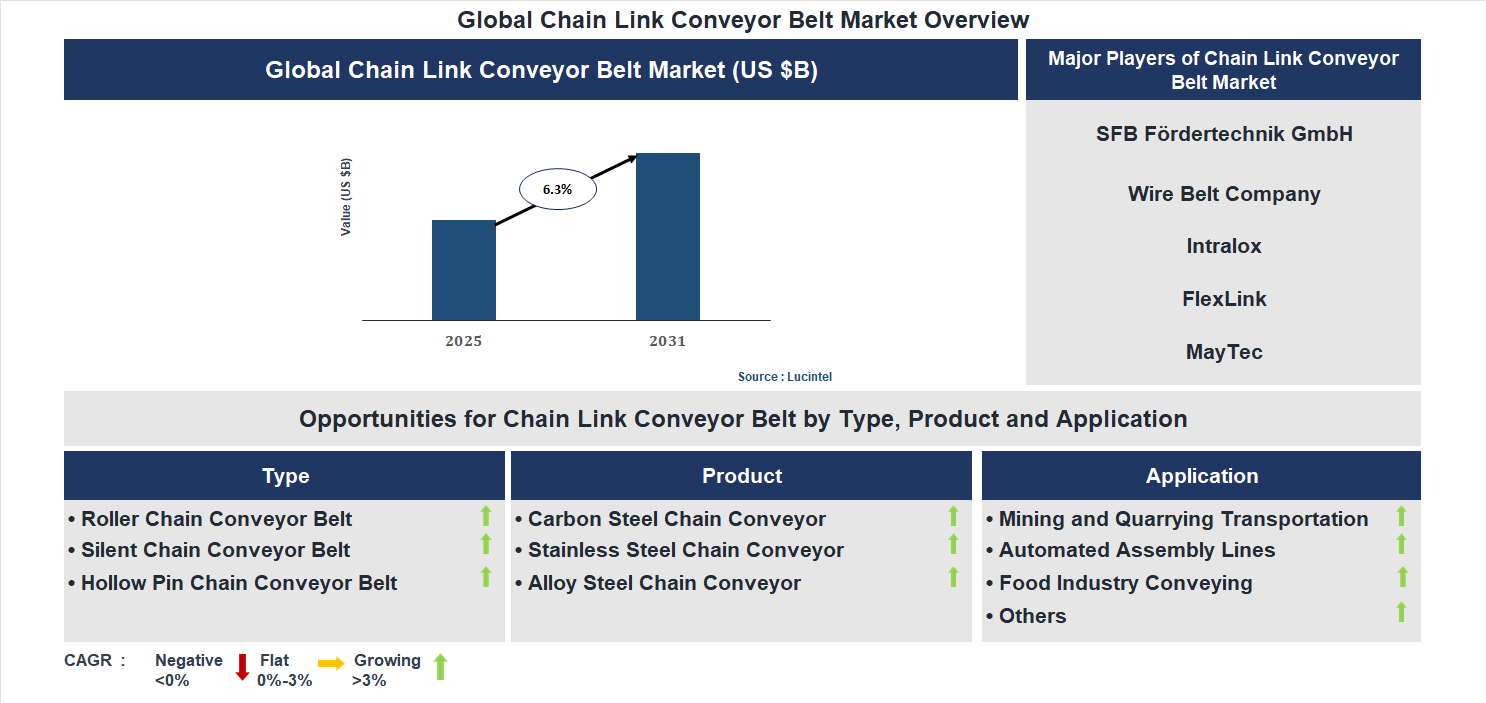
Key data points: The growth forecast = 6.3% annually for the next 6 years. Scroll below to get more insights. This market report covers trends, opportunities and forecasts in chain link conveyor belt market to 2031 by type (roller chain conveyor belt, silent chain conveyor belt, and hollow pin chain conveyor belt), product (carbon steel chain conveyor, stainless steel chain conveyor, and alloy steel chain conveyor), application (mining and quarrying transportation, automated assembly lines, food industry conveying, and others), and region (North America, Europe, Asia Pacific, and the Rest of the World)
We'll send your sample report shortly.
• Lucintel forecasts that, within the type category, roller chain conveyor belt is expected to witness the highest growth over the forecast period.
• Within the application category, mining & quarrying transportation is expected to witness the highest growth.
• In terms of region, APAC is expected to witness the highest growth over the forecast period. Gain valuable insights for your business decisions with our comprehensive 150+ page report. Sample figures with some insights are shown below.
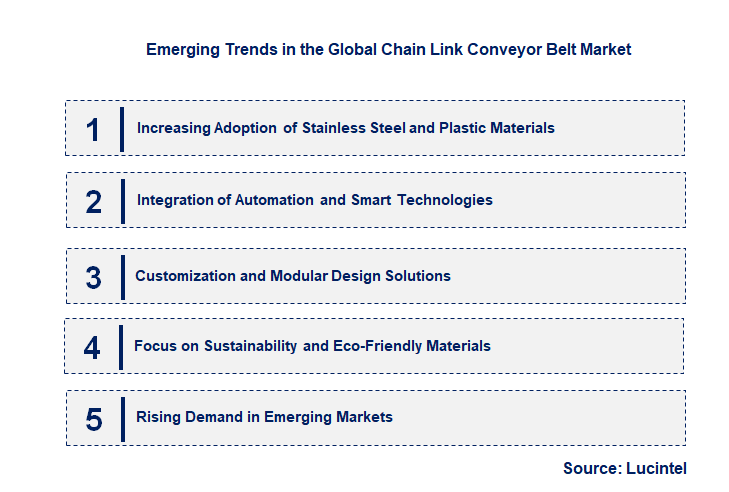
• Increasing adoption of stainless steel and plastic materials: The market is witnessing a shift towards stainless steel and high-grade plastics for conveyor belts, driven by their corrosion resistance, durability, and ease of cleaning. These materials are particularly favored in food processing and pharmaceutical industries, where hygiene standards are critical. The use of such materials extends the lifespan of conveyor belts, reduces maintenance costs, and ensures compliance with safety regulations. This trend enhances operational efficiency and supports the growing demand for sanitary and long-lasting conveyor solutions.
• Integration of automation and smart technologies: Automation is transforming conveyor belt systems through the integration of sensors, IoT, and control systems. These smart conveyor belts enable real-time monitoring, predictive maintenance, and improved process control, reducing downtime and operational costs. Automated systems facilitate faster throughput and better inventory management, especially in large-scale manufacturing and logistics operations. The adoption of these technologies is driven by Industry 4.0 initiatives, aiming to optimize productivity and ensure seamless, data-driven operations across various sectors.
• Customization and modular design solutions: The market is moving towards highly customizable and modular conveyor belt systems that can be tailored to specific industry needs. Modular designs allow easy installation, reconfiguration, and scalability, accommodating changing production requirements. Customization options include belt width, length, surface texture, and drive mechanisms, enabling industries to optimize their workflows. This trend provides flexibility, reduces downtime during upgrades, and enhances overall efficiency, making conveyor systems more adaptable to diverse operational environments.
• Focus on sustainability and eco-friendly materials: Environmental concerns are prompting manufacturers to develop sustainable conveyor belt solutions. This includes the use of recyclable materials, energy-efficient drive systems, and eco-friendly manufacturing processes. Companies are also exploring biodegradable plastics and reduced energy consumption designs to minimize environmental impact. These initiatives align with global sustainability goals and regulatory requirements, appealing to environmentally conscious clients. The shift towards greener solutions not only benefits the environment but also enhances brand reputation and compliance.
• Rising demand in emerging markets: Rapid industrialization and infrastructure development in emerging economies are fueling the demand for chain link conveyor belts. Countries in Asia-Pacific, Latin America, and Africa are witnessing increased investments in manufacturing, logistics, and food processing sectors. This growth creates new opportunities for market expansion and innovation. Local manufacturers are also adopting advanced technologies to meet global standards, further driving market competitiveness. The rising demand in these regions is reshaping the global landscape, making the market more diverse and dynamic, with significant growth potential. In summary, these trends are collectively reshaping the chain link conveyor belt market by enhancing product performance, integrating advanced technologies, promoting sustainability, and expanding into new geographical regions. These developments are enabling industries to achieve higher efficiency, safety, and environmental compliance, ensuring the markets continued growth and innovation.
• Growth in Manufacturing Sector: The rising demand for automation in manufacturing plants is fueling the need for reliable conveyor systems. Chain link conveyor belts offer durability, flexibility, and ease of maintenance, making them ideal for diverse industrial applications. As industries aim to improve efficiency and reduce downtime, the adoption of these belts is increasing, leading to market expansion. This trend is expected to continue, driven by industrial growth in emerging economies and technological innovations.
• Technological Advancements in Materials: The development of high-performance materials such as stainless steel, plastic composites, and corrosion-resistant alloys is revolutionizing conveyor belt manufacturing. These innovations enhance belt longevity, reduce maintenance costs, and improve operational efficiency. The integration of lightweight yet durable materials also allows for easier installation and handling. As companies prioritize sustainability and cost-effectiveness, the adoption of advanced materials is set to boost market growth significantly.
• Customization and Design Flexibility: Increasing demand for tailored conveyor solutions to meet specific industry needs is a key driver. Manufacturers are offering customizable chain link belts with various mesh sizes, widths, and surface finishes. This flexibility allows for better handling of different products, from food items to heavy machinery parts. The ability to design belts suited for unique operational environments enhances market competitiveness and customer satisfaction, fostering further growth in the sector.
• Rising Adoption in Food and Beverage Industry: The food processing sector is increasingly adopting chain link conveyor belts due to their hygiene, ease of cleaning, and compliance with safety standards. These belts facilitate the efficient movement of products while maintaining cleanliness and preventing contamination. The growing food industry, especially in developing regions, is a significant contributor to market expansion. Innovations in belt materials that meet food safety regulations are further propelling this trend.
• Increasing Focus on Sustainability and Eco-Friendly Solutions: Environmental concerns are prompting manufacturers to develop eco-friendly conveyor belts with recyclable materials and energy-efficient designs. These sustainable options reduce carbon footprints and operational costs. The market is witnessing a shift towards belts that are resistant to wear and corrosion, extending lifespan and reducing waste. This focus on sustainability aligns with global regulatory standards and consumer preferences, driving market growth and innovation. The recent developments in the chain link conveyor belt market, including technological innovations, customization, and sustainability initiatives, are significantly impacting the industry. These advancements are enhancing operational efficiency, reducing costs, and expanding application scopes across various sectors. As a result, the market is poised for sustained growth, driven by increasing industrial automation, evolving customer demands, and a focus on eco-friendly solutions. Overall, these developments are shaping a more dynamic and resilient market landscape.
• Expansion in Food Processing and Packaging Industries: Chain link conveyor belts are increasingly adopted in food processing and packaging due to their durability, ease of cleaning, and compliance with hygiene standards. Their ability to handle high temperatures and facilitate sanitation makes them ideal for these sectors. As food production scales globally, demand for reliable conveying solutions grows, creating opportunities for manufacturers to innovate with corrosion-resistant and food-grade materials, thereby expanding market share in this lucrative segment.
• Adoption of Customizable and Modular Conveyor Systems: The need for flexible, adaptable conveyor solutions is rising across industries such as automotive, logistics, and pharmaceuticals. Modular chain link belts allow easy customization for different product sizes and shapes, improving operational efficiency. Manufacturers are developing versatile designs that can be easily integrated into existing systems, reducing downtime and costs. This trend toward tailored solutions is expected to drive market growth by meeting specific industry requirements and enhancing overall productivity.
• Integration of Advanced Materials for Enhanced Performance: The development of high-performance materials like stainless steel, plastic composites, and coated metals is improving chain link belt durability, corrosion resistance, and temperature tolerance. These innovations enable belts to operate in harsher environments, reducing maintenance and replacement costs. As industries seek longer-lasting, low-maintenance conveying options, the adoption of advanced materials will be a key growth driver, expanding applications in heavy-duty and specialized sectors.
• Rising Demand in Mining and Heavy Industry Sectors: The mining and heavy industries require robust conveying systems capable of handling abrasive, heavy, and irregularly shaped materials. Chain link conveyor belts offer high strength, resistance to wear, and ease of maintenance, making them suitable for such demanding environments. As these sectors expand globally, the need for reliable, durable conveyor solutions will increase, presenting significant growth opportunities for market players to develop specialized, heavy-duty chain link belts.
• Focus on Sustainability and Eco-Friendly Solutions: Environmental concerns are prompting manufacturers to develop eco-friendly chain link conveyor belts using recyclable and sustainable materials. Energy-efficient manufacturing processes and designs that reduce waste are gaining traction. These sustainable solutions appeal to environmentally conscious industries and regulatory bodies, fostering market growth. As sustainability becomes a core business objective, the adoption of green conveyor belt options will accelerate, opening new markets and reinforcing the market’s long-term viability. The overall market outlook is positively influenced by these growth opportunities, promising increased innovation, expanded applications, and heightened competitiveness. Emphasizing customization, durability, and sustainability will enable industry players to capitalize on emerging demands, ensuring sustained growth and technological advancement in the chain link conveyor belt market.
• Technological Innovation: The integration of advanced materials and automation technologies enhances the durability, efficiency, and customization of conveyor belts. Innovations such as corrosion-resistant coatings and lightweight composites improve performance in harsh environments, expanding application possibilities. Automation integration allows for smarter, more synchronized manufacturing processes, reducing downtime and increasing productivity. These technological advancements meet industry demands for higher throughput and reliability, fueling market growth and opening new avenues in sectors like food processing, logistics, and manufacturing.
• Industrial Expansion: Rapid growth in manufacturing, logistics, and construction sectors globally is a significant driver. As industries expand, the need for efficient material handling solutions increases, boosting demand for chain link conveyor belts. Infrastructure projects and urban development initiatives further contribute to this growth, especially in emerging economies. The ability of these belts to handle heavy loads and operate continuously makes them ideal for large-scale industrial applications, supporting overall market expansion and encouraging manufacturers to innovate and diversify their product offerings.
• Regulatory Compliance and Safety Standards: Stringent safety and environmental regulations compel industries to adopt safer and more sustainable conveyor systems. Chain link conveyor belts that meet these standards—such as fire resistance, food safety, and environmental impact—are in higher demand. Compliance ensures reduced liability and enhances brand reputation, prompting manufacturers to develop products that adhere to evolving regulations. This regulatory landscape drives innovation in materials and design, fostering a market that prioritizes safety, sustainability, and quality assurance.
• Growing E-commerce and Logistics Sector: The surge in e-commerce has significantly increased the demand for efficient material handling solutions in warehouses and distribution centers. Chain link conveyor belts facilitate quick, reliable movement of goods, supporting fast-paced logistics operations. Their adaptability to various product types and sizes makes them ideal for e-commerce fulfillment centers. As online shopping continues to grow, so does the need for scalable, durable conveyor systems, which propels market growth and encourages technological enhancements tailored to logistics needs.
• Material Advancements: The development of new, high-performance materials such as stainless steel, plastics, and composites has improved the lifespan and functionality of conveyor belts. These materials offer resistance to corrosion, wear, and extreme temperatures, making them suitable for diverse environments. Material innovations also enable lighter, more flexible, and easier-to-maintain belts, reducing operational costs. This continuous evolution in materials broadens application scopes and enhances the competitiveness of the market, attracting investments and fostering product innovation. The challenges in the chain link conveyor belt market are:
• High Initial Investment Costs: Implementing advanced conveyor systems requires substantial capital expenditure, which can be a barrier for small and medium-sized enterprises. The costs associated with procurement, installation, and maintenance of durable, high-quality belts can deter adoption, especially in price-sensitive markets. Additionally, the need for specialized installation and ongoing servicing adds to the financial burden. This challenge limits market penetration in developing regions and constrains the growth of smaller players, necessitating innovative financing or leasing options to facilitate adoption.
• Fluctuating Raw Material Prices: The market heavily depends on raw materials such as steel, plastics, and rubber, which are subject to volatile prices due to global supply chain disruptions, geopolitical tensions, and environmental regulations. Price fluctuations can impact manufacturing costs, leading to increased product prices and reduced profit margins. This unpredictability hampers long-term planning and investment in R&D, potentially slowing innovation and market expansion. Manufacturers must develop strategies to mitigate risks associated with raw material price volatility to sustain growth.
• Stringent Regulatory Environment: Evolving safety, environmental, and quality standards impose compliance challenges on manufacturers. Meeting diverse regional regulations requires continuous product modifications, testing, and certification, which can be time-consuming and costly. Non-compliance risks legal penalties, product recalls, and damage to brand reputation. Navigating this complex regulatory landscape demands significant resources and expertise, potentially delaying product launches and increasing operational costs. This challenge underscores the need for proactive compliance strategies and adaptable product designs. A broad overview of the chain link conveyor belt market reveals a landscape driven by technological advancements, expanding industrial sectors, and regulatory compliance. While these drivers foster innovation and growth, challenges such as high costs, raw material volatility, and regulatory complexities pose significant hurdles. The markets future will depend on how effectively stakeholders can leverage technological innovations and adapt to regulatory demands while managing costs and supply chain risks. Overall, the market is poised for growth, provided that companies can navigate these challenges through strategic planning, innovation, and collaboration, ensuring sustainable development and competitive advantage.
• SFB Fördertechnik GmbH
• Wire Belt Company
• Intralox
• FlexLink
• MayTec
• Modular Automation
• Bharat Wire Mesh Co.
• Wire-Mesh Products
• Bechtel GmbH
• Tsubakimoto Chain
• Roller Chain Conveyor Belt
• Silent Chain Conveyor Belt
• Hollow Pin Chain Conveyor Belt
• Carbon Steel Chain Conveyor
• Stainless Steel Chain Conveyor
• Alloy Steel Chain Conveyor
• Mining and Quarrying Transportation
• Automated Assembly Lines
• Food Industry Conveying
• Others
• North America
• Europe
• Asia Pacific
• The Rest of the World
• United States: The U.S. market has seen substantial growth due to increased automation in the manufacturing and logistics sectors. Innovations include the integration of smart sensors and IoT technology for real-time monitoring and maintenance. Major companies are focusing on eco-friendly materials and energy-efficient designs to meet sustainability goals. The adoption of customized conveyor solutions tailored to specific industry needs is also rising, boosting market expansion. Additionally, the U.S. government’s investments in infrastructure and manufacturing modernization further support market growth.
• China: China remains a dominant player in the chain link conveyor belt market, driven by rapid industrialization and infrastructure development. The country is investing heavily in automation to enhance productivity and reduce labor costs. Recent developments include the adoption of lightweight, corrosion-resistant materials and modular designs for easier maintenance. The Chinese market is also witnessing increased adoption of conveyor belts in e-commerce logistics and food processing industries. Government policies promoting technological innovation and export-oriented manufacturing are fueling market expansion and product diversification.
• Germany: Germany’s market is characterized by high-quality standards and technological innovation. The focus is on developing durable, high-performance conveyor belts suitable for heavy-duty applications in automotive and machinery manufacturing. German companies are leading in integrating automation and robotics with conveyor systems to improve efficiency. Sustainability initiatives are prompting the adoption of environmentally friendly materials and energy-efficient designs. The country’s emphasis on Industry 4.0 and smart manufacturing is driving the development of intelligent conveyor solutions that enhance operational productivity.
• India: The Indian market is experiencing rapid growth due to expanding manufacturing, food processing, and logistics sectors. There is a rising demand for cost-effective, durable conveyor belts that can operate in diverse environments. Recent developments include the adoption of modular and lightweight designs to facilitate easy installation and maintenance. The government’s initiatives, like Make in India and infrastructure development projects, are boosting market opportunities. Local manufacturers are increasingly adopting advanced materials and automation technologies to compete with international players, leading to a more competitive and innovative market landscape.
• Japan: Japan’s market is focused on high-precision, reliable conveyor systems for electronics, automotive, and food industries. Recent advancements include the integration of automation, robotics, and IoT for enhanced efficiency and predictive maintenance. Japanese companies emphasize the use of high-quality, corrosion-resistant materials to extend product lifespan. Sustainability is also a key focus, with innovations aimed at reducing energy consumption and environmental impact. The market benefits from Japan’s strong technological expertise and a growing trend toward smart manufacturing, which is driving the development of intelligent conveyor belt solutions.


• SFB Fördertechnik GmbH
• Wire Belt Company
• Intralox
• FlexLink
• MayTec
• Modular Automation
• Bharat Wire Mesh Co.
• Wire-Mesh Products
• Bechtel GmbH
• Tsubakimoto Chain Q5. Which chain link conveyor belt market segment will be the largest in future? Answer: Lucintel forecasts that, within the type category, roller chain conveyor belt is expected to witness the highest growth over the forecast period. Q6. In chain link conveyor belt market, which region is expected to be the largest in next 5 years? Answer: In terms of region, APAC is expected to witness the highest growth over the forecast period. Q7. Do we receive customization in this report? Answer: Yes, Lucintel provides 10% customization without any additional cost.


Choose a license that fits your team. Instant PDF delivery.
Prices exclude taxes. Instant delivery. Custom licensing available on request.
Market Report · July 31, 2026
Market Report · July 22, 2026
Market Report · July 20, 2026
Trusted partner for strategic intelligence and business growth


Receive a complimentary market analysis tailored to your industry. Our analysts will identify key growth opportunities and competitive dynamics specific to your business.

Market size, growth rate, and key trend analysis for your specific sector.

Top competitor positioning and market share analysis.

Strategic recommendations backed by data-driven insights.
Get curated market intelligence and competitive moves straight to your inbox.
By subscribing, you agree to receive our monthly insights. Unsubscribe anytime.
Receive a complimentary market analysis tailored to your industry. Our analysts will identify key growth opportunities and competitive dynamics specific to your business.
Market size, growth rate, and key trend analysis for your specific sector.
Top competitor positioning and market share analysis.
Strategic recommendations backed by data-driven insights.
Get curated market intelligence, emerging trends, and competitive moves straight to your inbox each month.
By subscribing, you agree to receive our monthly insights. Unsubscribe anytime.
We'll send your sample report shortly.