
Market Report · July 22, 2026

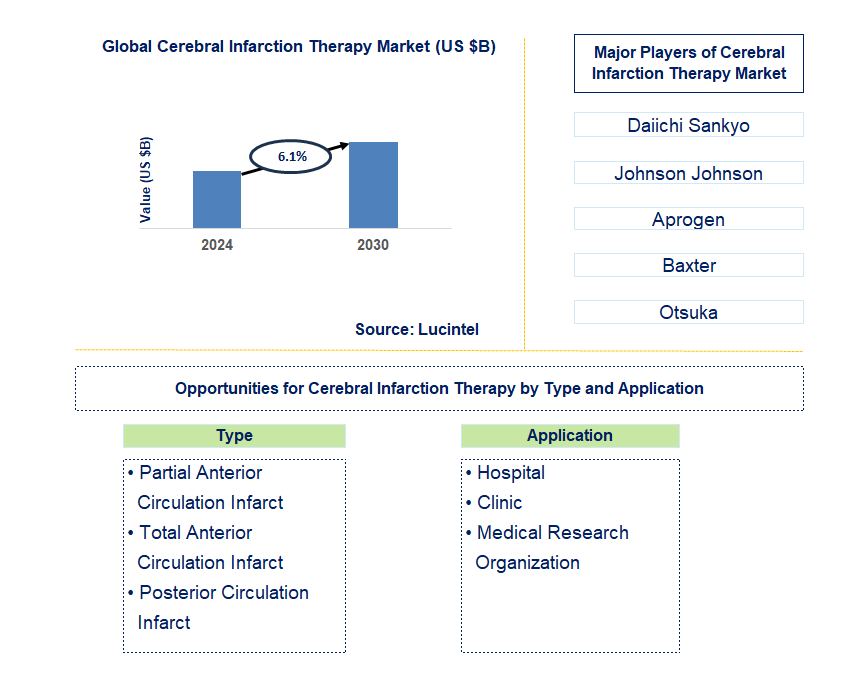
Key data points: The growth forecast = 6.1% annually for the next 6 years. Scroll below to get more insights. This market report covers trends, opportunities, and forecasts in the global cerebral infarction therapy market to 2030 by type (partial anterior circulation infarct, total anterior circulation infarct, and posterior circulation infarct), application (hospital, clinic, and medical research organization), and region (North America, Europe, Asia Pacific, and the Rest of the World)
We'll send your sample report shortly.
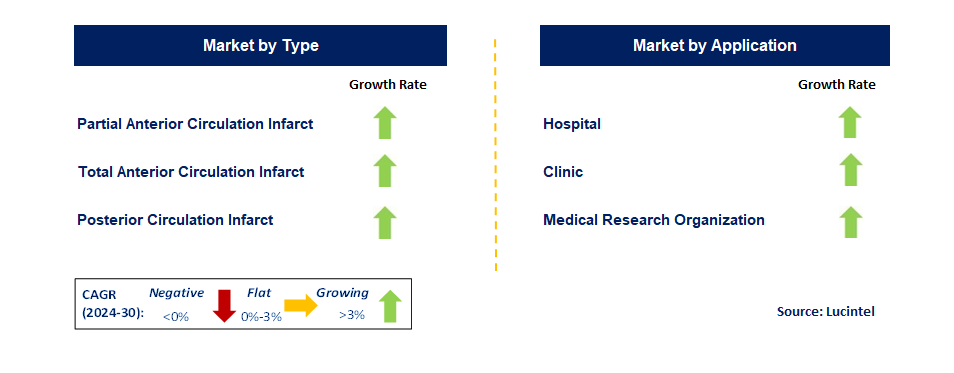
• Lucintel forecasts that, within the type category, the partial anterior circulation infarct is expected to witness the highest growth over the forecast period.
• Within the application category, the hospital is expected to witness the highest growth.
• In terms of region, North America is expected to witness the highest growth over the forecast period. A more than 150-page report is developed to help in your business decisions.
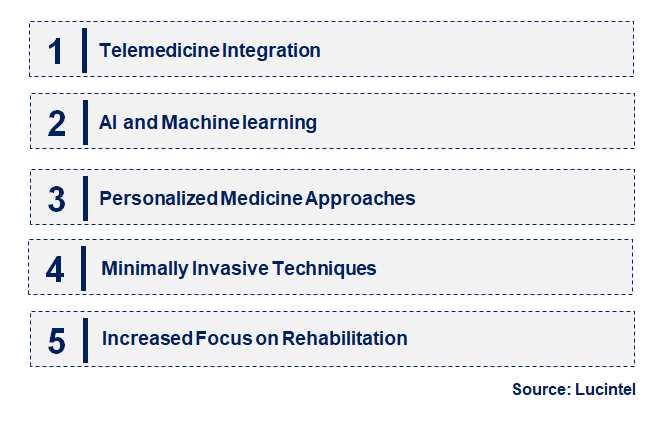
• Telemedicine Integration: The introduction of telemedicine is changing the delivery of stroke care, enabling treatment within an hour after the event, with relatives and doctors consulting online. This trend improves timely access to stroke management and enhances care, particularly in peripheral areas where expert management is difficult to receive.
• AI and Machine Learning: Artificial intelligence and machine learning are transforming the dynamics of diagnosis, especially the detection of strokes and treatment strategies. These technologies help assess conditions more accurately within shorter time frames, improving the consistency of managing patients and enhancing treatment outcomes for cerebral infarctions.
• Personalized Medicine Approaches: Stroke treatment is increasingly becoming individualized, considering genetic information and biological markers. In these cases, the effectiveness and safety of treatments improve as appropriate measures are applied to the right patients.
• Minimally Invasive Techniques: Trends are emerging toward using less invasive methods for treating cerebral infarction. Endovascular thrombectomy is being adopted as a routine practice, reducing recovery time and complications from other procedures, while achieving the benefits of invasive surgery with less risk and fewer side effects.
• Increased Focus on Rehabilitation: A new strategy is emerging that emphasizes not only treatment but also rehabilitation measures after a stroke. There is a growing trend to manage the disease earlier and to use integrated care models to improve recovery, quality of life, and reduce the long-term effects of cerebral infarctions. These trends are changing the dynamics of the cerebral infarction therapy market by expanding treatment options, making them more accessible to patients, and consequently improving the overall health status of those affected by strokes.
• Extension of Thrombectomy Technique: The arrival of novel thrombectomy devices has drastically improved the performance of mechanical thrombectomy in patients with acute ischemic attacks. Patients with large vessel occlusions now have improved chances of successful reperfusion rates and better clinical outcomes due to these advancements.
• Other Newly Developed Compounds: Notably, the development of new neuroprotective agents is aimed at minimizing stroke damage. Their safety and effectiveness are being tested through clinical trials, potentially leading to new treatment tools and improvements in current treatment protocols.
• New Imaging Technology: Today, with the incorporation of MRI and CT perfusion, diagnostic capabilities in stroke treatment have expanded. These methods enhance visualization of brain structures, leading to improved patient outcomes.
• Programs for Increased Awareness: Awareness campaigns aimed at recognizing stroke symptoms and the need for immediate action have started gaining traction. These campaigns are crucial in minimizing treatment waiting times and improving survival and prognosis outcomes for stroke patients.
• Emerging Integrated Care Models: There is increasing interest in integrated care models where intensive treatment is followed by rehabilitation services. This comprehensive approach maximizes treatment effectiveness by providing continuous care and improving the quality of life for stroke patients. Such changes significantly influence the market for treating cerebral ischemia by widening the range of treatment possibilities, promoting better patient outcomes, and nurturing holistic stroke management.
• Telemedicine Solutions: The potential use of telemedicine for diagnosing and treating stroke allows services to be provided from a distance. This integration enables specialist medical attention in hard-to-reach areas, improving outcomes for stroke patients.
• Neuroprotective Therapies: There is a significant opportunity for research, development, and market introduction of neuroprotective therapies aimed at limiting brain damage caused by ischemia. These therapies could fill gaps in current acute care stroke management and enhance rehabilitation success.
• Rehabilitation Technologies: The demand for new and effective rehabilitation technologies, such as robotics and virtual reality, is increasing. These technologies can enhance recovery after a stroke, allowing patients to regain independence more efficiently.
• Advanced Imaging Solutions: There is a lucrative opportunity in developing and implementing advanced imaging solutions to improve characterization, diagnosis, and planning of stroke management. Enhanced imaging will improve evaluations, thereby optimizing procedures and outcomes.
• Education and Training Programs: Increasing education and training programs for healthcare providers on stroke recognition and management present expansion opportunities. These initiatives can improve care quality, shorten the time to treatment initiation, and ultimately enhance patient outcomes. These strategic growth opportunities indicate that the cerebral infarction therapy market is poised for significant growth, fostering innovation in addressing relevant conditions and enhancing stroke care globally.
• Technological Advancements: Continuous improvements in medical equipment designs, including radiologically administered devices, are fueling advancements in cerebral infarction therapy. These innovations enhance the effectiveness of therapies, leading to better patient outcomes and contributing to market growth.
• Aging Population: The increasing number of aging individuals suffering from cerebral infarction is driving the demand for effective therapy. As the population of stroke patients grows, the need for treatment rises correspondingly.
• Improved Healthcare Infrastructure: Better healthcare systems and access to advanced medical facilities are improving stroke management and outcomes. Enhancements in healthcare infrastructure are vital for timely assistance to patients with cerebral infarctions.
• Awareness and Education Initiatives: Heightened public awareness of stroke symptoms and the urgency for immediate action have increased the need for timely intervention. Educational programs effectively reduce the time required to treat patients, which can improve survival rates.
• Regulatory Support: Improved regulatory frameworks that streamline the development and approval of new treatment technologies have spurred innovation. Such processes enable healthcare providers to quickly administer new therapies to patients. Challenges in the cerebral infarction therapy market include:
• High Treatment Costs: Advanced therapies for cerebral infarction can be very expensive, limiting patient access, especially in lower and middle-income countries. Affordability must be addressed for effective treatment opportunities to be widely adopted.
• Limited Appreciation of Treatment in Rural Areas: In rural regions, treatment options are often underappreciated, making it harder for patients to seek care, which can negatively impact outcomes.
• Differences in Access to Care: Communication barriers, language disparities, and other factors can restrict access to care, affecting outcomes. Variations between regions and healthcare systems complicate the uniform management of stroke, which is essential for improving treatment for cerebral infarctions. Overall, these drivers and challenges shape the cerebral infarction therapy market. Stakeholders must identify these factors to develop clear strategies that harness opportunities and mitigate threats, thereby enhancing stroke management and patient outcomes.
• Daiichi Sankyo
• Johnson Johnson
• Aprogen
• Baxter
• Otsuka
• Mitsubishi Chemical Holdings
• Nordmark
• Takeda
• Sanofi
• Bristol-Myers Squibb
• Partial Anterior Circulation Infarct
• Total Anterior Circulation Infarct
• Posterior Circulation Infarct
• Hospital
• Clinic
• Medical Research Organization
• North America
• Europe
• Asia Pacific
• The Rest of the World
• United States: In the US, significant advances have been made in a technique called endovascular thrombectomy for managing acute ischemic strokes, which is now standard practice. Patients experiencing strokes are receiving timely interventions with improved care delivery, as ongoing clinical trials are exploring new neuroprotective treatments, and telemedicine usage is increasing.
• China: China has made substantial progress in treating cerebral infarction, particularly in thrombectomy and thrombolytic treatments. Systematic government investment in healthcare facilities and effective measures aimed at early stroke detection are enhancing patient care, especially in developed areas where such technologies are available.
• Germany: Germany remains at the forefront of research on cerebral infarction, focusing on the use of precision medicine. The accuracy and effectiveness of stroke care are being improved through the application of advanced imaging tools and therapy planning, with clinical recommendations being regularly updated based on new evidence.
• India: In India, the cerebral infarction therapy market is gaining traction with a focus on increasing awareness and access to stroke treatments. Programs for training healthcare providers and developing diagnostic facilities are vital for reducing mortality rates in underserved populations, alongside the promotion of low-cost thrombolytic treatments.
• Japan: Japan is advancing in the treatment of cerebral infarction through the integration of mechanical embolectomy equipment and rehabilitation therapies. The use of advanced technological devices for monitoring patients and providing post-stroke care has recently improved recovery outcomes and the quality of life for stroke patients.


• Daiichi Sankyo
• Johnson Johnson
• Aprogen
• Baxter
• Otsuka
• Mitsubishi Chemical Holdings
• Nordmark
• Takeda
• Sanofi
• Bristol-Myers Squibb Q5. Which cerebral infarction therapy market segment will be the largest in the future? Answer: Lucintel forecasts that partial anterior circulation infarct is expected to witness the highest growth over the forecast period. Q6. In the cerebral infarction therapy market, which region is expected to be the largest in the next 5 years? Answer: North America is expected to witness the highest growth over the forecast period. Q.7 Do we receive customization in this report? Answer: Yes, Lucintel provides 10% customization without any additional cost.


Choose a license that fits your team. Instant PDF delivery.
Prices exclude taxes. Instant delivery. Custom licensing available on request.
Market Report · July 22, 2026
Market Report · July 22, 2026
Market Report · July 22, 2026
Trusted partner for strategic intelligence and business growth


Receive a complimentary market analysis tailored to your industry. Our analysts will identify key growth opportunities and competitive dynamics specific to your business.

Market size, growth rate, and key trend analysis for your specific sector.

Top competitor positioning and market share analysis.

Strategic recommendations backed by data-driven insights.
Get curated market intelligence and competitive moves straight to your inbox.
By subscribing, you agree to receive our monthly insights. Unsubscribe anytime.
Receive a complimentary market analysis tailored to your industry. Our analysts will identify key growth opportunities and competitive dynamics specific to your business.
Market size, growth rate, and key trend analysis for your specific sector.
Top competitor positioning and market share analysis.
Strategic recommendations backed by data-driven insights.
Get curated market intelligence, emerging trends, and competitive moves straight to your inbox each month.
By subscribing, you agree to receive our monthly insights. Unsubscribe anytime.
We'll send your sample report shortly.