
Report Feature
Ceramic Tableware Digital Printing Market Trends and Forecast
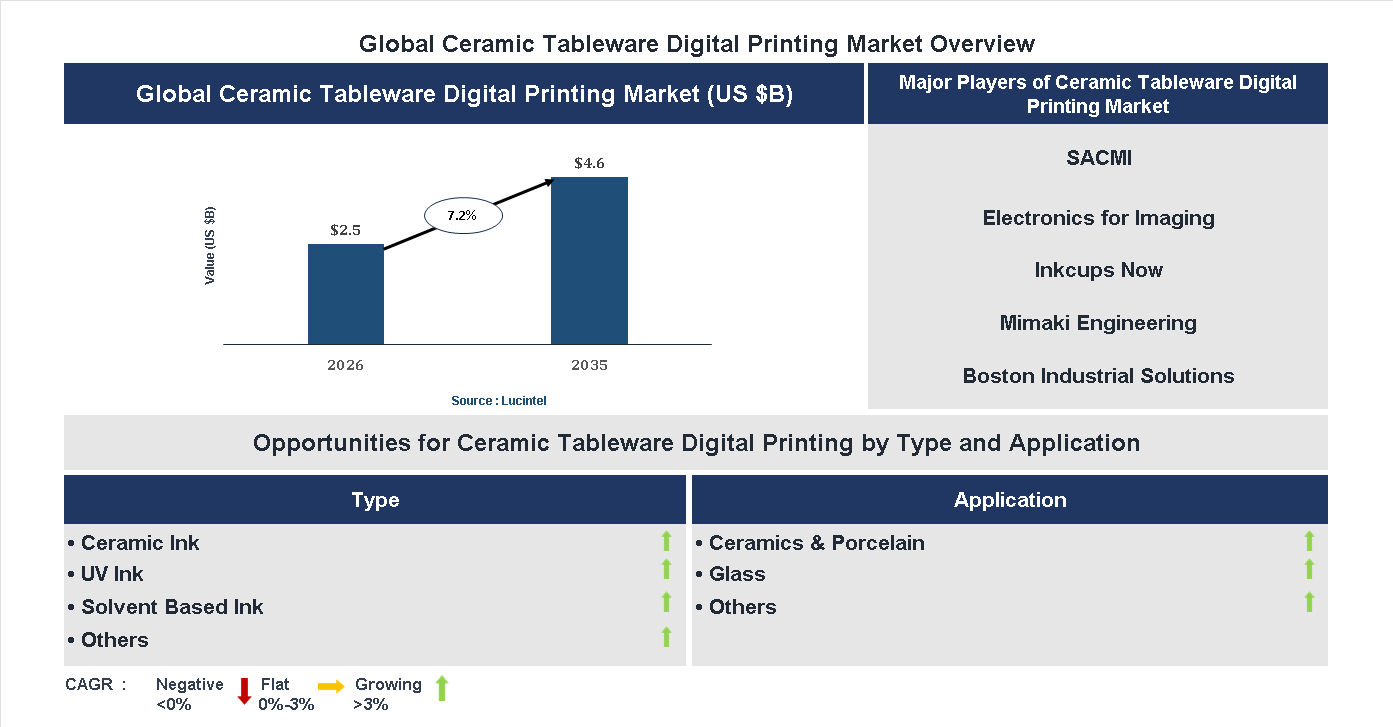
The future of the global ceramic tableware digital printing market looks promising with opportunities in the ceramics & porcelain and glass markets. The global ceramic tableware digital printing market is expected to reach an estimated $4.6 billion by 2035 with a CAGR of 7.2% from 2026 to 2035. The major drivers for this market are the increasing demand for customized tableware designs, the rising popularity of sustainable ceramic materials, and the growing consumer interest in unique home decor.• Lucintel forecasts that, within the type category, ceramic ink is expected to witness the highest growth over the forecast period.
• Within the application category, ceramics & porcelain is expected to witness higher growth.
• In terms of region, APAC is expected to witness the highest growth over the forecast period. Gain valuable insights for your business decisions with our comprehensive 150+ page report. Sample figures with some insights are shown below.
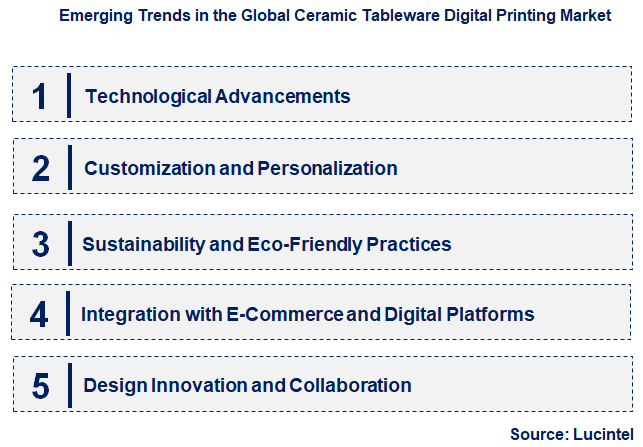
Emerging Trends in the Ceramic Tableware Digital Printing Market
The ceramic tableware digital printing market is experiencing rapid growth driven by technological advancements, changing consumer preferences, and increasing demand for personalized and innovative designs. As brands seek to differentiate their products and meet the rising expectations for customization, digital printing technology offers a versatile and efficient solution. This market is also influenced by sustainability trends, with eco-friendly inks and processes gaining popularity. Additionally, the integration of digital printing with other manufacturing techniques is expanding design possibilities. These developments are transforming traditional ceramic manufacturing, making products more appealing, sustainable, and tailored to consumer needs, thereby reshaping the competitive landscape.• Technological Advancements: The adoption of high-resolution digital printing technology allows for intricate, vibrant, and customizable designs on ceramic surfaces. This innovation reduces production time and costs while enabling on-demand printing, which appeals to both manufacturers and consumers. As technology continues to evolve, the ability to print complex patterns and images with precision is expanding, opening new avenues for creative expression and product differentiation. This trend enhances the aesthetic appeal of ceramic tableware and supports small-batch and personalized production, ultimately driving market growth and diversification.
• Customization and Personalization: Consumers increasingly seek unique, personalized tableware that reflects their individual style and preferences. Digital printing facilitates easy customization, allowing brands to offer bespoke designs, monograms, or themed patterns efficiently. This trend is particularly prominent in the gift and hospitality sectors, where personalized items add value and emotional appeal. The ability to produce limited editions or one-off designs without significant cost increases is transforming the market, fostering customer loyalty and opening new revenue streams for manufacturers. Customization is thus a key driver of innovation and market expansion.
• Sustainability and Eco-Friendly Practices: The market is witnessing a shift towards environmentally sustainable printing processes, including the use of water-based, biodegradable, and non-toxic inks. Digital printing reduces waste by enabling precise application and minimizing excess production. Additionally, eco-conscious consumers are increasingly demanding sustainable products, prompting manufacturers to adopt greener practices. This trend not only aligns with global sustainability goals but also enhances brand reputation and market competitiveness. The integration of sustainable materials and processes is expected to become a standard practice, influencing product development and supply chain strategies.
• Integration with E-Commerce and Digital Platforms: The rise of online retail channels has accelerated the demand for digitally printed ceramic tableware. E-commerce platforms enable consumers to customize and order products directly, fostering a seamless shopping experience. Digital printing technology supports this trend by allowing rapid production of personalized items in small quantities, reducing lead times. This integration also facilitates data-driven design customization and direct-to-consumer marketing, expanding market reach. As digital platforms become more sophisticated, they will further influence design trends and consumer engagement, making digital printing a critical component of the online ceramic market.
• Design Innovation and Collaboration: The ability to print complex, multi-layered, and photorealistic images is fostering new design possibilities. Collaborations between artists, designers, and brands are leveraging digital printing to create limited-edition collections and innovative patterns. This trend encourages creative experimentation and cultural expression, appealing to a broader audience. It also enables brands to stay ahead of trends by quickly adapting designs based on consumer feedback and market demands. The fusion of art and technology through digital printing is thus driving product differentiation and elevating the aesthetic value of ceramic tableware. In summary, these emerging trends are fundamentally reshaping the ceramic tableware digital printing market by enhancing customization, sustainability, technological capabilities, and consumer engagement. They are fostering innovation, expanding market opportunities, and redefining the competitive landscape, ultimately leading to a more dynamic and consumer-centric industry.
Recent Development in the Ceramic Tableware Digital Printing Market
The ceramic tableware digital printing market is experiencing rapid growth driven by technological advancements and changing consumer preferences. Innovations in digital printing techniques are enabling manufacturers to produce highly customized and intricate designs efficiently. The increasing demand for personalized tableware in the hospitality and retail sectors is fueling market expansion. Additionally, sustainability concerns are prompting the adoption of eco-friendly printing methods. Market players are investing in R&D to enhance print quality and durability, positioning the industry for significant future growth. These developments are reshaping the competitive landscape and opening new opportunities for innovation.• Growth in Customization Opportunities: The rise of digital printing allows for highly personalized ceramic tableware, catering to individual consumer preferences and corporate branding. This flexibility enhances product appeal and enables brands to differentiate themselves in a competitive market. Customization also supports small batch production, reducing waste and inventory costs. As consumers seek unique, personalized items, manufacturers are increasingly adopting digital printing to meet these demands, thereby expanding market share and driving revenue growth.
• Innovation in Printing Technologies: Advances in digital printing technology, such as UV and inkjet printing, have improved print quality, color vibrancy, and durability on ceramic surfaces. These innovations enable detailed, high-resolution designs that withstand washing and usage. The integration of automation and new ink formulations reduces production time and costs, making high-quality printing accessible to a broader range of manufacturers. This technological progress enhances product value, broadens application possibilities, and accelerates market growth.
• Increasing Adoption in Hospitality Sector: The hospitality industry is increasingly utilizing digitally printed ceramic tableware for its aesthetic appeal and customization options. Hotels, restaurants, and catering services prefer unique, branded tableware to enhance guest experience and brand identity. Digital printing offers quick turnaround times and cost-effective solutions for large orders. This trend boosts demand for innovative designs and sustainable printing methods, significantly contributing to market expansion and creating new revenue streams for manufacturers.
• Eco-Friendly and Sustainable Printing Solutions: Growing environmental concerns are driving the adoption of eco-friendly digital printing methods, such as water-based inks and energy-efficient processes. These sustainable practices reduce chemical waste and carbon footprint, aligning with global sustainability goals. Manufacturers investing in green technologies are gaining a competitive advantage and appealing to environmentally conscious consumers. The shift towards sustainable printing not only enhances brand reputation but also opens new market segments focused on eco-friendly products, fostering long-term industry growth.
• Expansion of Market Reach and E-Commerce: The proliferation of online retail platforms and digital marketing has expanded the market reach for ceramic tableware with digital prints. Consumers increasingly purchase customized and designer tableware online, prompting manufacturers to develop direct-to-consumer channels. E-commerce facilitates rapid order fulfillment and broadens geographic access, accelerating sales growth. This digital shift enables brands to engage with niche markets and offer personalized options at scale, significantly impacting overall market dynamics and fostering global industry expansion. These developments are transforming the ceramic tableware digital printing market by enhancing customization, technological innovation, sustainability, and market accessibility. The integration of advanced printing techniques and eco-friendly solutions is elevating product quality and appeal. The hospitality sectors adoption and e-commerce expansion are broadening market reach and driving revenue growth. Collectively, these opportunities are fostering a competitive, innovative environment that promises sustained growth and diversification in the industry.
Strategic Growth Opportunities in the Ceramic Tableware Digital Printing Market
The ceramic tableware digital printing market is experiencing rapid expansion driven by technological advancements, consumer demand for customization, and the growing hospitality industry. Innovations in printing techniques and materials are enabling manufacturers to offer more personalized and high-quality products. Additionally, increasing environmental awareness and sustainability initiatives are influencing market growth. This dynamic landscape presents numerous opportunities for industry players to capitalize on emerging trends, expand their product portfolios, and enhance customer engagement through innovative digital printing solutions.• Customization and Personalization Opportunities: The demand for personalized ceramic tableware is rising as consumers seek unique, customized designs for special occasions, gifting, and branding. Digital printing enables high-resolution, intricate patterns on demand, reducing lead times and inventory costs. Manufacturers can leverage this trend to offer tailored products, increase customer satisfaction, and differentiate themselves in a competitive market. The ability to produce small batches cost-effectively makes customization a key growth driver.
• Expansion into the Hospitality and Foodservice Sectors: The hospitality industry, including hotels, restaurants, and catering services, increasingly adopts digital printing for branding and decor. Customized tableware enhances guest experiences and reinforces brand identity. Digital printing allows quick updates of designs for seasonal menus or events, providing flexibility and cost efficiency. As these sectors grow globally, the demand for innovative, visually appealing ceramic tableware with digital prints is expected to surge, creating significant market opportunities.
• Adoption of Eco-Friendly and Sustainable Printing Technologies: Environmental concerns are prompting manufacturers to develop sustainable digital printing solutions using eco-friendly inks and recyclable materials. These innovations reduce chemical waste and energy consumption, aligning with global sustainability goals. The market for green digital printing technologies is expanding as consumers and businesses prioritize environmentally responsible products. This shift not only enhances brand reputation but also opens new avenues for market growth and compliance with evolving regulations.
• Integration of Advanced Printing Technologies for Higher Quality: The adoption of cutting-edge digital printing technologies, such as UV, ceramic, and inkjet printing, enhances print quality, durability, and design complexity. These advancements enable the production of highly detailed, vibrant, and long-lasting designs on ceramic surfaces. Manufacturers investing in these technologies can meet increasing customer expectations for premium, visually striking products. The continuous evolution of printing equipment and techniques is expected to further boost market competitiveness and product innovation.
• Growing Demand for Artistic and Limited-Edition Collections: Consumers are increasingly interested in artistic, limited-edition, and designer ceramic tableware. Digital printing facilitates the creation of intricate, one-of-a-kind designs that appeal to collectors and enthusiasts. This trend encourages collaborations with artists and designers, fostering innovation and exclusivity. The ability to produce small runs with high detail and quality positions digital printing as a key enabler of artistic expression, driving demand for unique collections and expanding market segments. The overall impact of these growth opportunities is set to significantly enhance market size, diversify product offerings, and foster innovation within the ceramic tableware digital printing industry. Companies that effectively leverage these trends can strengthen their market position, meet evolving consumer preferences, and achieve sustainable growth in a competitive landscape.
Ceramic Tableware Digital Printing Market Driver and Challenges
The ceramic tableware digital printing market is influenced by a variety of technological, economic, and regulatory factors. Advances in digital printing technology have revolutionized customization and design capabilities, enabling manufacturers to produce intricate patterns efficiently. Economic growth in emerging markets boosts demand for premium and personalized tableware, while regulatory standards concerning environmental sustainability and safety influence manufacturing processes. Additionally, consumer preferences are shifting towards unique, eco-friendly, and innovative products, further shaping market dynamics. These drivers and challenges collectively determine the growth trajectory, competitiveness, and innovation within the market, requiring stakeholders to adapt swiftly to technological advancements, regulatory changes, and evolving consumer trends. The factors responsible for driving the ceramic tableware digital printing market include:• Technological Innovation: The rapid development of digital printing technology allows for high-resolution, customizable, and cost-effective designs on ceramic surfaces. This innovation enables manufacturers to meet increasing consumer demand for personalized and unique tableware, reducing lead times and production costs. As digital printers become more sophisticated, they facilitate complex patterns and vibrant colors, expanding creative possibilities. The ability to produce small batches economically also supports niche markets and bespoke products, fueling overall market growth.
• Rising Consumer Preference for Customization: Consumers increasingly seek personalized and unique tableware to reflect individual tastes and lifestyles. Digital printing offers the flexibility to create customized designs, logos, and artwork efficiently, catering to both retail and hospitality sectors. This trend is driven by the desire for distinctive tableware for special occasions, gifting, and branding purposes. As a result, manufacturers are investing in digital printing solutions to meet this demand, which significantly boosts market expansion.
• Growth of E-commerce and Retail Channels: The proliferation of online retail platforms has expanded access to a broader customer base seeking customized ceramic tableware. E-commerce enables direct-to-consumer sales, allowing brands to showcase a wide array of designs and personalization options. This digital shift encourages manufacturers to adopt digital printing technologies to offer on-demand, personalized products, thereby increasing sales volumes and market reach. The convenience and variety offered online are key factors propelling market growth.
• Environmental Sustainability Initiatives: Increasing regulatory pressure and consumer awareness about environmental impact are driving the adoption of eco-friendly manufacturing practices. Digital printing reduces waste by enabling on-demand production and minimizing excess inventory. Additionally, the use of water-based inks and sustainable materials aligns with environmental standards, appealing to eco-conscious consumers. Manufacturers investing in sustainable digital printing solutions can enhance brand reputation and comply with evolving regulations, fostering long-term market stability.
• Expansion in Hospitality and Catering Sectors: The hospitality industry’s demand for aesthetically appealing, durable, and customizable tableware is a significant growth driver. Digital printing allows hotels, restaurants, and catering services to create branded, themed, or seasonal tableware efficiently. This customization enhances customer experience and brand visibility. As the hospitality sector continues to grow globally, the need for innovative and personalized ceramic tableware increases, further propelling the market. The challenges facing this ceramic tableware digital printing market include:
• High Initial Investment and Operational Costs: Implementing digital printing technology requires substantial capital expenditure on advanced equipment and training. Small and medium-sized manufacturers may find these costs prohibitive, limiting market entry and expansion. Additionally, ongoing maintenance and ink costs can impact profit margins. This financial barrier restricts widespread adoption, especially in regions with limited access to capital, thereby impeding overall market growth.
• Regulatory and Safety Standards: Stringent regulations concerning the use of certain inks, chemicals, and materials in ceramic printing pose compliance challenges. Manufacturers must ensure their products meet safety standards related to food contact, environmental impact, and worker safety. Navigating these complex regulatory landscapes can delay product launches and increase costs. Non-compliance risks legal penalties and damage to brand reputation, creating a significant hurdle for market players.
• Market Fragmentation and Competition: The market is highly fragmented with numerous small and regional players competing alongside established brands. This intense competition leads to price wars, reduced profit margins, and innovation pressures. Additionally, rapid technological changes require continuous investment in R&D, which can strain resources. Market fragmentation also complicates branding and customer loyalty efforts, making it challenging for new entrants to establish a foothold and for existing players to sustain growth. In summary, the ceramic tableware digital printing market is shaped by technological advancements, consumer preferences, and sustainability initiatives, which collectively drive growth. However, high investment costs, regulatory hurdles, and intense competition pose significant challenges. The interplay of these factors influences market dynamics, requiring stakeholders to innovate, adapt, and invest strategically. Overall, the market’s future depends on balancing technological progress with regulatory compliance and competitive positioning, ensuring sustainable growth and innovation.
List of Ceramic Tableware Digital Printing Companies
Companies in the market compete on the basis of product quality offered. Major players in this market focus on expanding their manufacturing facilities, R&D investments, infrastructural development, and leverage integration opportunities across the value chain. With these strategies ceramic tableware digital printing companies cater increasing demand, ensure competitive effectiveness, develop innovative products & technologies, reduce production costs, and expand their customer base. Some of the ceramic tableware digital printing companies profiled in this report include-• SACMI
• Electronics for Imaging
• Inkcups Now
• Mimaki Engineering
• Boston Industrial Solutions
• PROJECTA ENGINEERING
• Engineered Printing Solutions
• INX International Ink
• Kerajet
• Dip-Tech
Ceramic Tableware Digital Printing Market by Segment
The study includes a forecast for the global ceramic tableware digital printing market by type, application, and region.Ceramic Tableware Digital Printing Market by Type [Value from 2019 to 2035]:
• Ceramic Ink
• UV Ink
• Solvent Based Ink
• Others
Ceramic Tableware Digital Printing Market by Application [Value from 2019 to 2035]:
• Ceramics & Porcelain
• Glass
• Others
Ceramic Tableware Digital Printing Market by Region [Value from 2019 to 2035]:
• North America
• Europe
• Asia Pacific
• The Rest of the World
Country Wise Outlook for the Ceramic Tableware Digital Printing Market
The ceramic tableware digital printing market has experienced significant growth driven by technological advancements, increasing consumer demand for personalized products, and expanding e-commerce channels. Countries are adopting innovative printing techniques to enhance design quality and production efficiency. Sustainability concerns are also influencing market trends, prompting the adoption of eco-friendly inks and materials. The markets evolution reflects a shift towards customization, rapid production, and digital integration, making it a competitive landscape globally. Key players are investing in R&D to develop new printing solutions, while regional markets are witnessing varying degrees of adoption based on technological infrastructure and consumer preferences.• United States: The U.S. market has seen rapid adoption of digital printing technologies, driven by high consumer demand for personalized and unique ceramic tableware. Major companies are investing in advanced ink formulations and printing equipment to improve design quality and durability. E-commerce platforms have facilitated wider distribution, boosting sales. Sustainability initiatives are gaining traction, with brands adopting eco-friendly inks and recyclable materials. The U.S. government’s focus on innovation and manufacturing modernization further supports market growth, making it a leader in digital ceramic printing advancements.
• China: China remains the largest market for ceramic tableware digital printing, fueled by a booming domestic consumer base and export growth. Local manufacturers are rapidly adopting digital printing to meet the rising demand for customized products. Technological innovations, including high-speed printing and multi-color capabilities, are enhancing production efficiency. The government’s support for manufacturing upgrades and sustainable practices is encouraging eco-friendly ink use. Additionally, the rise of online retail channels has expanded market reach. China’s competitive pricing and large-scale production capabilities position it as a dominant player in the global market.
• Germany: Germany’s market is characterized by a focus on high-quality, artisanal ceramic products with digital printing as a means to enhance design intricacy. The country’s emphasis on sustainability has led to increased adoption of environmentally friendly inks and processes. German manufacturers are integrating digital printing with traditional craftsmanship to create premium, customized tableware. Innovation in printing technology, such as UV-curable inks and precise color matching, is prominent. The strong presence of design-focused brands and a robust export sector support steady market growth, with a particular emphasis on eco-conscious and luxury segments.
• India: The Indian ceramic tableware digital printing market is experiencing rapid growth due to rising disposable incomes and a growing middle class seeking personalized and aesthetically appealing products. Local manufacturers are investing in affordable digital printing solutions to cater to domestic demand. The expansion of online retail and organized retail outlets is facilitating wider access to customized ceramic products. Additionally, the government’s initiatives to promote manufacturing and export are encouraging technological upgrades. The market is also witnessing a shift towards sustainable practices, with increased adoption of eco-friendly inks and materials to meet global standards.
• Japan: Japan’s market is characterized by a focus on innovation, quality, and sustainability. Japanese manufacturers are adopting advanced digital printing techniques to produce highly detailed and durable designs. The emphasis on eco-friendly inks and sustainable production methods aligns with the country’s environmental policies. The market benefits from a strong domestic demand for premium, artistically designed ceramic tableware, as well as export opportunities. Technological integration, such as automation and smart printing systems, is enhancing efficiency. Overall, Japan’s market is driven by a combination of tradition and innovation, maintaining its position as a leader in high-quality ceramic printing solutions.

Features of the Global Ceramic Tableware Digital Printing Market
Market Size Estimates: Ceramic tableware digital printing market size estimation in terms of value ($B). Trend and Forecast Analysis: Market trends (2019 to 2025) and forecast (2026 to 2035) by various segments and regions. Segmentation Analysis: Ceramic tableware digital printing market size by type, application, and region in terms of value ($B). Regional Analysis: Ceramic tableware digital printing market breakdown by North America, Europe, Asia Pacific, and Rest of the World. Growth Opportunities: Analysis of growth opportunities in different types, applications, and regions for the ceramic tableware digital printing market. Strategic Analysis: This includes M&A, new product development, and competitive landscape of the ceramic tableware digital printing market. Analysis of competitive intensity of the industry based on Porter’s Five Forces model.
FAQ
Q1. What is the ceramic tableware digital printing market size? Answer: The global ceramic tableware digital printing market is expected to reach an estimated $4.6 billion by 2035. Q2. What is the growth forecast for ceramic tableware digital printing market? Answer: The global ceramic tableware digital printing market is expected to grow with a CAGR of 7.2% from 2026 to 2035. Q3. What are the major drivers influencing the growth of the ceramic tableware digital printing market? Answer: The major drivers for this market are the increasing demand for customized tableware designs, the rising popularity of sustainable ceramic materials, and the growing consumer interest in unique home decor. Q4. What are the major segments for ceramic tableware digital printing market? Answer: The future of the ceramic tableware digital printing market looks promising with opportunities in the ceramics & porcelain and glass markets. Q5. Who are the key ceramic tableware digital printing market companies? Answer: Some of the key ceramic tableware digital printing companies are as follows:• SACMI
• Electronics for Imaging
• Inkcups Now
• Mimaki Engineering
• Boston Industrial Solutions
• PROJECTA ENGINEERING
• Engineered Printing Solutions
• INX International Ink
• Kerajet
• Dip-Tech Q6. Which ceramic tableware digital printing market segment will be the largest in future? Answer: Lucintel forecasts that, within the type category, ceramic ink is expected to witness the highest growth over the forecast period. Q7. In ceramic tableware digital printing market, which region is expected to be the largest in next 5 years? Answer: In terms of region, APAC is expected to witness the highest growth over the forecast period. Q8. Do we receive customization in this report? Answer: Yes, Lucintel provides 10% customization without any additional cost.
Table of Contents
List of Figures
List of Tables
Methodology
- In-depth interviews of the major players in this market
- Detailed secondary research from competitors’ financial statements and published data
- Extensive searches of published works, market, and database information pertaining to industry news, company press releases, and customer intentions
- A compilation of the experiences, judgments, and insights of Lucintel’s professionals, who have analyzed and tracked this market over the years.


Buy Now
Choose a license that fits your team. Instant PDF delivery.
Prices exclude taxes. Instant delivery. Custom licensing available on request.
Key Questions
- • What are some of the most promising, high-growth opportunities for the ceramic tableware digital printing market by type (ceramic ink, UV ink, solvent based ink, and others), application (ceramics & porcelain, glass, and others), and region (North America, Europe, Asia Pacific, and the Rest of the World)?
- • Which segments will grow at a faster pace and why?
- • Which region will grow at a faster pace and why?
- • What are the key factors affecting market dynamics? What are the key challenges and business risks in this market?
- • What are the business risks and competitive threats in this market?
- • What are the emerging trends in this market and the reasons behind them?
- • What are some of the changing demands of customers in the market?
- • What are the new developments in the market? Which companies are leading these developments?
- • Who are the major players in this market? What strategic initiatives are key players pursuing for business growth?
- • What are some of the competing products in this market and how big of a threat do they pose for loss of market share by material or product substitution?
- • What M&A activity has occurred in the last 7 years and what has its impact been on the industry? For any questions related to Ceramic Tableware Digital Printing Market, Ceramic Tableware Digital Printing Market Size, Ceramic Tableware Digital Printing Market Growth, Ceramic Tableware Digital Printing Market Analysis, Ceramic Tableware Digital Printing Market Report, Ceramic Tableware Digital Printing Market Share, Ceramic Tableware Digital Printing Market Trends, Ceramic Tableware Digital Printing Market Forecast, Ceramic Tableware Digital Printing Companies, write Lucintel analyst at email: helpdesk@lucintel.com. We will be glad to get back to you soon.


