
Market Report · May 18, 2026

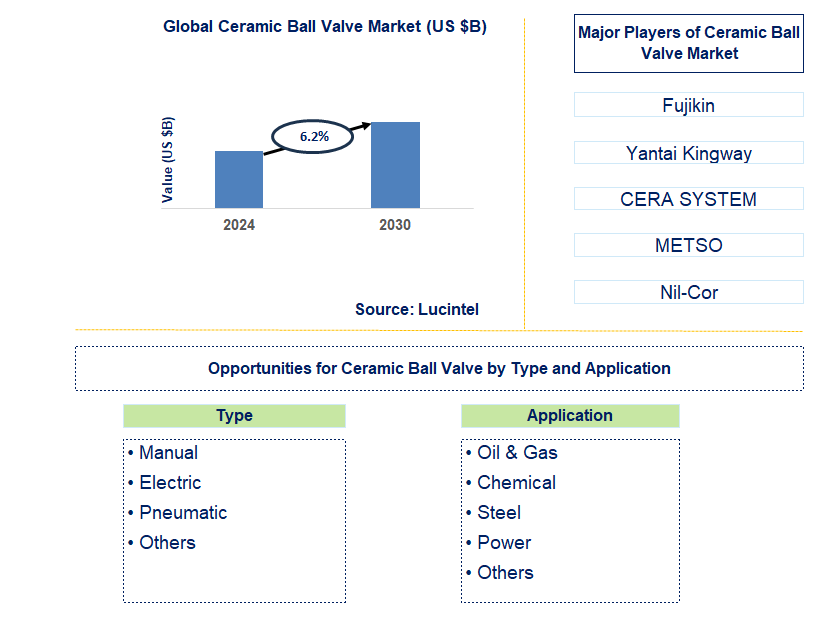
Key data points: The growth forecast = 6.2% annually for the next 6 years. Scroll below to get more insights. This market report covers trends, opportunities, and forecasts in the global ceramic ball valve market to 2030 by type (manual, electric, pneumatic, and others), application (oil & gas, chemical, steel, power, and others), and region (North America, Europe, Asia Pacific, and the Rest of the World)
We'll send your sample report shortly.
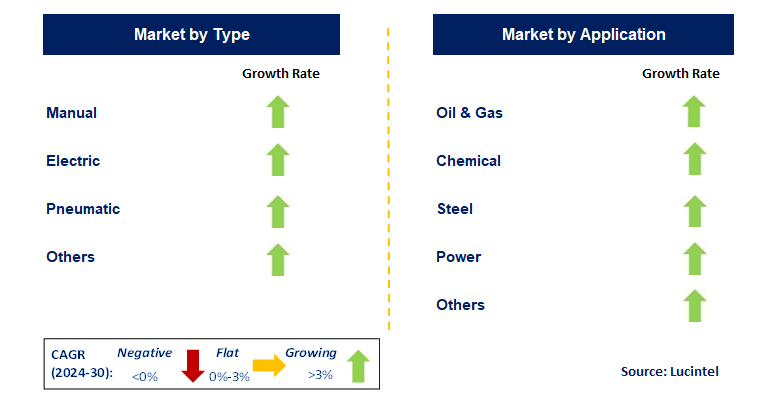
• Lucintel forecasts that, within the type category, electric segment is expected to witness the highest growth over the forecast period due to automation and advanced control capabilities.
• Within the application category, oil & gas segment will remain the largest segment due to industry demand.
• In terms of regions, APAC is expected to witness the highest growth over the forecast period due to industrial growth and infrastructure development. A more than 150-page report is developed to help in your business decisions.
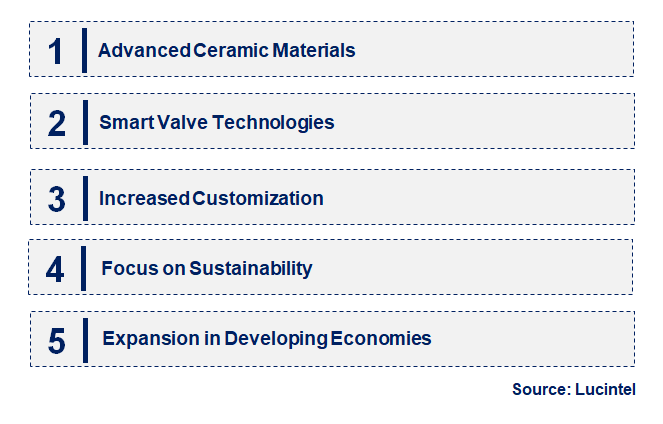
• Advanced Ceramic Materials: New high-performance ceramic materials are improving the durability and efficiency of ceramic ball valves. These materials are more resistant to damage compared to standard ceramics, offering enhanced resistance to heat, corrosion, and wear.
• Smart Valve Technologies: The integration of smart technologies, such as sensors and IoT capabilities, is on the rise. These technologies enable real-time monitoring and control of valve performance, increasing efficiency and minimizing the need for frequent maintenance interventions.
• Increased Customization: The trend toward greater customization allows ceramic ball valves to be tailored to specific applications. This includes altering valve dimensions and incorporating performance features to meet the unique needs of different industries.
• Focus on Sustainability: Sustainability is becoming a priority in the ceramic ball valve industry. This includes minimizing waste and improving energy efficiency in the manufacturing process. The push for greener solutions is influencing how valves are designed and produced.
• Expansion in Developing Economies: The biggest growth in ceramic ball valve demand is seen in Asian markets, driven by industrial development and construction. These regions are seeking affordable, high-quality valve solutions to meet their growing needs. The emerging trends in the ceramic ball valve market reflect a shift toward enhanced materials, the integration of smart technologies, greater customization, sustainability practices, and a growing market presence in developing economies. These trends are transforming the market by improving product performance, operational efficiency, and environmental sustainability.
• Introduction of High-Durability Materials: New high-durability ceramic materials are being introduced, offering superior resistance to corrosion and wear. This extends the lifespan of ceramic ball valves and enhances their reliability in challenging environments.
• Advancements in Manufacturing Techniques: Innovations in manufacturing processes are improving the precision and efficiency of ceramic ball valve production. These advancements help reduce costs while increasing the quality of the final product.
• Integration of Smart Technologies: The adoption of smart technologies, including sensors and IoT integration, is increasing. These technologies allow for real-time monitoring, improved performance, and predictive maintenance capabilities.
• Expansion into New Applications: Ceramic ball valves are gaining traction in new applications, such as chemical processing and water treatment, due to their exceptional performance in demanding environments.
• Focus on Environmental Sustainability: There is a growing emphasis on adopting environmentally sustainable practices in the ceramic ball valve market. Manufacturers are incorporating eco-friendly materials and production methods to reduce the environmental impact of their products. These recent developments in the ceramic ball valve market are driving improvements in valve performance, manufacturing efficiency, cost-effectiveness, and environmental sustainability.
• Increasing Application in Chemical Processing: The application of ceramic ball valves in chemical processing is increasing due to their resistance to harsh chemicals. There is an opportunity to design valves with enhanced corrosion resistance and durability to meet the specific needs of this industry.
• Gaining Traction in Water Treatment: Ceramic ball valves are increasingly being used in water treatment plants due to their reliability and performance. Growth opportunities lie in developing generic valves suitable for all stages of the water treatment process, improving their effectiveness.
• Developments in Power Generation: The power generation industry presents opportunities for ceramic ball valves designed to withstand high temperatures and pressures. There is a market for valves that can handle extreme conditions, offering durability and reliability in power plants.
• Market Potential in the Automotive Industry: The automotive industry is increasingly using ceramic ball valves in engine parts, focusing on performance and reliability. This offers an opportunity to customize valves for the automotive market, driving growth in this sector.
• Concentration on Sustainable Solutions: Green ceramic ball valves designed with eco-friendly materials and manufacturing processes represent a significant growth opportunity. Manufacturers can cater to environmentally conscious industries by creating sustainable products with longer lifespans and lower maintenance requirements. These growth opportunities in the ceramic ball valve market include expanding applications in chemical processing, water treatment, power generation, and automotive industries, as well as focusing on sustainable solutions. These strategies are driving innovation and market expansion while promoting eco-friendly practices.
• Technological advancements: The status of the thermal ceramic ball valve market is dominated by the positive impacts of innovation in ceramic materials and ceramic fabrication technologies. Features like high resistance and prolonged durability are attracting numerous industries towards the concept of ceramic ball valves.
• Increasing industrial demand: Market expansion is being fueled by the rising need for high quality valves for industrial use in chemical processing, water treatment and power generation. In harsh operational environments, ceramic ball valves are superior because of their high performance.
• Focus on Durability and Reliability: The above demand on durability and reliability is a major concern on so many drivers in the valve solutions. Ceramic ball valves are long-term efficient and have less servicing compared to other types of valves, enabling industries with tough processes.
• Expansion of Applications: The growth of the market is also attributed to the increasing applications of ceramic ball valves in different sectors. The growing demand in new applications and industries utilizing ceramic valves due to the demanded performance is overwhelming.
• Environmental Regulations: Due to the environmental responsibility of the industries, they are being compelled these days to incorporate solutions which are more sustainable and less harmful. This is why the use of ceramic ball valves in housing being practices is appropriate as it utilize longer life span and less maintenance. Challenges in the ceramic ball valve market are:
• High Initial Costs: The high cost of ceramic ball valves is a challenge for industries with cost constraints. The upfront investment required for ceramic valves may deter some
• businesses from adopting them, especially in cost-sensitive markets.
• Complex Manufacturing Processes: The manufacturing process for ceramic ball valves involves complex steps, which can impact production efficiency and costs. Streamlining these processes without compromising quality is a key challenge for manufacturers.
• Market Competition: The competitive nature of the valve market, with many companies vying for market share, puts pressure on pricing and product differentiation. Companies must innovate to stay ahead of competitors.
• Limited Awareness in Emerging Markets: Lack of awareness of the benefits of ceramic ball valves in emerging markets can limit their adoption. Educating potential clients and demonstrating the advantages of these valves is crucial for market expansion.
• Technological Integration Issues: Integrating new technologies into existing systems can be challenging, especially when improving the design of ceramic ball valves. Manufacturers must develop solutions that seamlessly integrate with other technologies. Overall, the ceramic ball valve market is driven by technological advancements, increasing industrial demand, a focus on durability, expanding applications, and environmental policies. However, challenges such as high initial costs, complex manufacturing, market competition, limited awareness in emerging markets, and technological integration must be addressed to fully capitalize on market growth.
• Fujikin
• Yantai Kingway
• CERA SYSTEM
• METSO
• Nil-Cor
• Shengkai Industry
• Huagong Valve
• Dingchuang
• Shanggao Valve
• Neeinn
• Manual
• Electric
• Pneumatic
• Others
• Oil & Gas
• Chemical
• Steel
• Power
• Others
• North America
• Europe
• Asia Pacific
• The Rest of the World
• United States: The U.S. market is adopting advanced ceramic ball valves with improved durability and longer service life. High-performance synthetic materials are now being used to enhance the lifespan of valves in demanding industrial sectors.
• China: China focuses on increasing output and making ceramic ball valves more affordable. Innovations in manufacturing techniques and cost-effective ceramic materials are driving both domestic and export demand.
• Germany: Germany is leading in technological advancements for ceramic ball valves, using precise engineering and superior quality components. The integration of smart devices for remote monitoring and management is enhancing operational efficiency.
• India: In India, industries such as chemical processing and water treatment are adopting ceramic ball valves. Growing trends include developing flexible designs to meet specific local operational needs and expand the range of applications.
• Japan: Japan is at the forefront of developing advanced ceramic ball valves designed for high-temperature, high-pressure environments. Recent innovations focus on improving valve robustness for use in power generation and automotive applications.


• Fujikin
• Yantai Kingway
• CERA SYSTEM
• METSO
• Nil-Cor
• Shengkai Industry
• Huagong Valve
• Dingchuang
• Shanggao Valve
• Neeinn Q5. Which ceramic ball valve market segment will be the largest in future? Answer: Lucintel forecasts that electric segment is expected to witness the highest growth over the forecast period due to automation and advanced control capabilities. Q6. In ceramic ball valve market, which region is expected to be the largest in next 5 years? Answer: APAC is expected to witness the highest growth over the forecast period due to industrial growth and infrastructure development. Q.7 Do we receive customization in this report? Answer: Yes, Lucintel provides 10% customization without any additional cost.


Choose a license that fits your team. Instant PDF delivery.
Prices exclude taxes. Instant delivery. Custom licensing available on request.
Market Report · May 18, 2026
Market Report · May 18, 2026
Market Report · March 24, 2026
Trusted partner for strategic intelligence and business growth


Receive a complimentary market analysis tailored to your industry. Our analysts will identify key growth opportunities and competitive dynamics specific to your business.

Market size, growth rate, and key trend analysis for your specific sector.

Top competitor positioning and market share analysis.

Strategic recommendations backed by data-driven insights.
Get curated market intelligence and competitive moves straight to your inbox.
By subscribing, you agree to receive our monthly insights. Unsubscribe anytime.
Receive a complimentary market analysis tailored to your industry. Our analysts will identify key growth opportunities and competitive dynamics specific to your business.
Market size, growth rate, and key trend analysis for your specific sector.
Top competitor positioning and market share analysis.
Strategic recommendations backed by data-driven insights.
Get curated market intelligence, emerging trends, and competitive moves straight to your inbox each month.
By subscribing, you agree to receive our monthly insights. Unsubscribe anytime.
We'll send your sample report shortly.