
Market Report · July 22, 2026

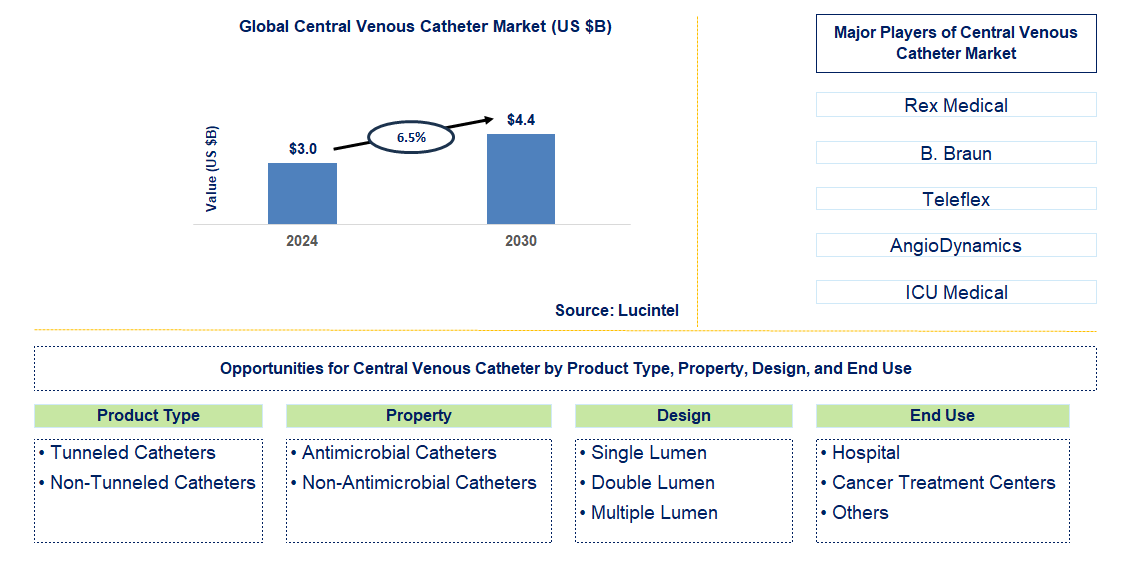
Key data points: The market size in 2030 = $4.4 billion, growth forecast = 6.5% annually next 6 years. Scroll below to get more insights. This market report covers trends, opportunities, and forecast in the global central venous catheter market to 2030 by product type (tunneled catheters and non-tunneled catheters), property (antimicrobial catheters and non-antimicrobial catheters), design (single lumen, double lumen, and multiple lumen), end use (hospital, cancer treatment centers, and others), and region (North America, Europe, Asia Pacific, and the Rest of the World)
We'll send your sample report shortly.
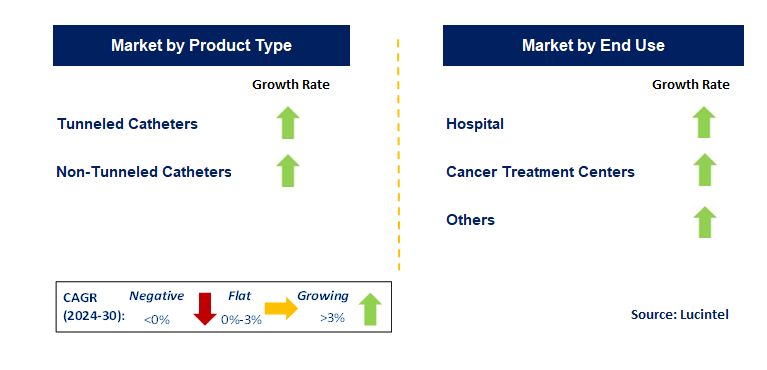
• Lucintel forecasts that non-tunneled catheter segment will remain larger segment over the forecast period.
• Within this market, hospital will remain larger segment over the forecast period.
• North America will remain the largest region over the forecast period. A more than 150-page report is developed to help in your business decisions.
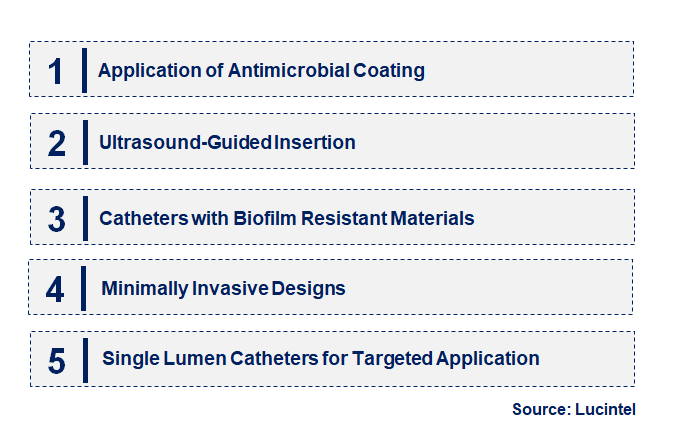
• Application of Antimicrobial Coating: Embedding antimicrobial coatings on CVCs has become common to minimize the risk of infections. This trend reduces the incidence of catheter-related bloodstream infections (CRBSIs), which pose a significant risk to patients.
• Ultrasound-Guided Insertion: This increase is due to the introduction of the ultrasound-guided approach in CVC insertion, which enhances precise placement and decreases complications. This trend improves the safety of patients as well as their clinical outcomes.
• Catheters with Biofilm-Resistant Materials: Catheters made with biofilm-resistant materials and antibacterial coatings are being developed to prevent fluids from getting stuck within the catheters. This innovation assists in the prevention of infections and extends the life of the catheters.
• Minimally Invasive Designs: There is a growing inclination towards less traumatic CVCs when inserting and removing, which are classified as minimally invasive. This is particularly helpful in the case of children and elderly patients where long-term care is needed.
• Single Lumen Catheters for Targeted Applications: With advancements in medical practice, single-lumen catheters are being strategically designed for specific medical applications such as cancer therapies and kidney dialysis. This trend accommodates the increased need for long-term vascular access for targeted therapy. Those changes—the use of antimicrobial coatings, ultrasound for insertion facilitation, materials resistant to biofilms, minimally invasive designs, and single-lumen catheters—will change the CVC market trend by maximizing safety and care efficiency.
• Antimicrobial-Coated Catheters: There has been a new development of CVCs in the form of antimicrobial-coated CVCs, which help to prevent infection. Moreover, this coating is very effective in preventing CRBSIs, thereby minimizing the complication risk related to long-term catheter usage.
• Advanced Catheter Stabilization Devices: Catheter stabilization devices that limit the movement of the catheter and prevent its dislodgment have been widely embraced. These reductions in catheter-related complications are expected to result in a positive impact on patients.
• Biofilm-Resistant Catheters: Another major advancement meant to prevent bacterial infiltration and infection in CVCs is the inclusion of biofilm-resistant materials in the devices. These materials enable longer catheter durations, thereby reducing the frequency of catheter changes.
• Ultrasound-Guided Catheters: The wider usage of ultrasound-guided catheters decreases the rates of placement errors and related complications. Such advancements are especially advantageous for patients with difficult-to-find veins.
• Miniaturized Catheters for Pediatrics: The new miniaturized CVCs used for pediatric care focus on reducing the size of the catheter, allowing for longer use in children with better biocompatibility. These new approaches antimicrobial surface coatings, stabilization devices, biofilm-resistant materials, ultrasound-assisted catheterization, and innovations targeted at pediatric patients are increasing overall safety, decreasing complications, and improving the efficiency of central venous access and catheter use.
• Oncology Treatment: There is an increasing demand for CVCs in oncology due to the rising number of patients requiring CVCs for long-term chemotherapy. This segment of the industry presents a strategic growth opportunity with CVCs engineered for frequent drug supply and blood sampling.
• Dialysis Applications: Chronic kidney disease is on the rise due to diabetes and hypertension, increasing the use of CVCs in dialysis therapy. This presents an important growth opportunity for industry leaders manufacturing catheters suitable for high-flow dialysis processes.
• Pediatric Care: The future growth for specialized and miniaturized CVCs is promising, hence the focus on this area. These types of catheters address the challenge of providing vascular access in children through less invasive procedures over a long term, thus expanding the pediatric vascular access market.
• Intensive Care Units (ICUs): The role of CVCs in ICUs for critical care management is increasing. There is potential for market growth in catheters that offer long-term venous access while reducing the risk of infection.
• Home Healthcare Solutions: There has been a shift in emphasis from institution-based healthcare services to home-based healthcare services. As such, CVCs designed for home use, particularly for managing chronic diseases and long-term treatments, provide a market opportunity for manufacturers. Core expansion opportunities in oncology, dialysis, pediatrics, critical care units (ICUs), and home healthcare are expanding the CVC market as innovation continues to focus on specific patient situations and prolonged care.
• Rising Demand for Long-Term Care: There has been a growing trend towards chronic conditions that require dedicated care for patients, which has pushed the CVC market. These catheters are important vascular access devices for prolonged therapies.
• Technological Advancements: Market expansion has been significantly driven by product development, aided by innovations such as antimicrobial coatings and biofilm-inhibiting materials.
• Growing Prevalence of Chronic Diseases: The increasing number of chronic conditions, including cancer and kidney disease, boosts the market for CVCs, which are primary means of drug delivery and dialysis.
• Increased Focus on Infection Prevention: Advancements in catheter technology that reduce catheter-related complications and ensure better insertion techniques are encouraging healthcare professionals to adopt more advanced CVCs with various safety designs.
• Growth of Home Healthcare: The increase in the use of home-based healthcare services, especially for chronic diseases, is driving the demand for CVCs that can be used safely in unsupervised environments. Challenges in the central venous catheter market are:
• High Risk of Infection: Nonetheless, CVCs that have been in use for prolonged periods are still associated with high morbidity rates due to complications related to infection. Infection prevention remains a significant obstacle for all manufacturers.
• Cost of Advanced Technologies: The acceptance and application of CVCs with advanced features, such as built-in antimicrobial properties, are cost-restrictive, particularly in developing countries.
• Regulatory Hurdles: Different countries have varying regulatory guidelines, some of which may be challenging for manufacturers, especially for medical device companies. Medical device regulations are evolving, requiring manufacturers to frequently update their approvals and certifications. Expansion of major factors like rising demand for long-term care and the growth of home healthcare is driving CVC market growth. Nevertheless, these markets have challenges to be addressed to enable better control over infection risks, costs, regulations, and market competition.
• Rex Medical
• B. Braun
• Teleflex
• AngioDynamics
• ICU Medical
• Vygon
• Medtronic
• Merit Medical Systems
• Asahi Kasei
• Becton, Dickinson and Company
• Tunneled Catheters
• Non-Tunneled Catheters
• Antimicrobial Catheters
• Non-Antimicrobial Catheters
• Single Lumen
• Double Lumen
• Multiple Lumen
• Hospital
• Cancer Treatment Centers
• Others
• North America
• Europe
• Asia Pacific
• The Rest of the World
• United States: In the U.S., the use of antimicrobial-coated CVCs is gaining popularity due to the decreasing trend of catheter-related infections. Recent innovations include improved approaches to catheter insertion and the development of ultrasound-guided catheters for better patient care.
• China: The demand for advanced healthcare infrastructure in China is fueling the growth of the Chinese CVC market. Recent developments include the incorporation of antibacterial elements into CVCs to prevent infections and the creation of low-cost but high-quality catheter options.
• Germany: The German market for central venous catheters focuses on modern technologies that can prevent infections. Examples include the integration of biofilm-preventing materials and optimization of catheter securement methods to decrease risks associated with prolonged catheterization.
• India: The increasing prevalence of long-term care needs among the population in Intensive Care Units and oncology departments in India has led to a rise in the usage of central venous catheters. Recent developments have focused on low-cost solutions that improve safety for patients, particularly those requiring long-term catheterization.
• Japan: In addition to the principles mentioned above, Japan is pursuing the miniaturization of CVCs and developing more innovative biocompatible options. The nation is also integrating minimally invasive methods and advanced technologies that enhance the accuracy and safety of catheter devices, particularly for younger and older individuals.


• Rex Medical
• B. Braun
• Teleflex
• AngioDynamics
• ICU Medical
• Vygon
• Medtronic
• Merit Medical Systems
• Asahi Kasei
• Becton, Dickinson and Company Q6. Which central venous catheter market segment will be the largest in future? Answer: Lucintel forecasts that non-tunneled catheter segment will remain larger segment over the forecast period. Q7. In central venous catheter market, which region is expected to be the largest in next 5 years? Answer: North America will remain the largest region over the forecast period. Q.8 Do we receive customization in this report? Answer: Yes, Lucintel provides 10% customization without any additional cost.


Choose a license that fits your team. Instant PDF delivery.
Prices exclude taxes. Instant delivery. Custom licensing available on request.
Market Report · July 22, 2026
Market Report · July 22, 2026
Market Report · July 22, 2026
Trusted partner for strategic intelligence and business growth


Receive a complimentary market analysis tailored to your industry. Our analysts will identify key growth opportunities and competitive dynamics specific to your business.

Market size, growth rate, and key trend analysis for your specific sector.

Top competitor positioning and market share analysis.

Strategic recommendations backed by data-driven insights.
Get curated market intelligence and competitive moves straight to your inbox.
By subscribing, you agree to receive our monthly insights. Unsubscribe anytime.
Receive a complimentary market analysis tailored to your industry. Our analysts will identify key growth opportunities and competitive dynamics specific to your business.
Market size, growth rate, and key trend analysis for your specific sector.
Top competitor positioning and market share analysis.
Strategic recommendations backed by data-driven insights.
Get curated market intelligence, emerging trends, and competitive moves straight to your inbox each month.
By subscribing, you agree to receive our monthly insights. Unsubscribe anytime.
We'll send your sample report shortly.