
Report Feature
Cell Sorter Market Trends and Forecast
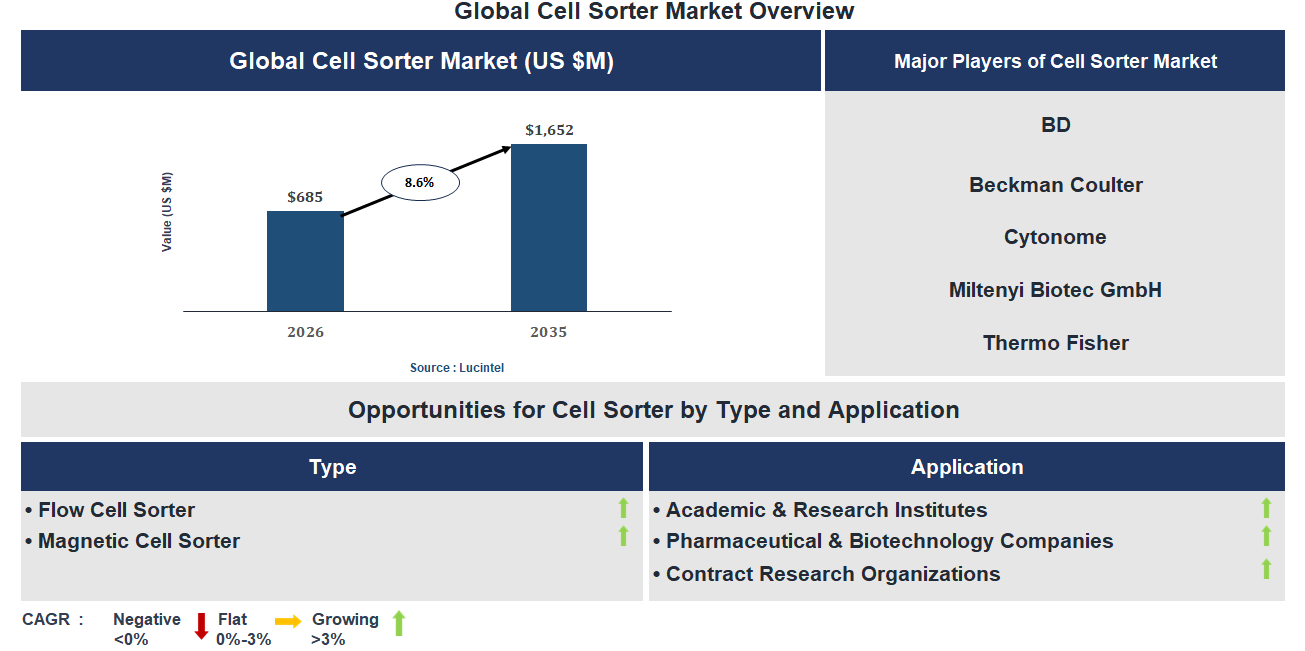
The future of the global cell sorter market looks promising with opportunities in the academic & research institute, pharmaceutical & biotechnology company, and contract research organization markets. The global cell sorter market is expected to reach an estimated $1,652 million by 2035 with a CAGR of 8.6% from 2026 to 2035. The major drivers for this market are the increasing demand for single cell analysis, the rising use in immunology & oncology research, and the growing adoption of automated cell sorting systems.• Lucintel forecasts that, within the type category, flow cell sorter is expected to witness higher growth over the forecast period.
• Within the application category, academic & research institute is expected to witness the highest growth.
• In terms of region, APAC is expected to witness the highest growth over the forecast period. Gain valuable insights for your business decisions with our comprehensive 150+ page report. Sample figures with some insights are shown below.
Emerging Trends in the Cell Sorter Market
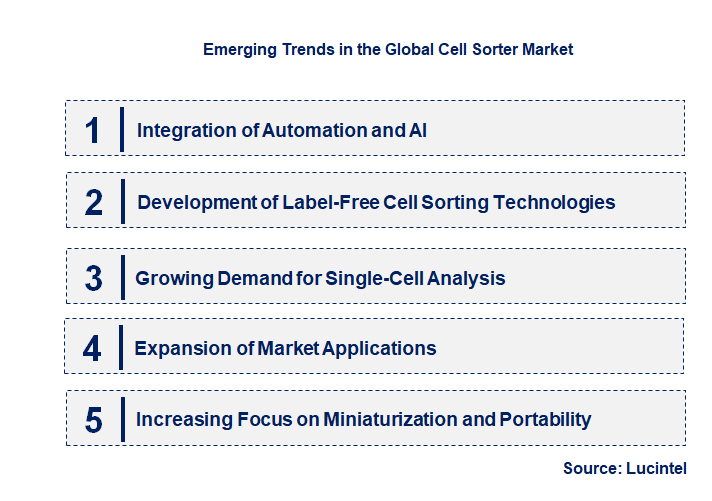
The cell sorter market is experiencing rapid evolution driven by technological advancements, increasing research and development activities, and a growing demand for precise cellular analysis across various sectors such as healthcare, biotechnology, and pharmaceuticals. These developments are transforming how scientists and clinicians isolate and analyze specific cell populations, leading to improved diagnostics, personalized medicine, and innovative therapies. As the market adapts to these changes, several emerging trends are shaping its future landscape. Understanding these key trends is essential for stakeholders to capitalize on opportunities and navigate challenges effectively in this dynamic environment.• Integration of Automation and AI: The adoption of automation and artificial intelligence in cell sorting processes enhances efficiency, accuracy, and reproducibility. Automated systems reduce manual intervention, minimizing human error and increasing throughput. AI algorithms enable real-time data analysis, pattern recognition, and decision-making, which accelerates research timelines and improves diagnostic precision. This trend is particularly impactful in clinical settings where rapid, reliable results are critical. As automation and AI become more sophisticated, they are expected to lower operational costs and expand the accessibility of advanced cell sorting technologies across various laboratories and healthcare facilities.
• Development of Label-Free Cell Sorting Technologies: Label-free methods, such as dielectrophoresis and microfluidic-based techniques, are gaining prominence as they eliminate the need for fluorescent or magnetic labels. These technologies reduce sample preparation time, preserve cell viability, and enable the sorting of rare or sensitive cell types without altering their natural state. The impact of label-free sorting is significant in regenerative medicine, stem cell research, and clinical diagnostics, where maintaining cell integrity is crucial. As these technologies mature, they are likely to become more cost-effective and widely adopted, broadening the scope of applications and improving overall research outcomes.
• Growing Demand for Single-Cell Analysis: The increasing focus on understanding cellular heterogeneity has driven the demand for single-cell sorting and analysis. This trend is vital for cancer research, immunology, and personalized medicine, where identifying rare cell populations can lead to targeted therapies. Advanced cell sorters capable of isolating individual cells with high precision are enabling researchers to explore cellular functions and interactions at an unprecedented level. The impact includes more accurate disease modeling, better biomarker discovery, and tailored treatment strategies. As single-cell technologies evolve, they are set to revolutionize diagnostics and therapeutic development.
• Expansion of Market Applications: The cell sorter market is expanding beyond traditional research laboratories into clinical diagnostics, regenerative medicine, and cell therapy manufacturing. This diversification is driven by the need for high-purity cell populations in stem cell therapies, cancer treatment, and immune cell therapies. The impact is a broader market scope, increased revenue streams, and enhanced collaboration between research institutions and healthcare providers. Regulatory approvals and technological innovations are facilitating this expansion, making cell sorting an integral part of personalized medicine and advanced therapeutic solutions.
• Increasing Focus on Miniaturization and Portability: The development of compact, portable cell sorting devices is a notable trend aimed at point-of-care testing and field applications. Miniaturized systems offer advantages such as ease of use, reduced costs, and the ability to perform cellular analysis outside traditional laboratory settings. This trend is particularly impactful in resource-limited environments, remote locations, and emergency scenarios where rapid diagnostics are essential. As technology advances, portable cell sorters are expected to become more powerful and versatile, significantly expanding the reach and utility of cell sorting technologies globally. These emerging trends are collectively reshaping the cell sorter market by enhancing technological capabilities, broadening application areas, and improving accessibility. They are driving innovation, increasing efficiency, and enabling more precise cellular analysis, which ultimately accelerates scientific discovery and clinical advancements. The market is poised for significant growth as these trends continue to evolve and intersect, offering new opportunities for stakeholders across the healthcare and research sectors.
Recent Development in the Cell Sorter Market
The cell sorter market is experiencing rapid growth driven by technological advancements, increasing demand in biomedical research, and expanding applications in clinical diagnostics. Innovations are enhancing sorting accuracy, speed, and automation, making these devices more accessible across various sectors. The integration of AI and machine learning is further transforming the landscape, enabling more precise cell analysis. As research and healthcare needs evolve, the market is poised for significant expansion, attracting investments and fostering new product development to meet diverse customer requirements.• Technological Innovations Drive Market Growth: The development of advanced cell sorting technologies, such as microfluidics and acoustic sorting, is significantly improving efficiency and precision. These innovations reduce processing time and increase throughput, making cell sorters more suitable for high-volume applications. Enhanced automation and user-friendly interfaces are also expanding accessibility for non-specialist users. This progress is attracting new customers from research, clinical, and industrial sectors, thereby fueling overall market growth and opening new revenue streams.
• Rising Demand in Biomedical Research and Drug Discovery: Increasing investments in biomedical research and personalized medicine are boosting the need for precise cell sorting solutions. Researchers require high-purity cell populations for experiments, leading to a surge in demand for advanced sorters. The rise in cell-based assays and regenerative medicine further amplifies this trend. As a result, manufacturers are innovating to meet these needs, expanding product portfolios and driving market expansion. This demand is expected to sustain growth in the coming years, especially in the academic and pharmaceutical sectors.
• Expansion of Clinical Diagnostics Applications: Cell sorters are increasingly used in clinical diagnostics for cancer, infectious diseases, and immunology. The ability to isolate specific cell types enhances diagnostic accuracy and treatment planning. Regulatory approvals and technological improvements are facilitating their integration into clinical labs. This expansion is creating new revenue opportunities for manufacturers and encouraging the development of portable, user-friendly devices suitable for point-of-care testing. The growing clinical adoption is a key driver of market growth and diversification.
• Integration of Artificial Intelligence and Automation: The incorporation of AI and machine learning algorithms is revolutionizing cell sorting by enabling real-time data analysis and decision-making. Automated systems reduce human error, improve reproducibility, and increase throughput. These advancements are making cell sorters more efficient and accessible, especially in high-volume settings. AI-driven features also facilitate complex sorting tasks, broadening the application scope. This technological integration is attracting new users and expanding market reach, ultimately accelerating industry growth and innovation.
• Growing Focus on Personalized Medicine and Cell Therapy: The rise of personalized medicine and cell-based therapies is creating a substantial demand for precise cell sorting. These applications require high-purity, viable cell populations, which advanced sorters can provide. The development of specialized instruments tailored for cell therapy manufacturing is further fueling market growth. As these fields expand, the need for reliable, scalable sorting solutions will increase, prompting ongoing innovation. This trend is positioning the cell sorter market as a critical component in future healthcare and regenerative medicine landscapes. The overall impact of these developments is a robust, expanding market characterized by technological innovation, increased clinical and research applications, and growing integration of AI. These factors are driving higher adoption rates, fostering new product development, and attracting investments, ultimately shaping a dynamic and competitive industry poised for sustained growth.
Strategic Growth Opportunities in the Cell Sorter Market
The cell sorter market is experiencing rapid growth driven by advancements in technology, increasing demand for personalized medicine, and expanding applications across research and clinical diagnostics. Innovations in automation, accuracy, and throughput are making cell sorting more accessible and efficient. As industries recognize the importance of cell analysis in disease diagnosis, drug development, and cell therapy, market players are focusing on strategic collaborations and product development to capitalize on these opportunities. This evolving landscape presents significant potential for market expansion and technological breakthroughs.• Integration of Artificial Intelligence and Automation in Cell Sorting: The adoption of AI and automation technologies is transforming cell sorting by enhancing precision, reducing manual intervention, and increasing throughput. Automated systems enable high-speed, reproducible results, making the process more efficient for research and clinical applications. AI-driven algorithms improve cell identification and classification, leading to better data accuracy. These innovations are expected to expand the usability of cell sorters, especially in high-volume laboratories, and foster new applications in personalized medicine and regenerative therapies.
• Growing Demand for Cell Sorting in Cancer Research and Diagnostics: The increasing prevalence of cancer and the need for precise diagnostic tools are driving demand for advanced cell sorting solutions. Researchers utilize cell sorters to isolate specific cancer cell populations, study tumor heterogeneity, and develop targeted therapies. Clinical laboratories rely on these technologies for minimal residual disease detection and prognosis. The ability to accurately sort and analyze rare cell populations enhances diagnostic accuracy and treatment planning, making cell sorting indispensable in oncology research and clinical workflows.
• Expansion of Cell Sorting Applications in Regenerative Medicine and Cell Therapy: The rise of regenerative medicine and cell-based therapies is creating new opportunities for cell sorting technologies. These applications require high-purity cell populations for transplantation, tissue engineering, and stem cell research. Cell sorters facilitate the isolation of specific cell types, ensuring safety and efficacy in therapies. As regenerative medicine advances, the demand for scalable, gentle, and precise sorting methods will grow, encouraging innovation and new product development tailored to these specialized needs.
• Increasing Adoption of Microfluidic and Label-Free Cell Sorting Technologies: Microfluidic and label-free sorting methods are gaining traction due to their minimally invasive nature and ability to handle small sample volumes. These technologies reduce reliance on fluorescent labels, lowering costs and complexity. They enable real-time sorting with high precision, suitable for delicate cells and rare populations. The trend toward portable, point-of-care devices also benefits from microfluidic innovations, broadening the scope of cell sorting applications in field diagnostics, personalized medicine, and resource-limited settings.
• Strategic Collaborations and Product Innovations to Drive Market Growth: Companies are forming strategic alliances with research institutions and healthcare providers to accelerate product development and expand market reach. Innovations such as multi-parameter sorting, integration with downstream analysis tools, and user-friendly interfaces are enhancing product offerings. These collaborations facilitate access to new markets, funding, and technological expertise. Continuous innovation and strategic partnerships are essential for staying competitive and capturing emerging opportunities in the evolving cell sorter landscape. These growth opportunities are poised to significantly influence the cell sorter market by fostering technological advancements, expanding application areas, and improving operational efficiencies. The integration of cutting-edge technologies and strategic collaborations will enable market players to meet increasing demand across research, clinical, and therapeutic sectors. As these opportunities unfold, the market is expected to experience sustained growth, innovation, and broader adoption of cell sorting solutions worldwide.
Cell Sorter Market Driver and Challenges
The cell sorter market is influenced by a variety of technological, economic, and regulatory factors that shape its growth trajectory. Advances in automation and precision technology are enabling more efficient cell sorting processes, while increasing demand for personalized medicine and cell-based therapies is expanding market opportunities. Economic factors such as healthcare expenditure and research funding significantly impact market expansion, whereas regulatory frameworks ensure safety and efficacy but can also pose barriers to innovation. Navigating these complex drivers and challenges is essential for stakeholders aiming to capitalize on emerging trends and sustain competitive advantage in this dynamic industry. The factors responsible for driving the cell sorter market include:-• Technological Advancements: The continuous development of high-speed, high-precision cell sorting technologies, such as fluorescence-activated cell sorting (FACS), has significantly improved accuracy and efficiency. These innovations enable researchers and clinicians to analyze and isolate specific cell populations rapidly, facilitating breakthroughs in personalized medicine, immunotherapy, and stem cell research. As technology evolves, costs decrease and usability increases, broadening adoption across research labs and clinical settings, thus fueling market growth.
• Rising Prevalence of Chronic Diseases: The increasing incidence of cancer, autoimmune disorders, and infectious diseases worldwide is driving demand for advanced diagnostic and therapeutic solutions. Cell sorters play a crucial role in disease diagnosis, monitoring, and treatment development by enabling detailed cellular analysis. This rising disease burden prompts healthcare providers and research institutions to invest in sophisticated cell sorting equipment, thereby expanding the market.
• Growing Adoption in Biopharmaceutical and Research Sectors: The expanding biopharmaceutical industry relies heavily on cell sorting for drug discovery, monoclonal antibody production, and cell therapy development. Research institutions and biotech companies are increasingly adopting cell sorters to enhance experimental precision and efficiency. This trend is supported by increased funding for life sciences research and the rising focus on regenerative medicine, which collectively propel market growth.
• Regulatory Support and Funding: Governments and regulatory agencies worldwide are promoting research and innovation through grants, subsidies, and favorable policies. These initiatives facilitate the adoption of advanced cell sorting technologies by reducing financial barriers and encouraging clinical and research applications. Regulatory frameworks also ensure product safety and efficacy, fostering trust and wider acceptance, which in turn accelerates market expansion. The challenges in the cell sorter market are:
• High Cost of Equipment and Maintenance: The sophisticated nature of cell sorters involves significant capital investment, along with ongoing maintenance and operational costs. This financial barrier limits adoption among smaller research labs and developing regions. Additionally, the need for specialized personnel to operate and maintain these systems further increases expenses, restricting market penetration and slowing overall growth.
• Technical Complexity and Skill Gap: Operating advanced cell sorting equipment requires specialized training and expertise. The technical complexity can lead to operational errors, affecting data accuracy and reproducibility. The shortage of skilled personnel hampers widespread adoption, especially in emerging markets, and necessitates investment in training programs, which can delay deployment and increase costs.
• Regulatory and Ethical Challenges: Stringent regulatory requirements for clinical applications and ethical concerns related to cell handling and genetic modification pose hurdles. Navigating complex approval processes can delay product launches and limit market entry. Ethical debates surrounding certain cell therapies also influence regulatory policies, creating uncertainty and potentially restricting innovation and commercialization efforts. A synthesis of these drivers and challenges indicates that while technological innovations and increasing disease prevalence are propelling the cell sorter market forward, high costs, skill gaps, and regulatory complexities pose significant barriers. Strategic investments in training, cost reduction, and regulatory navigation are essential for sustainable growth. Overall, the markets future depends on balancing innovation with accessibility, ensuring that advancements benefit a broader spectrum of research and clinical applications.
List of Cell Sorter Companies
Companies in the market compete on the basis of product quality offered. Major players in this market focus on expanding their manufacturing facilities, R&D investments, infrastructural development, and leverage integration opportunities across the value chain. With these strategies cell sorter companies cater increasing demand, ensure competitive effectiveness, develop innovative products & technologies, reduce production costs, and expand their customer base. Some of the cell sorter companies profiled in this report include-• BD
• Beckman Coulter
• Cytonome
• Miltenyi Biotec GmbH
• Thermo Fisher
• Bio-Rad Laboratories
• Cytek
• Sony Biotechnology
• Union Biometrica
• NanoCellect
Cell Sorter Market by Segment
The study includes a forecast for the global cell sorter market by type, application, and region.Cell Sorter Market by Type [Value from 2019 to 2035]:
• Flow Cell Sorter
• Magnetic Cell Sorter
Cell Sorter Market by Application [Value from 2019 to 2035]:
• Academic & Research Institutes
• Pharmaceutical & Biotechnology Companies
• Contract Research Organizations
Cell Sorter Market by Region [Value from 2019 to 2035]:
• North America
• Europe
• Asia Pacific
• The Rest of the World
Country Wise Outlook for the Cell Sorter Market
The cell sorter market has experienced significant advancements driven by technological innovations, increasing demand for personalized medicine, and expanding applications in research and clinical diagnostics. Countries are investing heavily in research and development to enhance the efficiency, accuracy, and affordability of cell sorting technologies. The markets growth is also fueled by the rising prevalence of chronic diseases, cancer research, and biotechnological advancements. Each country’s unique healthcare infrastructure, research focus, and regulatory environment influence its market dynamics, leading to diverse developmental trends across regions.• United States: The US leads the cell sorter market with extensive adoption in clinical and research settings. Innovations in flow cytometry and automation have improved throughput and precision. Major players are investing in AI-driven sorting systems, and regulatory approvals for new devices are accelerating market growth. The increasing focus on personalized medicine and cancer immunotherapy further boosts demand. Additionally, government funding and collaborations with biotech firms foster innovation and market expansion.
• China: China’s market is rapidly expanding due to government initiatives supporting the biotech and healthcare sectors. The country is witnessing increased adoption of cell sorting technologies in research institutions and hospitals. Local manufacturers are emerging, offering cost-effective solutions to meet domestic demand. Investments in stem cell research and regenerative medicine are driving growth. Regulatory frameworks are evolving to facilitate faster approval processes, and collaborations with international firms are enhancing technological capabilities.
• Germany: Germany remains a key player in the European cell sorter market, with a strong focus on research and clinical applications. The country emphasizes high-precision, reliable systems and is known for integrating advanced flow cytometry technologies. German companies are investing in miniaturization and automation to improve usability. The healthcare system’s emphasis on early diagnosis and personalized treatment supports market growth. Additionally, collaborations between academia and industry foster innovation, and strict regulatory standards ensure product quality and safety.
• India: India’s cell sorter market is witnessing rapid growth driven by increasing research activities and rising healthcare awareness. The expanding biotech and pharmaceutical sectors are adopting advanced cell sorting solutions for drug development and diagnostics. Cost-effective, portable systems are gaining popularity, catering to the diverse needs of research labs and hospitals. Government initiatives to promote biotech research and healthcare infrastructure development are further propelling market growth. However, regulatory hurdles and the need for skilled personnel remain challenges to widespread adoption.
• Japan: Japan’s market is characterized by high technological adoption and a focus on precision medicine. The country invests heavily in research and development, leading to innovative cell sorting solutions. The integration of automation and AI enhances efficiency and accuracy. Japan’s aging population increases demand for advanced diagnostics and personalized therapies, boosting market growth. Regulatory support and collaborations with global firms facilitate technological advancements. The emphasis on quality and safety standards ensures the deployment of reliable cell sorting systems across clinical and research domains.

Features of the Global Cell Sorter Market
Market Size Estimates: Cell sorter market size estimation in terms of value ($M). Trend and Forecast Analysis: Market trends (2019 to 2025) and forecast (2026 to 2035) by various segments and regions. Segmentation Analysis: Cell sorter market size by type, application, and region in terms of value ($M). Regional Analysis: Cell sorter market breakdown by North America, Europe, Asia Pacific, and Rest of the World. Growth Opportunities: Analysis of growth opportunities in different types, applications, and regions for the cell sorter market. Strategic Analysis: This includes M&A, new product development, and competitive landscape of the cell sorter market. Analysis of competitive intensity of the industry based on Porter’s Five Forces model.
FAQ
Q1. What is the market size and growth forecast for cell sorter market? Answer: The global cell sorter market is expected to reach an estimated $1,652 million by 2035 and grow with a CAGR of 8.6% from 2026 to 2035. Q2. What are the major drivers influencing the growth of the cell sorter market? Answer: The major drivers for this market are the increasing demand for single cell analysis, the rising use in immunology & oncology research, and the growing adoption of automated cell sorting systems. Q3. What are the major segments for cell sorter market? Answer: The future of the cell sorter market looks promising with opportunities in the academic & research institute, pharmaceutical & biotechnology company, and contract research organization markets. Q4. Who are the key cell sorter market companies? Answer: Some of the key cell sorter companies are as follows:• BD
• Beckman Coulter
• Cytonome
• Miltenyi Biotec GmbH
• Thermo Fisher
• Bio-Rad Laboratories
• Cytek
• Sony Biotechnology
• Union Biometrica
• NanoCellect Q5. Which cell sorter market segment will be the largest in future? Answer: Lucintel forecasts that, within the type category, flow cell sorter is expected to witness higher growth over the forecast period. Q6. In cell sorter market, which region is expected to be the largest in next 5 years? Answer: In terms of region, APAC is expected to witness the highest growth over the forecast period. Q7. Do we receive customization in this report? Answer: Yes, Lucintel provides 10% customization without any additional cost.
Table of Contents
List of Figures
List of Tables
Methodology
- In-depth interviews of the major players in this market
- Detailed secondary research from competitors’ financial statements and published data
- Extensive searches of published works, market, and database information pertaining to industry news, company press releases, and customer intentions
- A compilation of the experiences, judgments, and insights of Lucintel’s professionals, who have analyzed and tracked this market over the years.


Buy Now
Choose a license that fits your team. Instant PDF delivery.
Prices exclude taxes. Instant delivery. Custom licensing available on request.
Key Questions
- • What are some of the most promising, high-growth opportunities for the cell sorter market by type (flow cell sorter and magnetic cell sorter), application (academic & research institutes, pharmaceutical & biotechnology companies, and contract research organizations), and region (North America, Europe, Asia Pacific, and the Rest of the World)?
- • Which segments will grow at a faster pace and why?
- • Which region will grow at a faster pace and why?
- • What are the key factors affecting market dynamics? What are the key challenges and business risks in this market?
- • What are the business risks and competitive threats in this market?
- • What are the emerging trends in this market and the reasons behind them?
- • What are some of the changing demands of customers in the market?
- • What are the new developments in the market? Which companies are leading these developments?
- • Who are the major players in this market? What strategic initiatives are key players pursuing for business growth?
- • What are some of the competing products in this market and how big of a threat do they pose for loss of market share by material or product substitution?
- • What M&A activity has occurred in the last 7 years and what has its impact been on the industry? For any questions related to Cell Sorter Market, Cell Sorter Market Size, Cell Sorter Market Growth, Cell Sorter Market Analysis, Cell Sorter Market Report, Cell Sorter Market Share, Cell Sorter Market Trends, Cell Sorter Market Forecast, Cell Sorter Companies, write Lucintel analyst at email: helpdesk@lucintel.com. We will be glad to get back to you soon.


