
Market Report · July 29, 2026

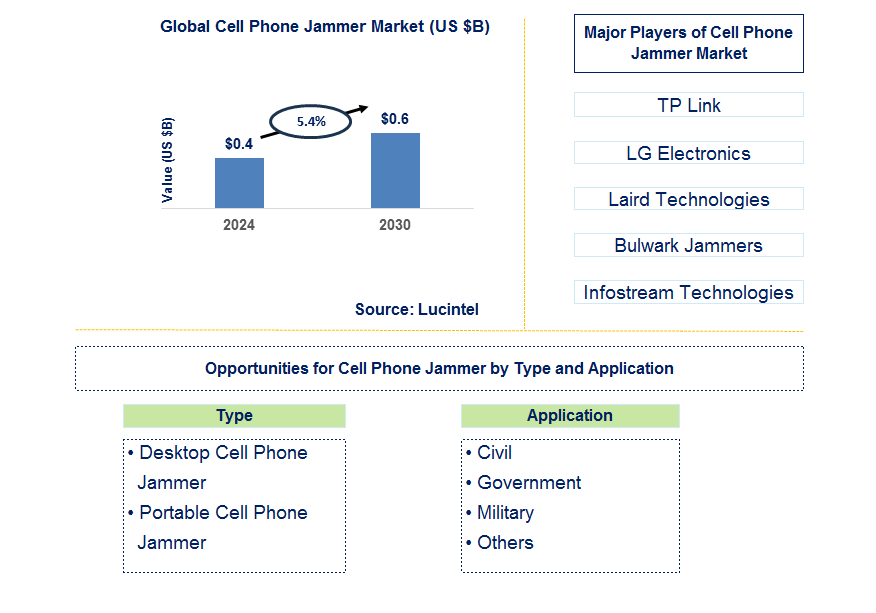
Key data points: The market size in 2030 = $0.6 billion, growth forecast = 5.4% annually next 6 years. Scroll below to get more insights. This market report covers trends, opportunities, and forecast in the global cell phone jammer market to 2030 by type (desktop cell phone jammer and portable cell phone jammer), application (civil, government, military, and others), and region (North America, Europe, Asia Pacific, and the Rest of the World)
We'll send your sample report shortly.
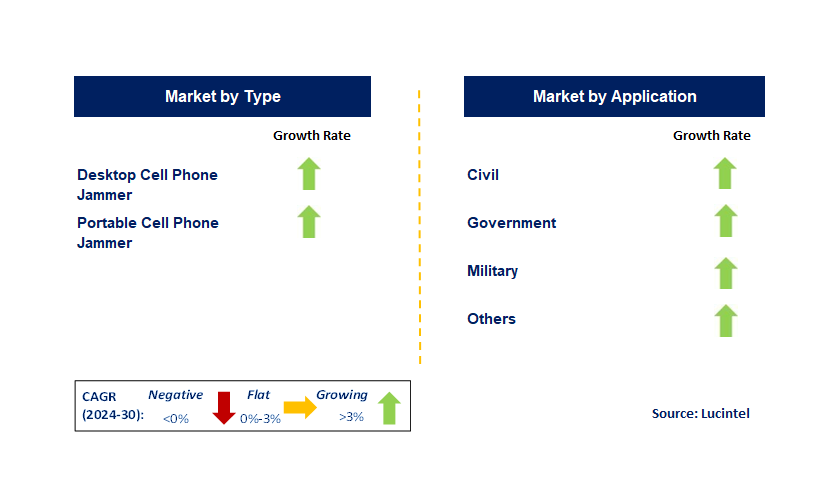
• Lucintel forecasts that, within the type category, desktop cell phone jammers will remain the larger segment over the forecast period because of the bigger devices that block cell phone signals within a given range and are fixed in a certain location, like offices or classrooms.
• In terms of regions, North America will remain the largest region over the forecast period because of growing demand for handheld and portable jammers owing to their usability and portability, growing necessity for jammers in public places like theaters, jails, and schools as there is surge in unlawful activities employing mobile phones. Gain valuable insights for your business decisions with our comprehensive 150+ page report.
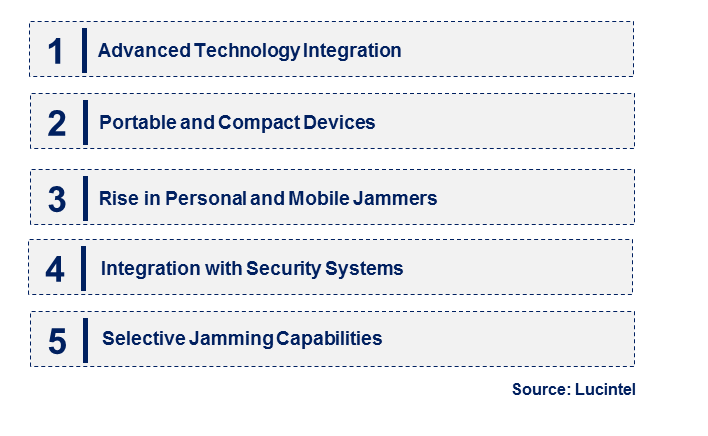
• Advanced Technology Integration: Development of sophisticated jammers incorporating technologies such as frequency-hopping and adaptive signal detection for improved performance.
• Portable and Compact Devices: Growing demand for portable, compact jammers that offer convenience and flexibility for personal and professional use.
• Rise in Personal and Mobile Jammers: Increased interest in personal and mobile jammers designed for discreet use in various environments, including educational and corporate settings.
• Integration with Security Systems: Trend towards integrating jammers with comprehensive security systems, including surveillance and access control, for enhanced protection.
• Selective Jamming Capabilities: Advances in selective jamming technologies that allow for targeted signal blocking without affecting emergency communications. Emerging trends in the cell phone jammer market include advanced technology integration, portability, regulatory compliance, and the development of selective jamming capabilities, with a growing focus on integrating jammers into comprehensive security systems.
• Technological Advancements: Introduction of new jammer models featuring advanced signal detection, frequency-hopping, and adaptive jamming technologies for improved effectiveness.
• Regulatory Challenges: Ongoing changes in regulations governing the use of jammers, with a focus on balancing security needs and minimizing interference with legitimate communications.
• Market Expansion: Growth in the market driven by increased demand for jammers in educational institutions, corporate environments, and public events for enhanced security and privacy.
• Integration with Security Systems: Rising trend towards integrating jammers with other security technologies, such as surveillance systems and access controls, to provide comprehensive solutions.
• Portable Solutions: Development of compact and portable jammers that offer flexibility and ease of use for personal and mobile applications.
• Legal Compliance Efforts: Increased emphasis on designing jammers that comply with legal standards and regulations to avoid potential conflicts with law enforcement and emergency services. Recent developments in the cell phone jammer market highlight advancements in technology, regulatory challenges, and market expansion, with a growing focus on integrating jammers into comprehensive security systems and ensuring legal compliance.
• Educational Institutions: Growing demand for jammers in educational settings to prevent cheating and enhance focus during exams, while ensuring compliance with regulations.
• Corporate Environments: Increasing use of jammers in corporate offices to protect sensitive information and prevent unauthorized communication during confidential meetings.
• Public Events: Expanding opportunities for deploying jammers at large public events and transportation hubs to manage security and control communication disruptions.
• Government Facilities: Strategic growth in the use of jammers in government buildings and secure facilities to safeguard against unauthorized communication and potential security threats.
• Healthcare Settings: Potential applications of jammers in healthcare environments to prevent interference with medical equipment and ensure patient privacy.
• Military and Defense: Significant opportunities for jammers in military and defense applications, including secure communications and protection against electronic warfare threats. Strategic growth opportunities in the cell phone jammer market include applications in educational institutions, corporate environments, public events, government facilities, healthcare settings, and military and defense sectors.
• Increasing Security Concerns: Growing emphasis on security and privacy in educational, corporate, and public environments is driving demand for cell phone jammers.
• Technological Advancements: Continuous innovations in jammer technology are improving performance and expanding applications.
• Regulatory Support: Some regions are adopting regulations that allow controlled use of jammers for security purposes, supporting market growth.
• Integration with Security Systems: Rising interest in integrating jammers with other security technologies enhances their effectiveness and appeal.
• Cost Reductions: Decreasing costs of jammer technology are making advanced solutions more accessible to a broader range of users. Challenges in the cell phone jammer market are:
• Regulatory Restrictions: Strict regulations and legal constraints on the use of jammers pose challenges for widespread adoption and deployment.
• Potential Interference Issues: Risk of unintended interference with emergency communications and legitimate signals can limit the use of jammers.
• High Initial Costs: The high cost of advanced jamming systems can be a barrier to adoption, particularly in price-sensitive markets.
• Technical Complexity: Integrating advanced technologies and ensuring accurate performance can be challenging for manufacturers and users.
• Public Perception: Concerns about privacy and potential misuse of jammers can affect market acceptance and adoption. The cell phone jammer market is driven by security concerns, technological advancements, and regulatory support, while facing challenges related to regulatory restrictions, potential interference issues, high costs, technical complexity, and public perception.
• TP Link
• LG Electronics
• Laird Technologies
• Bulwark Jammers
• Infostream Technologies
• Network Jammer
• Lockheed Martin
• Desktop Cell Phone Jammer
• Portable Cell Phone Jammer
• Civil
• Government
• Military
• Others
• North America
• Europe
• Asia Pacific
• The Rest of the World
• USA: In the USA, recent developments in the cell phone jammer market reflect both technological advancements and regulatory challenges. The U.S. market is seeing an increase in the deployment of sophisticated, multi-frequency jammers used in critical infrastructure and secure facilities to prevent unauthorized communication. Innovations include compact, portable devices that offer enhanced performance and coverage. However, regulatory scrutiny remains high, with strict laws governing the use of jammers due to potential interference with emergency communications. Companies are focusing on developing jammers that comply with legal standards while meeting the needs of security-conscious sectors.
• China: China's cell phone jammer market is expanding rapidly, driven by increasing security needs and technological advancements. Recent developments include the introduction of high-power jammers designed for large-scale applications such as public events and transportation hubs. Chinese manufacturers are focusing on enhancing jammer performance and reliability, with new models featuring advanced frequency-hopping and anti-jamming technologies. There is also a trend towards integrating jammers with surveillance systems for comprehensive security solutions. However, the use of jammers is regulated, and there is ongoing debate about the balance between security and potential disruption of legitimate communications.
• India: In India, the cell phone jammer market is witnessing growth due to rising concerns about privacy and security in public and private sectors. Recent developments include the adoption of compact and cost-effective jammers tailored for educational institutions, corporate environments, and government facilities. Innovations in jammer technology focus on improving efficiency and ease of use while addressing legal and regulatory constraints. Indian companies are also exploring the development of jammers that can selectively block signals without affecting emergency services. The market is characterized by a growing emphasis on affordability and practical applications in diverse settings.
• Japan: Japan is seeing advancements in the cell phone jammer market with a focus on integrating high-tech features and ensuring regulatory compliance. Recent developments include the introduction of advanced jammers with enhanced signal detection and targeting capabilities, suitable for use in high-security environments such as government buildings and corporate offices. Japanese manufacturers are also investing in research to improve the miniaturization and portability of jamming devices. The market is characterized by stringent regulations and a strong emphasis on technology that complies with legal standards while addressing the needs of security-conscious users.


• TP Link
• LG Electronics
• Laird Technologies
• Bulwark Jammers
• Infostream Technologies
• Network Jammer
• Lockheed Martin Q6. Which cell phone jammer market segment will be the largest in future? Answer: Lucintel forecasts that desktop cell phone jammers will remain the larger segment over the forecast period because of the bigger devices that block cell phone signals within a given range and are fixed in a certain location, like offices or classrooms. Q7. In cell phone jammer market, which region is expected to be the largest in next 5 years? Answer: North America will remain the largest region over the forecast period because of growing demand for handheld and portable jammers owing to their usability and portability, growing necessity for jammers in public places like theaters, jails, and schools as there is surge in unlawful activities employing mobile phones. Q.8 Do we receive customization in this report? Answer: Yes, Lucintel provides 10% customization without any additional cost.


Choose a license that fits your team. Instant PDF delivery.
Prices exclude taxes. Instant delivery. Custom licensing available on request.
Market Report · July 29, 2026
Market Report · July 20, 2026
Market Report · July 20, 2026
Trusted partner for strategic intelligence and business growth


Receive a complimentary market analysis tailored to your industry. Our analysts will identify key growth opportunities and competitive dynamics specific to your business.

Market size, growth rate, and key trend analysis for your specific sector.

Top competitor positioning and market share analysis.

Strategic recommendations backed by data-driven insights.
Get curated market intelligence and competitive moves straight to your inbox.
By subscribing, you agree to receive our monthly insights. Unsubscribe anytime.
Receive a complimentary market analysis tailored to your industry. Our analysts will identify key growth opportunities and competitive dynamics specific to your business.
Market size, growth rate, and key trend analysis for your specific sector.
Top competitor positioning and market share analysis.
Strategic recommendations backed by data-driven insights.
Get curated market intelligence, emerging trends, and competitive moves straight to your inbox each month.
By subscribing, you agree to receive our monthly insights. Unsubscribe anytime.
We'll send your sample report shortly.