
Market Report · July 22, 2026

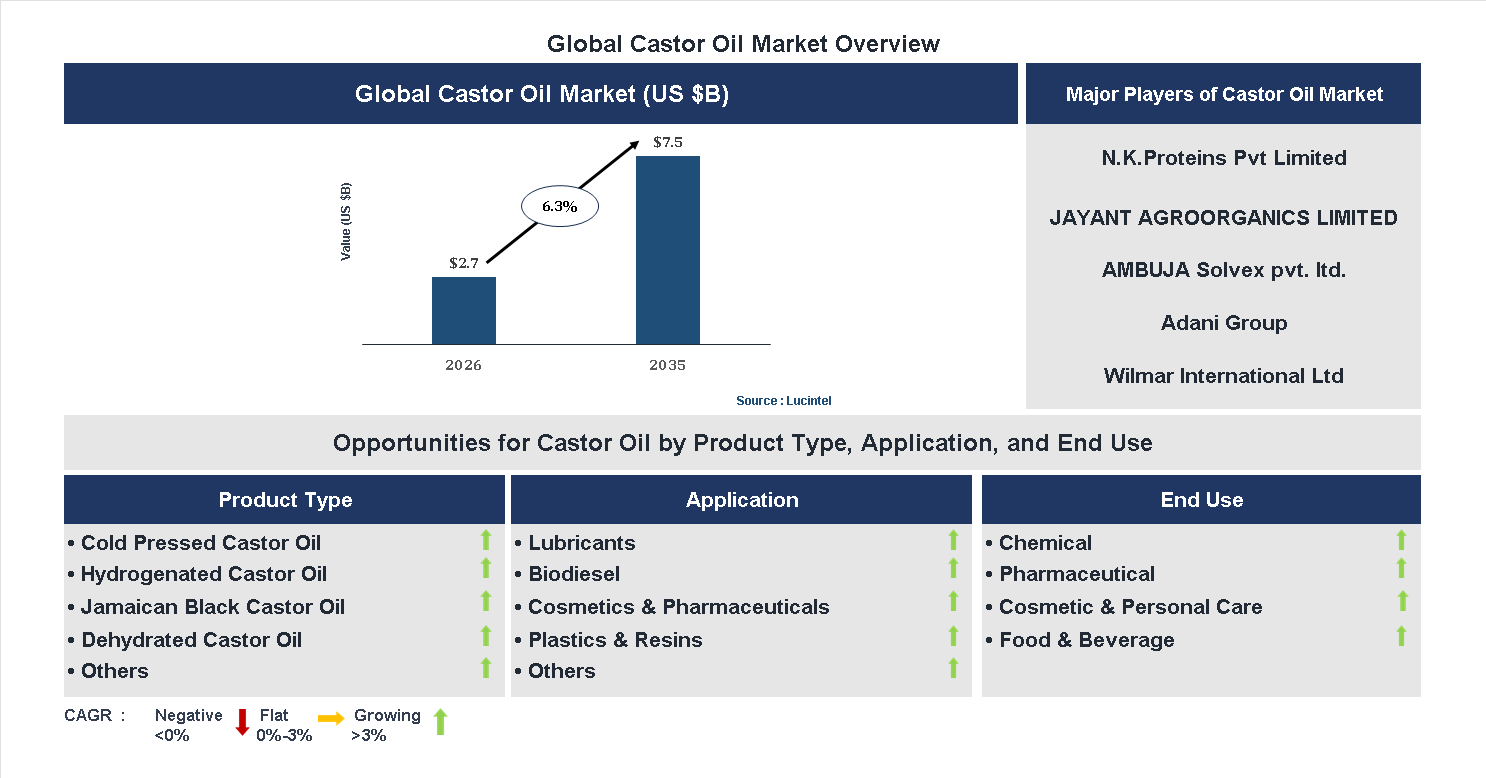
Key data points: The market size in 2035 = $7.5 billion, growth forecast = 6.3% annually for the next 8 years. Scroll below to get more insights. This market report covers trends, opportunities and forecasts in castor oil market to 2035 by product type (cold pressed castor oil, hydrogenated castor oil, Jamaican black castor oil, dehydrated castor oil, and others), application (lubricants, biodiesel, cosmetics & pharmaceuticals, plastics & resins, and others), end use (chemical, pharmaceutical, cosmetic & personal care, and food & beverage), and region (North America, Europe, Asia Pacific, and the Rest of the World)
We'll send your sample report shortly.
• Lucintel forecasts that, within the product type category, cold pressed castor oil is expected to witness the highest growth over the forecast period.
• Within the end use category, cosmetic & personal care is expected to witness the highest growth.
• In terms of region, APAC is expected to witness the highest growth over the forecast period. Gain valuable insights for your business decisions with our comprehensive 150+ page report. Sample figures with some insights are shown below.
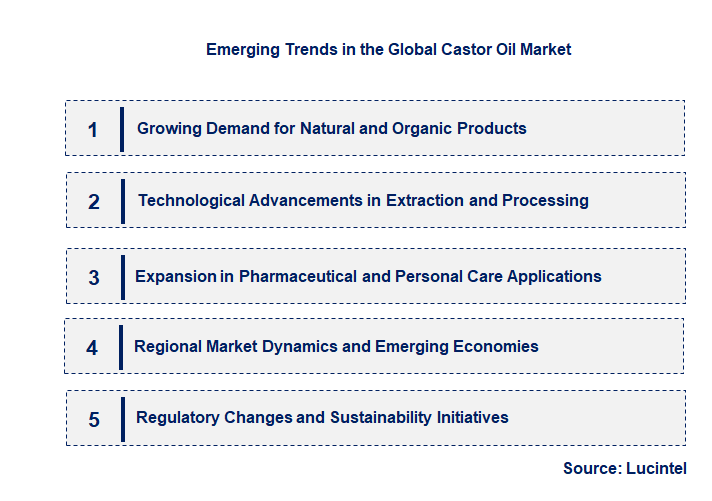
• Growing Demand for Natural and Organic Products: The increasing consumer preference for natural, organic, and chemical-free products is boosting castor oils popularity. This trend is driven by health consciousness and environmental concerns, leading to higher demand for cosmetics, personal care, and health supplements. Companies are focusing on sustainable sourcing and organic certifications to meet consumer expectations, which enhances brand loyalty and market share. This shift encourages producers to adopt eco-friendly cultivation and extraction practices, ultimately expanding the market and encouraging innovation in product formulations.
• Technological Advancements in Extraction and Processing: Innovations such as cold-press extraction, solvent-free methods, and biotechnology are improving castor oil quality and yield. These advancements reduce environmental impact and enhance the purity and efficacy of the oil, making it more attractive for pharmaceutical and cosmetic applications. Enhanced processing techniques also enable the production of specialized derivatives, opening new market segments. As technology evolves, costs decrease, and efficiency increases, the industry benefits from higher profitability and sustainability, further fueling market growth.
• Expansion in Pharmaceutical and Personal Care Applications: The versatility of castor oil in medicinal and cosmetic formulations is driving its demand in these sectors. Its properties as a moisturizer, anti-inflammatory, and carrier oil make it ideal for skincare, haircare, and medicinal products. Ongoing research into its therapeutic benefits is expanding its use in drug delivery systems and topical treatments. This diversification enhances market stability and growth prospects, with companies investing heavily in R&D to develop innovative products that leverage castor oils natural benefits.
• Regional Market Dynamics and Emerging Economies: Rapid industrialization and increasing disposable incomes in regions like Asia-Pacific and Latin America are fueling demand. These markets benefit from local cultivation, reducing import dependence and costs. Government initiatives promoting sustainable agriculture and bio-based products further support growth. Additionally, regional players are expanding their distribution networks and product offerings, capturing a larger market share. This regional expansion is reshaping the global supply chain, making castor oil more accessible and affordable worldwide.
• Regulatory Changes and Sustainability Initiatives: Stricter regulations on chemical use and environmental impact are encouraging the adoption of natural oils like castor oil. Certification standards for organic and sustainable sourcing are becoming more stringent, influencing production practices. Companies are investing in eco-friendly cultivation and processing to meet these standards, which enhances their market reputation. Sustainability initiatives, including fair trade and zero-waste practices, are gaining prominence, aligning industry growth with environmental and social responsibility, and opening new market opportunities. These emerging trends are collectively reshaping the castor oil market by promoting sustainability, innovation, and regional expansion. They are driving increased demand across diverse sectors, encouraging technological progress, and aligning industry practices with global environmental standards. As a result, the market is poised for sustained growth, with opportunities for new entrants and established players to innovate and expand their footprint in this evolving landscape.
• Technological Advancements in Extraction Techniques: Improving efficiency and yield. New extraction methods like cold-pressing and enzymatic processes are increasing castor oil production efficiency, reducing costs, and enhancing quality. These innovations enable producers to meet rising demand while maintaining sustainability. Enhanced extraction technology also minimizes environmental impact, aligning with eco-conscious consumer preferences. As a result, market competitiveness improves, and supply chain stability strengthens, fostering growth in both developed and emerging markets.
• Expansion into New Application Sectors: Diversification of uses. The versatility of castor oil is opening doors to new sectors such as bio-based plastics, lubricants, and specialty chemicals. These applications are driven by the shift towards sustainable and biodegradable materials. The expansion into these sectors offers manufacturers new revenue streams and reduces dependency on traditional markets. This diversification supports market resilience and encourages innovation, ultimately broadening the global footprint of castor oil in various industrial processes.
• Growing Demand in Pharmaceutical Industry: Natural remedies and drug formulation. The pharmaceutical sector is increasingly adopting castor oil for its medicinal properties, including anti-inflammatory and laxative effects. Its use in drug delivery systems and topical formulations is expanding, driven by consumer preference for natural ingredients. This trend boosts market growth, encourages research and development, and enhances the value chain. The pharmaceutical demand also stabilizes the market, providing a steady revenue base amid fluctuating industrial applications.
• Rising Consumer Preference for Natural and Organic Products: Health and sustainability focus. Consumers are prioritizing natural, organic, and chemical-free products, boosting demand for castor oil in cosmetics, skincare, and personal care items. This shift influences manufacturers to incorporate castor oil as a key ingredient, promoting product differentiation. The trend supports premium pricing and market expansion, especially in developed regions. It also encourages sustainable sourcing practices, which further enhance the market’s reputation and long-term growth prospects.
• Regional Market Growth in Asia-Pacific: Increasing industrialization and urbanization. The Asia-Pacific region is witnessing rapid industrial growth, urbanization, and rising disposable incomes, fueling castor oil demand. Countries like India and China are major producers and consumers, expanding their manufacturing capacities. Government initiatives promoting sustainable agriculture and exports further support growth. This regional expansion not only boosts local markets but also enhances global supply chains, making Asia-Pacific a critical hub for castor oil production and trade. These developments collectively are transforming the castor oil market by enhancing production efficiency, diversifying applications, and expanding regional footprints. The focus on sustainability and natural products aligns with consumer preferences, driving demand across industries. Technological innovations and regional growth are creating new opportunities, making the market more resilient and competitive. Overall, these trends are positioning castor oil as a vital ingredient in sustainable and health-conscious product formulations worldwide.
• Expanding Use in Pharmaceutical Industry: Castor oil’s unique properties, including its anti-inflammatory and laxative effects, make it highly valuable in pharmaceuticals. It is used in manufacturing medicines, ointments, and drug delivery systems. Growing consumer preference for natural remedies and the development of new formulations are driving demand. Additionally, its role as a bio-based raw material for producing specialty chemicals enhances its importance in pharmaceutical applications, supporting sustained market growth.
• Rising Demand in Cosmetics and Personal Care Products: The natural moisturizing and skin-conditioning properties of castor oil make it popular in cosmetics and personal care products. It is used in lotions, lip balms, hair care, and anti-aging creams. Increasing consumer preference for organic and chemical-free products boosts their adoption. Manufacturers are innovating with castor oil to develop multifunctional products, which further expands their market share. The trend toward clean-label cosmetics is expected to sustain demand growth.
• Growing Industrial Applications in Lubricants and Plastics: Castor oil’s high viscosity and lubricating properties make it suitable for industrial applications such as bio-based lubricants and greases. It is also used in the production of biodegradable plastics and resins. The shift toward sustainable and eco-friendly industrial materials is propelling their use. Innovations in bio-lubricants and environmentally friendly plastics are opening new avenues, positioning castor oil as a key raw material in industrial manufacturing sectors.
• Increasing Adoption in the Food Industry as an Additive and Preservative: Castor oil is used as a food additive, preservative, and flavoring agent due to its safety profile and functional properties. Rising consumer awareness about natural ingredients and clean-label products is boosting their use in food applications. Food manufacturers are exploring castor oil for its emulsifying and stabilizing properties. Regulatory approvals and safety standards support its expanded use, making it a promising growth area within the food industry.
• Strategic Investments and Market Expansion in Emerging Economies: Emerging economies present significant growth opportunities due to increasing agricultural productivity and favorable government policies. Investments in castor cultivation and processing facilities are expanding supply chains. Market players are forming strategic partnerships to penetrate new regions and develop local markets. This expansion is expected to enhance supply stability, reduce costs, and meet rising global demand, thereby strengthening the overall market position of castor oil. These growth opportunities are poised to significantly influence the castor oil market by diversifying applications and expanding geographic reach. Innovation, sustainability, and strategic collaborations will be key drivers in capitalizing on these opportunities. As demand continues to rise across multiple sectors, the market is set for robust growth, fostering economic development and technological advancements in the industry.
• Increasing Demand from Pharmaceutical and Personal Care Industries: The rising use of castor oil in pharmaceuticals, cosmetics, and personal care products is a major growth driver. Its natural moisturizing, anti-inflammatory, and healing properties make it highly desirable. As consumers seek organic and natural ingredients, manufacturers are expanding their product lines, boosting demand. Moreover, the growing aging population and increasing awareness of health benefits further propel this sector. This trend is expected to continue, supporting sustained market growth and encouraging investments in sustainable cultivation and extraction methods.
• Technological Advancements in Extraction and Processing: Innovations in extraction techniques, such as cold-pressing and solvent-free methods, have enhanced the quality and yield of castor oil. These advancements reduce processing costs and environmental impact, making the product more attractive to eco-conscious consumers and manufacturers. Improved processing also allows for the production of specialized grades of castor oil tailored for specific applications, expanding its usability. As R&D efforts continue, new formulations and derivatives are emerging, further fueling market expansion and opening avenues for value-added products.
• Growing Use in Industrial Applications: Castor oils unique chemical properties, including high ricinoleic acid content, make it suitable for various industrial applications such as lubricants, paints, plastics, and bio-based plastics. The shift towards sustainable and biodegradable materials is increasing demand in these sectors. Additionally, the oils role as a raw material in manufacturing lubricants for machinery and automotive parts is expanding. This industrial versatility is driving demand across multiple sectors, encouraging manufacturers to invest in scalable production and innovative product development to meet rising industrial needs.
• Rising Focus on Sustainable and Organic Sourcing: Environmental concerns and consumer preferences for organic products are pushing the industry toward sustainable cultivation practices. Certification standards and eco-friendly farming methods are gaining importance, ensuring minimal environmental impact. Governments and organizations are promoting sustainable sourcing through incentives and regulations, which influence supply chains. This focus not only enhances brand reputation but also ensures long-term supply stability. As sustainability becomes a key differentiator, companies are adopting responsible sourcing strategies, which in turn influence market dynamics and consumer trust.
• Expansion of Emerging Markets and Export Opportunities: Rapid economic growth in emerging markets such as India, China, and Southeast Asia is increasing domestic consumption of castor oil. These regions are also becoming significant exporters, leveraging their large cultivable land and favorable climatic conditions. International trade agreements and global demand for natural oils further open export opportunities. Market players are investing in local cultivation and processing facilities to capitalize on these trends. The expansion into new markets enhances revenue streams and diversifies supply sources, contributing to overall market resilience and growth potential. The challenges facing this Market include:-
• Fluctuations in Raw Material Supply and Prices: The availability of castor seeds is subject to climatic conditions, pests, and agricultural practices, leading to supply variability. Price volatility is common due to seasonal harvests and geopolitical factors affecting trade. These fluctuations impact production costs and profit margins, creating uncertainty for manufacturers and investors. Ensuring a stable supply chain requires strategic sourcing and inventory management, which can increase operational complexity and costs, potentially hindering market growth.
• Stringent Regulatory and Quality Standards: The industry faces increasing regulatory scrutiny related to safety, environmental impact, and quality standards. Compliance with international regulations such as REACH and FDA guidelines demands significant investment in testing, certification, and quality control. Non-compliance can result in product recalls, legal penalties, and loss of market access. Navigating these complex regulatory landscapes requires continuous adaptation and resource allocation, which can pose barriers for smaller players and slow down market expansion.
• Environmental and Sustainability Challenges: While sustainability is a driver, it also presents challenges. Overharvesting and unsustainable farming practices threaten biodiversity and soil health. Water usage and chemical inputs in cultivation can lead to environmental degradation. Balancing economic growth with ecological preservation requires implementing responsible farming practices, which may increase costs and complexity. Failure to address these issues could lead to regulatory restrictions, consumer backlash, and long-term supply risks, impacting overall market stability. The castor oil market is shaped by a combination of technological innovations, expanding industrial applications, and increasing demand from health-conscious consumers. However, supply chain volatility, regulatory hurdles, and environmental concerns pose significant challenges. The interplay of these factors will influence market growth, requiring stakeholders to adopt sustainable practices, innovate continuously, and navigate regulatory landscapes effectively. Overall, the markets future hinges on balancing growth opportunities with responsible management of its inherent risks.
• N.K.Proteins Pvt Limited
• JAYANT AGROORGANICS LIMITED
• AMBUJA Solvex pvt. ltd.
• Adani Group
• Wilmar International Ltd
• rpkagrotech
• Gokulrefoil
• Adya Oils & Chemicals Ltd.
• Taj Agro International
• Girnar Industries
• Cold Pressed Castor Oil
• Hydrogenated Castor Oil
• Jamaican Black Castor Oil
• Dehydrated Castor Oil
• Others
• Lubricants
• Biodiesel
• Cosmetics & Pharmaceuticals
• Plastics & Resins
• Others
• Chemical
• Pharmaceutical
• Cosmetic & Personal Care
• Food & Beverage
• North America
• Europe
• Asia Pacific
• The Rest of the World
• United States: The US market has seen increased demand for castor oil in cosmetics and personal care products, driven by consumer interest in natural ingredients. Innovations in sustainable extraction methods and stricter regulations on product safety have boosted industry standards. The pharmaceutical sector continues to expand, utilizing castor oil for drug delivery systems and therapeutic applications. Additionally, the US is investing in research to develop bio-based alternatives, promoting eco-friendly practices within the industry.
• China: China remains a major producer and consumer of castor oil, with rapid industrial growth fueling demand in manufacturing and agriculture. The government’s focus on sustainable agriculture has encouraged the adoption of castor as a crop, boosting local supply. Technological advancements in extraction processes have improved yield and quality. The expanding cosmetics and personal care sectors are also significant drivers, with domestic brands increasingly incorporating castor oil into their products to meet consumer preferences for natural ingredients.
• Germany: Germany’s market is characterized by high-quality standards and innovation in cosmetic and pharmaceutical applications. The country emphasizes sustainable sourcing and eco-friendly production practices, aligning with European Union regulations. German companies are investing in research to enhance castor oil’s functional properties, such as its use as a bio-based raw material. The growing trend toward organic and natural products has further propelled demand, with a focus on environmentally responsible supply chains.
• India: India is one of the largest producers and consumers of castor oil globally, with a well-established supply chain. The government’s support for castor cultivation and export incentives has bolstered the industry. Recent developments include the adoption of modern extraction techniques and increased focus on organic farming practices. The domestic market is expanding in sectors like cosmetics, lubricants, and pharmaceuticals, driven by rising health awareness and demand for natural products. Export markets are also growing, especially in Africa and Southeast Asia.
• Japan: Japan’s castor oil market is driven by its pharmaceutical and industrial sectors, with a focus on high-quality, specialty applications. The country emphasizes research and development to improve product efficacy and safety. Japan’s consumers’ preference for natural and organic products has increased demand for cosmetics and health supplements. The industry is also exploring sustainable sourcing and eco-friendly processing methods to meet environmental standards. Technological innovation and strict quality controls are key features of Japan’s evolving market landscape.


• N.K.Proteins Pvt Limited
• JAYANT AGROORGANICS LIMITED
• AMBUJA Solvex pvt. ltd.
• Adani Group
• Wilmar International Ltd
• rpkagrotech
• Gokulrefoil
• Adya Oils & Chemicals Ltd.
• Taj Agro International
• Girnar Industries Q6. Which castor oil market segment will be the largest in future? Answer: Lucintel forecasts that, within the product type category, cold pressed castor oil is expected to witness the highest growth over the forecast period. Q7. In castor oil market, which region is expected to be the largest in next 5 years? Answer: In terms of region, APAC is expected to witness the highest growth over the forecast period. Q8. Do we receive customization in this report? Answer: Yes, Lucintel provides 10% customization without any additional cost.


Choose a license that fits your team. Instant PDF delivery.
Prices exclude taxes. Instant delivery. Custom licensing available on request.
Market Report · July 22, 2026
Market Report · July 22, 2026
Market Report · July 22, 2026
Trusted partner for strategic intelligence and business growth


Receive a complimentary market analysis tailored to your industry. Our analysts will identify key growth opportunities and competitive dynamics specific to your business.

Market size, growth rate, and key trend analysis for your specific sector.

Top competitor positioning and market share analysis.

Strategic recommendations backed by data-driven insights.
Get curated market intelligence and competitive moves straight to your inbox.
By subscribing, you agree to receive our monthly insights. Unsubscribe anytime.
Receive a complimentary market analysis tailored to your industry. Our analysts will identify key growth opportunities and competitive dynamics specific to your business.
Market size, growth rate, and key trend analysis for your specific sector.
Top competitor positioning and market share analysis.
Strategic recommendations backed by data-driven insights.
Get curated market intelligence, emerging trends, and competitive moves straight to your inbox each month.
By subscribing, you agree to receive our monthly insights. Unsubscribe anytime.
We'll send your sample report shortly.