
Report Feature
Caring Patient Robot Market Trends and Forecast
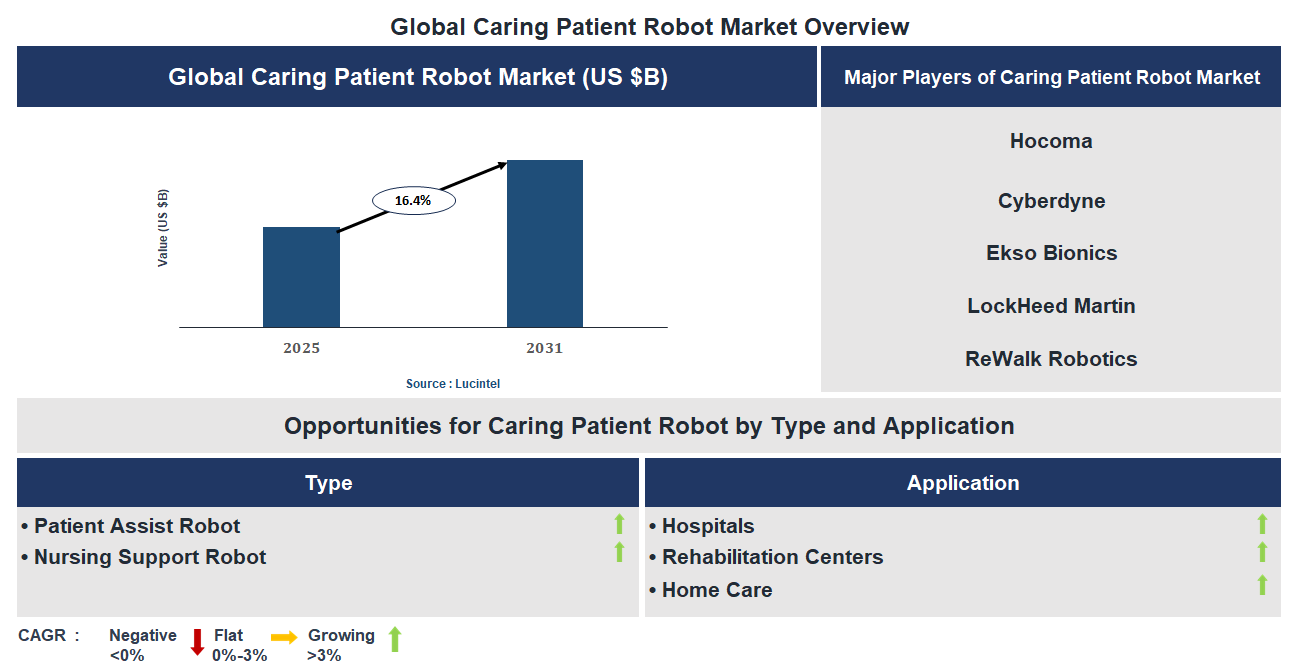
The future of the global caring patient robot market looks promising with opportunities in the hospital, rehabilitation center, and home care markets. The global caring patient robot market is expected to grow with a CAGR of 16.4% from 2025 to 2031. The major drivers for this market are the increasing demand for elderly care solutions, the rising adoption of robotic healthcare technology, and the growing need for cost-effective patient care.• Lucintel forecasts that, within the type category, patient assist robot is expected to witness higher growth over the forecast period.
• Within the application category, home care is expected to witness the highest growth.
• In terms of region, APAC is expected to witness the highest growth over the forecast period. Gain valuable insights for your business decisions with our comprehensive 150+ page report. Sample figures with some insights are shown below.
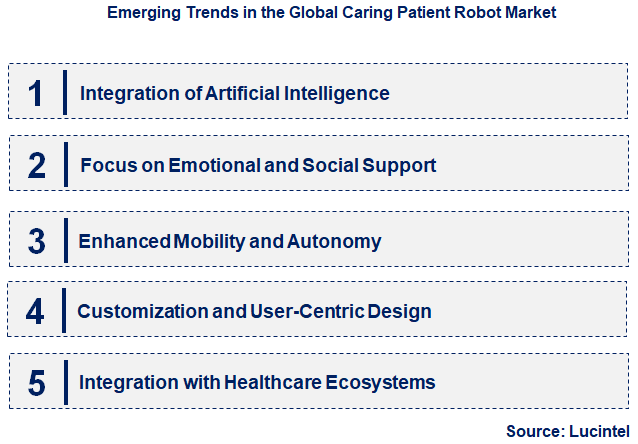
Emerging Trends in the Caring Patient Robot Market
The caring patient robot market is experiencing rapid growth driven by technological advancements, aging populations, and increasing healthcare demands. As hospitals and care facilities seek innovative solutions to improve patient outcomes and operational efficiency, robots are becoming integral to caregiving. These robots are designed to assist with tasks such as monitoring, companionship, and basic medical support, transforming traditional healthcare delivery. The markets evolution reflects a shift towards more personalized, efficient, and technology-driven care models. Emerging trends are shaping the future landscape, emphasizing automation, AI integration, and user-centric designs that cater to diverse patient needs and healthcare settings.• Integration of Artificial Intelligence: AI-powered caring robots are enhancing patient interaction by enabling natural language processing, emotional recognition, and personalized responses. This trend improves patient engagement, reduces staff workload, and allows for real-time health monitoring. AI also facilitates predictive analytics, helping anticipate patient needs and prevent complications, thus improving overall care quality. As AI technology advances, robots become more intuitive and capable of handling complex caregiving tasks, making them indispensable in modern healthcare environments.
• Focus on Emotional and Social Support: Robots are increasingly designed to provide companionship and emotional comfort, especially for elderly or isolated patients. These robots incorporate sensors and algorithms to recognize emotional cues and respond empathetically, reducing loneliness and improving mental health. This trend addresses the growing need for social interaction in healthcare, especially amid staffing shortages. By offering consistent, non-judgmental companionship, caring robots help foster a supportive environment, positively impacting patient recovery and well-being.
• Enhanced Mobility and Autonomy: Advances in robotics are leading to more mobile and autonomous caring robots capable of navigating complex hospital or home environments. These robots can perform tasks such as delivering medications, guiding patients, or assisting with mobility. Increased autonomy reduces reliance on human staff for routine tasks, allowing healthcare providers to focus on more critical interventions. Improved mobility also enables robots to operate in diverse settings, from hospitals to private homes, broadening their application scope and improving service delivery.
• Customization and User-Centric Design: The market is witnessing a shift towards highly customizable robots tailored to specific patient needs and care settings. User-centric designs prioritize ease of use, comfort, and cultural considerations, ensuring better acceptance and integration into daily routines. Customization options include adjustable interfaces, personalized interaction styles, and adaptable functionalities. This trend enhances patient satisfaction and compliance, making robots more effective caregivers. It also allows healthcare providers to deploy solutions that align with individual preferences and care protocols, fostering more personalized healthcare experiences.
• Integration with Healthcare Ecosystems: Caring robots are increasingly integrated into broader healthcare systems through IoT connectivity and electronic health records (EHR). This integration enables seamless data sharing, real-time monitoring, and coordinated care delivery. Robots can alert medical staff to changes in patient conditions, schedule appointments, or manage medication adherence automatically. Such connectivity enhances efficiency, reduces errors, and supports data-driven decision-making. As integration deepens, caring robots become vital components of smart healthcare ecosystems, improving overall operational workflows and patient outcomes. In summary, these emerging trends are fundamentally reshaping the caring patient robot market by making robots more intelligent, empathetic, autonomous, customizable, and integrated. This evolution is driving a shift towards more efficient, personalized, and holistic healthcare delivery, ultimately improving patient experiences and operational efficiencies across healthcare settings.
Recent Development in the Caring Patient Robot Market
The caring patient robot market has experienced significant growth driven by technological advancements, aging populations, and increasing healthcare demands. As hospitals and care facilities seek innovative solutions to improve patient outcomes and operational efficiency, robots are becoming integral to caregiving. Recent developments reflect a focus on enhancing robot capabilities, integration with healthcare systems, and addressing ethical considerations. These innovations are transforming patient care, reducing staff workload, and expanding access to healthcare services. The following key developments highlight the current trajectory of this evolving market, emphasizing technological, operational, and ethical progress.• Advanced AI Integration: The incorporation of sophisticated artificial intelligence enables robots to better understand patient needs, recognize emotions, and respond appropriately. This development improves patient engagement and personalized care, leading to higher satisfaction and better health outcomes. It also allows robots to assist with complex tasks, reducing the burden on healthcare staff and increasing efficiency.
• Enhanced Mobility and Dexterity: Recent innovations have improved robot mobility and dexterity, allowing them to navigate complex hospital environments and perform delicate tasks such as medication delivery and patient assistance. These advancements increase the robots versatility and safety, making them more effective in diverse healthcare settings and reducing the risk of accidents or errors.
• Telepresence and Remote Monitoring: The integration of telepresence technology enables healthcare providers to remotely monitor and interact with patients via robots. This development expands access to care, especially in remote or underserved areas, and facilitates continuous patient supervision. It also reduces the need for physical presence, minimizing infection risks and optimizing resource allocation.
• Focus on Ethical and Safety Standards: As robots become more autonomous, there is a growing emphasis on establishing strict safety protocols and ethical guidelines. This development aims to ensure patient privacy, data security, and safe robot operation. Regulatory bodies are working to create standards that foster trust and widespread adoption while safeguarding patient rights.
• Customization and User-Friendly Interfaces: The market has seen a shift toward customizable robots with intuitive interfaces tailored to different patient needs and care environments. This development enhances usability for both patients and healthcare providers, encouraging broader acceptance and integration into daily care routines. It also allows for better adaptation to individual preferences and conditions. In summary, these recent developments are significantly impacting the caring patient robot market by improving robot functionality, safety, and user experience. They are driving increased adoption across healthcare facilities, enhancing patient care quality, and addressing operational challenges. As technology continues to evolve, the market is poised for sustained growth, transforming traditional healthcare delivery models and expanding the role of robots in patient management.
Strategic Growth Opportunities in the Caring Patient Robot Market
The caring patient robot market is experiencing rapid evolution driven by technological advancements, increasing healthcare demands, and a focus on improving patient outcomes. As healthcare providers seek innovative solutions to enhance care delivery, patient robots are becoming integral in various applications. These developments are creating significant growth opportunities across multiple sectors, transforming traditional healthcare practices and improving efficiency. The following key growth opportunities by application highlight the potential for market expansion and innovation, shaping the future landscape of patient care through robotic solutions.• Enhanced independence and safety : Patient robots assist elderly individuals with daily activities, medication management, and emergency response, reducing caregiver burden and improving quality of life. This growth opportunity addresses the aging populations needs, fostering more autonomous living environments and reducing healthcare costs.
• Improved recovery outcomes : Robots in rehabilitation help patients regain mobility and strength through personalized, consistent therapy sessions. Their use accelerates recovery times, increases therapy adherence, and offers scalable solutions for healthcare providers, expanding access to quality rehabilitation services.
• Streamlined hospital workflows : Patient robots support tasks such as patient transport, inventory management, and basic patient monitoring. This reduces staff workload, minimizes errors, and enhances operational efficiency, leading to cost savings and improved patient experiences.
• Continuous health tracking : Robots equipped with sensors enable real-time monitoring of vital signs and health parameters outside clinical settings. This facilitates early intervention, reduces hospital readmissions, and supports telehealth initiatives, expanding healthcare reach.
• Engaging and comforting interactions : Robots designed for pediatric patients provide companionship, distraction during procedures, and health education. They improve patient cooperation, reduce anxiety, and enhance overall pediatric care experiences, fostering better health outcomes. In summary, these growth opportunities are significantly impacting the caring patient robot market by expanding its applications, improving patient outcomes, and optimizing healthcare delivery. As technology advances, the integration of robots across these key areas is expected to drive market growth, reduce costs, and enhance the quality of care provided to diverse patient populations.
Caring Patient Robot Market Driver and Challenges
The caring patient robot market is influenced by a variety of technological, economic, and regulatory factors that shape its growth and development. Advances in robotics, artificial intelligence, and healthcare technology are driving innovation, while economic considerations such as cost-effectiveness and healthcare expenditure impact adoption rates. Regulatory frameworks and safety standards also play a crucial role in shaping market dynamics. Additionally, demographic shifts, including aging populations, increase demand for patient care solutions. These factors collectively create opportunities and challenges that determine the trajectory of the caring patient robot market, requiring stakeholders to adapt to evolving technological capabilities, economic pressures, and regulatory requirements. The factors responsible for driving the caring patient robot market include:• Technological Innovation: The rapid development of robotics, AI, and sensor technologies enhances the capabilities of patient care robots, making them more efficient, reliable, and user-friendly. These innovations enable robots to perform complex tasks such as patient monitoring, assistance with mobility, and medication management, which improve patient outcomes and reduce healthcare provider workload. As technology continues to evolve, the integration of machine learning and IoT further expands the potential applications, fostering market growth and adoption across healthcare settings.
• Rising Aging Population: The global increase in elderly populations is a significant driver for the caring patient robot market. Older adults often require continuous care, assistance with daily activities, and health monitoring, which can strain healthcare resources. Patient robots offer a cost-effective and scalable solution to address these needs, providing companionship, mobility support, and health management. This demographic shift creates a sustained demand for innovative care solutions, encouraging healthcare providers and policymakers to invest in robotic technologies to improve quality of life for seniors.
• Healthcare Cost Reduction: Rising healthcare costs and the need for efficient resource utilization are fueling the adoption of patient care robots. Robots can reduce the burden on healthcare staff by automating routine tasks, minimizing human error, and enabling remote monitoring. This leads to shorter hospital stays, improved patient safety, and lower operational costs. As healthcare systems worldwide seek cost-effective solutions, the deployment of caring robots becomes an attractive strategy to optimize resource allocation and enhance service delivery.
• Regulatory Support and Standards: Governments and regulatory bodies are increasingly recognizing the importance of integrating robotics into healthcare, leading to supportive policies and standards. Clear guidelines for safety, efficacy, and ethical considerations facilitate market entry and adoption. Regulatory approval processes, when streamlined, encourage innovation and investment in caring robots. Moreover, compliance with international standards ensures interoperability and safety, boosting confidence among healthcare providers and patients, and accelerating market growth.
• Increasing Investment and Funding: The growing interest from private investors, venture capitalists, and government agencies is fueling innovation and commercialization in the caring patient robot market. Funding supports research and development, pilot projects, and large-scale deployments, enabling companies to refine their products and expand their market reach. Increased investment also attracts talent and fosters collaborations across technology and healthcare sectors, accelerating the pace of technological advancements and market penetration. The challenges facing this caring patient robot market include:
• High Development and Implementation Costs: Developing advanced caring robots involves significant investment in research, technology, and infrastructure. The costs associated with designing, testing, and deploying these robots can be prohibitive, especially for small and medium-sized enterprises. Additionally, integrating robots into existing healthcare systems requires substantial training and adaptation, which can further increase expenses. These high costs may hinder widespread adoption, particularly in resource-constrained settings, limiting market growth potential.
• Regulatory and Ethical Concerns: Despite supportive policies, regulatory approval processes for healthcare robots remain complex and time-consuming. Ensuring safety, efficacy, and ethical compliance is critical, but navigating diverse regulatory landscapes can delay product launches. Ethical issues related to patient privacy, data security, and the potential for reduced human interaction also pose challenges. Addressing these concerns requires comprehensive frameworks and stakeholder consensus, which can slow market progression and increase costs.
• Technological Limitations and Reliability: While technological advancements are rapid, current caring robots still face limitations in reliability, adaptability, and emotional intelligence. Robots may struggle with complex, unpredictable patient needs or nuanced human interactions, affecting their acceptance and effectiveness. Technical failures or malfunctions can compromise patient safety and trust, creating barriers to adoption. Overcoming these limitations requires ongoing innovation, rigorous testing, and validation, which can extend development timelines and increase costs. In summary, the caring patient robot market is driven by technological advancements, demographic shifts, cost-efficiency needs, regulatory support, and increased funding. However, high development costs, regulatory hurdles, and technological limitations pose significant challenges. These factors collectively influence the pace and scope of market growth, requiring stakeholders to balance innovation with practical and ethical considerations. The markets future depends on addressing these challenges effectively while leveraging technological and demographic opportunities to improve patient care worldwide.
List of Caring Patient Robot Companies
Companies in the market compete on the basis of product quality offered. Major players in this market focus on expanding their manufacturing facilities, R&D investments, infrastructural development, and leverage integration opportunities across the value chain. With these strategies caring patient robot companies cater increasing demand, ensure competitive effectiveness, develop innovative products & technologies, reduce production costs, and expand their customer base. Some of the caring patient robot companies profiled in this report include-• Hocoma
• Cyberdyne
• Ekso Bionics
• LockHeed Martin
• ReWalk Robotics
• Parker Hannifin
• Bionik
• ATOUN
• Myomo
• B-TEMIA Inc.
Caring Patient Robot Market by Segment
The study includes a forecast for the global caring patient robot market by type, application, and region.Caring Patient Robot Market by Type [Value from 2019 to 2031]:
• Patient Assist Robot
• Nursing Support Robot
Caring Patient Robot Market by Application [Value from 2019 to 2031]:
• Hospitals
• Rehabilitation Centers
• Home Care
Caring Patient Robot Market by Region [Value from 2019 to 2031]:
• North America
• Europe
• Asia Pacific
• The Rest of the World
Country Wise Outlook for the Caring Patient Robot Market
The caring patient robot market is experiencing rapid growth driven by technological advancements, aging populations, and increasing healthcare demands worldwide. Countries are investing heavily in robotics to improve patient care, reduce healthcare costs, and address workforce shortages. Innovations include AI-powered robots, remote monitoring systems, and assistive devices that enhance patient comfort and safety. As healthcare systems evolve, these robots are becoming integral to hospitals, nursing homes, and home care settings. The markets expansion reflects a global shift towards automation and digital health solutions, with each country tailoring developments to their specific healthcare needs and technological capabilities.• United States: The US market is leading in innovation, with significant investments in AI-driven patient care robots. Hospitals are adopting robots for tasks like medication delivery, patient monitoring, and physical assistance. Companies such as Intuitive Surgical and SoftBank are pioneering advanced robotic solutions, and regulatory frameworks are evolving to support wider deployment. The focus is on integrating robotics with telehealth and electronic health records, enhancing personalized care and operational efficiency.
• China: China is rapidly expanding its caring patient robot market, driven by government initiatives and a large aging population. Domestic companies like UBTECH and CloudMinds are developing affordable, multifunctional robots for hospitals and home care. The government promotes robotics as part of its "Made in China 2025" plan, emphasizing innovation and automation. The market sees a surge in AI integration, remote monitoring, and social robots designed to assist elderly and disabled patients.
• Germany: Germany emphasizes high-quality, reliable caring robots, especially in elder care and rehabilitation. Leading firms like KUKA and Fraunhofer Institute focus on precision engineering and safety standards. The country’s healthcare system adopts robots for physical therapy, mobility assistance, and patient transport. Germany’s strong industrial base and research institutions foster innovations in sensor technology, AI, and human-robot interaction, ensuring the market remains at the forefront of European healthcare robotics.
• India: India’s caring patient robot market is emerging, with a focus on affordability and scalability. Startups and established firms are developing cost-effective robots for rural and urban healthcare settings. The government’s Digital India initiative supports robotics integration into healthcare infrastructure. Key developments include remote monitoring devices, assistive robots for elderly care, and telepresence robots to bridge healthcare access gaps, especially in underserved regions.
• Japan: Japan remains a global leader in healthcare robotics, driven by its aging population and technological expertise. Companies like Panasonic and Toyota develop advanced robots for elder care, mobility assistance, and companionship. Japan emphasizes human-robot interaction, with innovations in soft robotics and AI. The government promotes robotics as part of its aging society strategy, fostering collaborations between industry and academia to enhance robot functionality, safety, and acceptance in healthcare environments.

Features of the Global Caring Patient Robot Market
Market Size Estimates: Caring patient robot market size estimation in terms of value ($B). Trend and Forecast Analysis: Market trends (2019 to 2024) and forecast (2025 to 2031) by various segments and regions. Segmentation Analysis: Caring patient robot market size by type, application, and region in terms of value ($B). Regional Analysis: Caring patient robot market breakdown by North America, Europe, Asia Pacific, and Rest of the World. Growth Opportunities: Analysis of growth opportunities in different types, applications, and regions for the caring patient robot market. Strategic Analysis: This includes M&A, new product development, and competitive landscape of the caring patient robot market. Analysis of competitive intensity of the industry based on Porter’s Five Forces model.
FAQ
Q1. What is the growth forecast for caring patient robot market? Answer: The global caring patient robot market is expected to grow with a CAGR of 16.4% from 2025 to 2031. Q2. What are the major drivers influencing the growth of the caring patient robot market? Answer: The major drivers for this market are the increasing demand for elderly care solutions, the rising adoption of robotic healthcare technology, and the growing need for cost-effective patient care. Q3. What are the major segments for caring patient robot market? Answer: The future of the caring patient robot market looks promising with opportunities in the hospital, rehabilitation center, and home care markets. Q4. Who are the key caring patient robot market companies? Answer: Some of the key caring patient robot companies are as follows:• Hocoma
• Cyberdyne
• Ekso Bionics
• LockHeed Martin
• ReWalk Robotics
• Parker Hannifin
• Bionik
• ATOUN
• Myomo
• B-TEMIA Inc. Q5. Which caring patient robot market segment will be the largest in future? Answer: Lucintel forecasts that, within the type category, patient assist robot is expected to witness higher growth over the forecast period. Q6. In caring patient robot market, which region is expected to be the largest in next 5 years? Answer: In terms of region, APAC is expected to witness the highest growth over the forecast period. Q7. Do we receive customization in this report? Answer: Yes, Lucintel provides 10% customization without any additional cost.
Table of Contents
List of Figures
List of Tables
Methodology
- In-depth interviews of the major players in this market
- Detailed secondary research from competitors’ financial statements and published data
- Extensive searches of published works, market, and database information pertaining to industry news, company press releases, and customer intentions
- A compilation of the experiences, judgments, and insights of Lucintel’s professionals, who have analyzed and tracked this market over the years.


Buy Now
Choose a license that fits your team. Instant PDF delivery.
Prices exclude taxes. Instant delivery. Custom licensing available on request.
Key Questions
- • What are some of the most promising, high-growth opportunities for the caring patient robot market by type (patient assist robot and nursing support robot), application (hospitals, rehabilitation centers, and home care), and region (North America, Europe, Asia Pacific, and the Rest of the World)?
- • Which segments will grow at a faster pace and why?
- • Which region will grow at a faster pace and why?
- • What are the key factors affecting market dynamics? What are the key challenges and business risks in this market?
- • What are the business risks and competitive threats in this market?
- • What are the emerging trends in this market and the reasons behind them?
- • What are some of the changing demands of customers in the market?
- • What are the new developments in the market? Which companies are leading these developments?
- • Who are the major players in this market? What strategic initiatives are key players pursuing for business growth?
- • What are some of the competing products in this market and how big of a threat do they pose for loss of market share by material or product substitution?
- • What M&A activity has occurred in the last 5 years and what has its impact been on the industry? For any questions related to Caring Patient Robot Market, Caring Patient Robot Market Size, Caring Patient Robot Market Growth, Caring Patient Robot Market Analysis, Caring Patient Robot Market Report, Caring Patient Robot Market Share, Caring Patient Robot Market Trends, Caring Patient Robot Market Forecast, Caring Patient Robot Companies, write Lucintel analyst at email: helpdesk@lucintel.com. We will be glad to get back to you soon.


