
Report Feature
Carbonated Beverage Processing Equipment Market Trends and Forecast
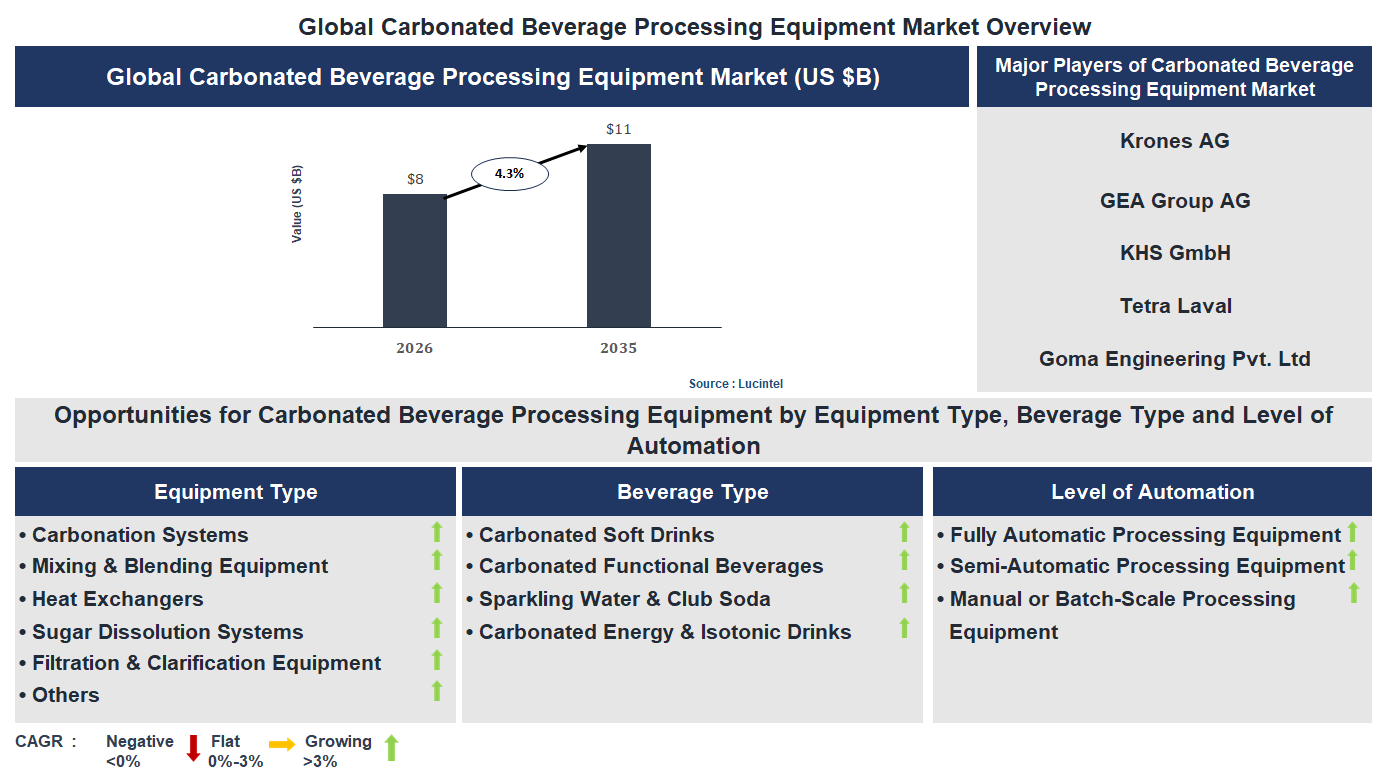
The future of the global carbonated beverage processing equipment market looks promising with opportunities in the carbonated soft drink, carbonated functional beverage, sparkling water & club soda, and carbonated energy & isotonic drink markets. The global carbonated beverage processing equipment market is expected to reach an estimated $11 billion by 2035 with a CAGR of 4.3% from 2026 to 2035. The major drivers for this market are the increasing demand for carbonated soft drinks, the rising focus on beverage production efficiency, and the growing popularity of flavored carbonated beverages.• Lucintel forecasts that, within the equipment type category, carbonation system is expected to witness the highest growth over the forecast period.
• Within the beverage type category, carbonated soft drink is expected to witness the highest growth.
• In terms of region, North America is expected to witness the highest growth over the forecast period. Gain valuable insights for your business decisions with our comprehensive 150+ page report. Sample figures with some insights are shown below.
Emerging Trends in the Carbonated Beverage Processing Equipment Market
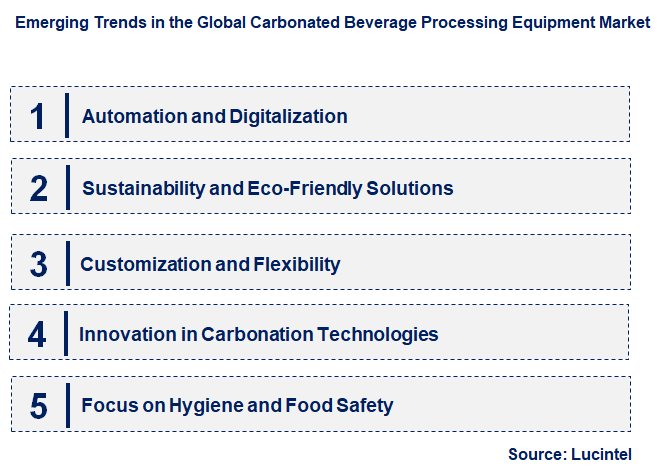
The carbonated beverage processing equipment market is experiencing rapid evolution driven by technological advancements, changing consumer preferences, and increasing demand for innovative beverage solutions. Manufacturers are focusing on efficiency, sustainability, and customization to meet market needs. As the industry adapts to these shifts, several key trends are emerging that are shaping the future landscape of carbonated beverage production. These trends reflect a move towards more sustainable, efficient, and consumer-centric approaches, influencing product development, manufacturing processes, and market strategies. Understanding these developments is crucial for stakeholders aiming to stay competitive and capitalize on new opportunities in this dynamic market.• Automation and Digitalization: The integration of automation and digital technologies is transforming beverage processing. Advanced sensors, IoT devices, and AI-driven systems enable real-time monitoring, predictive maintenance, and enhanced quality control. This reduces downtime, minimizes waste, and improves overall efficiency. Digitalization also facilitates data-driven decision-making, allowing manufacturers to optimize production processes and respond swiftly to market demands. As a result, companies can achieve higher productivity, lower operational costs, and better product consistency, giving them a competitive edge in a fast-paced industry.
• Sustainability and Eco-Friendly Solutions: Increasing environmental concerns are pushing the industry toward sustainable practices. Manufacturers are adopting eco-friendly equipment that reduces water and energy consumption, minimizes waste, and utilizes recyclable materials. Innovations such as energy-efficient compressors, eco-conscious packaging, and water-saving technologies are gaining prominence. These efforts not only help companies meet regulatory standards but also appeal to environmentally conscious consumers. The shift toward sustainability is reshaping equipment design and operational strategies, fostering a greener, more responsible beverage processing industry.
• Customization and Flexibility: Consumer preferences are shifting towards personalized and unique beverage options. Equipment that offers high flexibility and customization capabilities is in high demand. Modular systems allow producers to easily switch between different flavors, carbonation levels, and packaging formats. This trend enables small and medium-sized enterprises to innovate rapidly and respond to niche markets. The ability to produce customized beverages efficiently is becoming a key differentiator, encouraging equipment manufacturers to develop versatile, adaptable processing solutions that cater to diverse customer needs.
• Innovation in Carbonation Technologies: Advances in carbonation methods are enhancing product quality and shelf life. New techniques such as microbubbles and controlled carbonation systems improve carbonation stability and sensory attributes. These innovations allow for better control over carbonation levels, resulting in more consistent products. Additionally, innovative carbonation equipment reduces gas wastage and energy consumption, aligning with sustainability goals. As consumers seek fresher, more vibrant beverages, these technological improvements are critical in maintaining product appeal and competitive advantage in the market.
• Focus on Hygiene and Food Safety: Stringent regulations and consumer awareness are emphasizing hygiene and safety in beverage processing. Equipment with enhanced sanitation features, such as CIP (Clean-in-Place) systems and antimicrobial surfaces, is increasingly adopted. These innovations reduce contamination risks, ensure compliance with safety standards, and extend equipment lifespan. The focus on hygiene not only safeguards consumer health but also minimizes downtime and cleaning costs. As a result, manufacturers are investing in advanced, easy-to-clean processing equipment to meet evolving safety requirements and maintain high-quality standards. These emerging trends, automation and digitalization, sustainability, customization, technological innovation, and hygiene, are collectively reshaping the carbonated beverage processing equipment market. They are driving increased efficiency, environmental responsibility, product diversity, and safety, ultimately enabling industry players to meet evolving consumer demands and stay competitive in a rapidly changing landscape.
Recent Development in the Carbonated Beverage Processing Equipment Market
The carbonated beverage processing equipment market is experiencing rapid innovation driven by consumer demand for healthier options, technological advancements, and sustainability initiatives. Companies are investing in automation, eco-friendly materials, and efficient production methods to meet evolving industry standards. These developments are shaping the future landscape, offering new growth opportunities and competitive advantages. As the market adapts to changing preferences and regulations, understanding these key trends is essential for stakeholders aiming to capitalize on emerging prospects.• Automation and Digital Integration: Enhancing Efficiency and Consistency in Production: The integration of automation and digital technologies in carbonated beverage processing equipment is revolutionizing manufacturing. Automated systems improve precision, reduce labor costs, and increase throughput, enabling companies to meet high demand efficiently. Digital controls facilitate real-time monitoring and quality assurance, minimizing errors and waste. This technological shift enhances overall productivity, ensures product consistency, and allows for rapid adaptation to market changes, positioning companies for sustained growth and competitiveness.
• Eco-Friendly Materials and Sustainable Practices: Reducing Environmental Impact and Meeting Regulations: The adoption of eco-friendly materials and sustainable practices is gaining momentum in the industry. Equipment made from recyclable, biodegradable, or low-impact materials reduces environmental footprint. Sustainable practices such as water and energy conservation are being integrated into processing lines. These initiatives help companies comply with stringent environmental regulations, appeal to eco-conscious consumers, and reduce operational costs. Emphasizing sustainability enhances brand reputation and opens new market segments focused on green products.
• Innovation in Carbonation Technology: Improving Product Quality and Shelf Life: Advances in carbonation technology are enabling producers to create more consistent and high-quality beverages. New methods allow precise control over carbonation levels, enhancing sensory attributes and consumer satisfaction. Improved carbonation techniques also extend shelf life by reducing contamination risks and maintaining carbonation stability over time. These innovations support product differentiation, meet consumer preferences for premium quality, and enable brands to introduce novel beverage formats, boosting market share and profitability.
• Customization and Flexible Equipment Design: Catering to Diverse Consumer Preferences: The trend toward personalized beverages is driving demand for flexible processing equipment. Modular and adaptable systems allow manufacturers to produce a wide range of flavors, formulations, and packaging options efficiently. Customization capabilities enable quick product changes, reducing downtime and increasing responsiveness to market trends. This flexibility supports small-batch production and innovation, helping companies meet diverse consumer demands and expand their product portfolios, ultimately strengthening their market position.
• Integration of IoT and Data Analytics: Optimizing Operations and Predictive Maintenance: The incorporation of IoT devices and data analytics into processing equipment is transforming operational management. Real-time data collection enables predictive maintenance, reducing downtime and repair costs. Analytics provide insights into process efficiencies, energy consumption, and quality control, facilitating continuous improvement. This technological integration enhances operational transparency, reduces waste, and improves overall productivity. Companies leveraging IoT and analytics gain a competitive edge by making data-driven decisions and optimizing resource utilization. These developments are significantly transforming the carbonated beverage processing equipment market by enhancing efficiency, sustainability, and product quality. Automation, eco-friendly practices, innovative carbonation, flexible design, and IoT integration are creating new growth avenues and competitive advantages. As companies adopt these technologies, the market is expected to see increased innovation, reduced environmental impact, and improved consumer satisfaction. Overall, these trends are driving a more dynamic, sustainable, and customer-centric industry landscape.
Strategic Growth Opportunities in the Carbonated Beverage Processing Equipment Market
The carbonated beverage processing equipment market is experiencing rapid growth driven by increasing consumer demand for innovative, high-quality carbonated drinks worldwide. Technological advancements, expanding product portfolios, and rising health-consciousness are shaping market dynamics. Manufacturers are investing in automation, sustainability, and customization to meet diverse consumer preferences. This evolving landscape presents significant opportunities for industry players to enhance efficiency, reduce costs, and develop new product lines, ultimately fueling market expansion and competitive advantage.• Automation and Smart Technology Integration: Implementing automation and IoT-enabled systems in carbonation and filling processes enhances efficiency, reduces labor costs, and improves product consistency. Smart equipment allows real-time monitoring, predictive maintenance, and data-driven decision-making, leading to minimized downtime and optimized production. As industry standards evolve, automation becomes essential for meeting quality and safety regulations, providing a competitive edge, and enabling manufacturers to scale operations effectively.
• Development of Eco-Friendly and Sustainable Equipment: Growing environmental concerns drive demand for sustainable processing solutions. Manufacturers are focusing on energy-efficient machinery, water-saving technologies, and recyclable materials to reduce carbon footprints. Incorporating eco-friendly features not only aligns with regulatory requirements but also appeals to environmentally conscious consumers. Sustainable equipment design can lower operational costs and enhance brand reputation, making it a key growth avenue in the market.
• Expansion into Emerging Markets: Rapid urbanization and rising disposable incomes in developing regions create substantial opportunities for market expansion. Local manufacturers and global players are investing in regional production facilities and distribution networks to cater to increasing demand for carbonated beverages. Tailoring equipment to local production needs and preferences can facilitate market entry, foster brand loyalty, and accelerate growth in these high-potential markets.
• Customization and Flexibility in Equipment Design: The demand for diverse flavors, packaging sizes, and product formats necessitates adaptable processing equipment. Modular and flexible machinery allows manufacturers to quickly switch between product types, reducing downtime and increasing responsiveness to market trends. Customization capabilities enable brands to differentiate themselves and meet specific consumer preferences, fostering innovation and expanding product offerings in a competitive landscape.
• Focus on Hygiene and Food Safety Standards: Stringent regulations require advanced cleaning, sterilization, and contamination prevention measures. Equipment designed with hygienic features, such as easy-to-clean surfaces and CIP (Clean-in-Place) systems, ensures compliance and reduces contamination risks. Investing in safety-compliant machinery enhances product quality, consumer trust, and brand integrity. This focus on safety standards is crucial for market players aiming to maintain competitiveness and meet evolving regulatory requirements. The overall impact of these growth opportunities is a dynamic, innovative market poised for sustained expansion. Embracing automation, sustainability, regional growth, customization, and safety will enable industry players to meet evolving consumer demands, improve operational efficiency, and strengthen their market positions, ultimately driving long-term success in the carbonated beverage processing equipment industry.
Carbonated Beverage Processing Equipment Market Driver and Challenges
The carbonated beverage processing equipment market is influenced by a variety of technological, economic, and regulatory factors. Innovations in equipment design, automation, and sustainability are driving growth, while economic fluctuations impact consumer spending and production costs. Regulatory standards related to health, safety, and environmental concerns also shape market dynamics. Additionally, consumer preferences for healthier and innovative beverage options influence product development and equipment requirements. Navigating these diverse factors requires industry players to adapt swiftly to technological advancements, comply with evolving regulations, and respond to shifting market demands, ultimately shaping the growth trajectory of this competitive sector. The factors responsible for driving the carbonated beverage processing equipment market include:• Technological Innovation: The continuous development of advanced processing equipment enhances efficiency, product quality, and scalability. Innovations such as automated filling lines, carbonation systems, and energy-efficient machinery reduce operational costs and improve production speed. These technological advancements enable manufacturers to meet increasing demand for high-quality carbonated beverages while maintaining compliance with safety standards. As technology evolves, companies that adopt cutting-edge equipment can differentiate themselves in a competitive market, leading to increased market share and revenue growth.
• Growing Consumer Demand for Novelty and Healthier Options: Consumers are increasingly seeking innovative, healthier, and low-calorie carbonated beverages. This shift drives manufacturers to develop new formulations and invest in specialized processing equipment capable of handling diverse ingredients and packaging formats. The demand for organic, sugar-free, and functional beverages pushes the industry to upgrade existing machinery or acquire new equipment tailored to these products. This trend fosters market expansion as companies innovate to meet evolving consumer preferences, thereby boosting sales and market penetration.
• Expansion in Emerging Markets: Rapid urbanization, rising disposable incomes, and changing lifestyles in emerging economies are fueling demand for carbonated beverages. This growth encourages equipment manufacturers to establish local production facilities and supply chains, adapting their machinery to regional preferences and regulatory requirements. The expansion into these markets offers significant revenue opportunities and drives technological adaptation to meet local standards, ultimately contributing to global market growth and diversification.
• Increasing Focus on Sustainability and Energy Efficiency: Environmental concerns and regulatory pressures are prompting manufacturers to adopt sustainable practices. This includes investing in energy-efficient machinery, waste reduction systems, and eco-friendly packaging solutions. Equipment that minimizes water and energy consumption not only reduces operational costs but also aligns with corporate social responsibility goals. The push for sustainability influences equipment design and procurement decisions, fostering innovation and creating a competitive advantage for companies that prioritize eco-friendly solutions.
• Strategic Partnerships and Mergers & Acquisitions: Collaborations between equipment manufacturers, beverage companies, and technology providers facilitate the development of innovative processing solutions. Mergers and acquisitions enable access to new markets, advanced technologies, and expanded product portfolios. These strategic moves accelerate market growth by fostering innovation, increasing production capacity, and enhancing distribution networks. Such collaborations also help companies stay ahead of regulatory changes and consumer trends, ensuring long-term competitiveness in the evolving market landscape. The challenges facing the carbonated beverage processing equipment market include:
• Stringent Regulatory Compliance: The industry faces complex regulations related to food safety, labeling, and environmental standards. Compliance requires significant investment in testing, certification, and process modifications, which can increase operational costs and delay product launches. Navigating diverse regulatory environments across regions adds complexity, especially for small and medium-sized enterprises. Failure to comply can result in legal penalties, product recalls, and damage to brand reputation, posing a substantial challenge to market players.
• High Capital Investment and Operational Costs: The installation and maintenance of advanced processing equipment demand substantial capital expenditure. Small and emerging companies may find it difficult to afford such investments, limiting their market participation. Additionally, operational costs related to energy, water, and raw materials fluctuate, impacting profit margins. The need for continuous upgrades to keep pace with technological advancements further strains financial resources, making cost management a critical challenge for sustainable growth.
• Rapid Technological Changes and Obsolescence: The fast pace of technological innovation can render existing equipment obsolete quickly. Companies must continually invest in upgrading or replacing machinery to stay competitive, which can be costly and disruptive. Keeping up with industry standards and integrating new technologies requires expertise and strategic planning. Failure to adapt promptly may result in reduced efficiency, lower product quality, and loss of market share, emphasizing the importance of agility in technological adoption. The carbonated beverage processing equipment market is shaped by technological advancements, changing consumer preferences, and regulatory frameworks. While these drivers foster growth and innovation, challenges such as compliance costs, high capital requirements, and rapid technological changes pose significant hurdles. Companies that effectively navigate these factors through innovation, strategic partnerships, and sustainable practices are positioned for long-term success. Overall, the markets evolution will depend on balancing technological progress with regulatory adherence and cost management, ensuring resilient growth amid dynamic industry conditions.
List of Carbonated Beverage Processing Equipment Companies
Companies in the market compete on the basis of product quality offered. Major players in this market focus on expanding their manufacturing facilities, R&D investments, infrastructural development, and leverage integration opportunities across the value chain. With these strategies carbonated beverage processing equipment companies cater increasing demand, ensure competitive effectiveness, develop innovative products & technologies, reduce production costs, and expand their customer base. Some of the carbonated beverage processing equipment companies profiled in this report include-• Krones AG
• GEA Group AG
• KHS GmbH
• Tetra Laval
• Goma Engineering Pvt. Ltd
• Alfa Laval AB
• A DUE SpA
• Bajaj Group
• Pentair Plc
• Raj Innotech Pvt. Ltd.
Carbonated Beverage Processing Equipment Market by Segment
The study includes a forecast for the global carbonated beverage processing equipment market by equipment type, beverage type, level of automation, and region.Carbonated Beverage Processing Equipment Market by Equipment Type [Value from 2019 to 2035]:
• Carbonation Systems
• Mixing & Blending Equipment
• Heat Exchangers
• Sugar Dissolution Systems
• Filtration & Clarification Equipment
• Others
Carbonated Beverage Processing Equipment Market by Beverage Type [Value from 2019 to 2035]:
• Carbonated Soft Drinks
• Carbonated Functional Beverages
• Sparkling Water & Club Soda
• Carbonated Energy & Isotonic Drinks
Carbonated Beverage Processing Equipment Market by Level of Automation [Value from 2019 to 2035]:
• Fully Automatic Processing Equipment
• Semi-Automatic Processing Equipment
• Manual or Batch-Scale Processing Equipment
Carbonated Beverage Processing Equipment Market by Region [Value from 2019 to 2035]:
• North America
• Europe
• Asia Pacific
• The Rest of the World
Country Wise Outlook for the Carbonated Beverage Processing Equipment Market
The carbonated beverage processing equipment market has experienced significant growth driven by increasing consumer demand for innovative and healthier beverage options, technological advancements, and expanding markets worldwide. As the industry evolves, key players are investing in automation, sustainability, and product customization to meet diverse consumer preferences. Regulatory standards and environmental concerns are also shaping the development of more efficient and eco-friendly equipment. The markets trajectory varies across regions, influenced by local economic conditions, consumer trends, and technological adoption. Understanding these regional developments provides insight into the global landscape and future opportunities within the carbonated beverage processing sector.• United States: The U.S. market has seen a surge in automation and smart equipment integration, enhancing efficiency and product consistency. Companies are focusing on sustainable solutions, such as energy-efficient machinery and waste reduction technologies. The demand for healthier, low-sugar beverages has prompted equipment manufacturers to develop versatile systems capable of handling diverse formulations. Additionally, innovations in packaging and carbonation techniques are gaining popularity, driven by consumer preferences for convenience and eco-friendliness. Regulatory compliance and safety standards continue to influence equipment design and operation, fostering industry-wide improvements.
• China: Chinas market is rapidly expanding due to rising disposable incomes and urbanization, leading to increased demand for carbonated beverages. Local manufacturers are adopting advanced processing equipment to improve production capacity and product quality. There is a notable shift towards automation and digital control systems to enhance efficiency and reduce labor costs. The government’s focus on environmental sustainability is encouraging the adoption of energy-efficient and water-saving technologies. Moreover, domestic companies are investing in R&D to develop innovative equipment tailored to regional tastes and preferences, supporting the growth of premium and functional beverage segments.
• Germany: Germany remains a key player in the European carbonated beverage equipment market, emphasizing high-quality, precision engineering, and sustainability. The industry is characterized by the adoption of eco-friendly technologies, such as energy-efficient compressors and recyclable materials. German manufacturers are leading in automation and process optimization, ensuring consistent product quality and reducing operational costs. The focus on innovation includes equipment capable of handling organic and natural ingredients, aligning with consumer trends towards health-conscious products. Regulatory standards in Europe also drive the development of safer, more sustainable processing solutions, maintaining Germany’s competitive edge.
• India: The Indian market is witnessing rapid growth driven by increasing urbanization, changing lifestyles, and a young demographic eager for diverse beverage options. Manufacturers are investing in scalable, cost-effective processing equipment to meet rising demand. Automation and digital controls are becoming more prevalent to improve efficiency and reduce manual labor. The focus on local sourcing and affordability is leading to innovations in equipment design that cater to small and medium-sized enterprises. Additionally, there is a growing emphasis on sustainable practices, including water conservation and energy efficiency, to align with global environmental standards and consumer expectations.
• Japan: Japan’s market is characterized by technological innovation and a focus on quality and safety. Advanced processing equipment with high precision and automation is widely adopted to ensure product consistency. The industry is also exploring eco-friendly technologies, such as energy-efficient carbonation systems and waste reduction methods. Consumer preferences for health-oriented and functional beverages are influencing equipment development, with an emphasis on versatility and customization. Japan’s strict regulatory environment fosters continuous improvements in safety standards and environmental impact, positioning the country as a leader in innovative, sustainable beverage processing solutions.

Features of the Global Carbonated Beverage Processing Equipment Market
Market Size Estimates: Carbonated beverage processing equipment market size estimation in terms of value ($B). Trend and Forecast Analysis: Market trends (2019 to 2025) and forecast (2026 to 2035) by various segments and regions. Segmentation Analysis: Carbonated beverage processing equipment market size by equipment type, beverage type, level of automation, and region in terms of value ($B). Regional Analysis: Carbonated beverage processing equipment market breakdown by North America, Europe, Asia Pacific, and Rest of the World. Growth Opportunities: Analysis of growth opportunities in different equipment types, beverage types, levels of automation, and regions for the carbonated beverage processing equipment market. Strategic Analysis: This includes M&A, new product development, and competitive landscape of the carbonated beverage processing equipment market. Analysis of competitive intensity of the industry based on Porter’s Five Forces model.
FAQ
Q1. What is the carbonated beverage processing equipment market size? Answer: The global carbonated beverage processing equipment market is expected to reach an estimated $11 billion by 2035. Q2. What is the growth forecast for carbonated beverage processing equipment market? Answer: The global carbonated beverage processing equipment market is expected to grow with a CAGR of 4.3% from 2026 to 2035. Q3. What are the major drivers influencing the growth of the carbonated beverage processing equipment market? Answer: The major drivers for this market are the increasing demand for carbonated soft drinks, the rising focus on beverage production efficiency, and the growing popularity of flavored carbonated beverages. Q4. What are the major segments for carbonated beverage processing equipment market? Answer: The future of the carbonated beverage processing equipment market looks promising with opportunities in the carbonated soft drink, carbonated functional beverage, sparkling water & club soda, and carbonated energy & isotonic drink markets. Q5. Who are the key carbonated beverage processing equipment market companies? Answer: Some of the key carbonated beverage processing equipment companies are as follows:• Krones AG
• GEA Group AG
• KHS GmbH
• Tetra Laval
• Goma Engineering Pvt. Ltd
• Alfa Laval AB
• A DUE SpA
• Bajaj Group
• Pentair Plc
• Raj Innotech Pvt. Ltd. Q6. Which carbonated beverage processing equipment market segment will be the largest in future? Answer: Lucintel forecasts that, within the equipment type category, carbonation system is expected to witness the highest growth over the forecast period. Q7. In carbonated beverage processing equipment market, which region is expected to be the largest in next 8 years? Answer: In terms of region, North America is expected to witness the highest growth over the forecast period. Q8. Do we receive customization in this report? Answer: Yes, Lucintel provides 10% customization without any additional cost.
Table of Contents
List of Figures
List of Tables
Methodology
- In-depth interviews of the major players in this market
- Detailed secondary research from competitors’ financial statements and published data
- Extensive searches of published works, market, and database information pertaining to industry news, company press releases, and customer intentions
- A compilation of the experiences, judgments, and insights of Lucintel’s professionals, who have analyzed and tracked this market over the years.


Buy Now
Choose a license that fits your team. Instant PDF delivery.
Prices exclude taxes. Instant delivery. Custom licensing available on request.
Key Questions
- • What are some of the most promising, high-growth opportunities for the carbonated beverage processing equipment market by equipment type (carbonation systems, mixing & blending equipment, heat exchangers, sugar dissolution systems, filtration & clarification equipment, and others), beverage type (carbonated soft drinks, carbonated functional beverages, sparkling water & club soda, and carbonated energy & isotonic drinks), level of automation (fully automatic processing equipment, semi-automatic processing equipment, and manual or batch-scale processing equipment), and region (North America, Europe, Asia Pacific, and the Rest of the World)?
- • Which segments will grow at a faster pace and why?
- • Which region will grow at a faster pace and why?
- • What are the key factors affecting market dynamics? What are the key challenges and business risks in this market?
- • What are the business risks and competitive threats in this market?
- • What are the emerging trends in this market and the reasons behind them?
- • What are some of the changing demands of customers in the market?
- • What are the new developments in the market? Which companies are leading these developments?
- • Who are the major players in this market? What strategic initiatives are key players pursuing for business growth?
- • What are some of the competing products in this market and how big of a threat do they pose for loss of market share by material or product substitution?
- • What M&A activity has occurred in the last 7 years and what has its impact been on the industry? For any questions related to Carbonated Beverage Processing Equipment Market, Carbonated Beverage Processing Equipment Market Size, Carbonated Beverage Processing Equipment Market Growth, Carbonated Beverage Processing Equipment Market Analysis, Carbonated Beverage Processing Equipment Market Report, Carbonated Beverage Processing Equipment Market Share, Carbonated Beverage Processing Equipment Market Trends, Carbonated Beverage Processing Equipment Market Forecast, Carbonated Beverage Processing Equipment Companies, write Lucintel analyst at email: helpdesk@lucintel.com. We will be glad to get back to you soon.


