
Market Report · July 22, 2026

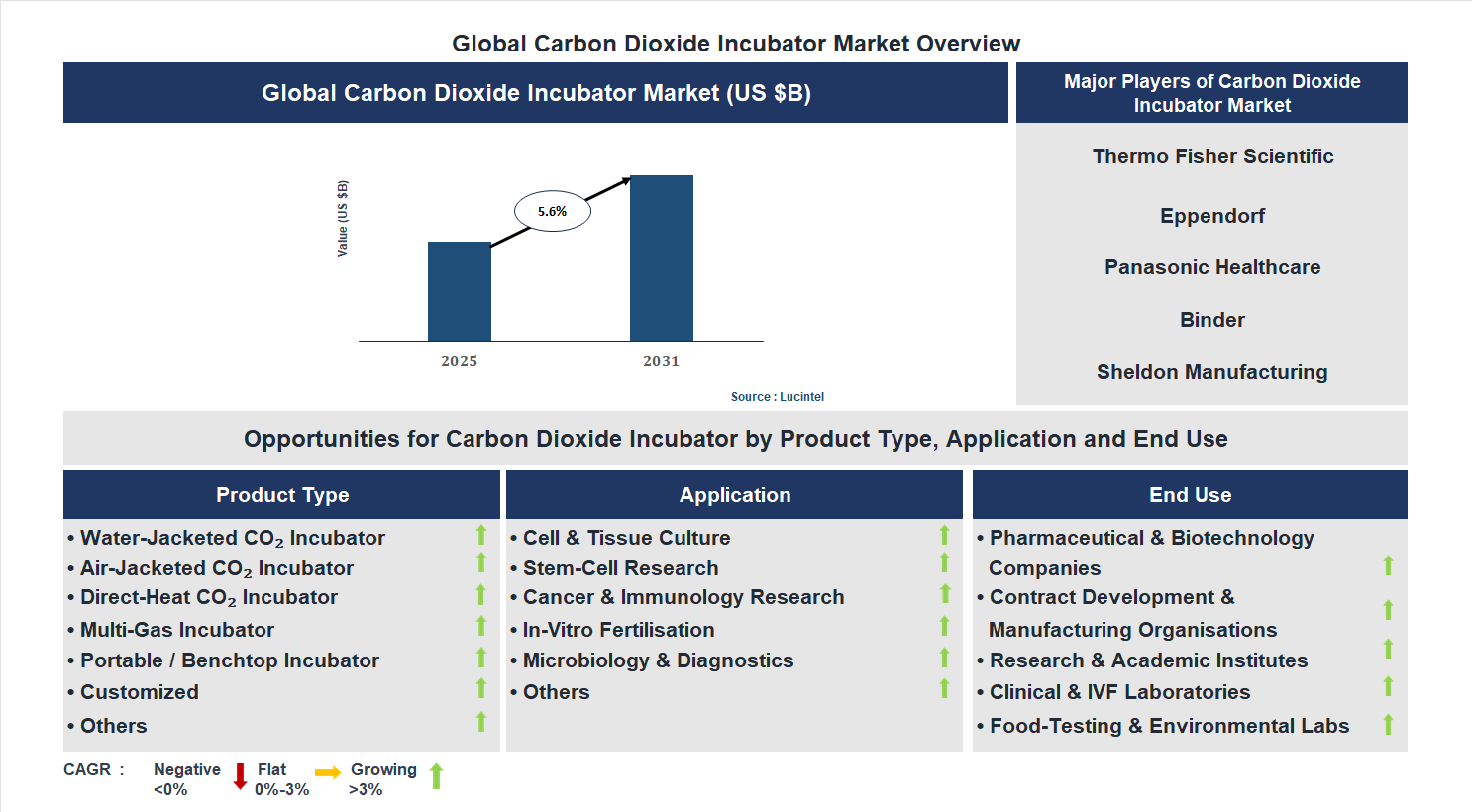
Key data points: The growth forecast = 5.6% annually for the next 7 years. Scroll below to get more insights. This market report covers trends, opportunities and forecasts in carbon dioxide incubator market to 2031 by product type (water-jacketed CO₂ incubator, air-jacketed CO₂ incubator, direct-heat CO₂ incubator, multi-gas incubator, portable / benchtop incubator, customized, and others), application (cell & tissue culture, stem-cell research, cancer & immunology research, in-vitro fertilisation, microbiology & diagnostics, and others), end use (pharmaceutical & biotechnology companies, contract development & manufacturing organisations, research & academic institutes, clinical & ivf laboratories, and food-testing & environmental labs), and region (North America, Europe, Asia Pacific, and the Rest of the World)
We'll send your sample report shortly.
• Lucintel forecasts that, within the product type category, water-jacketed CO₂ incubator is expected to witness the highest growth over the forecast period.
• Within the end use category, contract development & manufacturing organisation is expected to witness the highest growth.
• In terms of region, APAC is expected to witness the highest growth over the forecast period. Gain valuable insights for your business decisions with our comprehensive 150+ page report. Sample figures with some insights are shown below.
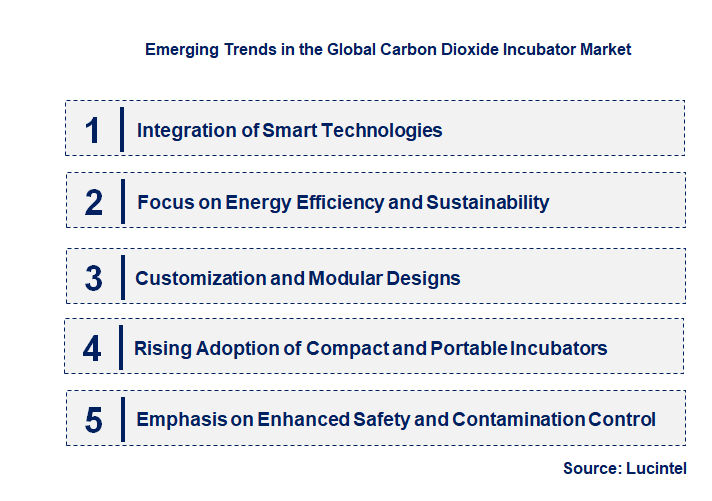
• Integration of Smart Technologies: The adoption of IoT and automation features in CO2 incubators is transforming laboratory workflows. Smart incubators enable remote monitoring, real-time data collection, and automated adjustments, improving accuracy and reducing human error. This trend enhances operational efficiency, ensures consistent environmental conditions, and facilitates data management, which is crucial for compliance and research reproducibility. As laboratories seek more sophisticated solutions, smart technology integration is becoming a key differentiator among market players.
• Focus on Energy Efficiency and Sustainability: Environmental concerns and rising energy costs are prompting manufacturers to develop energy-efficient incubators. These models incorporate advanced insulation, energy-saving components, and eco-friendly materials to reduce power consumption. This trend aligns with global sustainability initiatives and appeals to institutions aiming to minimize their carbon footprint. Energy-efficient incubators not only lower operational costs but also meet regulatory standards, making them increasingly preferred in research and clinical settings.
• Customization and Modular Designs: The market is witnessing a shift towards customizable and modular incubator solutions tailored to specific research needs. Modular designs allow easy upgrades, maintenance, and scalability, providing flexibility for diverse applications. Customization options include adjustable temperature and CO2 levels, specialized chamber sizes, and integrated accessories. This trend caters to the growing demand for personalized laboratory equipment, enabling researchers to optimize conditions for various experiments and improve overall productivity.
• Rising Adoption of Compact and Portable Incubators: The demand for compact, portable CO2 incubators is increasing, especially in point-of-care testing, field research, and small laboratories. These units offer space-saving benefits, ease of transport, and quick setup, making them ideal for mobile or decentralized research environments. The trend is driven by the need for flexible, on-the-go solutions that do not compromise on performance, thereby expanding the market reach into new segments and applications.
• Emphasis on Enhanced Safety and Contamination Control: Ensuring sample integrity and safety is paramount in research and clinical laboratories. Manufacturers are incorporating advanced features such as HEPA filters, UV sterilization, and airtight chambers to prevent contamination. These safety enhancements reduce the risk of microbial growth and cross-contamination, ensuring reliable results. The focus on safety and contamination control is critical amid increasing regulatory scrutiny and the need for high-quality, reproducible research outcomes. In summary, these emerging trends are significantly reshaping the carbon dioxide incubator market by driving innovation, improving efficiency, and expanding application scope. The integration of smart technologies, sustainability efforts, customization options, portability, and safety features collectively enhance product offerings and meet evolving customer demands. As a result, the market is becoming more competitive, dynamic, and aligned with the future needs of scientific and medical research.
• Technological Integration: Enhanced control systems and automation have been introduced, allowing for precise regulation of temperature, humidity, and CO2 levels, which improves experimental accuracy and reduces manual intervention.
• Sustainable Innovations: Manufacturers are adopting eco-friendly materials and energy-efficient designs, reducing the carbon footprint of incubators and aligning with global sustainability goals.
• Increased Customization: Incubators now offer customizable features tailored to specific research needs, such as variable CO2 concentrations and specialized chamber sizes, broadening application possibilities.
• Digital Connectivity: The integration of IoT and remote monitoring capabilities enables real-time data tracking and management, increasing operational efficiency and reducing downtime.
• Expansion in Application Areas: The use of CO2 incubators has expanded beyond traditional biological research to include stem cell research, regenerative medicine, and personalized therapy development, driving market growth. The recent developments in the carbon dioxide incubator market are significantly enhancing product performance, sustainability, and versatility. These innovations are enabling researchers to achieve more accurate results, operate more efficiently, and explore new scientific frontiers. Consequently, the market is experiencing accelerated growth, increased competitiveness, and a broader application scope, positioning it for sustained expansion in the coming years.
• Healthcare & Clinical Diagnostics: Enhanced incubators improve the accuracy and reliability of diagnostic tests, leading to faster disease detection and better patient outcomes. This application benefits from innovations that support high-throughput testing and automation, expanding the market for clinical laboratories and hospitals.
• Pharmaceutical & Biotech Research: Advanced CO2 incubators facilitate the development of new drugs and therapies by providing stable environments for cell and tissue culture. This growth supports personalized medicine and regenerative therapies, boosting research productivity and innovation.
• Academic & Research Institutions: The demand for sophisticated incubators in universities and research centers drives market expansion. These institutions require reliable equipment for fundamental research, fostering scientific discoveries and training future scientists.
• Cell & Gene Therapy Development: The rise of cell and gene therapies necessitates specialized incubators that support the growth of genetically modified cells. This application is critical for advancing personalized treatments and expanding market opportunities in regenerative medicine.
• Food & Agriculture Biotechnology: CO2 incubators are increasingly used in agricultural research to develop genetically modified crops and improve food safety. This application supports sustainable agriculture practices and enhances food security initiatives. In summary, these key growth opportunities are significantly impacting the carbon dioxide incubator market by driving innovation, expanding application scopes, and increasing demand across healthcare, research, and industrial sectors. The market is becoming more dynamic, with technological advancements enabling more precise and efficient research and clinical outcomes. This evolution is expected to foster sustained growth and diversification in the coming years.
• Technological Innovation: The development of advanced incubation systems with features like automation, precise temperature control, and real-time monitoring enhances reliability and efficiency. These innovations meet the increasing demand for high-quality research tools in biotechnology, pharmaceuticals, and clinical laboratories. As research methodologies evolve, the need for sophisticated incubators grows, fueling market expansion. Companies investing in R&D to improve product performance and introduce smart features are gaining competitive advantages, thus propelling market growth.
• Rising Research and Development Activities: Increased funding and focus on biomedical research, drug development, and regenerative medicine are significant drivers. Laboratories and research institutions require reliable incubation environments to conduct experiments, leading to higher adoption rates. The surge in clinical trials and biopharmaceutical research further amplifies demand. Governments and private sectors are investing heavily in R&D infrastructure, which directly impacts the growth of the CO2 incubator market.
• Growing Prevalence of Chronic Diseases: The rising incidence of diseases such as cancer, infectious diseases, and metabolic disorders necessitates extensive research, often conducted using CO2 incubators. These incubators provide controlled environments essential for cell culture and microbiological studies. As the global disease burden increases, so does the need for advanced laboratory equipment, including CO2 incubators, to support ongoing research and development efforts.
• Regulatory and Quality Standards: Stringent regulatory requirements for laboratory equipment, especially in pharmaceuticals and healthcare, drive innovation and quality improvements. Compliance with standards such as ISO and FDA regulations ensures safety, reliability, and efficacy, encouraging manufacturers to develop compliant products. These standards also influence market entry barriers and promote the adoption of high-quality, validated incubators, thereby supporting market growth. The challenges facing this carbon dioxide incubator market include:-
• High Cost of Advanced Incubators: The sophisticated features and technological enhancements in modern CO2 incubators often result in high purchase and maintenance costs. This can limit adoption among smaller laboratories and research institutions with constrained budgets. The ongoing expenses related to calibration, servicing, and upgrades further add to the financial burden, potentially hindering market expansion in cost-sensitive regions.
• Regulatory Complexity and Compliance: Navigating complex regulatory landscapes can be challenging for manufacturers. Meeting diverse international standards requires significant investment in quality assurance, documentation, and validation processes. Delays in approval and compliance issues can restrict product launches and market penetration, impacting overall growth prospects.
• Technological Obsolescence and Market Saturation: Rapid technological advancements can render existing models obsolete quickly, pressuring manufacturers to continuously innovate. Additionally, market saturation in developed regions limits growth opportunities, compelling companies to seek emerging markets. This dynamic creates a competitive environment where staying ahead requires substantial R&D investment and strategic positioning. In summary, the carbon dioxide incubator market is driven by technological advancements, increased research activities, and rising disease prevalence, which collectively foster growth. However, high costs, regulatory hurdles, and market saturation pose significant challenges. These factors collectively influence market dynamics, requiring stakeholders to innovate continuously and adapt strategies to sustain growth. The overall impact is a competitive, evolving landscape with substantial opportunities for growth amid ongoing technological and regulatory developments.
• Thermo Fisher Scientific
• Eppendorf
• Panasonic Healthcare
• Binder
• Sheldon Manufacturing
• NuAire
• Memmert
• LEEC
• Esco Micro
• MMM Medcenter Einrichtungen
• Water-Jacketed CO₂ Incubator
• Air-Jacketed CO₂ Incubator
• Direct-Heat CO₂ Incubator
• Multi-Gas Incubator
• Portable / Benchtop Incubator
• Customized
• Others
• Cell & Tissue Culture
• Stem-Cell Research
• Cancer & Immunology Research
• In-Vitro Fertilisation
• Microbiology & Diagnostics
• Others
• Pharmaceutical & Biotechnology Companies
• Contract Development & Manufacturing Organisations
• Research & Academic Institutes
• Clinical & IVF Laboratories
• Food-Testing & Environmental Labs
• North America
• Europe
• Asia Pacific
• The Rest of the World
• United States: The US market has seen increased adoption of smart incubators with IoT integration, enhancing monitoring and control capabilities. Leading companies are investing in R&D to develop energy-efficient models, aligning with sustainability goals. Regulatory agencies are updating standards to ensure safety and reliability, fostering innovation in biotech and medical research sectors. The US also witnesses a rise in private investments and collaborations between academia and industry to accelerate product development.
• China: China’s market is rapidly expanding due to government initiatives supporting biotech and healthcare innovation. Local manufacturers are improving product quality and affordability, gaining market share. There is a growing focus on developing incubators with advanced temperature and humidity control features. The country is also witnessing increased exports of incubators, driven by rising domestic demand and international partnerships. Regulatory frameworks are evolving to streamline approval processes and ensure product safety.
• Germany: Germany’s market emphasizes high-quality, precision incubators tailored for research and clinical applications. The country is a leader in integrating automation and digital controls into incubator designs. Sustainability and energy efficiency are key priorities, with manufacturers adopting eco-friendly materials and practices. Germany’s strong regulatory environment ensures product reliability, fostering trust among healthcare providers and research institutions. The market also benefits from collaborations within the European Union to standardize product specifications.
• India: India’s market is characterized by a focus on cost-effective solutions to meet the needs of growing healthcare infrastructure. Local manufacturers are expanding their product portfolios with basic to advanced incubators. There is an increasing demand from research institutions, diagnostic labs, and hospitals. The government’s initiatives to promote biotech research are fueling market growth. Efforts are underway to improve product quality standards and reduce import dependence, with a rising trend of domestic innovation.
• Japan: Japan’s market is driven by technological innovation and aging population healthcare needs. Manufacturers are developing incubators with enhanced safety features, energy efficiency, and user-friendly interfaces. The integration of AI and IoT technologies is gaining traction for improved data management and operational efficiency. Regulatory compliance and high-quality standards are prioritized, supporting the country’s reputation for precision medical equipment. The market also benefits from strong collaborations between industry and academia to develop next-generation incubation solutions.


• Thermo Fisher Scientific
• Eppendorf
• Panasonic Healthcare
• Binder
• Sheldon Manufacturing
• NuAire
• Memmert
• LEEC
• Esco Micro
• MMM Medcenter Einrichtungen Q5. Which carbon dioxide incubator market segment will be the largest in future? Answer: Lucintel forecasts that, within the product type category, water-jacketed CO₂ incubator is expected to witness the highest growth over the forecast period. Q6. In carbon dioxide incubator market, which region is expected to be the largest in next 5 years? Answer: In terms of region, APAC is expected to witness the highest growth over the forecast period. Q7. Do we receive customization in this report? Answer: Yes, Lucintel provides 10% customization without any additional cost.


Choose a license that fits your team. Instant PDF delivery.
Prices exclude taxes. Instant delivery. Custom licensing available on request.
Market Report · July 22, 2026
Market Report · July 22, 2026
Market Report · July 22, 2026
Trusted partner for strategic intelligence and business growth


Receive a complimentary market analysis tailored to your industry. Our analysts will identify key growth opportunities and competitive dynamics specific to your business.

Market size, growth rate, and key trend analysis for your specific sector.

Top competitor positioning and market share analysis.

Strategic recommendations backed by data-driven insights.
Get curated market intelligence and competitive moves straight to your inbox.
By subscribing, you agree to receive our monthly insights. Unsubscribe anytime.
Receive a complimentary market analysis tailored to your industry. Our analysts will identify key growth opportunities and competitive dynamics specific to your business.
Market size, growth rate, and key trend analysis for your specific sector.
Top competitor positioning and market share analysis.
Strategic recommendations backed by data-driven insights.
Get curated market intelligence, emerging trends, and competitive moves straight to your inbox each month.
By subscribing, you agree to receive our monthly insights. Unsubscribe anytime.
We'll send your sample report shortly.