Close Lucintel Chat
Didn't Find What You're Looking for?
Call us at +1972 636 5056 or write at helpdesk@Lucintel.com
Ask an Expert Provide Custom Requirements Download Sample Report Search Available Reports
  • helpdesk@Lucintel.com
  • |
  • Call Lucintel +1 972 636 5056
  • |
  • Login
  • |
  • Register
  • |
  • Search
  • |
'
...

The Impact of COVID-19 is included in Car Window Regulator Market Report. Buy it today to get an advantage.

Request the impact of COVID-19 on your product or industry


Car Window Regulator Market Trends and Forecast

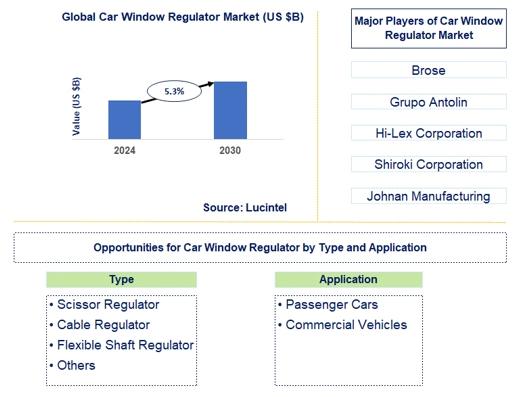
The future of the global car window regulator market looks promising with opportunities in the passenger cars, commercial vehicles markets. The global car window regulator market is expected to grow with a CAGR of 4.6% from 2025 to 2031. The major drivers for this market are the increasing demand for automotive safety and comfort features, the technological advancements, and the government regulations and safety standards.

• Lucintel forecasts that, within the type category, scissor regulator is expected to witness the highest growth over the forecast period due to its widespread use in passenger vehicles, cost-effectiveness, and reliable performance.
• Within the application category, passenger cars is expected to witness the higher growth due to the growing demand for power windows, and the global increase in vehicle sales.
• In terms of region, APAC is expected to witness the highest growth over the forecast period due to increasing adoption of power windows, and the rapid expansion of automotive markets.
Gain valuable insights for your business decisions with our comprehensive 150+ page report. Sample figures with some insights are shown below.
Car Window Regulator Market Trends and Forecast

Car Window Regulator Market by Segment

Emerging Trends in the Car Window Regulator Market

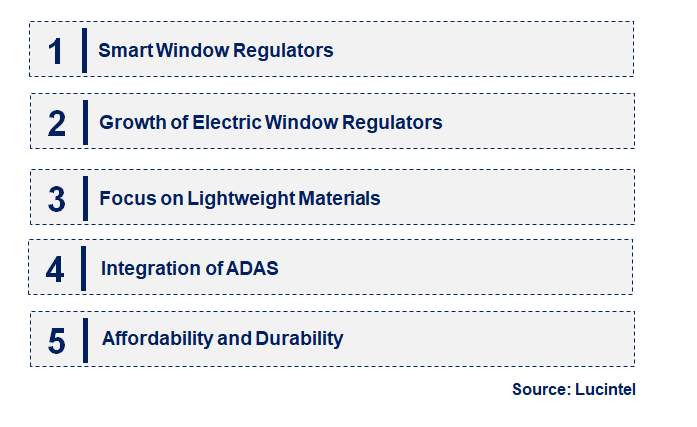
The car window regulator market is undergoing significant transformation as technology, consumer preferences, and environmental regulations evolve. Emerging trends in this market highlight the shift towards electric and automated window regulators, sustainability in materials, and integration with broader vehicle control systems. As automakers aim to meet consumer expectations for comfort, safety, and energy efficiency, these trends are reshaping the landscape of car window regulators. Let’s explore five key trends influencing the market.
• Shift toward Electric Window Regulators: Electric window regulators are becoming the standard in most new vehicles, replacing traditional manual systems. This shift is driven by consumer demand for greater convenience and ease of use, especially in premium and electric vehicles. Electric window regulators enable smoother operation and can be integrated with advanced vehicle control systems, allowing for features such as automatic window adjustments, anti-pinch mechanisms, and better overall user experience. As electric and hybrid vehicles gain popularity, the demand for electric window regulators continues to grow, especially in markets like the U.S., China, and Germany.
• Integration with Vehicle Control Systems: Car window regulators are increasingly being integrated with broader vehicle control systems. This trend includes the incorporation of sensors, automatic window control, and features like anti-pinch functionality, which automatically reverses the window if it detects an obstruction. Integration with infotainment systems and advanced driver-assistance systems (ADAS) is also a key development. This trend enhances the overall functionality of vehicles and aligns with the growing trend of connected car technologies, where various subsystems within the vehicle are seamlessly connected for a smoother, smarter experience for the user.
• Use of Lightweight and Sustainable Materials: As automakers continue to focus on fuel efficiency and reducing carbon emissions, lightweight materials are gaining prominence in the manufacturing of car window regulators. Materials such as carbon fiber, aluminum, and lightweight composites are being used to reduce the weight of regulators, contributing to lower vehicle weight and improved fuel efficiency. Additionally, there is a growing trend toward using sustainable and eco-friendly materials in the production of these components, in line with the automotive industry’s focus on sustainability and adherence to stricter environmental regulations.
• Demand for Noise-Reducing Window Regulators: With increasing consumer expectations for comfort and quiet driving experiences, there is a rising demand for noise-reducing window regulators. Manufacturers are focusing on creating regulators that offer smoother operation and reduce the mechanical noise produced when the windows are raised or lowered. This trend is particularly evident in premium vehicles, where consumers expect a higher level of refinement and a quieter cabin environment. Noise-reducing technologies, along with improved sealing systems, are becoming important features in the development of modern window regulators.
• Growth of the Electric Vehicle Market: The growing popularity of electric vehicles (EVs) is reshaping the car window regulator market, as these vehicles often require advanced window regulators that align with energy efficiency goals. EVs are lighter and more energy-efficient than traditional vehicles, and window regulators play an important role in reducing energy consumption while maintaining smooth window operation. As the EV market expands, the demand for electric and energy-efficient window regulators is expected to increase. Additionally, the integration of solar panels and energy recovery systems in EVs may also drive innovation in window regulator technologies.
Emerging trends in the car window regulator market are driven by the shift towards electric vehicles, greater integration with vehicle control systems, and consumer demand for comfort and sustainability. As automakers focus on innovation and efficiency, these trends are leading to the development of smarter, quieter, and more eco-friendly window regulators, significantly shaping the future of the market.
Emerging Trends in the Car Window Regulator Market

Recent Development in the Car Window Regulator Market

The car window regulator market is experiencing notable developments as manufacturers focus on integrating new technologies, improving efficiency, and meeting consumer demand for advanced features. From electric and smart window regulators to the adoption of sustainable materials, these innovations are reshaping the industry. Below are five key developments in the car window regulator market that highlight the industry’s ongoing transformation.
• Introduction of Smart and Automated Window Regulators: Smart and automated window regulators are one of the key developments in the automotive industry. These regulators are integrated with sensors, enabling features like automatic window adjustment based on weather conditions or user preference. Additionally, some systems now include anti-pinch technology, which automatically reverses the window if an obstruction is detected. These innovations not only improve safety but also enhance the convenience and comfort of vehicle occupants, leading to greater consumer satisfaction and a more advanced user experience.
• Increased Use of Lightweight Materials: The use of lightweight materials in the manufacturing of car window regulators has been a significant development. By incorporating materials such as carbon fiber composites and aluminum, manufacturers are able to reduce the overall weight of the regulator systems, improving vehicle fuel efficiency. The growing emphasis on fuel efficiency, combined with stricter emission regulations, has led automakers to seek out lightweight solutions, making the use of these materials a key development in the market.
• Noise-Reducing Window Regulator Technologies: As consumer demand for quieter driving experiences increases, noise-reducing window regulator technologies have emerged as an important development. Manufacturers are focusing on reducing the mechanical noise generated by window regulators during operation. This has led to the development of smoother-operating window systems with better sealing and noise-damping capabilities. These advancements are especially important in the premium vehicle segment, where a quiet cabin environment is highly valued.
• Electric Window Regulators for EVs: The rise of electric vehicles (EVs) has contributed to the increasing adoption of electric window regulators. These systems offer energy-efficient operation and can be easily integrated with the vehicle’s power systems. In addition to contributing to the vehicle’s overall energy efficiency, electric window regulators in EVs are typically more durable and require less maintenance than manual systems. As the EV market expands, this trend is expected to accelerate, driving further innovation in window regulator technologies for electric vehicles.
• Customization for Vehicle Models and Preferences: The car window regulator market is also witnessing a trend toward more customization to meet the needs of specific vehicle models and consumer preferences. Manufacturers are now offering tailored solutions that accommodate unique window shapes, sizes, and operational features. This trend is particularly evident in the luxury and electric vehicle markets, where consumers expect high-performance, customized solutions that enhance the overall driving experience. The ability to provide tailored solutions is becoming a significant competitive advantage for manufacturers in the car window regulator market.
Recent developments in the car window regulator market, such as the introduction of smart regulators, the use of lightweight materials, and the growth of noise-reducing technologies, reflect the ongoing transformation of the automotive sector. These developments are responding to consumer demand for enhanced comfort, safety, and energy efficiency, while also addressing environmental sustainability goals. As the industry continues to innovate, these advancements will shape the future of car window regulators.

Strategic Growth Opportunities in the Car Window Regulator Market

The car window regulator market is poised for growth as automakers adopt advanced technologies and respond to consumer demands for more efficient, convenient, and sustainable window regulator systems. Key growth opportunities exist in various applications, ranging from electric vehicle production to noise reduction and lightweight solutions. Below are five strategic growth opportunities in the car window regulator market that manufacturers can leverage to expand their reach and stay competitive.
• Electric Vehicle (EV) Market Expansion: The growing electric vehicle (EV) market presents a significant opportunity for car window regulator manufacturers. EVs often require more energy-efficient and durable window regulators, as these vehicles rely on optimizing energy usage for maximum range. As the EV market expands, manufacturers have the opportunity to develop and supply window regulators that meet the unique needs of electric vehicles, such as systems that reduce energy consumption while offering smooth, automated window operation.
• Customization for Luxury and Premium Vehicles: There is a growing demand for customized car window regulators in the luxury and premium vehicle segment. Consumers in this market expect advanced features such as noise reduction, personalized window control, and high-quality materials. Manufacturers can capitalize on this trend by offering tailor-made window regulators that enhance the overall comfort and experience of premium vehicle owners, positioning themselves as key suppliers in the luxury vehicle market.
• Adoption of Smart Window Regulators: The integration of smart technologies into car window regulators presents another strategic growth opportunity. Smart window regulators that can be controlled remotely, adjust automatically based on temperature or weather conditions, and provide real-time performance data are becoming increasingly popular. Manufacturers can seize this opportunity by developing window regulators that integrate with vehicle control systems and advanced driver-assistance systems (ADAS), enhancing the overall functionality of vehicles.
• Sustainability and Eco-Friendly Solutions: As environmental concerns continue to rise, manufacturers that focus on creating eco-friendly window regulators using sustainable materials can tap into a growing market segment. The demand for lightweight and energy-efficient window regulators is expected to increase as automakers work to meet stricter environmental regulations. By developing regulators made from sustainable, recyclable materials, manufacturers can differentiate themselves in the marketplace and cater to eco-conscious consumers.
• Growth of Aftermarket and Replacement Markets: The aftermarket and replacement markets for car window regulators offer significant growth opportunities. With the rise in vehicle ownership and aging car fleets, there is an increasing demand for high-quality, affordable replacement window regulators. Manufacturers can expand their presence in this market by offering durable and competitively priced products that meet the needs of vehicle owners seeking reliable solutions for worn-out regulators.
Strategic growth opportunities in the car window regulator market lie in the electric vehicle sector, customization for premium vehicles, smart technologies, sustainability initiatives, and the growing aftermarket demand. Manufacturers can take advantage of these trends to innovate and expand their product offerings, positioning themselves for long-term growth in an evolving automotive landscape.

Car Window Regulator Market Driver and Challenges

The car window regulator market is influenced by a range of drivers and challenges. Technological advancements, growing consumer preferences for comfort and convenience, and regulatory pressures related to energy efficiency and sustainability are all major drivers. However, challenges such as high production costs, supply chain issues, and the need for constant innovation in a competitive market remain prevalent. Understanding these factors is crucial to comprehending the dynamics shaping the market.
The factors responsible for driving the Car Window Regulator market include:
1. Technological Advancements: Technological advancements in window regulator systems, such as electric and smart window regulators, are a key driver of market growth. These innovations enhance the convenience, safety, and energy efficiency of vehicle windows, meeting increasing consumer expectations for advanced features. Automation and integration with vehicle control systems also help reduce manual intervention and improve overall performance.
2. Electric Vehicle (EV) Growth: The expansion of the electric vehicle market is a significant driver for the car window regulator industry. EVs require specialized window regulators that are energy-efficient and align with the vehicle’s overall energy optimization goals. This growing market offers substantial opportunities for manufacturers to develop innovative window regulator solutions tailored to EVs.
3. Consumer Demand for Comfort: Consumers increasingly demand more comfort and convenience from their vehicles. Features such as noise reduction, smoother window operation, and automated window control are driving demand for advanced window regulators. This trend is particularly strong in premium and electric vehicle segments, where high levels of comfort and sophistication are expected.
4. Environmental Regulations and Sustainability: Stringent environmental regulations and growing consumer awareness about sustainability are driving the demand for eco-friendly and energy-efficient window regulators. Automakers are focusing on reducing the overall weight of vehicles and adopting sustainable materials in their products. This trend is boosting demand for lightweight and eco-friendly window regulators that align with the industry’s sustainability goals.
5. Automated and Smart Vehicle Technologies: The rise of automated and smart vehicle technologies is driving the adoption of more advanced window regulators. Features like automatic window adjustment, anti-pinch technology, and integration with vehicle control systems are becoming standard in modern vehicles. This trend is contributing to the growth of the window regulator market as manufacturers develop more intelligent and automated solutions.
Challenges in the Car Window Regulator market are:
1. High Production Costs: The development of advanced car window regulators with innovative features often involves high production costs. Manufacturers must invest in research and development to create high-quality, energy-efficient, and durable window regulators, which can lead to higher costs. For smaller manufacturers or those operating in developing markets, these costs can be a significant barrier to entry.
2. Supply Chain Disruptions: The global automotive supply chain has been disrupted by factors such as raw material shortages, transportation challenges, and geopolitical tensions. These disruptions can impact the production and availability of car window regulators, leading to delays and increased costs. Manufacturers must adapt to these challenges by diversifying suppliers and improving supply chain resilience.
3. Integration with Legacy Systems: Integrating modern car window regulators with existing vehicle systems can be challenging, particularly in older vehicle models. Upgrading or retrofitting legacy systems requires significant investment and technical expertise. This challenge is particularly relevant in markets with older car fleets, where manufacturers must develop window regulators that are compatible with a wide range of vehicles.
The car window regulator market is driven by technological advancements, the growth of electric vehicles, consumer demand for comfort, and regulatory pressures for sustainability. However, challenges such as high production costs, supply chain disruptions, and integration with legacy systems continue to pose obstacles. Despite these challenges, the drivers of innovation, sustainability, and smart technologies are expected to propel the market forward, shaping the future of car window regulators.

List of Car Window Regulator Companies

Companies in the market compete on the basis of product quality offered. Major players in this market focus on expanding their manufacturing facilities, R&D investments, infrastructural development, and leverage integration opportunities across the value chain. With these strategies car window regulator companies cater increasing demand, ensure competitive effectiveness, develop innovative products & technologies, reduce production costs, and expand their customer base. Some of the car window regulator companies profiled in this report include-
• Brose
• Grupo Antolin
• Hi-Lex Corporation
• Shiroki Corporation
• Johnan Manufacturing
• Valeo
• Magna International
• Inteva Products
• Kwangjin
• Kuster

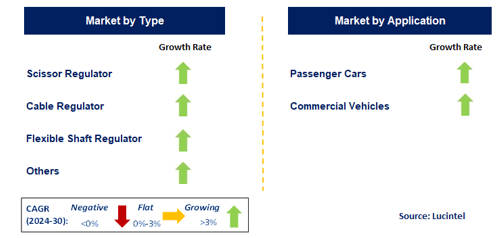
Car Window Regulator Market by Segment

The study includes a forecast for the global car window regulator market by type, application, and region.

Car Window Regulator Market by Type [Value from 2019 to 2031]:


• Scissor Regulator
• Cable Regulator
• Flexible Shaft Regulator
• Others

Car Window Regulator Market by Application [Value from 2019 to 2031]:


• Passenger Cars
• Commercial Vehicles

Car Window Regulator Market by Region [Value from 2019 to 2031]:


• North America
• Europe
• Asia Pacific
• The Rest of the World

Country Wise Outlook for the Car Window Regulator Market

The car window regulator market plays a pivotal role in the automotive sector, ensuring smooth operation of vehicle windows. Technological advancements, evolving consumer preferences, and regulatory pressures are influencing the development of car window regulators globally. Electric window regulators, improvements in materials, and integration with automotive electronic systems are shaping the market. Additionally, the growing demand for electric vehicles (EVs) and eco-friendly solutions are driving new trends. Let’s explore recent developments in the car window regulator market across the United States, China, Germany, India, and Japan, focusing on key advancements in these regions.
• United States: In the United States, the car window regulator market is witnessing strong growth, primarily due to the increasing demand for electric vehicles (EVs) and the shift towards automated window technologies. Automotive manufacturers are increasingly incorporating electric and smart window regulators to meet the demands for enhanced comfort and convenience. Moreover, technological innovations in materials such as lightweight composites and plastics are helping reduce the weight of window regulators, improving vehicle efficiency. The integration of smart window regulators with vehicle control systems for seamless operation is also becoming more common, aligning with the trend towards smart cars and greater automation.
• China: China, the world’s largest automotive market, is seeing significant growth in the car window regulator market, driven by the rapid expansion of the electric vehicle (EV) sector. With China’s ambitious plans for green transportation, automakers are increasingly adopting electric window regulators to enhance the energy efficiency of EVs. Additionally, there is a rising demand for high-quality, durable, and noise-reducing regulators as consumer preferences shift towards premium vehicles. The Chinese market is also witnessing significant innovation in manufacturing processes, with more companies focusing on local production to reduce costs and improve supply chain efficiency.
• Germany: Germany, a leader in automotive technology, has seen advancements in the car window regulator market, with a focus on sustainability and innovation. German automakers are incorporating more lightweight materials, such as carbon fiber composites, to reduce the overall weight of vehicles, which in turn enhances fuel efficiency and performance. The shift towards electric and hybrid vehicles is prompting an increased demand for electric window regulators. Additionally, Germany’s stringent environmental regulations are encouraging automakers to adopt energy-efficient components, which has positively impacted the market for eco-friendly and sustainable window regulator systems.
• India: In India, the car window regulator market is growing due to the increasing production and sales of both internal combustion engine (ICE) vehicles and electric vehicles (EVs). The demand for more advanced and cost-effective car window regulators is driven by the growing middle class and their preference for comfort and convenience features in vehicles. While traditional manual window regulators still dominate in lower-end vehicles, electric window regulators are becoming more common in mid-range and premium models. Local manufacturers are adapting to this shift by enhancing their production capabilities and offering competitive, quality products that meet local needs.
• Japan: Japan’s car window regulator market is characterized by strong demand for advanced technology and innovation. Japanese automakers are integrating electric window regulators in both traditional and electric vehicles, driven by the need for greater efficiency and convenience. The market is also experiencing a rise in demand for more durable and lightweight regulators, particularly as Japan’s automotive industry continues to focus on fuel efficiency and the development of electric vehicles. Additionally, Japanese manufacturers are focusing on integrating smart technologies into window regulators, such as sensors for automatic window control, which aligns with global trends toward intelligent vehicle systems.
Lucintel Analytics Dashboard

Features of the Global Car Window Regulator Market

Market Size Estimates: Car window regulator market size estimation in terms of value ($B).
Trend and Forecast Analysis: Market trends (2019 to 2024) and forecast (2025 to 2031) by various segments and regions.
Segmentation Analysis: Car window regulator market size by type, application, and region in terms of value ($B).
Regional Analysis: Car window regulator market breakdown by North America, Europe, Asia Pacific, and Rest of the World.
Growth Opportunities: Analysis of growth opportunities in different type, application, and regions for the car window regulator market.
Strategic Analysis: This includes M&A, new product development, and competitive landscape of the car window regulator market.
Analysis of competitive intensity of the industry based on Porter’s Five Forces model.

Lucintel Consulting Services

FAQ

Q1. What is the growth forecast for car window regulator market?
Answer: The global car window regulator market is expected to grow with a CAGR of 4.6% from 2025 to 2031.
Q2. What are the major drivers influencing the growth of the car window regulator market?
Answer: The major drivers for this market are the increasing demand for automotive safety and comfort features, the technological advancements, and the government regulations and safety standards.
Q3. What are the major segments for car window regulator market?
Answer: The future of the car window regulator market looks promising with opportunities in the passenger cars, commercial vehicles markets.
Q4. Who are the key car window regulator market companies?
Answer: Some of the key car window regulator companies are as follows:
• Brose
• Grupo Antolin
• Hi-Lex Corporation
• Shiroki Corporation
• Johnan Manufacturing
• Valeo
• Magna International
• Inteva Products
• Kwangjin
• Kuster
Q5. Which car window regulator market segment will be the largest in future?
Answer: Lucintel forecasts that scissor regulator is expected to witness the highest growth over the forecast period due to its widespread use in passenger vehicles, cost-effectiveness, and reliable performance.
Q6. In car window regulator market, which region is expected to be the largest in next 5 years?
Answer: APAC is expected to witness the highest growth over the forecast period due to increasing adoption of power windows, and the rapid expansion of automotive markets.
Q7. Do we receive customization in this report?
Answer: Yes, Lucintel provides 10% customization without any additional cost.

This report answers following 11 key questions:

Q.1. What are some of the most promising, high-growth opportunities for the car window regulator market by type (scissor regulator, cable regulator, flexible shaft regulator, and others), application (passenger cars and commercial vehicles), and region (North America, Europe, Asia Pacific, and the Rest of the World)?
Q.2. Which segments will grow at a faster pace and why?
Q.3. Which region will grow at a faster pace and why?
Q.4. What are the key factors affecting market dynamics? What are the key challenges and business risks in this market?
Q.5. What are the business risks and competitive threats in this market?
Q.6. What are the emerging trends in this market and the reasons behind them?
Q.7. What are some of the changing demands of customers in the market?
Q.8. What are the new developments in the market? Which companies are leading these developments?
Q.9. Who are the major players in this market? What strategic initiatives are key players pursuing for business growth?
Q.10. What are some of the competing products in this market and how big of a threat do they pose for loss of market share by material or product substitution?
Q.11. What M&A activity has occurred in the last 5 years and what has its impact been on the industry?

For any questions related to Car Window Regulator Market, Car Window Regulator Market Size, Car Window Regulator Market Growth, Car Window Regulator Market Analysis, Car Window Regulator Market Report, Car Window Regulator Market Share, Car Window Regulator Market Trends, Car Window Regulator Market Forecast, Car Window Regulator Companies, write Lucintel analyst at email: helpdesk@lucintel.com. We will be glad to get back to you soon.
                                                            Table of Contents

            1. Executive Summary

            2. Global Car Window Regulator Market : Market Dynamics
                        2.1: Introduction, Background, and Classifications
                        2.2: Supply Chain
                        2.3: Industry Drivers and Challenges

            3. Market Trends and Forecast Analysis from 2019 to 2031
                        3.1. Macroeconomic Trends (2019-2024) and Forecast (2025-2031)
                        3.2. Global Car Window Regulator Market Trends (2019-2024) and Forecast (2025-2031)
                        3.3: Global Car Window Regulator Market by Type
                                    3.3.1: Scissor Regulator
                                    3.3.2: Cable Regulator
                                    3.3.3: Flexible Shaft Regulator
                                    3.3.4: Others
                        3.4: Global Car Window Regulator Market by Application
                                    3.4.1: Passenger Cars
                                    3.4.2: Commercial Vehicles

            4. Market Trends and Forecast Analysis by Region from 2019 to 2031
                        4.1: Global Car Window Regulator Market by Region
                        4.2: North American Car Window Regulator Market
                                    4.2.1: North American by type: scissor regulator, cable regulator, flexible shaft regulator, and others
                                    4.2.2: North American by application: passenger cars and commercial vehicles
                        4.3: European Car Window Regulator Market
                                    4.3.1: European by type: scissor regulator, cable regulator, flexible shaft regulator, and others
                                    4.3.2: European by application: passenger cars and commercial vehicles
                        4.4: APAC Car Window Regulator Market
                                    4.4.1: APAC by type: scissor regulator, cable regulator, flexible shaft regulator, and others
                                    4.4.2: APAC by application: passenger cars and commercial vehicles
                        4.5: ROW Car Window Regulator Market
                                    4.5.1: ROW by type: scissor regulator, cable regulator, flexible shaft regulator, and others
                                    4.5.2: ROW by application: passenger cars and commercial vehicles

            5. Competitor Analysis
                        5.1: Product Portfolio Analysis
                        5.2: Operational Integration
                        5.3: Porter’s Five Forces Analysis

            6. Growth Opportunities and Strategic Analysis
                        6.1: Growth Opportunity Analysis
                                    6.1.1: Growth Opportunities for the Global Car Window Regulator Market by Type
                                    6.1.2: Growth Opportunities for the Global Car Window Regulator Market by Application
                                    6.1.3: Growth Opportunities for the Global Car Window Regulator Market by Region
                        6.2: Emerging Trends in the Global Car Window Regulator Market
                        6.3: Strategic Analysis
                                    6.3.1: New Product Development
                                    6.3.2: Capacity Expansion of the Global Car Window Regulator Market
                                    6.3.3: Mergers, Acquisitions, and Joint Ventures in the Global Car Window Regulator Market
                                    6.3.4: Certification and Licensing

            7. Company Profiles of Leading Players
                        7.1: Brose
                        7.2: Grupo Antolin
                        7.3: Hi-Lex Corporation
                        7.4: Shiroki Corporation
                        7.5: Johnan Manufacturing
                        7.6: Valeo
                        7.7: Magna International
                        7.8: Inteva Products
                        7.9: Kwangjin
                        7.10: Kuster
.

Buy full report or by chapter as follows

Limited Time Offer

Price by License Type:
[-] Hide Chapter Details
[Chapter Number] [Chapter Name] [Chapter Number Of Pages] [Chapter Price]
Title/Chapter Name Pages Price
Full Report: Car Window Regulator Market Report: Trends, Forecast and Competitive Analysis to 2031 Full Report $ 2,990
A 150 Page Report
Lucintel has been in the business of market research and management consulting since 2000 and has published over 1000 market intelligence reports in various markets / applications and served over 1,000 clients worldwide. This study is a culmination of four months of full-time effort performed by Lucintel's analyst team. The analysts used the following sources for the creation and completion of this valuable report:
  • In-depth interviews of the major players in this market
  • Detailed secondary research from competitors’ financial statements and published data 
  • Extensive searches of published works, market, and database information pertaining to industry news, company press releases, and customer intentions
  • A compilation of the experiences, judgments, and insights of Lucintel’s professionals, who have analyzed and tracked this market over the years.
Extensive research and interviews are conducted across the supply chain of this market to estimate market share, market size, trends, drivers, challenges, and forecasts. Below is a brief summary of the primary interviews that were conducted by job function for this report.
 
Thus, Lucintel compiles vast amounts of data from numerous sources, validates the integrity of that data, and performs a comprehensive analysis. Lucintel then organizes the data, its findings, and insights into a concise report designed to support the strategic decision-making process. The figure below is a graphical representation of Lucintel’s research process. 
 

Please sign in below to get report brochure - Car Window Regulator Market Report.

At Lucintel, we respect your privacy and maintain the confidentiality of information / data provided by you
(Please enter your corporate email. * These fields are mandatory )

Follow us on