
Market Report · July 31, 2026

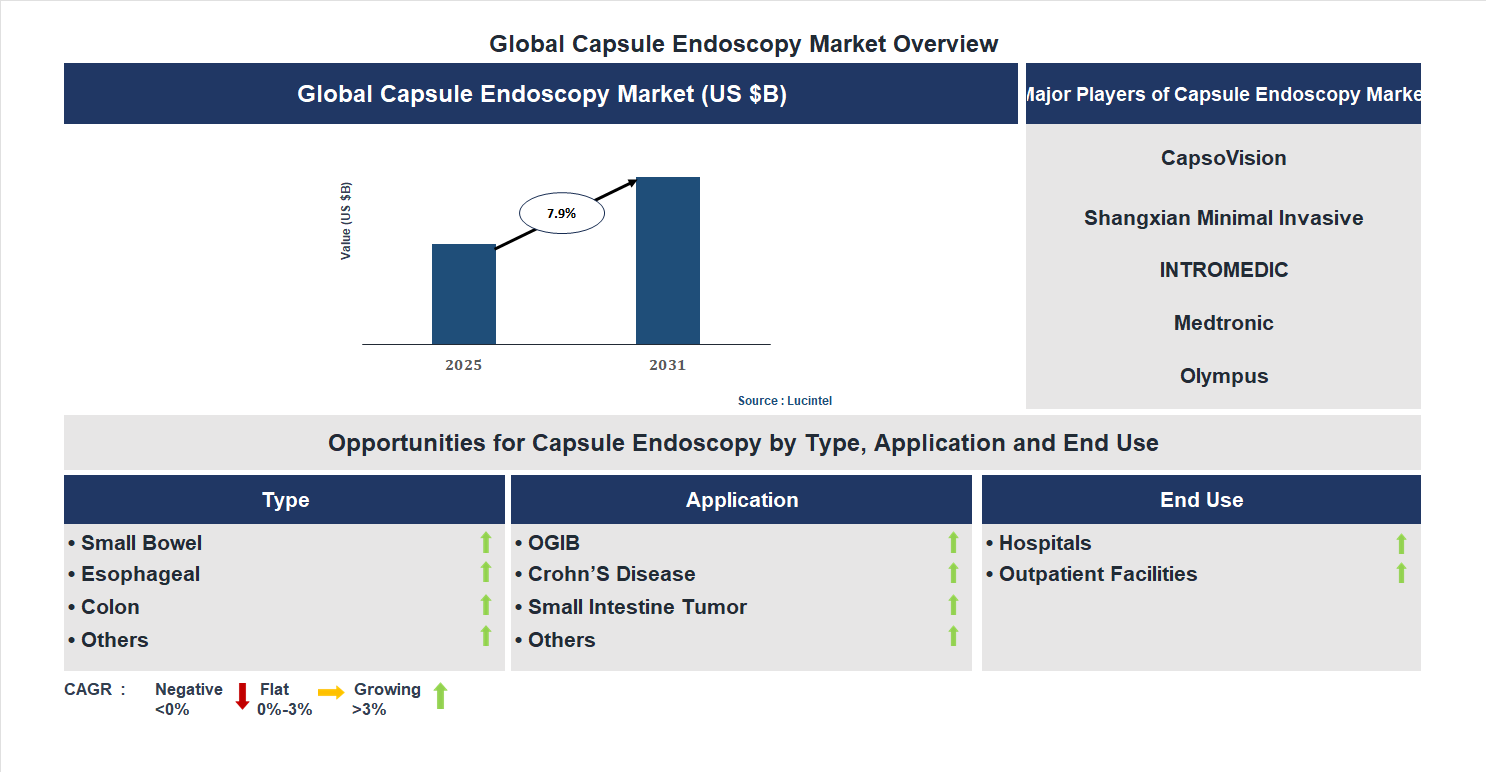
Key data points: The growth forecast = 7.9% annually for the next 7 years. Scroll below to get more insights. This market report covers trends, opportunities and forecasts in capsule endoscopy market to 2031 by type (small bowel, esophageal, colon, and others), application (OGIB, crohn’s disease, small intestine tumor, and others), end use (hospitals and outpatient facilities), and region (North America, Europe, Asia Pacific, and the Rest of the World)
We'll send your sample report shortly.
• Lucintel forecasts that, within the type category, small bowel is expected to witness the highest growth over the forecast period.
• Within the end use category, hospital is expected to witness higher growth.
• In terms of region, APAC is expected to witness the highest growth over the forecast period. Gain valuable insights for your business decisions with our comprehensive 150+ page report. Sample figures with some insights are shown below.
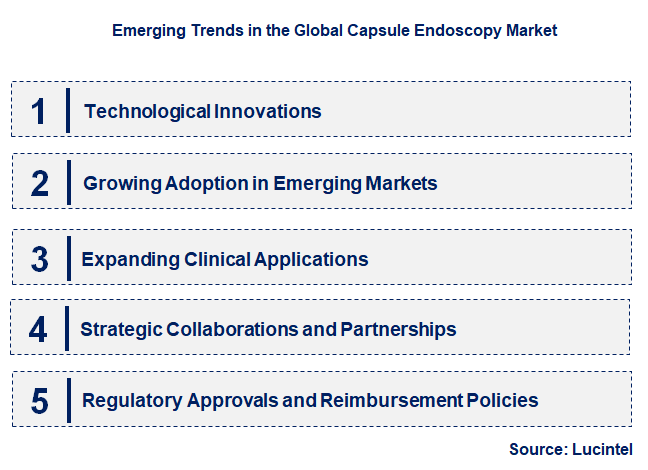
• Technological Innovations: Advancements in capsule design and imaging quality are transforming diagnostics. Newer capsules now feature higher-resolution cameras, longer battery life, and improved maneuverability, enabling more detailed visualization of the gastrointestinal tract. These innovations enhance diagnostic accuracy, reduce procedure times, and improve patient comfort. Integration of artificial intelligence (AI) for image analysis is also emerging, facilitating faster and more precise diagnoses. As technology continues to evolve, the market is poised for increased adoption and expanded clinical applications.
• Growing Adoption in Emerging Markets: Increasing healthcare infrastructure development and rising awareness about minimally invasive procedures are driving growth in emerging economies. Countries in Asia-Pacific, Latin America, and the Middle East are witnessing higher adoption rates due to expanding healthcare access and affordability. Local manufacturers are entering the market, offering cost-effective solutions that cater to regional needs. This trend broadens the market reach, diversifies the customer base, and accelerates global market expansion, making capsule endoscopy more accessible worldwide.
• Expanding Clinical Applications: Originally used primarily for small bowel examination, capsule endoscopy is now being applied to diagnose conditions in the esophagus, colon, and even the respiratory tract. Its versatility allows for early detection of gastrointestinal cancers, inflammatory bowel disease, and obscure gastrointestinal bleeding. Researchers are exploring new indications, including Crohn’s disease monitoring and polyp detection. This expansion increases the clinical utility of capsule endoscopy, attracting more healthcare providers and patients, and fueling market growth through broader application scope.
• Strategic Collaborations and Partnerships: Companies are forming alliances with technology firms, healthcare providers, and research institutions to accelerate innovation and market penetration. Collaborations facilitate the development of integrated solutions, such as AI-powered image analysis and telemedicine-compatible capsules. Partnerships also help in navigating regulatory pathways and expanding distribution networks. These strategic moves enhance product offerings, improve market competitiveness, and foster innovation, ultimately driving growth and adoption across diverse healthcare settings.
• Regulatory Approvals and Reimbursement Policies: Increasing regulatory approvals and favorable reimbursement policies are critical for market expansion. Governments and health authorities are recognizing the clinical benefits of capsule endoscopy, leading to streamlined approval processes and inclusion in insurance coverage. This reduces out-of-pocket costs for patients and encourages healthcare providers to adopt these technologies. Clearer regulatory pathways and reimbursement frameworks are essential for market stability and growth, ensuring wider accessibility and encouraging ongoing innovation in capsule endoscopy solutions. In summary, technological advancements, expanding applications, emerging market growth, strategic collaborations, and supportive regulatory environments are collectively reshaping the capsule endoscopy market. These trends are driving increased adoption, improving diagnostic accuracy, and broadening the scope of use, ultimately transforming gastrointestinal diagnostics and patient care worldwide.
• Technological Innovations: Enhanced Imaging Capabilities : New capsule designs now feature higher-resolution cameras and wider viewing angles, improving diagnostic accuracy. These advancements enable better visualization of the gastrointestinal tract, leading to earlier and more precise detection of abnormalities. The improved imaging quality reduces the need for invasive procedures and enhances patient comfort, thereby expanding market adoption.
• Expansion of Clinical Applications: Beyond Gastrointestinal Disorders : Capsule endoscopy is increasingly used for diagnosing conditions such as Crohn’s disease, celiac disease, and obscure gastrointestinal bleeding. The expanding clinical applications are driving demand across various healthcare settings. This diversification broadens the market scope and encourages manufacturers to develop specialized capsules tailored to specific conditions.
• Strategic Collaborations and Partnerships: Industry Growth and Innovation : Major players are forming alliances with research institutions and healthcare providers to develop advanced capsule technologies. These collaborations facilitate the integration of artificial intelligence and machine learning for image analysis, improving diagnostic efficiency. Such partnerships accelerate product development and market penetration, fostering overall industry growth.
• Regulatory Approvals and Reimbursement Policies: Facilitating Market Penetration : Recent approvals from regulatory bodies like the FDA and CE mark have validated the safety and efficacy of new capsule endoscopy devices. Additionally, favorable reimbursement policies are making these procedures more accessible to patients. These regulatory and financial supports are crucial for expanding market reach and encouraging adoption among healthcare providers.
• Rising Adoption in Emerging Markets: Increasing Healthcare Infrastructure and Awareness : Countries in Asia-Pacific and Latin America are witnessing growing adoption of capsule endoscopy due to expanding healthcare infrastructure and rising awareness of minimally invasive diagnostics. Local manufacturers are entering the market, offering cost-effective solutions. This trend is expected to significantly boost global market growth by tapping into previously underserved regions. In summary, technological advancements, expanding clinical applications, strategic collaborations, regulatory support, and rising adoption in emerging markets are collectively propelling the capsule endoscopy market forward. These developments are enhancing diagnostic capabilities, broadening market reach, and improving patient outcomes, thereby shaping a promising future for gastrointestinal diagnostics.
• Increasing prevalence of gastrointestinal diseases: Growing incidence of conditions like Crohn’s disease and colorectal cancer is driving demand for advanced diagnostic tools, including capsule endoscopy, to enable early detection and improve patient management.
• Technological advancements in capsule design: Innovations such as high-resolution imaging, longer battery life, and real-time data transmission are enhancing diagnostic accuracy and patient comfort, thereby expanding application scope.
• Rising adoption in pediatric and geriatric populations: The development of smaller, more comfortable capsules is increasing usage among children and elderly patients, broadening the market and addressing unmet needs in these vulnerable groups.
• Expansion into emerging markets: Growing healthcare infrastructure and awareness in developing regions are creating new opportunities for capsule endoscopy, facilitating market penetration and revenue growth.
• Integration with artificial intelligence (AI): Incorporating AI for image analysis and diagnosis is improving efficiency, reducing diagnostic time, and increasing accuracy, which is attracting more healthcare providers to adopt capsule endoscopy. In summary, these growth opportunities are significantly impacting the capsule endoscopy market by expanding its applications, improving diagnostic capabilities, and increasing accessibility across diverse patient populations. This evolution is fostering innovation, driving revenue growth, and positioning capsule endoscopy as a vital tool in gastrointestinal healthcare.
• Technological Innovation: The continuous development of high-resolution cameras, wireless data transmission, and battery life improvements enhances diagnostic accuracy and patient comfort. These technological advancements enable more comprehensive and quicker diagnoses, expanding clinical applications and increasing adoption rates among healthcare providers. As technology evolves, costs tend to decrease, making capsule endoscopy more accessible and appealing to a broader patient demographic.
• Rising Prevalence of Gastrointestinal Disorders: The increasing incidence of conditions such as Crohn’s disease, gastrointestinal bleeding, and small bowel tumors drives demand for minimally invasive diagnostic tools. Capsule endoscopy offers a non-invasive alternative to traditional procedures like endoscopy and radiology, leading to earlier detection and improved patient outcomes. This growing disease burden directly correlates with market expansion and increased investment in research and development.
• Healthcare Infrastructure Development: The expansion of healthcare facilities, especially in emerging economies, supports the adoption of advanced diagnostic tools like capsule endoscopy. Investments in healthcare infrastructure, training, and awareness campaigns facilitate wider acceptance among clinicians and patients, thereby boosting market growth. Additionally, collaborations between device manufacturers and healthcare providers foster innovation and distribution.
• Regulatory Approvals and Reimbursement Policies: Favorable regulatory environments and reimbursement frameworks significantly influence market growth. Approvals from agencies such as the FDA and EMA validate device safety and efficacy, encouraging adoption. Reimbursement policies that cover capsule endoscopy procedures reduce out-of-pocket expenses for patients, incentivizing healthcare providers to recommend these diagnostics and accelerating market penetration. The challenges in the capsule endoscopy market are:
• High Device Costs: The advanced technology involved in capsule endoscopy results in high manufacturing and procurement costs, which can limit accessibility, especially in low-resource settings. These costs impact healthcare providers’ willingness to adopt the technology widely and can lead to higher patient expenses, potentially restricting market growth in price-sensitive regions.
• Regulatory Hurdles: Navigating complex regulatory pathways remains a significant barrier. Lengthy approval processes, stringent safety and efficacy requirements, and varying standards across regions delay product launches and limit market expansion. These hurdles increase costs for manufacturers and can hinder timely access to innovative solutions for patients.
• Technological Limitations: Despite advancements, issues such as limited battery life, incomplete visualization, and difficulty in controlling capsule movement pose challenges. These technological constraints can affect diagnostic accuracy and reliability, leading to potential misdiagnoses or the need for supplementary procedures, which can slow market growth and reduce confidence among clinicians. In summary, the capsule endoscopy market is shaped by rapid technological advancements, increasing disease prevalence, and supportive healthcare infrastructure, which collectively promote growth. However, high costs, regulatory complexities, and technological limitations present significant hurdles. Balancing these drivers and challenges will determine the pace and scope of market expansion, with ongoing innovation and policy support being crucial for sustained development. Overall, the market is poised for growth, provided stakeholders effectively address these barriers and leverage emerging opportunities.
• CapsoVision
• Shangxian Minimal Invasive
• INTROMEDIC
• Medtronic
• Olympus
• AnX Robotics
• JINSHAN Science & Technology
• Check-Cap
• RF
• BioCam
• Small Bowel
• Esophageal
• Colon
• Others
• OGIB
• Crohn’S Disease
• Small Intestine Tumor
• Others
• Hospitals
• Outpatient Facilities
• North America
• Europe
• Asia Pacific
• The Rest of the World
• United States: The US market has seen rapid adoption of advanced capsule endoscopy devices, with significant investments in R&D. Key players are focusing on AI integration for improved image analysis and diagnostic precision. The FDA has approved several innovative capsules, expanding clinical applications such as Crohn’s disease and small bowel tumors. Telemedicine integration and reimbursement policies are further boosting market growth, making capsule endoscopy more accessible to a broader patient base.
• China: China is experiencing robust growth due to increasing healthcare infrastructure and rising awareness of gastrointestinal diseases. Local manufacturers are developing cost-effective capsule endoscopy solutions tailored to the domestic market. Government initiatives to improve healthcare access and investments in medical technology are accelerating adoption. Additionally, collaborations with international firms are facilitating technology transfer and innovation, expanding the scope of capsule endoscopy applications across China.
• Germany: Germany’s market is characterized by high technological adoption and stringent regulatory standards. Leading companies are focusing on enhancing image quality and device miniaturization. The country emphasizes clinical research to validate new applications, such as detecting early-stage gastrointestinal cancers. Reimbursement policies and a well-established healthcare system support widespread use, while partnerships with research institutions foster innovation in capsule design and functionality.
• India: The Indian market is witnessing rapid growth driven by increasing healthcare expenditure and a large patient population with gastrointestinal issues. Local companies are developing affordable capsule endoscopy devices to improve accessibility in rural and underserved areas. Government health programs and private sector investments are promoting awareness and adoption. The focus is on cost-effective solutions that can be integrated into existing healthcare infrastructure, expanding diagnostic capabilities across the country.
• Japan: Japan’s market benefits from a high prevalence of gastrointestinal disorders and advanced healthcare infrastructure. Companies are investing in smart capsule technologies with features like real-time monitoring and enhanced imaging. Regulatory agencies facilitate swift approval processes for innovative devices. The aging population drives demand for minimally invasive diagnostics, and collaborations with tech firms are leading to the development of integrated health monitoring systems, further advancing the capsule endoscopy market in Japan.


• CapsoVision
• Shangxian Minimal Invasive
• INTROMEDIC
• Medtronic
• Olympus
• AnX Robotics
• JINSHAN Science & Technology
• Check-Cap
• RF
• BioCam Q5. Which capsule endoscopy market segment will be the largest in future? Answer: Lucintel forecasts that, within the type category, small bowel is expected to witness the highest growth over the forecast period. Q6. In capsule endoscopy market, which region is expected to be the largest in next 5 years? Answer: In terms of region, APAC is expected to witness the highest growth over the forecast period. Q7. Do we receive customization in this report? Answer: Yes, Lucintel provides 10% customization without any additional cost.


Choose a license that fits your team. Instant PDF delivery.
Prices exclude taxes. Instant delivery. Custom licensing available on request.
Market Report · July 31, 2026
Market Report · July 31, 2026
Market Report · July 31, 2026
Trusted partner for strategic intelligence and business growth


Receive a complimentary market analysis tailored to your industry. Our analysts will identify key growth opportunities and competitive dynamics specific to your business.

Market size, growth rate, and key trend analysis for your specific sector.

Top competitor positioning and market share analysis.

Strategic recommendations backed by data-driven insights.
Get curated market intelligence and competitive moves straight to your inbox.
By subscribing, you agree to receive our monthly insights. Unsubscribe anytime.
Receive a complimentary market analysis tailored to your industry. Our analysts will identify key growth opportunities and competitive dynamics specific to your business.
Market size, growth rate, and key trend analysis for your specific sector.
Top competitor positioning and market share analysis.
Strategic recommendations backed by data-driven insights.
Get curated market intelligence, emerging trends, and competitive moves straight to your inbox each month.
By subscribing, you agree to receive our monthly insights. Unsubscribe anytime.
We'll send your sample report shortly.