
Market Report · July 31, 2026

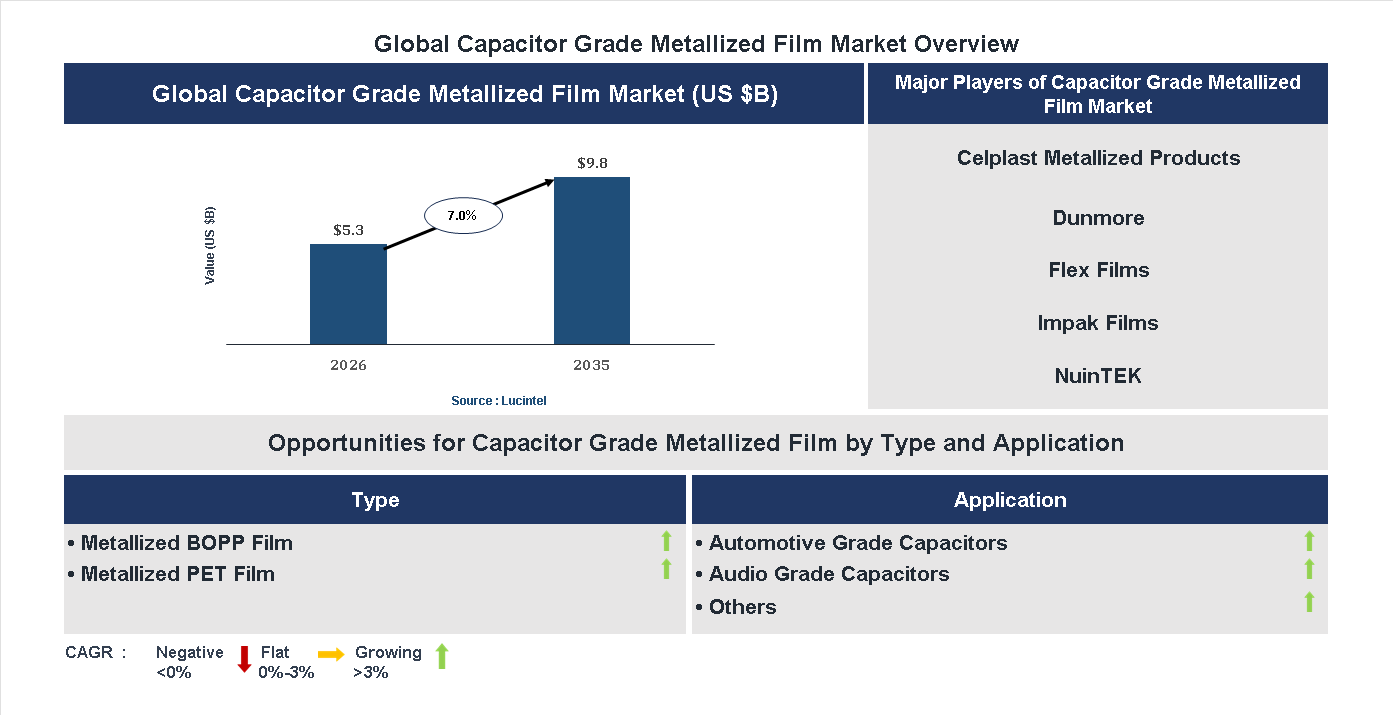
Key data points: The market size in 2035 = $9.8 billion, growth forecast = 7% annually for the next 8 years. Scroll below to get more insights. This market report covers trends, opportunities and forecasts in capacitor grade metallized film market to 2035 by type (metallized BOPP film and metallized PET film), application (automotive grade capacitors, audio grade capacitors, and others), and region (North America, Europe, Asia Pacific, and the Rest of the World)
We'll send your sample report shortly.
• Lucintel forecasts that, within the type category, metallized PET film is expected to witness higher growth over the forecast period.
• Within the application category, automotive grade capacitor is expected to witness higher growth.
• In terms of region, APAC is expected to witness the highest growth over the forecast period. Gain valuable insights for your business decisions with our comprehensive 150+ page report. Sample figures with some insights are shown below.
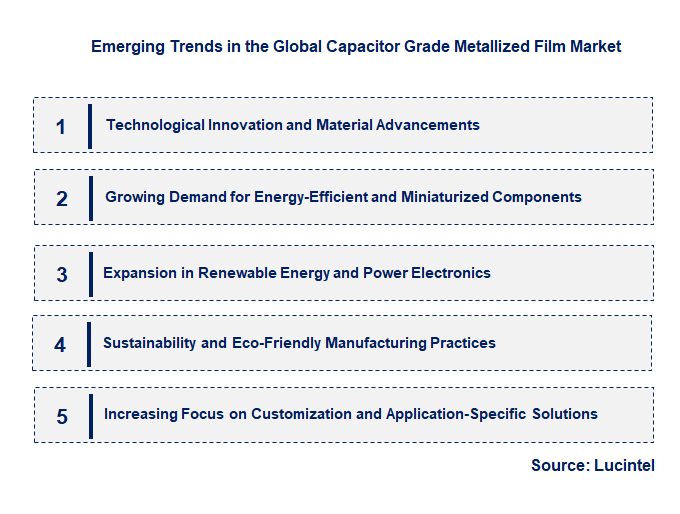
• Technological Innovation and Material Advancements: The market is witnessing significant innovation in metallized film materials, including the development of ultra-thin, high-dielectric-strength films. These advancements improve capacitor performance by enabling higher capacitance values, better thermal stability, and longer lifespan. Manufacturers are investing in research to create films with enhanced moisture resistance and reduced environmental impact. This trend allows for more compact, efficient, and reliable capacitors, which are essential for high-performance electronic applications. As a result, technological innovation is driving product differentiation and opening new avenues for market expansion.
• Growing Demand for Energy-Efficient and Miniaturized Components: The increasing adoption of portable electronics, electric vehicles, and renewable energy systems is fueling demand for smaller, more energy-efficient capacitors. Metallized films enable the production of compact capacitors with high energy density, which are critical for space-constrained applications. This trend is driven by consumer preferences for lightweight devices and the automotive industrys push toward electric vehicles. The focus on energy efficiency also aligns with global sustainability goals, prompting manufacturers to develop environmentally friendly materials and processes. Consequently, this trend is reshaping product design and expanding market opportunities in emerging sectors.
• Expansion in Renewable Energy and Power Electronics: The rising integration of renewable energy sources and the proliferation of power electronic devices are significantly impacting the market. Metallized film capacitors are vital for power conditioning, energy storage, and filtering applications in solar and wind energy systems. Their ability to withstand high voltages and frequencies makes them suitable for these demanding environments. As governments and industries invest heavily in clean energy infrastructure, the demand for reliable, high-performance capacitors increases. This trend is fostering innovation in capacitor design and encouraging manufacturers to develop specialized products tailored for renewable energy applications.
• Sustainability and Eco-Friendly Manufacturing Practices: Environmental concerns are prompting the industry to adopt sustainable manufacturing processes and eco-friendly materials. This includes reducing the use of hazardous substances, minimizing waste, and improving energy efficiency during production. The shift toward biodegradable or recyclable metallized films is gaining momentum, aligning with global regulations and consumer expectations. These practices not only reduce the environmental footprint but also enhance brand reputation and compliance. As sustainability becomes a key differentiator, manufacturers are investing in green technologies, which are expected to influence product development and supply chain strategies in the coming years.
• Increasing Focus on Customization and Application-Specific Solutions: The diverse requirements of end-use industries are driving a trend toward customized metallized film capacitors. Manufacturers are offering tailored solutions with specific dielectric properties, sizes, and performance characteristics to meet unique application needs. This approach enhances device efficiency, reliability, and lifespan. Customization also enables companies to differentiate their offerings in a competitive market. The growing demand for application-specific solutions is encouraging innovation in design and manufacturing processes, fostering closer collaboration between material suppliers and end-users. This trend is expected to lead to more versatile and high-performing capacitor products. These emerging trends are collectively transforming the capacitor grade metallized film market by fostering innovation, promoting sustainability, and enabling application-specific solutions. They are driving market growth, expanding application horizons, and reshaping competitive strategies, ultimately leading to a more dynamic and resilient industry landscape.
• Technological Innovations in Film Manufacturing: The development of advanced coating and deposition techniques has significantly improved film quality, reducing defects and enhancing performance. These innovations enable manufacturers to produce films with superior dielectric properties, higher stability, and longer lifespan. As a result, the market benefits from increased product reliability, expanded application scope, and competitive pricing, driving overall growth and attracting new customers seeking high-performance materials.
• Sustainability and Eco-Friendly Solutions: Growing environmental concerns have prompted manufacturers to adopt sustainable practices, such as using biodegradable materials and reducing energy consumption during production. The shift towards eco-friendly metallized films not only aligns with regulatory standards but also appeals to environmentally conscious consumers. This development enhances brand reputation, opens new market segments, and encourages innovation in recyclable and low-impact materials, ultimately fostering market expansion and supporting global sustainability goals.
• Expansion of End-Use Industries: The increasing adoption of metallized films in electronics, automotive, and renewable energy sectors has created substantial growth opportunities. In electronics, they are used in capacitors and insulation; in automotive, for lightweight and durable components; and in renewable energy, for efficient energy storage solutions. This diversification of applications boosts demand, encourages product customization, and stimulates investment in research and development, thereby strengthening the market’s overall growth trajectory.
• Integration of Smart Technologies: The incorporation of smart features such as self-healing capabilities and enhanced dielectric properties has revolutionized the use of metallized films. These advancements improve product longevity and performance, especially in high-stress environments. The integration of IoT and automation in manufacturing processes further enhances efficiency and quality control. This development attracts high-end applications, increases product value, and positions the market for future technological leadership and innovation.
• Market Consolidation and Strategic Partnerships: Recent mergers, acquisitions, and collaborations among key players have strengthened market positioning and expanded distribution networks. Strategic partnerships facilitate technology sharing, joint R&D efforts, and access to new markets. This consolidation enhances competitiveness, accelerates innovation, and ensures supply chain stability. As a result, the market becomes more resilient, with increased capacity to meet rising demand and adapt to evolving customer needs, fostering sustainable growth. The overall impact of these developments is a more dynamic, innovative, and sustainable market environment. Enhanced product quality, expanded applications, and strategic collaborations are driving growth, increasing competitiveness, and opening new opportunities. These factors collectively position the capacitor grade metallized film market for long-term success, benefiting manufacturers, consumers, and the broader electronics and energy sectors.
• Expanding Use in Renewable Energy Systems: The rising adoption of renewable energy sources like solar and wind power is boosting demand for high-performance capacitors. Capacitor grade metallized films are essential for power conditioning, energy storage, and grid stabilization. As renewable projects grow globally, the need for reliable, durable, and cost-effective capacitor solutions increases, presenting significant growth opportunities for manufacturers to innovate and capture market share in this expanding sector.
• Advancements in Film Manufacturing Technologies: Innovations in manufacturing processes, such as improved coating techniques and material formulations, are enhancing film quality and performance. These technological advancements enable the production of films with higher dielectric strength, lower dissipation factors, and better stability. Such improvements allow for more efficient capacitors, opening avenues for new applications and enabling existing applications to operate at higher voltages and temperatures, thus expanding market potential.
• Growing Demand in Automotive Electronics: The automotive industry’s shift toward electric vehicles (EVs) and advanced driver-assistance systems (ADAS) is increasing the need for reliable, high-capacity capacitors. Metallized films are critical components in power electronics, energy storage, and noise filtering within vehicles. As EV adoption accelerates, the demand for specialized capacitor films that meet stringent safety and performance standards is expected to rise, creating substantial growth prospects for industry players.
• Increasing Adoption in Consumer Electronics: The proliferation of smart devices, wearables, and high-performance gadgets is driving demand for compact, efficient capacitors. Metallized films offer advantages such as miniaturization, high stability, and low losses, making them ideal for consumer electronics. As consumers demand more sophisticated and energy-efficient products, manufacturers can capitalize on this trend by developing tailored capacitor solutions that meet evolving technological requirements.
• Rising Focus on Sustainability and Eco-Friendly Materials: Environmental concerns are prompting manufacturers to develop sustainable metallized films with reduced environmental impact. Innovations include biodegradable coatings, recyclable materials, and energy-efficient production processes. These eco-friendly solutions appeal to environmentally conscious consumers and regulatory bodies, providing a competitive edge. Emphasizing sustainability can also open new markets and foster long-term growth by aligning with global green initiatives and standards. The overall market landscape is poised for robust growth as these opportunities converge, enabling manufacturers to innovate, expand their applications, and meet the evolving demands of various industries. Strategic focus on technological advancements, sustainability, and emerging applications will be crucial for capturing future market share and ensuring sustained success.
• Technological Innovation: The rapid development of electronic devices and energy storage systems necessitates advanced capacitor materials. Innovations in metallized film manufacturing, such as improved dielectric properties and film thickness control, enhance capacitor performance, reliability, and lifespan. These technological advancements enable manufacturers to meet the increasing demand for miniaturized, high-capacity, and energy-efficient components across sectors like consumer electronics, automotive, and industrial applications. As technology continues to evolve, the market benefits from new product development, fostering growth and competitiveness.
• Growing Electronics Industry: The expanding electronics sector, driven by consumer demand for smartphones, laptops, and wearable devices, significantly boosts the need for high-quality capacitor components. Additionally, the proliferation of IoT devices and smart technologies requires reliable energy storage solutions, further fueling demand. The automotive industry’s shift toward electric vehicles (EVs) also contributes, as capacitors are critical for power management and energy recovery systems. This broad-based growth across multiple industries creates a robust market environment for metallized films used in capacitors.
• Environmental Regulations and Sustainability: Increasing regulatory pressure to reduce environmental impact influences the market by encouraging the adoption of eco-friendly manufacturing processes and materials. Metallized films that are recyclable and produced with minimal hazardous chemicals are gaining preference. Governments and industry standards are pushing for sustainable practices, which incentivize manufacturers to innovate in biodegradable or low-impact materials. These regulatory trends not only promote environmental responsibility but also open new avenues for market differentiation and compliance, ultimately supporting long-term industry growth.
• Cost Reduction and Economies of Scale: As demand for capacitor-grade metallized films rises, manufacturers benefit from economies of scale, leading to reduced production costs. Cost-effective manufacturing processes, such as automation and improved film coating techniques, enable suppliers to offer competitive pricing. Lower costs make these films more accessible for a broader range of applications, including budget-sensitive consumer electronics and large-scale industrial projects. Cost reduction strategies also facilitate market expansion into emerging regions, further driving overall industry growth.
• Increasing Adoption in Renewable Energy: The integration of metallized films in renewable energy systems, such as solar and wind power, is a significant growth driver. Capacitors are essential for power conditioning, energy storage, and grid stabilization in renewable setups. The rising adoption of these sustainable energy sources necessitates reliable, high-performance capacitors, boosting demand for metallized films. This trend aligns with global efforts to reduce carbon emissions and transition to cleaner energy, positioning the market for sustained expansion as renewable energy infrastructure continues to develop. The challenges facing the Market include:-
• Fluctuating Raw Material Prices: The market heavily depends on raw materials like polypropylene and aluminum, whose prices are subject to volatility due to geopolitical tensions, supply chain disruptions, and fluctuating commodity markets. These fluctuations impact manufacturing costs and profit margins, creating uncertainty for producers and consumers alike. Companies must develop strategies to hedge against price swings or seek alternative materials, which can delay product development and increase operational complexity.
• Stringent Regulatory Compliance: Increasing environmental and safety regulations impose strict standards on manufacturing processes and product specifications. Compliance often requires significant investments in research, development, and certification, which can be costly and time-consuming. Non-compliance risks legal penalties, product recalls, and damage to brand reputation. Navigating diverse regulatory landscapes across regions adds complexity, potentially hindering market entry or expansion for some players.
• Technological Obsolescence: Rapid technological advancements can render existing metallized film products obsolete, forcing manufacturers to continuously innovate. Staying ahead requires substantial R&D investments and agility in product development cycles. Failure to adapt to emerging standards or customer preferences may lead to loss of market share. Additionally, integrating new technologies can pose manufacturing challenges and increase costs, impacting overall competitiveness and profitability. The capacitor grade metallized film market is driven by technological innovation, expanding electronics and renewable energy sectors, regulatory support for sustainability, and cost efficiencies. However, it faces challenges such as raw material price volatility, stringent regulatory compliance, and rapid technological obsolescence. These factors collectively influence market growth, requiring stakeholders to adopt strategic approaches to capitalize on opportunities while mitigating risks. The industry’s future hinges on balancing innovation with sustainability and cost management, ensuring resilient and sustainable growth pathways.
• Celplast Metallized Products
• Dunmore
• Flex Films
• Impak Films
• NuinTEK
• Polyplex Corporation
• REIKO Co
• Steiner
• Toray Plastics
• Vibac Group
• Metallized BOPP Film
• Metallized PET Film
• Automotive Grade Capacitors
• Audio Grade Capacitors
• Others
• North America
• Europe
• Asia Pacific
• The Rest of the World
• United States: The US market has seen substantial growth driven by advancements in consumer electronics, electric vehicles, and renewable energy sectors. Leading companies are investing in R&D to develop high-performance, eco-friendly metallized films with improved dielectric properties. The adoption of automation and smart manufacturing techniques has enhanced production efficiency. Additionally, US regulatory standards are encouraging the use of sustainable materials, prompting innovations in biodegradable and recyclable films. The market is also witnessing increased collaborations between technology firms and material suppliers to develop next-generation capacitor solutions.
• China: China remains a dominant player in the metallized film market, fueled by rapid industrialization and a booming electronics manufacturing sector. The country has increased investments in research to improve film quality and reduce production costs. Chinese manufacturers are expanding capacity to meet rising domestic demand for capacitors used in smartphones, electric vehicles, and energy storage systems. Government policies supporting green technology and sustainable manufacturing are encouraging the development of environmentally friendly metallized films. Moreover, China is focusing on technological innovation to enhance film performance, aiming to reduce reliance on imports and strengthen its global market position.
• Germany: Germanys market developments are characterized by a focus on high-quality, precision-engineered metallized films for automotive and industrial applications. The country’s emphasis on Industry 4.0 and automation has led to more efficient production processes. German companies are investing in research to improve film durability, thermal stability, and energy efficiency. The push toward electric mobility and renewable energy integration has increased demand for reliable capacitors, prompting innovations in film materials. Additionally, Germany is actively involved in European initiatives to promote sustainable manufacturing practices, which influence the development of environmentally friendly metallized films.
• India: The Indian market is experiencing rapid growth driven by expanding electronics manufacturing, renewable energy projects, and automotive sectors. Local companies are adopting advanced manufacturing techniques to produce high-quality metallized films at competitive prices. The government’s initiatives to promote Make in India and renewable energy targets are boosting demand for capacitors in solar and wind power systems. R&D efforts are focused on developing films with enhanced dielectric strength and environmental sustainability. The increasing adoption of electric vehicles and smart devices is further propelling market growth, with domestic manufacturers aiming to reduce import dependency and foster innovation.
• Japan: Japan continues to lead in technological innovation within the metallized film market, emphasizing high-performance, durable materials for industrial, automotive, and consumer electronics. Japanese firms are investing heavily in R&D to develop films with superior thermal stability, miniaturization capabilities, and energy efficiency. The country’s focus on sustainability has driven the development of eco-friendly metallized films, including biodegradable options. Japan’s advanced manufacturing infrastructure and strong emphasis on quality control ensure the production of reliable, high-quality products. The market is also benefiting from collaborations between industry and academia to pioneer next-generation capacitor materials, maintaining Japan’s competitive edge globally.


• Celplast Metallized Products
• Dunmore
• Flex Films
• Impak Films
• NuinTEK
• Polyplex Corporation
• REIKO Co
• Steiner
• Toray Plastics
• Vibac Group Q6. Which capacitor grade metallized film market segment will be the largest in future? Answer: Lucintel forecasts that, within the type category, metallized PET film is expected to witness higher growth over the forecast period. Q7. In capacitor grade metallized film market, which region is expected to be the largest in next 5 years? Answer: In terms of region, APAC is expected to witness the highest growth over the forecast period. Q8. Do we receive customization in this report? Answer: Yes, Lucintel provides 10% customization without any additional cost.


Choose a license that fits your team. Instant PDF delivery.
Prices exclude taxes. Instant delivery. Custom licensing available on request.
Market Report · July 31, 2026
Market Report · July 31, 2026
Market Report · July 31, 2026
Trusted partner for strategic intelligence and business growth


Receive a complimentary market analysis tailored to your industry. Our analysts will identify key growth opportunities and competitive dynamics specific to your business.

Market size, growth rate, and key trend analysis for your specific sector.

Top competitor positioning and market share analysis.

Strategic recommendations backed by data-driven insights.
Get curated market intelligence and competitive moves straight to your inbox.
By subscribing, you agree to receive our monthly insights. Unsubscribe anytime.
Receive a complimentary market analysis tailored to your industry. Our analysts will identify key growth opportunities and competitive dynamics specific to your business.
Market size, growth rate, and key trend analysis for your specific sector.
Top competitor positioning and market share analysis.
Strategic recommendations backed by data-driven insights.
Get curated market intelligence, emerging trends, and competitive moves straight to your inbox each month.
By subscribing, you agree to receive our monthly insights. Unsubscribe anytime.
We'll send your sample report shortly.