
Market Report · July 31, 2026

Key data points: The market size in 2035 = $224 billion, growth forecast = 8.2% annually for the next 9 years. Scroll below to get more insights. This market report covers trends, opportunities, and forecasts in the global cancer testing screening market to 2035 by technique (imaging, biopsy, genomic and molecular tests, next generation sequencing, RT-PCR, colonoscopy, biomarkers and others), cancer type (respiratory system cancer, leukemia, myeloma and lymphoma, skin cancer, abdominal/digestive system cancer, urinary system cancer, endocrine system cancer, breast cancer and others), application (hospitals, clinics, diagnostic centers, research institutes and others), end use (patients, healthcare providers, diagnostic laboratories, research institutes and pharmaceutical companies), and region (North America, Europe, Asia Pacific, and the Rest of the World)
We'll send your sample report shortly.
The future of the global cancer testing screening market looks promising with opportunities in the patients, healthcare providers, diagnostic laboratories, research institutes and pharmaceutical companies markets. The global cancer testing screening market is expected to reach an estimated $224 billion by 2035 with a CAGR of 8.2% from 2026 to 2035. The major drivers for this market are the increasing prevalence of cancer cases, the rising adoption of early screening programs and the growing demand for accurate diagnostics.
• Lucintel forecasts that, within the technique category, imaging will remain the largest segment over the forecast period as the growing clinical focus on early detection.
• Within the end use category, patients will remain the largest segment due to the the rising demand for early diagnosis.
• In terms of regions, North America will remain the largest region over the forecast period due to the the rising strong government support for early cancer detection.
Gain valuable insights for your business decisions with our comprehensive 150+ page report.The cancer testing screening market is undergoing a profound transformation as precision medicine, digital health, and advanced analytics converge to reshape how cancers are detected and monitored. Growing emphasis on early diagnosis, patient-centric care, and value-based reimbursement is accelerating adoption of innovative screening modalities that promise higher sensitivity, specificity, and accessibility. Liquid biopsy technologies, multi-cancer early detection platforms, artificial intelligence–enabled imaging, at-home and decentralized testing models, and integration of genomic profiling are redefining clinical pathways. Together, these emerging trends are expanding screening beyond traditional demographics, improving risk stratification, and enabling more personalized, proactive cancer management across healthcare systems.
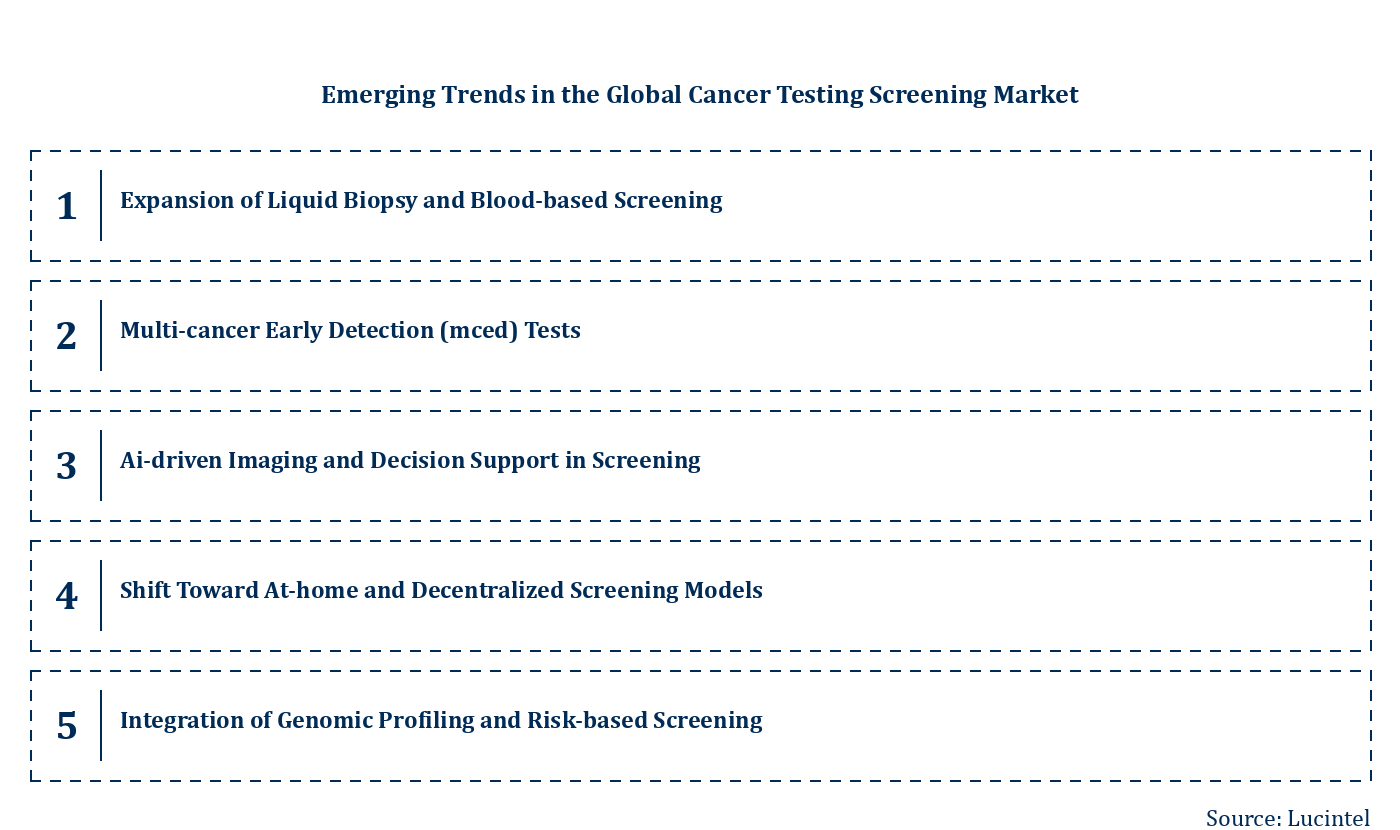
The cancer testing screening market is undergoing rapid transformation as healthcare systems prioritize early detection, personalized medicine, and population-level prevention strategies. Advances in genomics, imaging, and digital health are converging to deliver more accurate, less invasive, and faster screening options across major cancer types. Regulatory agencies and payers are increasingly supporting innovative tests that demonstrate clear clinical utility and cost-effectiveness. At the same time, industry players are forming strategic collaborations to accelerate validation and scale adoption globally. These developments are reshaping care pathways, improving patient outcomes, and redefining how cancer risk and early-stage disease are identified and managed.
The cancer testing screening market is evolving rapidly as healthcare systems prioritize earlier detection, personalized treatment planning, and cost-effective population health strategies. Advances in genomics, digital pathology, and liquid biopsy technologies are expanding the range of detectable cancers and improving accuracy across care settings. Payers and providers are increasingly aligned around value-based care, creating demand for screening tools that demonstrate clear clinical and economic benefits. At the same time, rising cancer incidence, aging populations, and widening access to diagnostics in emerging markets are reshaping application priorities. These dynamics are generating distinct, high-impact growth opportunities across key clinical applications.
The cancer testing and screening market is influenced by a complex mix of technological, economic, clinical, and regulatory dynamics. Rapid innovation in diagnostics, growing focus on early detection, and supportive reimbursement environments are expanding access to sophisticated screening tools. At the same time, high test costs, infrastructure gaps, and evidence requirements shape adoption patterns across regions and healthcare systems. Stakeholders must understand how these drivers and challenges interact to determine pricing, positioning, and investment priorities. This context is critical for aligning product strategies with evolving clinical guidelines, payer expectations, patient needs, and health system capacities worldwide.
The factors responsible for driving the cancer testing and screening market include:
The challenges in the cancer testing and screening market are:
The overall trajectory of the cancer testing and screening market reflects a tension between powerful growth drivers and persistent structural constraints. Technological breakthroughs, rising disease burden, and policy support are expanding opportunities for innovative diagnostics and comprehensive screening programs. However, cost pressures, regulatory demands, and system-level barriers slow diffusion and reinforce inequities across regions and populations. Market participants that align product design, pricing, and evidence generation with payer and provider needs, while addressing operational challenges, are best positioned to capture value. Over time, resolving access and implementation gaps will be critical to fully realize the clinical and commercial potential of cancer testing and screening.
Companies in the market compete on the basis of product quality offered. Major players in this market focus on expanding their manufacturing facilities, R&D investments, infrastructural development, and leverage integration opportunities across the value chain. Through these strategies cancer testing screening market companies cater increasing demand, ensure competitive effectiveness, develop innovative products & technologies, reduce production costs, and expand their customer base. Some of the cancer testing screening market companies profiled in this report include-
The study includes a forecast for the global cancer testing screening market by technique, cancer type, application, end use, and region.
The cancer testing and screening market is undergoing rapid change as countries expand early detection programs, adopt advanced diagnostics, and integrate digital technologies to improve outcomes. Growing cancer incidence, aging populations, and rising awareness are driving demand for more accurate, accessible, and cost-effective tests. Innovations span liquid biopsies, multi-cancer early detection (MCED) assays, AI-assisted imaging, and genomics-based screening. At the same time, payers and regulators are reassessing coverage and quality standards to ensure equitable access. The following country-level developments illustrate how major markets are reshaping their cancer screening ecosystems and investment priorities.
Cancer Testing Screening Market: Which Strategic Shifts Are Redefining Early Detection?
Dallas, July 29, 2026 – The cancer testing screening market is entering a pivotal phase as precision diagnostics, digital technologies, and new risk-stratification models converge to reshape how populations are screened and monitored. Across oncology, payers, technology providers, and health systems are reassessing screening programs in light of rising cancer incidence, aging demographics, and stronger evidence for early intervention. This shift is not a simple expansion of existing tests but a structural reconfiguration of where value is created, which patient segments are prioritized, and how data is monetized.
In this article, the major trends steering the cancer testing screening market are examined, along with the segments most likely to benefit, the disruption expected across healthcare and technology, and the challenges and opportunities emerging for incumbents and new entrants alike.
How Are Multi‑Cancer Early Detection and Liquid Biopsy Changing the Market Narrative?
A central trend in the cancer testing screening market is the rise of multi‑cancer early detection (MCED) platforms built around liquid biopsy technologies. These blood-based assays aim to detect multiple cancers simultaneously by analyzing circulating tumor DNA, RNA, proteins, and other biomarkers. Unlike traditional organ-specific screening methods such as mammography or colonoscopy, MCED tests promise broad coverage in a single, minimally invasive encounter.
This evolution is reshaping market dynamics in several ways. Clinical laboratories and diagnostic innovators are repositioning from single-test revenue models toward platforms that can be deployed across different cancer types and risk categories. Health systems see a potential shift from episodic, age-based screening programs to continuous, risk-adaptive surveillance that fits within primary care. Payers are closely watching long-term outcomes data to evaluate whether broad deployment of MCED can translate into earlier-stage detection, lower treatment costs, and improved survival.
Disruption is likely in markets already dominated by mature screening modalities, including breast, colorectal, lung, and cervical cancer. As evidence accrues, liquid biopsy platforms may begin to divert volume away from some existing procedures or, more realistically near term, complement them as a pre-screening triage layer. For technology players, the MCED race is creating demand for high-throughput sequencing, bioinformatics pipelines, secure cloud storage, and AI-driven pattern recognition tools, effectively linking oncology diagnostics with the broader data and analytics ecosystem.
Can AI and Advanced Analytics Redefine Who Gets Screened and When?
Another powerful current reshaping the cancer testing screening market is the application of artificial intelligence and advanced analytics to both imaging and non-imaging data. In radiology, AI-enabled tools are now supporting the interpretation of mammograms, low-dose CT scans for lung cancer, and MRI for prostate and hepatic lesions. These tools aim to reduce false positives and false negatives, standardize quality across settings, and optimize radiologist workflow.
The strategic implications extend beyond imaging suites. Machine learning models are being trained on electronic health records, genomics, lifestyle data, and social determinants of health to refine individual risk profiles. This enables more granular segmentation of who should be screened, at what age, at what frequency, and using which modality. Payers and population health managers see AI-based risk stratification as an opportunity to move from broad, age-based recommendations to truly personalized screening schedules that could reduce over-screening in low-risk groups and under-screening in high-risk populations.
Markets set to see strong impact include digital health platforms, radiology solution providers, and integrated delivery networks that can embed AI into their care pathways. Technology vendors supplying cloud infrastructure, medical imaging software, and predictive analytics engines are becoming critical partners in operationalizing data-driven screening programs. Over time, AI-enhanced triage and decision support could become a gatekeeper layer, influencing test volumes, modality choices, and downstream treatment patterns, thereby altering revenue flows for traditional test manufacturers.
Where Will At‑Home and Decentralized Screening Models Gain the Most Traction?
Growing emphasis on accessibility and patient convenience is accelerating the move toward at-home and decentralized screening approaches. Self-collection kits for colorectal cancer, HPV-based cervical cancer screening, and emerging blood and saliva tests enable individuals to complete elements of the screening process outside of clinical facilities. The pandemic-era expansion of telehealth has further normalized remote engagement, opening the door to hybrid models that combine virtual consultation, home-based sampling, and centralized laboratory analysis.
These shifts create powerful tailwinds for certain segments. Retail health, pharmacy chains, and mail-order diagnostics providers are positioning themselves as front-line access points for cancer screening. Employers and insurers are piloting home-based screening campaigns as part of workplace wellness and value-based benefits strategies. Logistics and last-mile delivery companies are finding new opportunities in managing kit distribution and sample return infrastructure.
The disruptive impact is particularly salient for markets with geographic and socioeconomic access barriers, where decentralized screening can bridge gaps in specialist availability and facility-based capacity. For traditional hospital-centric programs, this trend introduces competitive pressure but also partnership opportunities, as institutions look to extend their reach into communities using blended digital and physical models.
How Are Precision Oncology and Genomics Reframing the Value of Screening Data?
As precision oncology matures, genomic and molecular profiling are no longer confined to treatment decision-making in late-stage disease. There is growing interest in using genetic risk information and early molecular signals to shape screening strategies. This shift elevates the strategic importance of data generated through cancer testing screening and creates new intersections with the broader life sciences ecosystem.
Pharmaceutical and biotech companies are increasingly viewing screening programs as rich sources of de-identified real-world data that can inform drug discovery, clinical trial design, and companion diagnostic development. Partnerships between diagnostics firms and biopharma players are proliferating, with shared incentives to identify at-risk populations earlier and to match them with prevention and early-intervention studies.
For technology providers, this trend reinforces the role of high-performance computing, secure cloud environments, and interoperable data standards. Genomic data, pathology images, and longitudinal clinical records must be linked, de-identified, and analyzed at scale to unlock predictive insights. Cybersecurity and privacy-preserving technologies, including federated learning, homomorphic encryption, and tokenization, are gaining relevance as stakeholders seek to balance data utility with regulatory compliance and patient trust.
Which Challenges Could Slow Adoption Despite Strong Innovation Momentum?
Despite accelerated innovation, the cancer testing screening market faces structural challenges that could temper the speed and scale of adoption. Evidence generation remains a central barrier, as policymakers and payers require robust data on mortality reduction, cost-effectiveness, and potential harms such as overdiagnosis and unnecessary interventions. Trials for new screening paradigms are lengthy, complex, and resource-intensive, especially when multi-cancer and genomic approaches are involved.
Reimbursement and policy frameworks often lag technological progress. Many health systems operate with legacy benefit designs and screening guidelines that are slow to incorporate new modalities or risk-based models. This mismatch can leave promising technologies in pilot status rather than mainstream deployment. Additionally, inequities in access, digital literacy, and trust threaten to widen disparities if advanced tests and digital interfaces disproportionately reach higher-income, urban, and digitally fluent populations.
Where Are the Most Compelling Opportunities for Stakeholders Across Healthcare and Technology?
At the same time, the evolving cancer testing screening market offers significant strategic opportunities for those able to navigate regulatory, economic, and operational hurdles. Health systems can use advanced screening strategies to reposition themselves as proactive, prevention-focused organizations, differentiating on population health outcomes and patient experience. Payers and governments can leverage analytics-driven screening to bend long-term cost trajectories while demonstrating measurable public health gains.
For technology companies, the market provides a multi-layered opportunity landscape. AI vendors can anchor themselves as essential partners in imaging, risk modeling, and workflow optimization. Cloud and data infrastructure providers can capture value by hosting the rapidly expanding volumes of imaging, genomic, and real-world outcome data generated by screening programs. Cybersecurity and privacy specialists can become critical enablers as stakeholders confront tightening regulation and rising public expectations for data stewardship.
What Recent Developments Signal the Next Phase for the cancer testing screening market?
Recent developments underscore how quickly the cancer testing screening landscape is evolving. Several MCED and liquid biopsy players are advancing through pivotal trials, with early results hinting at the potential to detect multiple cancers at earlier stages than current standard screening methods alone. Regulatory agencies are actively reviewing new assays and updating guidance on the use of biomarkers and AI in diagnostics, increasing clarity even as expectations for evidence rise.
On the technology side, major cloud and AI companies are announcing expanded partnerships with hospital networks, diagnostics labs, and imaging vendors to build integrated cancer screening platforms. Venture and strategic investment in oncology-focused digital health, remote diagnostics, and population risk analytics remains robust, reflecting continued confidence in long-term demand. Large health systems are piloting risk-stratified screening pathways, integrating genomic risk scores and AI-based triage into routine care.
Together, these developments point to an inflection point in the cancer testing screening market. Stakeholders that treat screening as a data-rich, technology-enabled, and outcome-driven domain, rather than a set of isolated tests, are best positioned to capture value as early detection becomes a central pillar of oncology strategy worldwide.
1. F. Hoffmann-La Roche
F. Hoffmann-La Roche is a global pharmaceutical and diagnostics leader with a strong and diversified footprint in the cancer testing and screening market. Headquartered in Basel and founded in 1896, the company employs tens of thousands of people across more than 100 countries, with major commercial and manufacturing hubs in Europe, North America, Asia-Pacific, and Latin America. Roche’s Diagnostics division offers an extensive oncology-focused portfolio that spans immunohistochemistry, tissue diagnostics, molecular diagnostics, next-generation sequencing solutions, companion diagnostics for targeted therapies, and blood-based tumor markers for early detection and monitoring. The company markets systems such as the cobas line of molecular analyzers and tissue-based solutions under Roche Tissue Diagnostics (Ventana) that are widely used in pathology laboratories for cancer screening and confirmation. In recent years, Roche has expanded its cancer testing reach through partnerships and regional lab collaborations in Asia-Pacific and the Middle East to increase access to advanced molecular oncology assays. Its acquisition of Foundation Medicine strengthened its position in comprehensive genomic profiling for solid tumors and hematologic cancers, enabling more precise screening and stratification. Roche has also executed multiple collaborations with biotechnology firms to co-develop companion diagnostic tests that link specific biomarkers to targeted cancer therapies. These moves, combined with internal R&D and digital pathology initiatives, reinforce Roche’s role as a key integrated player across the cancer diagnostics continuum, from early screening to treatment selection and disease monitoring.
2. Abbott Laboratories
Abbott Laboratories is a diversified healthcare company with a substantial global presence in diagnostics, including cancer testing and screening. Founded in 1888 and headquartered in Abbott Park, Illinois, the company employs more than 100,000 people and operates in over 160 countries across North America, Europe, Asia-Pacific, Latin America, the Middle East, and Africa. Abbott’s Diagnostics segment provides core laboratory systems, immunoassays, hematology analyzers, and molecular platforms that support oncology-focused testing, including tumor markers, HPV screening, and assays relevant to colorectal, cervical, and other cancers. Platforms such as the ARCHITECT and Alinity systems enable high-throughput cancer marker testing in hospital and reference laboratories, while the m2000 and Alinity m molecular systems support nucleic acid–based assays relevant to oncogenic viruses and cancer risk. Abbott has expanded geographically through new manufacturing and diagnostic hubs in emerging markets, including Asia and Latin America, aimed at broadening access to screening technologies and point-of-care solutions. While much of its M&A activity has been broad-based, acquisitions in diagnostics have strengthened its oncology testing capabilities, particularly in immunoassay and molecular diagnostics technologies. The company continues to invest in R&D to refine biomarkers, improve assay sensitivity and specificity, and integrate data from cancer screening tests into clinical decision workflows. Abbott’s widespread installed base of diagnostic instruments and its extensive distribution network make it an influential player in scaling early cancer detection and population screening programs globally.
3. Quest Diagnostics
Quest Diagnostics is a leading provider of diagnostic information services and one of the largest clinical laboratory networks in the United States, with a growing international footprint. Headquartered in Secaucus, New Jersey and established in 1967, Quest employs tens of thousands of professionals and operates a broad network of central laboratories, patient service centers, and logistics operations that collectively support a large volume of cancer-related testing. The company’s oncology testing portfolio encompasses routine cancer screening assays such as Pap tests, HPV testing, prostate-specific antigen measurements, and fecal immunochemical tests, as well as more specialized molecular diagnostics, hereditary cancer risk panels, and minimal residual disease monitoring. Quest offers advanced genomic and biomarker-based assays for solid tumors and hematologic malignancies through its esoteric and specialty labs, supporting both early detection and therapy selection. Geographically, Quest maintains its strongest presence in the United States but also serves international customers through partnerships and joint ventures in regions such as Brazil and select markets in Europe and Asia. The company has grown its oncology screening reach through acquisitions of regional and specialized laboratories, which have enhanced its capacity in anatomic pathology and molecular oncology. Strategic collaborations with health systems and payers aim to embed evidence-based cancer screening protocols into population health programs. By leveraging extensive claims and lab data, Quest also works on analytics-driven initiatives to close care gaps in recommended cancer screening, enhancing adherence to guidelines for colorectal, cervical, breast, and prostate cancer testing.
4. QIAGEN
QIAGEN is a global provider of sample-to-insight solutions for molecular diagnostics, life sciences, and applied testing, with a significant role in cancer testing and screening. Founded in 1984 and headquartered in Hilden, Germany, QIAGEN employs thousands of people and maintains operations and subsidiaries across Europe, North America, Asia-Pacific, and Latin America. The company’s product portfolio for oncology includes nucleic acid extraction kits, PCR and real-time PCR assays, next-generation sequencing library preparation solutions, bioinformatics pipelines, and companion diagnostics. QIAGEN is particularly known for its HPV testing solutions used in cervical cancer screening, as well as assays for detecting oncogenic mutations and gene fusions relevant to lung, colorectal, and other cancers. Its QIAscreen and digene-based HPV tests are implemented widely in national and regional cervical cancer screening programs. QIAGEN has expanded its geographic presence in cancer diagnostics through collaborations with laboratories and reference centers in emerging markets, helping transition from cytology-based approaches to molecular HPV screening. The company has engaged in partnerships with pharmaceutical companies to develop and commercialize companion diagnostic assays that stratify patients for targeted cancer therapies, thereby integrating testing directly into oncology drug development. QIAGEN’s acquisition and integration of various diagnostics and informatics companies have strengthened its end-to-end oncology workflows, combining wet-lab technologies with interpretation software. By enabling standardized, high-sensitivity detection of cancer-associated biomarkers from tissue and liquid biopsy samples, QIAGEN supports both early detection and longitudinal monitoring, positioning itself as a critical molecular tools provider within the global cancer testing and screening ecosystem.
5. Siemens Healthineers
Siemens Healthineers is a major global medical technology company with a strong presence in imaging and diagnostics that directly supports cancer testing and screening. Headquartered in Erlangen, Germany and formally established as a separately listed entity in 2017, the company traces its healthcare heritage back many decades within Siemens. Siemens Healthineers employs tens of thousands of staff and serves customers in more than 70 countries, with significant operations across Europe, North America, Asia-Pacific, the Middle East, and Latin America. Its role in the cancer testing and screening market spans in vitro diagnostics and imaging-based detection. The Diagnostics business provides immunoassay, chemistry, and hematology analyzers along with oncology-related assays, including tumor markers used in screening and monitoring. The company’s molecular diagnostics portfolio includes PCR-based systems and assays for oncogenic viruses and genetic markers. In imaging, Siemens Healthineers is a leading provider of CT, MRI, PET-CT, and digital mammography systems, all central to early detection and staging of cancers such as lung, breast, and colorectal cancer. Recent geographic expansion has focused on installing advanced imaging and laboratory systems in high-growth markets in Asia and the Middle East, often in collaboration with governments and private providers to build comprehensive cancer centers. Through acquisitions such as Varian Medical Systems, Siemens Healthineers significantly expanded its oncology footprint, bringing radiation therapy, treatment planning, and oncology software into its portfolio. This combination of imaging, diagnostics, and therapy solutions enables integrated cancer care pathways, reinforcing the company’s influence across screening, diagnosis, and treatment planning in the global cancer market.
Lucintel has been in the business of market research and management consulting since 2000 and has published over 1000 market intelligence reports in various markets / applications and served over 1,000 clients worldwide. This study is a culmination of four months of full-time effort performed by Lucintel's analyst team. The analysts used the following sources for the creation and completion of this valuable report:
Extensive research and interviews are conducted across the supply chain of this market to estimate market share, market size, trends, drivers, challenges, and forecasts. Below is a brief summary of the primary interviews that were conducted by job function for this report.

Thus, Lucintel compiles vast amounts of data from numerous sources, validates the integrity of that data, and performs a comprehensive analysis. Lucintel then organizes the data, its findings, and insights into a concise report designed to support the strategic decision-making process. The figure below is a graphical representation of Lucintel's research process.

Choose a license that fits your team. Instant PDF delivery.
Prices exclude taxes. Instant delivery. Custom licensing available on request.
Market Report · July 31, 2026
Market Report · July 31, 2026
Market Report · July 22, 2026
Trusted partner for strategic intelligence and business growth


Receive a complimentary market analysis tailored to your industry. Our analysts will identify key growth opportunities and competitive dynamics specific to your business.

Market size, growth rate, and key trend analysis for your specific sector.

Top competitor positioning and market share analysis.

Strategic recommendations backed by data-driven insights.
Get curated market intelligence and competitive moves straight to your inbox.
By subscribing, you agree to receive our monthly insights. Unsubscribe anytime.
Receive a complimentary market analysis tailored to your industry. Our analysts will identify key growth opportunities and competitive dynamics specific to your business.
Market size, growth rate, and key trend analysis for your specific sector.
Top competitor positioning and market share analysis.
Strategic recommendations backed by data-driven insights.
Get curated market intelligence, emerging trends, and competitive moves straight to your inbox each month.
By subscribing, you agree to receive our monthly insights. Unsubscribe anytime.
We'll send your sample report shortly.