
Market Report · July 15, 2026

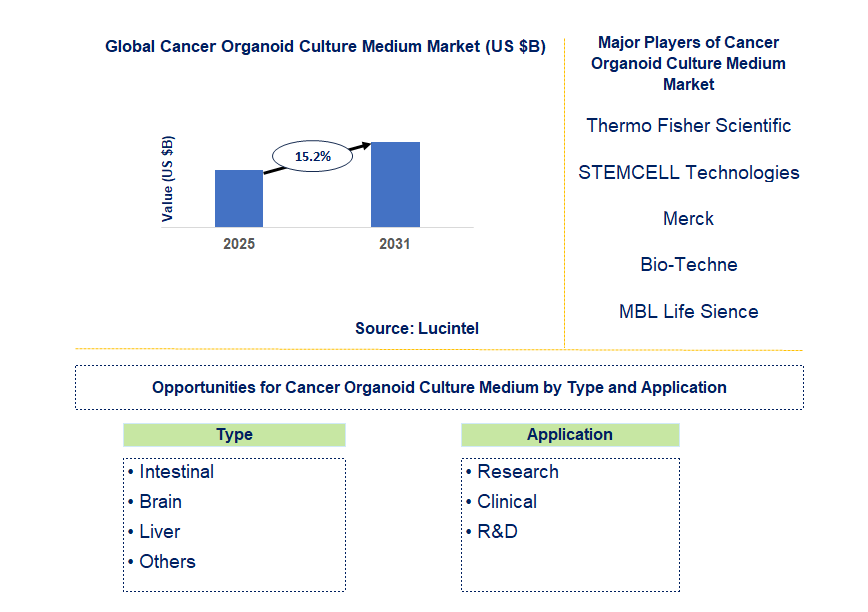
Key data points: The growth forecast = 15.2% annually for the next 7 years. Scroll below to get more insights. This market report covers Trends, opportunities and forecasts in cancer organoid culture medium market to 2031 by type (intestinal, brain, liver, and others), application (research, clinical, and R&D), and region (North America, Europe, Asia Pacific, and the Rest of the World)
We'll send your sample report shortly.
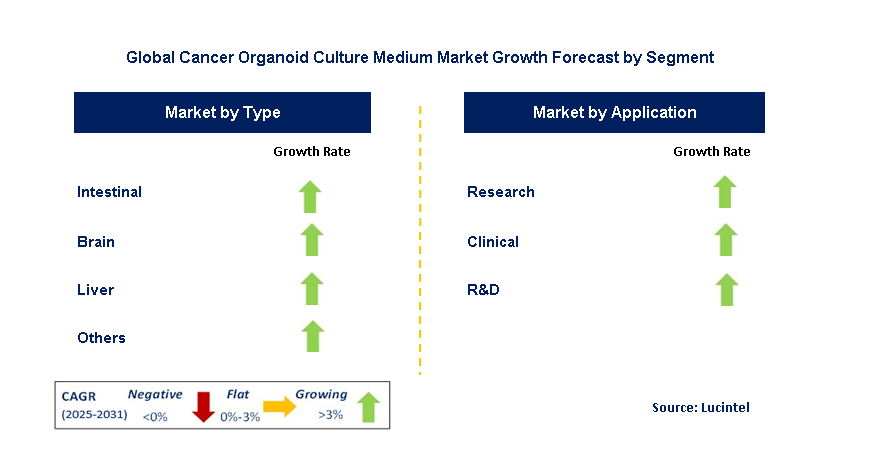
• Lucintel forecasts that, within the type category, liver is expected to witness the highest growth over the forecast period.
• Within the application category, R&D is expected to witness the highest growth.
• In terms of region, North America is expected to witness the highest growth over the forecast period due to the increasing adoption of advanced cell culture technologies.
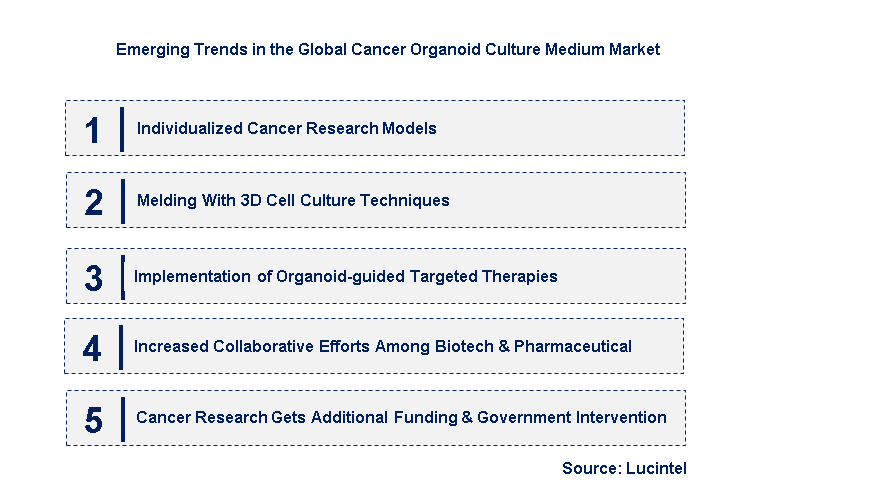
• Individualized Cancer Research Models: Cancer research personalization becomes more and more important, and organoids are at the forefront. Scientists are employing patient-derived cancer organoids to simulate specific tumor features reproductively for improved preclinical trials. This is changing the course of drug discovery and development as personalized organs in comparison to 2D cultures can predict better and are more relevant.
• Melding With 3D Cell Culture Techniques: The combination of cancer organoids with 3D cell cultures is increasing their potential to simulate the complex biology of cancer. These advanced 3D systems permit the accurate simulation of human tumor microenvironments, enabling improved examination of tumors, their drug responses, and resistance mechanisms. This integration allows more accurate and safer testing for new therapies aimed at curing cancer.
• Implementation of Organoid-guided Targeted Therapies: As personalized medicine priorities shift, cancer organoids are proving instrumental at creating individualized therapies. By studying the responses of patient-derived organoids to various drugs, targeted therapies can be designed that are specific to an individual’s cancer. This shift has far-reaching consequences for the development of cancer treatment strategies by designating more effective and less toxic intervention options.
• Increased Collaborative Efforts Among Biotech & Pharmaceutical: A notable increase in partnership between biotech companies and pharmaceutical companies for the purpose of developing and commercializing cancer organoid culture media is apparent. These collaborations are helpful in leveraging skills and assets which is bound to expedite the production of targeted culture media and novel cancer treatments. Such types of partnerships are most likely to multiply and lead to the provision of better directed solutions for cancer organoids culture.
• Cancer Research Gets Additional Funding & Government Intervention: There is new funding provided by public entities and private players in cancer research programs, increasing the need for sophisticated technology, such as cancer organoids. Investment dollars from the private sector and public funding are aiding in the widening of research efforts in cancer biology, application of other multidisciplinary fields, and therapeutic development. As cancer is a global problem, the need for effective solutions is likely to keep growing and so is the requirement for cancer organoid culture media. This trend is expected to grow. New trends are emerging that are reshaping the landscape of the Cancer Organoid Culture Medium market. The integration of computer-assisted design technologies is improving the efficiency of organoid systems. At the same time, tumor modeling is greatly benefitted by the use of 3D cell- organoid culture system devices. The development of precision medicine based on organoids and the growing partnerships between research institutes and biotech companies are further advancing the market. Increased funding because of growing cancer cases and changing policies will sustain these trends in the future and extend the application of cancer organoids in treatment development and precision oncology.
• Design of New Advanced Culture Media: One of the most powerful is the development of advanced culture media that allows growth of more sophisticated organoids of complex cancers. These media are attempts to provide more specific nutrients, growth factors, and other additives that foster the growth of cancers, and more organoids model tissues, and the rest. The directed development of these organoid models has enabled many researchers in clinical oncology drug development and individualized treatment.
• Increased Use in Drug Screening: Cancer organoid models are becoming a critical component in drug screening as they enable researchers to evaluate the efficacy and toxicity of new drugs prior to clinical trials. Recent work has been focused on the optimization of the scale and reproducibility of cancer organoid cultures for more efficient large-scale screening. This shift is increasing the need for specially formulated culture media for high-throughput screening of drugs.
• Integration of 3D Cell Culture Technologies: There is an observable market trend to combine 3D cell culture technologies with cancer organoids to better mimic the human tumor microenvironnement. The creation of new culture media that supports 3D cultures is promoting the innovation in cancer biology research, especially in metastasis, drug resistance, and immunotherapy. This is increasing the market need for sophisticated and novel culture media that can sustain these complex 3D structures.
• Customized Organoid Models for Precision Medicine: Research in personalized cancer treatments is seeing an uptick in the utilization of patient-centered organoids for the customization of the treatment provided to individual patients. Due to this shift, there has been the design of culturing media tailored to specific patient organoid models, which depict tumor activity and drug interactions with higher accuracy. These changes are greatly affecting the scope of precision oncology, which cultivates the need for specialized culture media.
• Partnerships Across Borders That Foster Development: The collaboration of academic bodies with biotech and pharmaceutical companies is giving rise to advanced cancer organoid models. This collective effort is opening more avenues towards the refinement of culture media and the rapid incorporation of organoids into clinical practice. With more funding and collaborative research, this pattern is anticipated to influence the Cancer Organoid Culture Medium market. Important milestones in the development of the Cancer Organoid Culture Medium market indicate noteworthy progress in research and technology. New culture media formulations aimed at enhancing organoid growth have improved the reproducibility and controllability of cancer models, aiding drug development and personalized medicine. In addition, important partnerships in the pharmaceutical industry and academia are fueling innovation, while greater funding cancer research provides the necessary resources for further progress. With these ranging increments coming forth, the Cancer Organoid Culture Medium market will develop further which, in turn, will facilitate the breakthroughs in cancer therapies and treatment optimization.
• Tailored Cancer Research and Drug Analysis: Personalized cancer medicine has been on the rise and is considered to be highly lucrative within the cancer organoid market. Patient-derived organoids are increasingly being adopted by cancer researchers for personalized medical treatment. This encourages the production of aid culture media that can support the proliferation of a greater variety of malignancies, providing a great chance for companies working on bespoke culture media solutions.
• Developing and Disovering Cancer Medications: The aid of cancer organoids in drug development is becoming more popular due to the accuracy of these models in forecasting the treatment response of tumors. Research and development in drug innovation for cancer is a hot market, and many organizations are adopting organoid technology. This provides opportunities for the development of culture media that facilitates the drug testing and therapy development processes.
• Growth into Developing Economies: There is a growing interest in acquiring cancer research technologies due to the developing healthcare infrastructure in the emerging economies like India, Brazil and China. Companies venturing into these areas should take advantage of the increasing development and research needs for cancer treatments, especially with the aided introduction of cancer organoid culture model systems. These areas will be relatively unsaturated which means there lies a significant opportunity in customizing culture media to local requirements.
• Modern Developments in Immuno-Oncology: Immuno-oncology cancer organoids have become progressively more common in the study of tumor immunology and the evaluation of the immune response. These developments create possibilities for enhanced organoid culture media capable of more faithfully reproducing the immune microenvironment and helping researchers evaluate immune-based treatments. Such media will be in increasing demand as the field of immunotherapy expands.
• Governmental Approvals and Clinical Applications: With the increasing use of cancer organoids in clinical trials, there is a potential need for new organoid culture media for clinical use. By meeting the regulatory criteria and demonstrating the effectiveness of organoids within the clinic, the institutes would help widen the revenue bases while enhancing the commercialization of cancer organoid technologies. Significant growth potential exists in the Cancer Organoid Culture Medium market, especially in personalized cancer medicine, drug development, and immuno-oncology. There is a clear value proposition for growth in these areas due to organoid technology advancement, as well as the rising need for precision medicine. As the research infrastructure improves in Asia and other developing markets, the Cancer Organoid Culture Medium market will also have significant opportunities in these emerging regions. The combination of continued innovation, aggressive marketing, and investments will aid in devising sophisticated culture media applied to varied advanced research purposes. These prospects will not only bolster cancer research, but also profoundly change the global landscape of cancer treatment development.
• Thermo Fisher Scientific
• STEMCELL Technologies
• Merck
• Bio-Techne
• MBL Life Sience
• bioGenous
• AimingMed
• K2 ONCOLOGY
• YEASEN
• Xiamen Mogengel
• Intestinal
• Brain
• Liver
• Others
• Research
• Clinical
• R&D
• North America
• Europe
• Asia Pacific
• The Rest of the World
• United States: The Cancer Organoid Culture Medium market in the United States is growing due to the funding directed toward research and the advancements made in cancer biotechnology. U.S. based biotech companies and research institutions are prominent in the international market for the development of advanced culture media for organoid culture and specialize in improving cancer drug discovery and treatment evaluation. Also, the developed healthcare system in the U.S. helps in the quicker adoption and application of new technologies. The supply for cancer organoid culture media will dramatically rise in the following years along with the increase in investment in personalized medicine and precision oncology.
• China: China's Cancer Organoid Culture Medium market is set for growth as the country develops its focus on biotechnological and cancer research. Government spending and other investments directed toward R&D have increased the availability of cancer organoid culture media, leading to better cancer therapies. The increasing population of patients and rising incidences of cancer in the country also increase the requirement of better cancer models for treatment and research. There is growing collaboration between education and pharmaceutical companies which helps increase the utilization of cancer organoids in research in China.
• Germany: Germany has positioned itself as a frontrunner in Europe for cancer research and biotechnology. The country’s well-equipped research institutions and the synergy between academia and industry have driven the growth of the Cancer Organoid Culture Medium market. Germany’s strong focus on precision medicine and individualized cancer treatments have created a need for sophisticated cancer models, including organoids. There is increasing adoption of these technologies by research institutions and pharmaceutical companies for the discovery of novel cancer biomarkers and testing of therapeutic approaches. Germany’s cancer organoid culture media has also got favorable legal provisions for its use.
• India: India is seeing a significant growth in cancer research and biotechnology which will benefit majorly in the Cancer Organoid Culture Medium market. With a rising incidence of cancer, there is a clear need for effective model systems for studying and treating cancer. While India possesses some challenges in terms of infrastructure and funding when compared to other nations, domestic firms and research organizations are beginning to develop media for culturing cancer organoids. Moreover, increased foreign partnerships and greater supplies of custom engineered media will aid the Indian market in the coming years.
• Japan: There have been notable advancements in the Japanese Cancer Organoid Culture Medium industry due to the ongoing innovation in healthcare and cancer research productivity in Japan. Investments into R and D activities have increased in recent years, which will aids in the advancements made towards developing sophisticated cancer organoid culture media in Japan. Japan has been known to incorporate new medical technologies into its healthcare system and organs that helps the prognosis of diseases. Integration of cancer organoids into drug discovery and development of tailored therapies by Japanese research institution and pharmaceutical companies is increasing the need for more specialized and efficient culture media.


• Thermo Fisher Scientific
• STEMCELL Technologies
• Merck
• Bio-Techne
• MBL Life Sience
• bioGenous
• AimingMed
• K2 ONCOLOGY
• YEASEN
• Xiamen Mogengel Q5. Which cancer organoid culture medium market segment will be the largest in future? Answer: Lucintel forecasts that, within the type category, liver is expected to witness the highest growth over the forecast period. Q6. In cancer organoid culture medium market, which region is expected to be the largest in next 5 years? Answer: In terms of region, North America is expected to witness the highest growth over the forecast period due to the increasing adoption of advanced cell culture technologies. Q7. Do we receive customization in this report? Answer: Yes, Lucintel provides 10% customization without any additional cost.


Choose a license that fits your team. Instant PDF delivery.
Prices exclude taxes. Instant delivery. Custom licensing available on request.
Market Report · July 15, 2026
Market Report · May 18, 2026
Market Report · May 18, 2026
Trusted partner for strategic intelligence and business growth


Receive a complimentary market analysis tailored to your industry. Our analysts will identify key growth opportunities and competitive dynamics specific to your business.

Market size, growth rate, and key trend analysis for your specific sector.

Top competitor positioning and market share analysis.

Strategic recommendations backed by data-driven insights.
Get curated market intelligence and competitive moves straight to your inbox.
By subscribing, you agree to receive our monthly insights. Unsubscribe anytime.
Receive a complimentary market analysis tailored to your industry. Our analysts will identify key growth opportunities and competitive dynamics specific to your business.
Market size, growth rate, and key trend analysis for your specific sector.
Top competitor positioning and market share analysis.
Strategic recommendations backed by data-driven insights.
Get curated market intelligence, emerging trends, and competitive moves straight to your inbox each month.
By subscribing, you agree to receive our monthly insights. Unsubscribe anytime.
We'll send your sample report shortly.