
Market Report · July 31, 2026

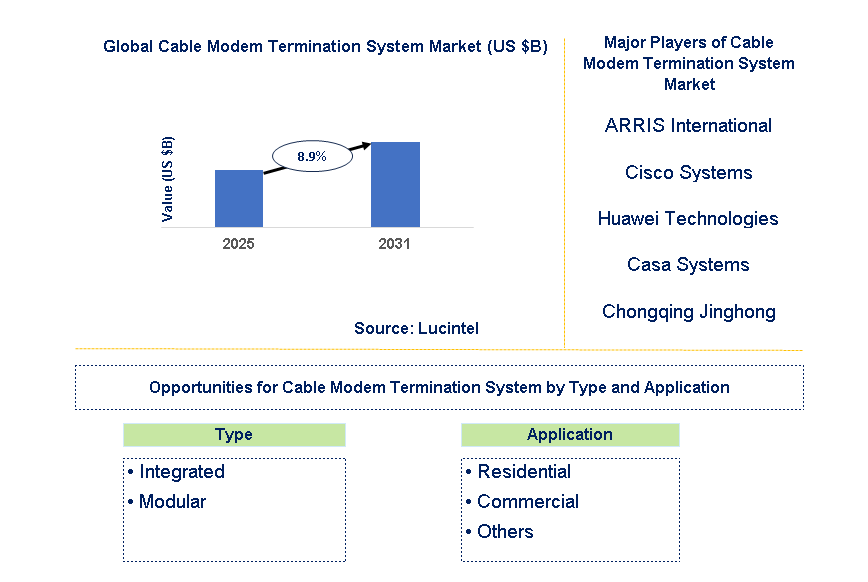
Key data points: The growth forecast = 8.9% annually for the next 7 years. Scroll below to get more insights. This market report covers Trends, opportunities and forecasts in cable modem termination system market to 2031 by type (integrated and modular), application (residential, commercial, and others), and region (North America, Europe, Asia Pacific, and the Rest of the World)
We'll send your sample report shortly.
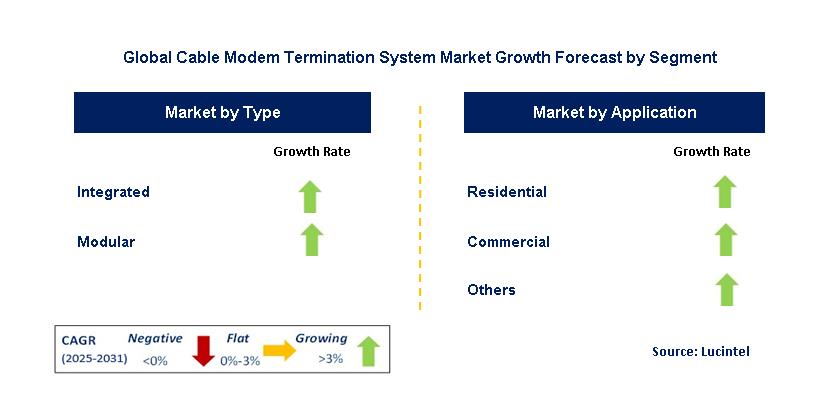
• Lucintel forecasts that, within the type category, modular is expected to witness higher growth over the forecast period.
• Within the application category, commercial is expected to witness higher growth.
• In terms of region, APAC is expected to witness the highest growth over the forecast period.
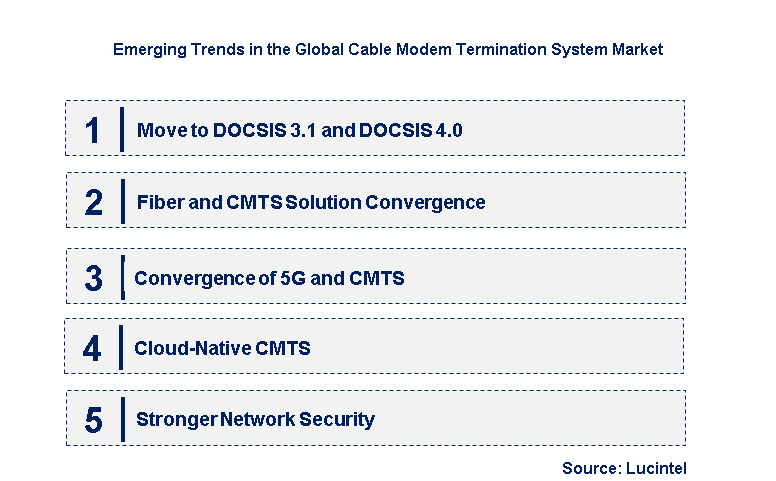
• Move to DOCSIS 3.1 and DOCSIS 4.0: The move away from legacy DOCSIS versions and towards DOCSIS 3.1 and the soon-to-be-released DOCSIS 4.0 is one of the most important trends in the cable modem termination system market. These technologies provide significantly higher speeds, improved capacity, and more effective utilization of the available spectrum, allowing operators to provide multi-gigabit broadband speeds. DOCSIS 3.1 also brings with it features such as improved latency and increased support for IPv6. The transition to DOCSIS 4.0 will further expand the capability of cable networks, enabling symmetrical gigabit speed and low latency, and further future-proof CMTS systems.
• Fiber and CMTS Solution Convergence: Fiber-optic technology convergence with CMTS solutions is becoming increasingly prevalent, especially as providers consider upgrading their networks to enable increased speeds and growing demand for services. Hybrid fiber-coaxial (HFC) networks are increasingly being adopted, where fiber is rolled out nearer to homes and businesses, and CMTS facilitates effective data transmission over coaxial cables. The hybrid approach enables cable operators to provide higher speeds at a lower cost than full fiber rollouts, particularly in high-density urban environments.
• Convergence of 5G and CMTS: The increasing deployment of 5G networks is leading to convergence with CMTS solutions. 5G networks need high-bandwidth and low-latency networks, and cable operators are deploying CMTS along with 5G networks to provide transparent connectivity across both fixed broadband and mobile networks. CMTS can be applied to control data traffic flow in a way that optimizes the performance of both mobile and fixed networks. This movement will be responsible for making sure that the next generation of wireless networks can accommodate massive data needs while providing high-quality service.
• Cloud-Native CMTS: Cloud-native CMTS solutions are becoming popular in the market as the demand for scalable and flexible network management grows. Through cloud technology, service providers can optimize the performance of their CMTS systems and increase capacity rapidly as customer needs expand. Cloud-native CMTS solutions also enable automation, enhanced network analytics, and higher service delivery reliability, minimizing the requirement for on-premises equipment and facilitating easier management of large-scale networks by operators.
• Stronger Network Security: With increased data transfer on broadband networks, security is the highest priority in the cable modem termination system market. Providers are putting emphasis on increasing the security capabilities of CMTS systems to safeguard against cyber-attacks, data theft, and other vulnerabilities. Advanced encryption techniques, authentication systems, and threat detection mechanisms are being implemented into CMTS solutions to safeguard the privacy and security of users. With cyber-attacks becoming more complex, manufacturers of CMTS are placing greater emphasis on security functions within their product lines. New trends like the migration to DOCSIS 3.1 and 4.0, the fusion of fiber and CMTS solutions, 5G convergence, cloud-native CMTS, and better network security are transforming the cable modem termination system market. The trends are contributing to speed, capacity, and reliability improvement in services, helping operators to satisfy increasing demand for high-quality broadband and multimedia services.
• Deployment of DOCSIS 3.1 Technology: The extensive rollout of DOCSIS 3.1 technology has been a major evolution in the cable modem termination system market. DOCSIS 3.1 provides much faster speeds and greater capacity than previous versions, enabling service providers to offer customers gigabit-level broadband. The technology is being implemented by large cable operators in the U.S. and Germany, allowing them to provide high-speed internet, video, and voice services over their current cable network. The upgrade is assisting operators in addressing growing demand for high-quality internet and multimedia services.
• Hybrid Fiber-Coaxial Network Expansion: Hybrid fiber-coaxial (HFC) network expansion has been an important advancement in the cable modem termination system market, especially where full fiber rollout is unaffordable due to cost factors. HFC networks employ a mix of fiber-optic and coaxial cables to provide broadband services cost-effectively. Operators in countries like the U.S. and Japan are utilizing HFC networks to deliver increased speeds and improved quality of service. The technology allows for providers to move up to faster networks without going for full fiber rollouts, and therefore it is a cost-efficient alternative.
• Cloud-Based CMTS Solutions: Cloud-based CMTS solutions are becoming increasingly relevant to the market. These solutions make it easier for service providers to operate their networks, providing greater scalability and flexibility. Cloud-based CMTS makes it possible for providers to save on costs by moving network management operations to the cloud, providing real-time visibility into network performance, and making it simpler to upgrade the network. This technology is being embraced by operators looking to upgrade their infrastructure and simplify operations so that they can address changing customer needs.
• 5G Integration with CMTS Systems: Integration of 5G with CMTS systems has become a vital development. Since 5G networks need high-capacity, low-latency connections, CMTS systems are being enhanced to meet the needs of 5G infrastructure. This integration enables service providers to provide smooth connectivity between fixed and mobile networks, allowing improved overall performance for consumers. Convergence of 5G and CMTS will be key in enabling the future generation of broadband and mobile services.
• DOCSIS 4.0 adoption: Adoption of DOCSIS 4.0 is poised to transform the cable modem termination system market. The next-gen technology has been touted to deliver symmetrical multi-gigabit speeds and stronger support for high-demand applications like 4K video streaming, telemedicine, and cloud gaming. By providing higher capacity and enhanced latency, DOCSIS 4.0 will enable cable operators to future-proof their networks and compete more effectively with fiber-optic operators. DOCSIS 4.0 deployment is likely to gain momentum in the next few years, transforming broadband service delivery around the world. The latest advances in the cable modem termination system market, including DOCSIS 3.1 adoption, HFC network growth, transition to cloud-based architectures, integration with 5G, and forthcoming DOCSIS 4.0 adoption, are greatly augmenting the functionality of broadband networks. These advances are allowing service providers to deliver faster, more consistent internet services while setting the stage for next-generation broadband and multimedia experiences.
• Rural Broadband Expansion: Rural broadband expansion presents a sizeable growth area for CMTS providers. As governments pursue the expansion of broadband in rural areas, CMTS technology provides an economically viable means for deploying high-speed internet. Combined hybrid fiber-coaxial networks and CMTS can deploy broadband reach in rural and sparsely populated areas, covering the digital divide and offering residents economic and educational opportunities.
• Smart Home and IoT Connectivity: Smart homes and Internet of Things (IoT) devices are on the rise, and there is an increasing opportunity for CMTS solutions. With more devices getting connected, the need for high-speed, quality internet grows. CMTS technology can help cable operators to fulfill this requirement through additional bandwidth and improved service quality. This opportunity becomes even more important as customers increasingly depend on broadband for smart home applications, security systems, and connected appliances.
• Telemedicine and Remote Work Solutions: The fast uptake of telemedicine and remote work solutions has generated huge demand for high-speed and stable internet connections. CMTS systems are optimally placed to host these applications, particularly in areas where fiber-optic infrastructure is not practical. Through providing secure and fast broadband, CMTS providers can meet the requirements of remote workers and medical professionals, such that these vital services continue to be accessible and efficient.
• Video Streaming Services: The increasing demand for video streaming services, such as 4K and 8K content, drives the need for faster internet speeds and increased network capacity. CMTS solutions, especially those enhanced with DOCSIS 3.1 and 4.0 technologies, can offer the infrastructure required to facilitate high-definition video streaming. This offers a major growth opportunity for CMTS providers, as they can provide customized services to streaming platforms and end users.
• Data-Intensive Applications and Cloud Gaming: The increasing popularity of data-intensive applications like virtual reality (VR) and augmented reality (AR) and cloud gaming necessitates high-speed internet with low latency. CMTS systems have the capability to provide such infrastructure that can handle high-demand services and enable service providers to differentiate based on premium bandwidth for AR/VR applications and cloud gaming. Opportunities for strategic expansion in the cable modem termination system market, including rural broadband buildout, smart home and IoT connectivity, remote work and telemedicine solutions, video streaming services, and cloud gaming, offer tremendous opportunities for service providers. These opportunities will propel the development of broadband services, generating new revenue streams and improving the consumer experience.
• ARRIS International
• Cisco Systems
• Huawei Technologies
• Casa Systems
• Chongqing Jinghong
• Coaxial Networks
• Gainspeed
• Sumavision Technologies
• Vecima Networks
• WISI Communications
• Integrated
• Modular
• Residential
• Commercial
• Others
• North America
• Europe
• Asia Pacific
• The Rest of the World
• United States: In the United States, CMTS systems are transforming to accommodate increasing demand for high-speed internet services, especially as cable operators migrate their networks to DOCSIS 3.1 and gear up for future deployment of DOCSIS 4.0. These innovations allow for increased speeds, reduced latency, and greater capacity for broadband services. Vendors such as Comcast and Charter are investing in CMTS to help them accommodate their growing base of customers. The U.S. also experiences growing use of hybrid fiber-coaxial (HFC) networks, with CMTS central to providing high-quality broadband, video, and voice services to both urban and rural communities.
• China: China has experienced swift growth in its cable modem termination system market, propelled by the nation's aggressive development of broadband infrastructure. The Chinese government's efforts to improve broadband connectivity and the general use of fiber-optic technology have heightened the need for CMTS solutions. Top companies such as China Telecom and China Unicom are combining CMTS with new technologies to meet the rising consumer demand for high-speed internet and video streaming services. The nation is also seeking to deploy next-generation CMTS systems to enable the expected growth of 5G networks, increasing data speeds and coverage over wide geographical areas.
• Germany: Germany's cable modem termination system market is changing as service providers concentrate on enhancing their broadband infrastructure, especially with the deployment of DOCSIS 3.1 technology. The nation is progressing towards upgrading current cable networks to enable higher internet speeds and more stable services. Operators such as Deutsche Telekom and Vodafone are using CMTS to provide competitive broadband, TV, and voice services. With the encouragement by the German government for countrywide high-speed broadband coverage, CMTS is increasingly becoming an essential element in meeting the target of digital inclusion, particularly in rural and underserved areas, where fiber-optic rollout is economically and logistically prohibitive.
• India: The market for CMTS in India is growing with the increasing demand for high-speed broadband services. Telecom operators such as Bharti Airtel and Reliance Jio are investing in strengthening their cable and broadband infrastructure to support the needs of a digitally connected populace. The emphasis by the Indian government on increasing access to broadband under the Digital India program is promoting the use of CMTS, particularly in tier-2 and tier-3 cities. Service providers are combining CMTS with FTTH and FTTN technologies to provide speedy and reliable internet, addressing growing demand for streaming, e-commerce, and online learning.
• Japan: Japan's cable modem termination system market is developing with an emphasis on ultra-high-speed broadband and next-gen cable services. Top telecom companies such as NTT and KDDI are updating their CMTS equipment to handle higher speeds and better service offerings. Japan's aggressive drive to fiber-optic internet and 5G mobile connectivity has catapulted CMTS into being an essential tool in providing premium internet and multimedia services. Its broadband infrastructure ranks among the most developed in the world, and CMTS facilitates high-speed data transmission to homes and offices, especially since demand for cloud applications and streaming services keeps accelerating.


• ARRIS International
• Cisco Systems
• Huawei Technologies
• Casa Systems
• Chongqing Jinghong
• Coaxial Networks
• Gainspeed
• Sumavision Technologies
• Vecima Networks
• WISI Communications Q5. Which cable modem termination system market segment will be the largest in future? Answer: Lucintel forecasts that, within the type category, modular is expected to witness higher growth over the forecast period. Q6. In cable modem termination system market, which region is expected to be the largest in next 5 years? Answer: In terms of region, APAC is expected to witness the highest growth over the forecast period. Q7. Do we receive customization in this report? Answer: Yes, Lucintel provides 10% customization without any additional cost.


Choose a license that fits your team. Instant PDF delivery.
Prices exclude taxes. Instant delivery. Custom licensing available on request.
Market Report · July 31, 2026
Market Report · July 31, 2026
Market Report · July 31, 2026
Trusted partner for strategic intelligence and business growth


Receive a complimentary market analysis tailored to your industry. Our analysts will identify key growth opportunities and competitive dynamics specific to your business.

Market size, growth rate, and key trend analysis for your specific sector.

Top competitor positioning and market share analysis.

Strategic recommendations backed by data-driven insights.
Get curated market intelligence and competitive moves straight to your inbox.
By subscribing, you agree to receive our monthly insights. Unsubscribe anytime.
Receive a complimentary market analysis tailored to your industry. Our analysts will identify key growth opportunities and competitive dynamics specific to your business.
Market size, growth rate, and key trend analysis for your specific sector.
Top competitor positioning and market share analysis.
Strategic recommendations backed by data-driven insights.
Get curated market intelligence, emerging trends, and competitive moves straight to your inbox each month.
By subscribing, you agree to receive our monthly insights. Unsubscribe anytime.
We'll send your sample report shortly.