
Market Report · July 31, 2026

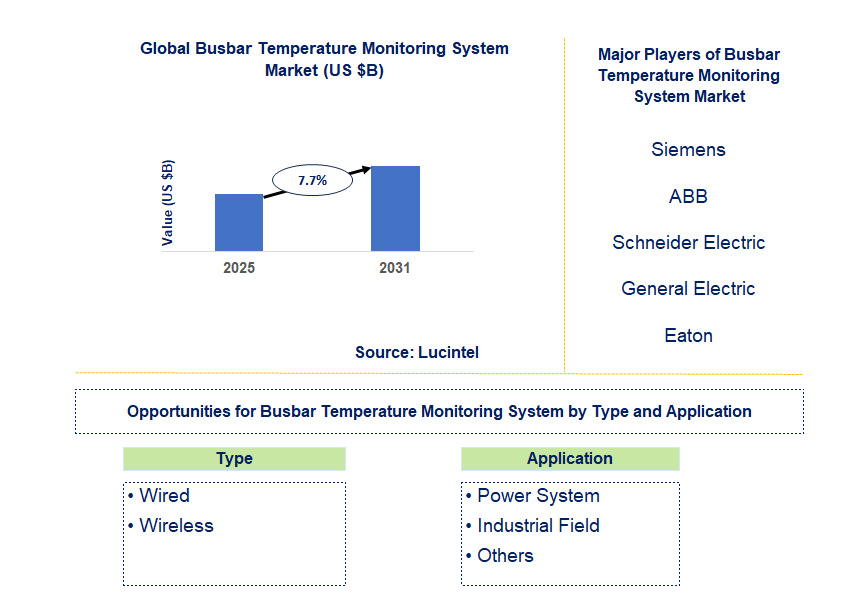
Key data points: The growth forecast = 7.7% annually for the next 7 years. Scroll below to get more insights. This market report covers Trends, opportunities and forecasts in busbar temperature monitoring system market to 2031 by type (wired and wireless), application (power system, industrial field, and others), and region (North America, Europe, Asia Pacific, and the Rest of the World)
We'll send your sample report shortly.
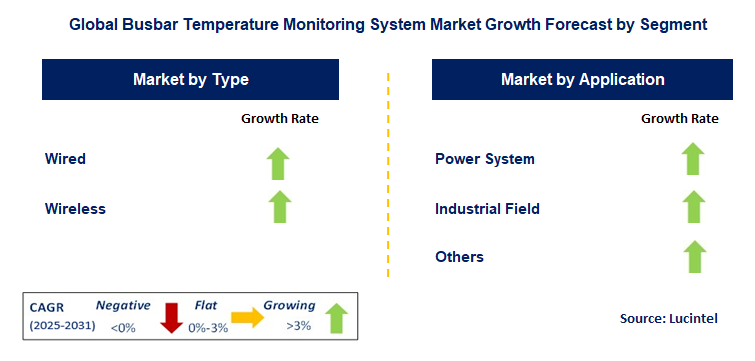
• Lucintel forecasts that, within the type category, wireless is expected to witness higher growth over the forecast period due to the growing demand for easy-to-install solutions.
• Within the application category, industrial field is expected to witness higher growth.
• In terms of region, APAC is expected to witness the highest growth over the forecast period.
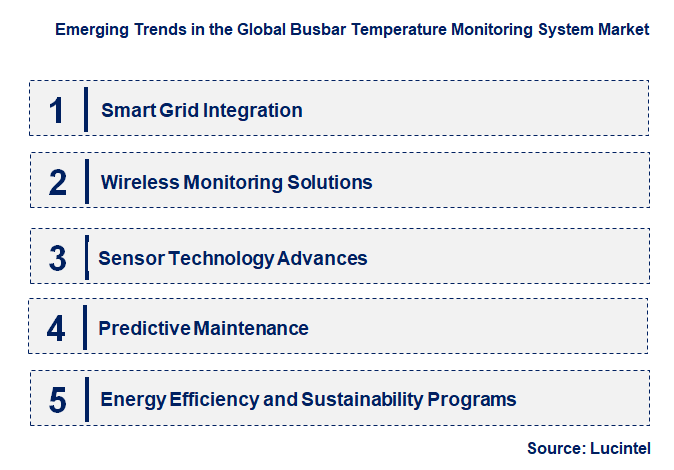
• Smart Grid Integration: Integration of busbar temperature monitoring systems with smart grids is an emerging trend. Smart grids allow real-time monitoring and control of energy distribution, which optimizes load management and enhances the reliability of electrical systems. By integrating busbar temperature monitoring, utilities can more effectively manage power flow and prevent overheating or system failure. Such an integration is of key importance to ensure increased energy efficiency and avoidance of expensive downtime, particularly for industries that utilize uninterrupted power supply.
• Wireless Monitoring Solutions: Wireless busbar temperature monitoring solutions are gaining immense popularity because they are easy to install and very flexible. Older wired systems are giving way to wireless systems that are more user-friendly and more scalable to use. These systems enable remote monitoring and data transmission, offering real-time information about the temperature condition of busbars without human intervention. Wireless systems are especially beneficial in big buildings or remote locations, lowering maintenance costs and enhancing operating efficiency.
• Sensor Technology Advances: Improved accuracy and longer lifespan of temperature sensors is another significant trend. These new sensors provide improved accuracy, quicker response times, and increased reliability in harsh environments. Emerging sensor technologies are being incorporated into busbar temperature monitoring systems to deliver more precise and real-time information, enabling more efficient temperature control and preventive maintenance. Improved sensor capabilities are also lowering the overall cost of temperature monitoring systems, making them more affordable for a broader industry base.
• Predictive Maintenance: Predictive maintenance is a newer trend that is propelling busbar temperature monitoring system adoption. Through real-time temperature monitoring, predictive maintenance systems can forecast failures or overheating incidents before they happen. With predictive analytics, businesses can pre-schedule maintenance, minimizing chances of unexpected downtime and maximizing system reliability. This is especially true in continuous operation industries like power generation and manufacturing, where equipment breakdown can result in heavy financial losses.
• Energy Efficiency and Sustainability Programs: With industries increasingly becoming sustainability-conscious, the need for energy-efficient systems is on the rise. Busbar temperature monitoring systems are an important part of energy management as they help ensure that electrical systems are at optimal temperatures, minimizing energy wastage. Most industries, such as manufacturing, are implementing these systems within their overall sustainability programs to reduce their carbon footprint. Monitoring systems prevent energy loss from overheating, enhancing the overall energy efficiency of electrical networks and industrial processes. These new trends are revolutionizing the busbar temperature monitoring system market, making it more sophisticated, effective, and affordable. With industries increasingly embracing smart technologies and green practices, the need for innovative temperature monitoring solutions will only increase, redesigning the management of electrical systems worldwide.
• IoT and Smart Technology Integration: IoT-based technologies integrated into busbar temperature monitoring systems represent a major step forward. Real-time monitoring and data analysis enabled by IoT technology provide important information about the status of electrical systems and grids. With cloud-based platforms, the systems enable remote monitoring and predictive analytics, so companies can make proactive steps towards avoiding failures or inefficiencies. IoT integration increases the scalability and efficiency of temperature monitoring solutions.
• Miniaturization of Monitoring Devices: Another significant trend is miniaturization of busbar temperature monitoring devices. Compact, smaller systems are being designed to facilitate easy installation in small spaces or where access is limited. The devices are not sacrificing performance, providing accurate and consistent temperature readings while minimizing the installation footprint. Miniaturized systems are best suited for use in industries like manufacturing, where space is limited but reliable monitoring is still required.
• Cloud-Based Data Analytics: Cloud-based data analytics is emerging as a central aspect of busbar temperature monitoring systems. Such systems enable the storage and analysis of large amounts of temperature data, which can be remotely accessed via a centralized dashboard. Cloud-based analytics allow real-time monitoring of performance, data-driven decision-making, and long-term trend analysis, enabling companies to optimize energy consumption, lower costs, and enhance the lifespan of electrical systems. This innovation is particularly beneficial in industries with extensive and complicated electrical systems.
• Sophisticated Thermal Imaging Solutions: Thermal imaging technology is increasingly being integrated into busbar temperature monitoring systems. These advanced systems employ infrared sensors to pick up temperature changes and give a distinct visual representation of hot spots in electrical equipment. Thermal imaging enables more in-depth monitoring, increasing the precision of temperature detection and assisting in detecting potential faults before they result in system breakdowns. The technology is most useful in high-voltage conditions, where overheating may have perilous results.
• Greater Emphasis on Wireless Connectivity: Wireless connectivity for busbar temperature monitoring has become increasingly common, allowing for more flexible and scalable installations. Wireless installations avoid the need for extensive wiring and complicated installations, making them a perfect choice for retrofitting existing infrastructure. Wireless connectivity also allows for real-time monitoring from remote sites, giving operators instant notification of temperature changes and potential hazards. This development enhances the efficiency of temperature monitoring and allows for faster responses to emerging issues. These key developments are driving the growth and evolution of the busbar temperature monitoring system market. As industries adopt more advanced technologies for system monitoring and maintenance, these innovations are improving safety, operational efficiency, and energy management across various sectors.
• Smart Grid Automation: Busbar temperature monitoring system integration with smart grid technology is a key growth opportunity. With increasing deployment of smart grids, the need for temperature monitoring systems that assist in optimizing the distribution of energy and reducing system failures has also increased. With the integration of these monitoring systems into smart grids, utilities are able to enhance the reliability and efficiency of the network, cut down on energy loss, and avoid electrical component overheating.
• Microgrids and Renewable Energy: Increasing use of renewable energy sources and microgrids is a key opportunity for the busbar temperature monitoring system market. As energy systems become more complex and there is a demand for effective power distribution, temperature monitoring systems play a vital role in controlling the flow of energy and maintaining the safety of electrical components. These systems have the potential to increase the performance and dependability of renewable energy facilities, for example, solar and wind farms, and microgrids utilized in off-grid regions.
• Industrial Automation: The growth of industrial automation, especially in industries such as manufacturing, oil and gas, and energy, is fueling demand for more advanced busbar temperature monitoring systems. Automated systems depend significantly on precise and trustworthy temperature information to provide safe and efficient operations. With industries increasingly embracing automated processes, the demand for accurate and real-time monitoring of electrical systems is becoming increasingly important. This trend is generating significant growth prospects for busbar temperature monitoring solutions.
• Energy-Efficient Buildings and Infrastructure: With the global emphasis on sustainability increasing, energy-efficient buildings and infrastructure are gaining prominence. Busbar temperature monitoring systems are part of ensuring that electrical systems in such buildings run efficiently, avoiding energy losses and enhancing overall energy management. As the demand for green buildings and smart cities continues to rise, there is a need for sophisticated temperature monitoring solutions that can assist in lowering the carbon footprint and maximizing energy consumption in commercial and residential buildings.
• Data Center and IT Infrastructure: The explosive growth of data centers and IT infrastructure is another major growth opportunity. These centers need high-capacity power distribution systems to handle high-performance computing and storage. Busbar temperature monitoring systems ensure that electrical systems in data centers are within safe temperature limits, avoiding overheating and system failure. With growing demand for data storage and cloud computing, demand for dependable temperature monitoring solutions for these plants will also increase. These strategic growth opportunities identify various applications and industries that are fueling the demand for busbar temperature monitoring systems. As businesses increasingly drive towards sustainability, energy efficiency, and smart technologies, the market for these monitoring systems will grow substantially.
• Siemens
• ABB
• Schneider Electric
• General Electric
• Eaton
• Honeywell
• Emerson Electric
• Mitsubishi Electric
• Hitachi Energy
• Larsen & Toubro
• Wired
• Wireless
• Power System
• Industrial Field
• Others
• North America
• Europe
• Asia Pacific
• The Rest of the World
• United States: The United States has experienced tremendous growth in the market for busbar temperature monitoring systems, mainly attributed to the rising need for stable electrical systems within the industrial and commercial industries. The use of smart grids and renewable energy solutions is also driving this market. More sophisticated busbar temperature monitoring systems are being incorporated by companies to maximize power distribution, enhance safety, and minimize energy loss. Besides, the standards and rules for electrical efficiency and safety have encouraged growing investments in busbar temperature monitoring technology to ensure the electrical system is efficient and safer.
• China: China is aggressively increasing its market for busbar temperature monitoring systems through rapid urbanization and industrialization growth. There is a growing need for such systems in industries including manufacturing, power generation, and construction. The Chinese government's emphasis on improving energy efficiency and advancing smart grid technology is also driving market expansion. Some domestic firms are concentrating on low-cost and efficient monitoring system development. As the country makes substantial investments in renewable energy and energy-efficient technology, the demand for efficient busbar temperature monitoring systems will grow.
• Germany: Germany is a pioneer in industrial automation and energy-efficient technologies in Europe, and the same applies to the busbar temperature monitoring system market. The German government's focus on energy transition and renewable energy has fueled the demand for more sophisticated monitoring systems in electrical grids. The drive for smart manufacturing in sectors such as automotive and heavy machinery is also fueling demand. German businesses are implementing innovative temperature monitoring technologies to enhance operational effectiveness, safety, and energy efficiency. Furthermore, developments in IoT and sensor technology are also boosting the market.
• India: India is growing its infrastructure and industrial base rapidly, creating an increasing demand for busbar temperature monitoring solutions. The government's programs, including Smart Cities and Make in India, are driving the market. With an emphasis on enhancing power distribution systems and minimizing energy losses, busbar temperature monitoring systems find growing acceptance among utilities and factories. The Indian market is also witnessing growth in the use of cost-effective monitoring systems for smaller industries and rural regions, promising a huge growth opportunity for the technology.
• Japan: Japan is using its technical prowess to take the lead in the development of the busbar temperature monitoring system market. The emphasis of the country to enhance energy efficiency, especially in industrial applications like automotive production, electronics, and power generation, is stimulating demand. Japan's efforts to move towards smart grids and renewable energy are also increasing the demand for accurate temperature monitoring. Manufacturers are embedding sophisticated sensors, wireless connectivity, and IoT features into their solutions, offering real-time temperature monitoring for better system performance and proactive maintenance.


• Siemens
• ABB
• Schneider Electric
• General Electric
• Eaton
• Honeywell
• Emerson Electric
• Mitsubishi Electric
• Hitachi Energy
• Larsen & Toubro Q5. Which busbar temperature monitoring system market segment will be the largest in future? Answer: Lucintel forecasts that, within the type category, wireless is expected to witness higher growth over the forecast period due to the growing demand for easy-to-install solutions. Q6. In busbar temperature monitoring system market, which region is expected to be the largest in next 5 years? Answer: In terms of region, APAC is expected to witness the highest growth over the forecast period. Q7. Do we receive customization in this report? Answer: Yes, Lucintel provides 10% customization without any additional cost.


Choose a license that fits your team. Instant PDF delivery.
Prices exclude taxes. Instant delivery. Custom licensing available on request.
Market Report · July 31, 2026
Market Report · July 22, 2026
Market Report · July 20, 2026
Trusted partner for strategic intelligence and business growth


Receive a complimentary market analysis tailored to your industry. Our analysts will identify key growth opportunities and competitive dynamics specific to your business.

Market size, growth rate, and key trend analysis for your specific sector.

Top competitor positioning and market share analysis.

Strategic recommendations backed by data-driven insights.
Get curated market intelligence and competitive moves straight to your inbox.
By subscribing, you agree to receive our monthly insights. Unsubscribe anytime.
Receive a complimentary market analysis tailored to your industry. Our analysts will identify key growth opportunities and competitive dynamics specific to your business.
Market size, growth rate, and key trend analysis for your specific sector.
Top competitor positioning and market share analysis.
Strategic recommendations backed by data-driven insights.
Get curated market intelligence, emerging trends, and competitive moves straight to your inbox each month.
By subscribing, you agree to receive our monthly insights. Unsubscribe anytime.
We'll send your sample report shortly.