
Report Feature
Bus Pantograph Charger Market Trends and Forecast
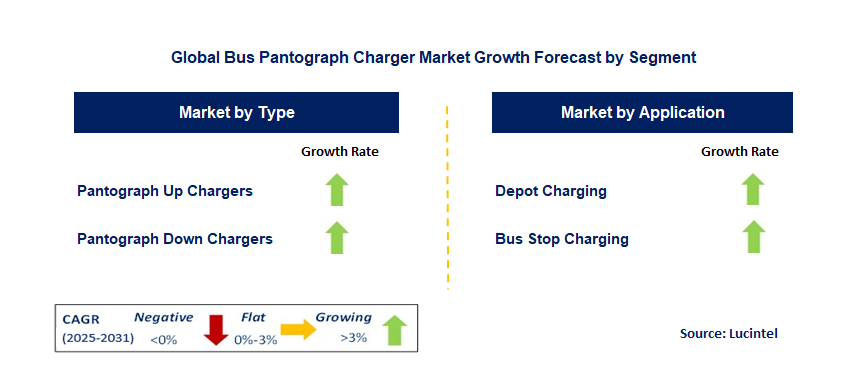
The future of the global bus pantograph charger market looks promising with opportunities in the depot charging and bus stop charging markets. The global bus pantograph charger market is expected to grow with a CAGR of 24.1% from 2025 to 2031. The major drivers for this market are increasing focus on reducing emissions and transitioning to sustainable transport, governments around the world are implementing policies and regulations to support green mobility solutions, and rapid urbanization in many regions is leading to overcrowded cities, increased traffic, and pollution. Lucintel forecasts that, within the type category, pantograph up charger is expected to witness higher growth over the forecast period due to its efficiency, wider adoption in public transport networks, safety advantages, and better compatibility with existing infrastructure. Within the application category, depot charging is expected to witness the higher growth due to its centralized, high-capacity, cost-effective, and efficient nature. In terms of region, APAC is expected to witness the highest growth over the forecast period due to the rapid urbanization, large-scale infrastructure projects, strong government support for electric mobility. Gain valuable insights for your business decisions with our comprehensive 150+ page report. Sample figures with some insights are shown below.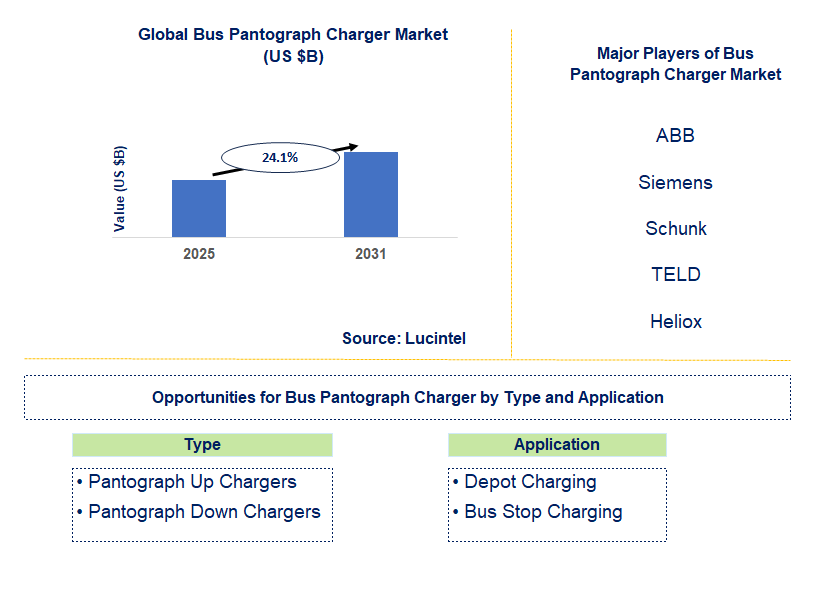
Emerging Trends in the Bus Pantograph Charger Market
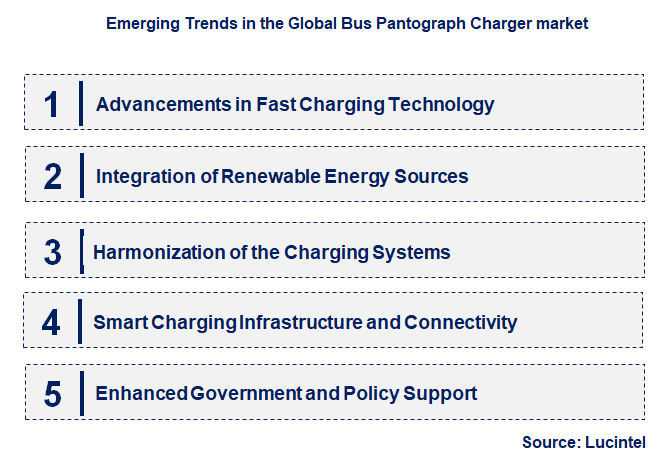
The bus pantograph charger market is experiencing dynamic changes, driven by advancements in technology, regulatory developments, and increasing global demand for electric buses. An urban transport system enabled with pantograph chargers brings about an improvement in charging speed and efficiency, corresponding to the global trend toward sustainability that will allow public transportation systems to reduce their carbon footprint. The industry is shifting toward more intelligent charging solutions, in conjunction with integrating renewable energy and becoming a future electric bus infrastructure. Five trends that will shape the bus pantograph charger market are presented as follows.• Advancements in Fast Charging Technology: Pantograph chargers are becoming more efficient, with advancements in fast charging technology allowing for quicker charging times, typically under 10 minutes. This reduces downtime for buses and increases fleet efficiency. As cities adopt larger electric bus fleets, the demand for fast charging infrastructure continues to rise. This trend supports the growing shift toward zero-emission public transport and plays a pivotal role in reducing the total cost of ownership for electric buses.
• Integration of Renewable Energy Sources: An increasing number of electric bus fleets are integrating renewable energy sources, such as solar and wind power, with pantograph charging systems. By combining renewable energy with bus charging infrastructure, cities can further reduce their carbon footprint and reliance on grid electricity. This trend is particularly prominent in regions like Europe, where there is a strong commitment to green energy solutions. Charging with renewable energy will help achieve the sustainability goals and make electric buses spread much faster.
• Harmonization of the Charging Systems: The push for global standardization in pantograph charging technology is gaining momentum. As the market for electric buses expands across different regions, uniform charging standards ensure compatibility between different bus models and charging stations. This trend facilitates easier adoption of electric buses, reduces operational costs, and promotes cross-border trade and integration. Standardization is crucial for scaling up the deployment of electric buses and pantograph chargers worldwide, making the technology more accessible and efficient.
• Smart Charging Infrastructure and Connectivity: Smart integration into pantograph charging systems, as an emerging trend, is being seen. Charging stations are equipped with sensors and monitoring systems to give data in real time for battery level, energy consumption, and charging time, thereby optimizing the charging process and fleet management with usage patterns and maintenance needs. Smarter infrastructure integrates better with electric grid systems and aids the more efficient distribution of energy.
• Enhanced Government and Policy Support: More incentives are being provided by governments across the world to develop electric bus fleets and pantograph charging infrastructure. These include subsidies, tax breaks, and funding for developing smart, fast-charging systems. The policies that promote clean and green public transportation are speeding up the deployment of pantograph chargers. Countries such as China, the United States, and Germany are at the forefront of this change. Policy pushes for sustainable urban mobility is a key growth driver in this market. These trends are dramatically transforming the bus pantograph charger market by pushing for innovation, increasing efficiency, and enhancing sustainability. The growth of smart, standardized, and renewable energy-powered charging solutions is making electric buses a more viable and attractive option for cities and transit authorities across the globe. As these trends unfold, the bus pantograph charger market will expand further with technological advancements and supportive policies.
Recent Development in the Bus Pantograph Charger Market
The bus pantograph charger market is undergoing rapid growth and transformation, with numerous developments occurring globally. Governments are incentivizing the use of electric buses, and advancements in pantograph charging technology are enabling faster, more efficient charging solutions. As cities strive to reduce emissions and improve public transport, the adoption of electric buses and supporting infrastructure, such as pantograph chargers, continues to increase. Below are five key developments shaping the market, highlighting technological, regulatory, and market-driven changes that are impacting the bus pantograph charger industry.• Expansion of Charging Infrastructure in Europe: Countries such as Germany and France have made key investments in fleets of electric buses and pantograph charging stations, which are beginning to proliferate across Europe, as cities embrace the shift towards electric buses. The adoption of pantograph systems ensures faster and more efficient time to charge operation. As Europe continues to keep its focus on reducing emissions from transportation, that is one big part of where this infrastructure‘s expansion comes.
• Renewable Energy Interconnection with the Charging Stations: Cities in Europe and North America are increasingly integrating renewable energy sources with their pantograph charging stations. By using solar or wind energy to power the charging infrastructure, cities reduce their carbon footprint and dependency on traditional energy sources. This integration is a key development in ensuring that electric buses are not only zero-emission vehicles but also charged in an environmentally friendly manner, further supporting sustainability efforts.
• Government Support and Policy Incentives in China: China continues to lead the global electric bus market, with significant investments in pantograph chargers. The Chinese government offers generous subsidies and incentives for the adoption of electric buses and charging infrastructure. This policy support has accelerated the development of bus pantograph chargers, making China a hub for both electric buses and associated technologies. These incentives help reduce the initial investment costs, making electric buses a more viable option for public transportation.
• Technological Advancements in Smart Charging Systems: The latest technological developments in pantograph chargers include the integration of smart sensors and monitoring systems that optimize charging efficiency. These systems allow for real-time data analysis, helping operators manage fleets more effectively. By incorporating these smart technologies, charging stations can optimize energy consumption, monitor bus battery status, and ensure a seamless charging experience. These advancements make pantograph charging systems more reliable and cost-effective, enhancing their appeal in the growing electric bus market.
• Development of Ultra-Fast Charging Stations in Japan: Japan has been focusing on the development of ultra-fast pantograph charging stations, capable of charging buses in less than 10 minutes. This development is particularly significant in cities like Tokyo, where high demand for fast and efficient public transport requires quick turnaround times for electric buses. These ultra-fast chargers contribute to reducing downtime and improving the operational efficiency of electric bus fleets, driving the wider adoption of electric buses in urban environments. Technological development, governmental support, and sustainable solutions are related to the bus pantograph charger market. During this time, many key advancements have emerged: integration of renewable energy, ultra-fast charge technology, as well as infrastructure investments. Such advancements will fuel further growth and change for the market. These developments shape the future of electric fleets of buses and the corresponding infrastructure needed to support them.
Strategic Growth Opportunites in the Bus Pantograph Charger Market
The bus pantograph charger market is growing rapidly with cities across the world adopting electric buses to reduce emissions and improve urban mobility. Pantograph charging systems, with their fast and efficient charging capabilities, are now becoming crucial for supporting electric bus infrastructure. As electric buses become more widespread, several strategic growth opportunities arise for companies within the bus pantograph charger market. These opportunities span various key applications, driven by technological advancements, policy support, and growing urban demand for sustainable transport solutions. The following outlines five significant growth opportunities in the market, focusing on both technological and market-driven factors.• Expansion of Electric Bus Fleets: One of the key growth opportunities in the bus pantograph charger market is the expansion of electric bus fleets. Cities around the world are investing in electric buses as part of their efforts to reduce emissions and improve air quality. With increasing urbanization and a global shift toward greener transportation, more governments are encouraging the adoption of electric buses, which requires the deployment of efficient pantograph charging systems. This expansion will boost demand for reliable and fast-charging infrastructure, opening up growth potential for manufacturers of pantograph chargers.
• Integration with Renewable Energy Sources: The integration of renewable energy sources, such as solar and wind power, into the bus pantograph charger infrastructure is another significant growth opportunity. As cities adopt electric buses to reduce emissions, they also seek ways to make the charging process more sustainable. By combining renewable energy with pantograph charging stations, operators can reduce their dependency on non-renewable grid electricity. This integration is attractive in regions with strong renewable energy policies, providing a competitive advantage to companies that offer solutions for green energy-powered bus charging infrastructure.
• Smart Charging Infrastructure: The rise of smart cities and the growing demand for real-time data management present a strategic growth opportunity in smart charging infrastructure. Pantograph chargers with integrated IoT (Internet of Things) technology are enabling operators to monitor and optimize the charging process. This smart infrastructure allows for data-driven decisions regarding charging times, energy consumption, and fleet management. As cities and operators look to maximize efficiency and reduce operational costs, the market for smart charging solutions is expected to grow, opening up opportunities for businesses that offer these advanced charging technologies.
• Public-Private Partnerships (PPP) in Urban Mobility: Public-private partnerships are becoming increasingly important in advancing the bus pantograph charger market. Governments and private enterprises are collaborating to fund and deploy electric buses and charging infrastructure. These partnerships are particularly beneficial in scaling up the adoption of electric buses in urban environments, where infrastructure investment is high. By offering financial support, tax incentives, and other incentives, PPPs help accelerate the installation of pantograph chargers, creating new opportunities for market players to participate in large-scale electric bus projects.
• Development of Ultra-Fast Charging Solutions: The development of ultra-fast pantograph charging systems is an emerging growth opportunity. As the demand for efficient, high-powered charging systems increases, manufacturers are focusing on developing ultra-fast charging technology that can minimize downtime for buses. Ultra-fast chargers can significantly improve fleet turnover by charging buses in under 10 minutes, making electric buses more competitive with traditional diesel-powered buses. This advancement opens up opportunities for companies to supply cutting-edge charging technology, particularly in markets with high transportation demands. These strategic growth opportunities in the bus pantograph charger market highlight the increasing demand for efficient, smart, and sustainable solutions for urban transport systems. The expansion of electric bus fleets, coupled with the integration of renewable energy, smart charging, public-private partnerships, and ultra-fast charging systems, is transforming the market. As these opportunities unfold, they are expected to drive the growth of the bus pantograph charger market, creating more demand for innovative charging infrastructure and leading to the widespread adoption of electric buses in cities worldwide.
Bus Pantograph Charger Market Driver and Challenges
The bus pantograph charger market is influenced by a range of factors, including technological advancements, regulatory support, economic considerations, and market dynamics. As cities transition to electric buses to address environmental concerns, the demand for pantograph chargers grows. However, various challenges such as infrastructure costs, technological limitations, and regulatory hurdles can affect the market’s growth trajectory. Understanding the major drivers and challenges is crucial to navigate this evolving market and capitalize on growth opportunities. Below, we outline five key drivers and three significant challenges that impact the bus pantograph charger market. The factors responsible for driving the bus pantograph charger market include: 1. Technological Advancements in Charging Systems: Technological advancements in charging systems are a very significant driver for the bus pantograph charger market. Innovations such as ultra-fast charging solutions, improved charging efficiency, and smart charging technologies are driving market growth. These advancements reduce charging times, enhance system reliability, and lower overall costs, making electric buses a more viable option for urban transportation. With continuous R&D efforts and technological improvements, the market for bus pantograph chargers is set to expand as operators seek more efficient and cost-effective charging solutions. 2. Government Incentives and Policy Support: Government incentives and policies are another key driver for the growth of the bus pantograph charger market. In many regions, governments are actively supporting the transition to electric buses by providing subsidies, tax breaks, and other financial incentives to reduce the adoption cost. These policies help accelerate the deployment of electric buses and charging infrastructure, particularly pantograph chargers. As regulatory frameworks continue to evolve, market players benefit from a supportive environment that encourages the growth of electric transportation solutions. 3. Growing Demand for Sustainable Public Transport: The increasing demand for sustainable public transportation is a major driver of the bus pantograph charger market. As cities face growing environmental concerns, especially air pollution and greenhouse gas emissions, electric buses powered by pantograph chargers are becoming a key solution. This shift toward greener public transport options is expected to continue as cities work to meet climate goals. The drive for more sustainable urban mobility systems is pushing the adoption of electric buses and the need for efficient charging infrastructure, creating a robust market for pantograph chargers. 4. Urbanization and Population Growth: Urbanization and population growth in cities worldwide are driving the demand for electric buses and pantograph chargers. With more people moving into urban areas, cities face increased pressure to provide efficient, clean, and sustainable transportation options. Electric buses, supported by pantograph chargers, offer a practical solution to address these urban mobility challenges. The need to expand public transportation networks and improve air quality in densely populated cities is fueling the demand for electric buses, further stimulating the pantograph charger market. 5. Cost Reductions in Electric Bus Manufacturing: The ongoing trend of reducing costs in the production of electric buses is a huge growth driver in the bus pantograph charger market. As this cost of producing electric buses further reduces with increasing advancements in both battery technology and manufacturing processes, the overall utilization of electric buses becomes more economic for cities as well as authorities in charge of transit. This, in turn, fuels the demand for supporting infrastructure, such as pantograph chargers, to facilitate the mass deployment and efficient operation of electric bus fleets. Challenges in the bus pantograph charger market are: 1. High Initial Infrastructure Investment Costs: The main challenge for the bus pantograph charger market is the high initial investment needed for charging infrastructure. The installation of pantograph charging stations, especially in urban areas, is expensive because of the need for specialized equipment and grid integration. For cities with limited budgets or for operators in emerging markets, the high upfront costs of infrastructure can be a significant barrier to adopting pantograph chargers and electric buses. Financial incentives and funding mechanisms are needed to overcome this challenge. 2. Limited Charging Network and Compatibility Issues: Another challenge in the bus pantograph charger market is the limited availability of charging stations and compatibility issues between different charging systems. The charging infrastructure in some areas is still not widespread enough to allow mass deployment of electric buses. Second, compatibility issues between different models of buses and charging stations could disrupt the integration of electric buses in the public transport network. Therefore, these are challenges that will require critical attention to support the seamless growth of the pantograph charger market. 3. Technological Limitations of Charging Systems: Despite advancements, pantograph charging systems still face technological limitations such as issues with energy efficiency, slow charging times, and the ability to manage high charging power. These limitations can impact the effectiveness and reliability of charging systems, slowing down the widespread adoption of electric buses. Continued innovation is necessary to address these technical challenges and improve the performance of pantograph chargers to meet the needs of modern electric bus fleets. The drivers outlined above highlight the key factors that are contributing to the rapid growth of the bus pantograph charger market, from government support to technological advancements. However, the challenges related to infrastructure costs, compatibility, and technological limitations must be addressed to ensure continued market growth. As these drivers and challenges evolve, they will shape the direction of the bus pantograph charger market, influencing both opportunities and obstacles for market participants.List of Bus Pantograph Charger Companies
Companies in the market compete on the basis of product quality offered. Major players in this market focus on expanding their manufacturing facilities, R&D investments, infrastructural development, and leverage integration opportunities across the value chain. With these strategies bus pantograph charger companies cater increasing demand, ensure competitive effectiveness, develop innovative products & technologies, reduce production costs, and expand their customer base. Some of the bus pantograph charger companies profiled in this report include-• ABB
• Siemens
• Schunk
• TELD
• Heliox
• Kempower
• Wabtec
• Medcom
• Hitachi Energy
• Ekoenergetyka-Polska
Bus Pantograph Charger Market by Segment
The study includes a forecast for the global bus pantograph charger market by type, application, and region.Bus Pantograph Charger Market by Type [Value from 2019 to 2031]:
• Pantograph Up Chargers
• Pantograph Down Chargers
Bus Pantograph Charger Market by Application [Value from 2019 to 2031]:
• Depot Charging
• Bus Stop Charging
Bus Pantograph Charger Market by Region [Value from 2019 to 2031]:
• North America
• Europe
• Asia Pacific
• The Rest of the World
Country Wise Outlook for the Bus Pantograph Charger Market
The bus pantograph charger market has seen significant growth in recent years, fueled by the rising demand for electric buses and efforts to reduce carbon emissions across various regions. Bus pantograph chargers, which use overhead charging systems for fast and efficient electric bus charging, have become a key component of urban transportation infrastructure. Countries like the United States, China, Germany, India, and Japan have made substantial strides in implementing and expanding electric bus fleets. The following outlines the developments in the bus pantograph charger market within these countries, highlighting advancements, policies, and market shifts.• United States: The United States has increasingly focused on expanding its electric bus infrastructure, with several major cities, such as Los Angeles and New York, adopting electric buses equipped with pantograph chargers. The government’s push for clean energy and the electrification of public transport has led to grants and funding programs aimed at boosting electric bus deployment. Key initiatives include investments in smart grid technology and charging stations to support the efficient integration of electric buses into urban transport systems. The U.S. market is expected to grow significantly as policies continue to support electrification.
• China: China is the global leader in electric bus adoption and pantograph charging infrastructure. The government has heavily invested in green energy and electric vehicles (EVs), making China the largest market for electric buses, with cities like Beijing and Shanghai implementing comprehensive charging networks. Pantograph charging systems are widely used in China’s bus fleets due to their efficiency and fast charging capabilities. As part of its green development plan, China has rolled out initiatives that combine electric buses with renewable energy sources, positioning the country at the forefront of sustainable public transportation.
• Germany: Germany is making strides toward sustainable mobility by expanding its electric bus fleets, particularly in cities like Berlin and Munich. The country has integrated pantograph chargers into its urban infrastructure, focusing on fast, high-power charging solutions to improve operational efficiency. Germany’s government has incentivized electric buses through various subsidies and grants, promoting their adoption in public transport networks. The integration of pantograph chargers aligns with Germany’s commitment to reducing CO2 emissions and transitioning to a more sustainable and eco-friendly transportation system.
• India: India’s electric bus adoption is still in its early stages, but the country has made progress in implementing pantograph chargers in select cities, such as Delhi and Mumbai. The Indian government is supporting the transition to electric buses through its Faster Adoption and Manufacturing of Hybrid and Electric Vehicles (FAME) scheme, offering incentives for electric bus infrastructure development. As India tackles air pollution, the move toward electric buses powered by pantograph chargers is expected to grow, especially in urban areas seeking to improve air quality and reduce dependence on fossil fuels.
• Japan: Japan has also embraced electric buses, especially in cities like Tokyo and Osaka, where pantograph chargers are increasingly being used for efficient public transport solutions. The Japanese government has supported this transition through various initiatives, including subsidies for electric bus procurement and charging infrastructure. Japan is particularly focused on incorporating renewable energy sources into the charging systems, promoting a cleaner, more sustainable transportation ecosystem. The market for bus pantograph chargers in Japan is expected to grow as the country seeks to reduce emissions and increase the use of eco-friendly transportation solutions.

Features of the Global Bus Pantograph Charger Market
Market Size Estimates: Bus pantograph charger market size estimation in terms of value ($B). Trend and Forecast Analysis: Market trends (2019 to 2024) and forecast (2025 to 2031) by various segments and regions. Segmentation Analysis: Bus pantograph charger market size by type, application, and region in terms of value ($B). Regional Analysis: Bus pantograph charger market breakdown by North America, Europe, Asia Pacific, and Rest of the World. Growth Opportunities: Analysis of growth opportunities in different type, application, and regions for the bus pantograph charger market. Strategic Analysis: This includes M&A, new product development, and competitive landscape of the bus pantograph charger market. Analysis of competitive intensity of the industry based on Porter’s Five Forces model.
FAQ
Q1. What is the growth forecast for bus pantograph charger market? Answer: The global bus pantograph charger market is expected to grow with a CAGR of 24.1% from 2025 to 2031. Q2. What are the major drivers influencing the growth of the bus pantograph charger market? Answer: The major drivers for this market are increasing focus on reducing emissions and transitioning to sustainable transport, governments around the world are implementing policies and regulations to support green mobility solutions, and rapid urbanization in many regions is leading to overcrowded cities, increased traffic, and pollution. Q3. What are the major segments for bus pantograph charger market? Answer: The future of the bus pantograph charger market looks promising with opportunities in the depot charging and bus stop charging markets. Q4. Who are the key bus pantograph charger market companies? Answer: Some of the key bus pantograph charger companies are as follows:• ABB
• Siemens
• Schunk
• TELD
• Heliox
• Kempower
• Wabtec
• Medcom
• Hitachi Energy
• Ekoenergetyka-Polska Q5. Which bus pantograph charger market segment will be the largest in future? Answer: Lucintel forecasts that pantograph up charger is expected to witness higher growth over the forecast period due to its efficiency, wider adoption in public transport networks, safety advantages, and better compatibility with existing infrastructure. Q6. In bus pantograph charger market, which region is expected to be the largest in next 5 years? Answer: APAC is expected to witness the highest growth over the forecast period due to the rapid urbanization, large-scale infrastructure projects, strong government support for electric mobility. Q7. Do we receive customization in this report? Answer: Yes, Lucintel provides 10% customization without any additional cost.
Table of Contents
Methodology
- In-depth interviews of the major players in this market
- Detailed secondary research from competitors’ financial statements and published data
- Extensive searches of published works, market, and database information pertaining to industry news, company press releases, and customer intentions
- A compilation of the experiences, judgments, and insights of Lucintel’s professionals, who have analyzed and tracked this market over the years.


Buy Now
Choose a license that fits your team. Instant PDF delivery.
Prices exclude taxes. Instant delivery. Custom licensing available on request.
Key Questions
- • What are some of the most promising, high-growth opportunities for the bus pantograph charger market by type (pantograph up chargers and pantograph down chargers), application (depot charging and bus stop charging), and region (North America, Europe, Asia Pacific, and the Rest of the World)?
- • Which segments will grow at a faster pace and why?
- • Which region will grow at a faster pace and why?
- • What are the key factors affecting market dynamics? What are the key challenges and business risks in this market?
- • What are the business risks and competitive threats in this market?
- • What are the emerging trends in this market and the reasons behind them?
- • What are some of the changing demands of customers in the market?
- • What are the new developments in the market? Which companies are leading these developments?
- • Who are the major players in this market? What strategic initiatives are key players pursuing for business growth?
- • What are some of the competing products in this market and how big of a threat do they pose for loss of market share by material or product substitution?
- • What M&A activity has occurred in the last 5 years and what has its impact been on the industry? For any questions related to Bus Pantograph Charger Market, Bus Pantograph Charger Market Size, Bus Pantograph Charger Market Growth, Bus Pantograph Charger Market Analysis, Bus Pantograph Charger Market Report, Bus Pantograph Charger Market Share, Bus Pantograph Charger Market Trends, Bus Pantograph Charger Market Forecast, Bus Pantograph Charger Companies, write Lucintel analyst at email: helpdesk@lucintel.com. We will be glad to get back to you soon.


