
Close Lucintel Chat
Didn't Find What You're Looking for?
Call us at +1972 636 5056 or write at helpdesk@Lucintel.com
Ask an Expert Provide Custom Requirements Download Sample Report Search Available Reports
  • helpdesk@Lucintel.com
  • |
  • Call Lucintel +1 972 636 5056
  • |
  • Login
  • |
  • Register
  • |
  • Search
  • |
'
...

The Impact of COVID-19 is included in Burn and Scald Treatment Market Report. Buy it today to get an advantage.

Request the impact of COVID-19 on your product or industry


Burn and Scald Treatment Market Trends and Forecast

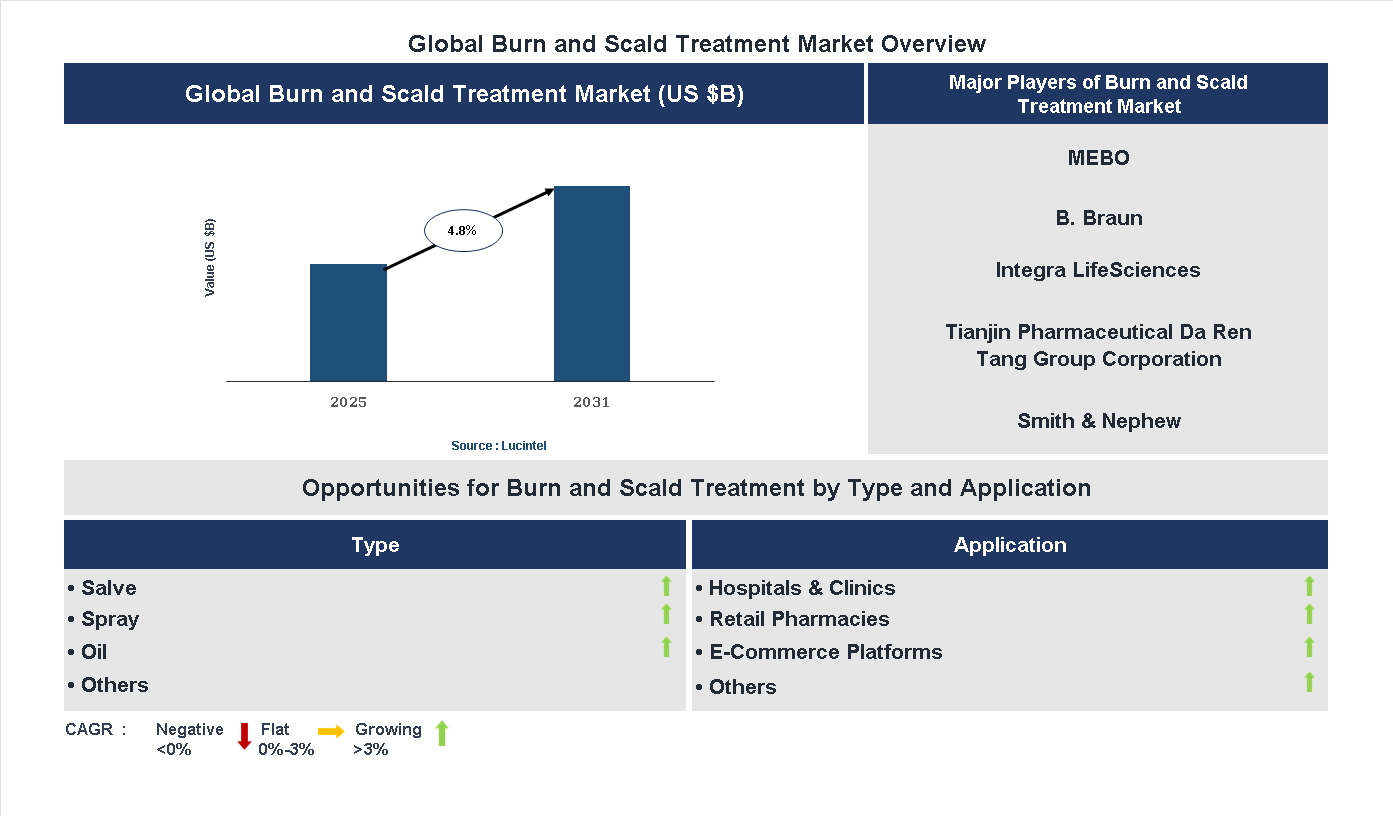
The future of the global burn and scald treatment market looks promising with opportunities in the hospital & clinic, retail pharmacy, and E-commerce platform markets. The global burn and scald treatment market is expected to grow with a CAGR of 4.8% from 2025 to 2031. The major drivers for this market are the increasing prevalence of burn related injuries, the rising awareness about advanced treatment options, and the growing demand for topical wound care products.

• Lucintel forecasts that, within the type category, salve is expected to witness the highest growth over the forecast period.
• Within the application category, E-commerce platform is expected to witness the highest growth.
• In terms of region, APAC is expected to witness the highest growth over the forecast period.
Gain valuable insights for your business decisions with our comprehensive 150+ page report. Sample figures with some insights are shown below.
Burn and Scald Treatment Market Trends and Forecast

Emerging Trends in the Burn and Scald Treatment Market

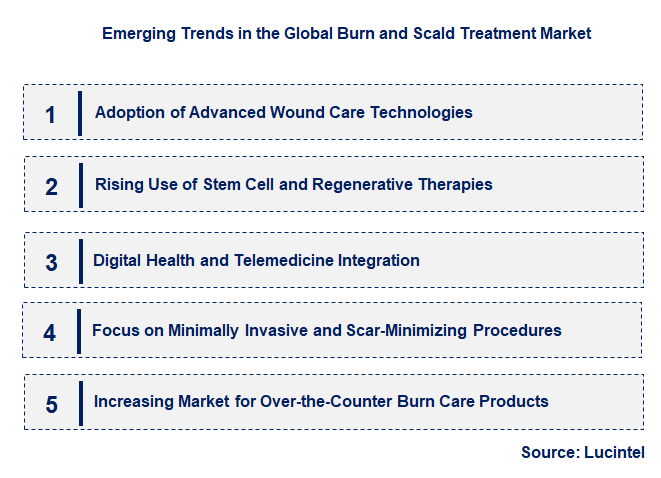
The burn and scald treatment market is experiencing rapid evolution driven by technological advancements, increasing awareness, and a growing prevalence of burn injuries worldwide. As healthcare providers seek more effective and innovative solutions, several emerging trends are shaping the future of this market. These developments are not only improving patient outcomes but also transforming treatment protocols, manufacturing processes, and market dynamics. Understanding these key trends is essential for stakeholders aiming to stay ahead in this competitive landscape and to meet the rising demand for advanced burn care solutions.

• Adoption of Advanced Wound Care Technologies: The market is witnessing increased use of innovative wound dressings, such as bioengineered skin substitutes, hydrocolloids, and antimicrobial dressings. These advanced materials promote faster healing, reduce infection risk, and improve patient comfort. The integration of nanotechnology and biocompatible materials further enhances treatment efficacy, leading to better clinical outcomes and shorter hospital stays. This trend is driven by ongoing research and a focus on personalized, minimally invasive therapies.
• Rising Use of Stem Cell and Regenerative Therapies: Stem cell-based treatments are gaining traction for their potential to regenerate damaged skin and tissues more effectively than traditional methods. These therapies facilitate faster healing, reduce scarring, and restore skin functionality. The market is witnessing increased investment in regenerative medicine research, leading to the development of novel cell-based products. As regulatory pathways become clearer, these therapies are expected to become mainstream, significantly impacting burn treatment protocols and patient recovery times.
• Digital Health and Telemedicine Integration: The incorporation of digital health tools and telemedicine platforms is transforming burn care management. Remote monitoring devices, mobile apps, and virtual consultations enable continuous patient assessment, early detection of complications, and personalized treatment adjustments. This trend enhances access to specialized care, especially in remote or underserved areas, and reduces hospital visits. The integration of digital solutions improves treatment adherence, patient engagement, and overall outcomes, making burn management more efficient and patient-centric.
• Focus on Minimally Invasive and Scar-Minimizing Procedures: There is a growing emphasis on minimally invasive techniques that reduce tissue damage and scarring. Laser therapy, micro-needling, and other non-invasive procedures are increasingly used for scar management and skin rejuvenation post-burn. These approaches improve aesthetic outcomes and patient satisfaction while decreasing recovery times. The trend reflects a broader shift towards patient comfort and quality of life, influencing product development and clinical practices in burn care.
• Increasing Market for Over-the-Counter (OTC) Burn Care Products: The demand for OTC burn and scald treatment products is rising, driven by consumer awareness and the need for immediate, accessible care. Products such as burn gels, antiseptic creams, and soothing ointments are becoming more sophisticated, offering enhanced healing properties. This trend expands the market beyond clinical settings, empowering consumers to manage minor burns effectively at home. It also encourages innovation in product formulations, safety, and efficacy, broadening the scope of burn treatment options available to the public.

In summary, these emerging trends are collectively reshaping the burn and scald treatment market by fostering innovation, improving patient outcomes, and expanding access to advanced care solutions. They reflect a shift towards more personalized, efficient, and minimally invasive treatment modalities, positioning the market for sustained growth and technological advancement.
Emerging Trends in the Burn and Scald Treatment Market

Recent Development in the Burn and Scald Treatment Market

The burn and scald treatment market has experienced significant advancements driven by technological innovations, increasing awareness, and rising incidences of burns worldwide. These developments aim to improve patient outcomes, reduce recovery times, and enhance treatment efficacy. As the healthcare sector continues to evolve, key innovations and trends are shaping the future of burn care. Understanding these developments is crucial for stakeholders to adapt strategies and improve service delivery in this specialized field. The following are five key recent developments shaping this market landscape.

• Adoption of Advanced Wound Dressings: The introduction of bioengineered and antimicrobial dressings has revolutionized burn care by promoting faster healing, reducing infection risk, and minimizing scarring. These dressings, such as hydrocolloids and collagen-based products, provide better moisture retention and protection, leading to improved patient comfort and outcomes. Their increasing adoption is driven by clinical evidence supporting their efficacy, which is positively impacting market growth and treatment standards.
• Growth of Telemedicine in Burn Management: Telemedicine platforms now enable remote consultation, follow-up, and monitoring of burn patients, especially in underserved or rural areas. This development enhances access to specialized care, reduces hospital visits, and facilitates early intervention. The integration of telehealth solutions is expanding the reach of burn treatment services, improving patient management, and reducing healthcare costs, thereby significantly influencing market dynamics.
• Innovations in Skin Regeneration Technologies: Advances in stem cell therapy, tissue engineering, and 3D bioprinting are paving the way for improved skin regeneration options. These technologies aim to restore skin integrity more effectively, reduce scarring, and accelerate healing processes. Their ongoing development is expected to transform burn treatment protocols, offering more personalized and effective solutions, and expanding market opportunities.
• Rising Use of Artificial Intelligence (AI) and Data Analytics: AI-driven diagnostic tools and data analytics are being employed to predict burn severity, optimize treatment plans, and monitor healing progress. These technologies improve decision-making accuracy, reduce treatment times, and enhance patient outcomes. The integration of AI into burn care is fostering more precise, efficient, and cost-effective treatments, thereby impacting market growth positively.
• Increasing Focus on Minimally Invasive Procedures: The trend toward less invasive treatments, such as laser therapy and minimally invasive debridement, is gaining momentum. These procedures reduce patient discomfort, shorten recovery times, and lower complication rates. Their adoption is driven by technological advancements and patient preference for less invasive options, contributing to a shift in treatment paradigms and expanding the market scope.

In summary, these recent developments are collectively transforming the burn and scald treatment market by improving treatment efficacy, expanding access, and fostering innovative solutions. The integration of advanced technologies and patient-centric approaches is driving market growth, enhancing patient outcomes, and setting new standards in burn care management.

Strategic Growth Opportunities in the Burn and Scald Treatment Market

The burn and scald treatment market is experiencing significant growth driven by increasing burn incidents, advancements in medical technology, and rising awareness of effective treatment options. As healthcare providers seek innovative solutions to improve patient outcomes, several key applications are emerging as vital growth areas. These opportunities are shaping the future landscape of burn care, offering improved healing, reduced complications, and enhanced patient quality of life. Understanding these growth opportunities across different applications is essential for stakeholders aiming to capitalize on market potential and address unmet medical needs effectively.

• Wound Care Management: The development of advanced dressings and skin substitutes is revolutionizing wound care management. These innovations promote faster healing, reduce infection risk, and improve patient comfort, thereby increasing demand for specialized burn treatment products. This growth enhances overall treatment efficacy and reduces hospitalization times.
• Skin Regeneration and Grafting: Innovations in skin grafting techniques and regenerative therapies are expanding the scope of skin regeneration. These methods improve aesthetic and functional outcomes for burn victims, reducing scarring and restoring skin integrity. The impact is a higher success rate in complex cases and better long-term results.
• Pain Management and Comfort: The focus on effective pain management solutions, including topical anesthetics and analgesics, is crucial in burn treatment. These advancements improve patient comfort during treatment and recovery, leading to better compliance and reduced psychological trauma, ultimately enhancing overall care quality.
• Infection Control: The rise of antimicrobial dressings and infection prevention protocols is vital in controlling burn-related infections. These innovations significantly decrease infection rates, reduce antibiotic use, and improve healing times, which collectively lower healthcare costs and improve patient outcomes.
• Rehabilitation and Physical Therapy: The integration of advanced rehabilitation techniques and devices is transforming post-burn recovery. These applications help restore mobility, reduce scarring, and improve functional outcomes, leading to quicker reintegration into daily life and reducing long-term disabilities.

In summary, these growth opportunities across key applications are profoundly impacting the burn and scald treatment market by enhancing treatment effectiveness, reducing complications, and improving patient quality of life. As innovation continues, the market is poised for substantial expansion, driven by the increasing need for comprehensive and effective burn care solutions.

Burn and Scald Treatment Market Driver and Challenges

The burn and scald treatment market is influenced by a variety of technological, economic, and regulatory factors that shape its growth and development. Advances in medical technology and innovative treatment options drive market expansion, while economic conditions impact healthcare spending and accessibility. Regulatory frameworks ensure safety and efficacy but can also pose barriers to new product approval and market entry. Additionally, increasing awareness about burn care and the rising prevalence of burn injuries globally contribute to market dynamics. Understanding these drivers and challenges is essential for stakeholders to navigate the evolving landscape and capitalize on opportunities while addressing potential obstacles.

The factors responsible for driving the burn and scald treatment market include:-
• Technological Advancements: The development of innovative wound care products, such as bioengineered skin substitutes, advanced dressings, and stem cell therapies, significantly enhances treatment efficacy. These innovations reduce healing time, minimize scarring, and improve patient outcomes, thereby increasing demand. Continuous research and technological progress attract investments and expand market opportunities, especially in minimally invasive and outpatient treatments. As technology evolves, the market benefits from improved product performance, safety, and patient comfort, fueling growth across healthcare settings.
• Rising Incidence of Burn Injuries: An increase in burn and scald injuries due to industrial accidents, fire incidents, and domestic mishaps worldwide is a major driver. Urbanization, industrialization, and unsafe cooking practices contribute to higher injury rates, especially in developing regions. This surge in cases creates a growing demand for effective treatment options, boosting market sales. Governments and healthcare providers are prioritizing burn care infrastructure, further propelling market expansion as the need for specialized treatments and wound management products rises.
• Increasing Awareness and Healthcare Expenditure: Growing awareness about burn prevention, early intervention, and advanced treatment options among the public and healthcare professionals enhances market growth. Additionally, rising healthcare expenditure, especially in emerging economies, enables better access to specialized burn care products and treatments. Insurance coverage and government initiatives support the adoption of advanced therapies, expanding the market. Educational campaigns and training programs also contribute to improved patient outcomes, driving demand for comprehensive burn management solutions.
• Regulatory Approvals and Support: Stringent regulatory frameworks ensure the safety and efficacy of burn treatment products, fostering trust among healthcare providers and patients. Approval of innovative products by agencies like the FDA and EMA accelerates market entry and adoption. Regulatory support for research and development, along with favorable policies, encourages companies to innovate and expand their product portfolios. This environment promotes the availability of high-quality, effective treatments, ultimately driving market growth and improving patient care standards.

The challenges facing this burn and scald treatment market include:-
• High Cost of Advanced Treatments: Innovative burn treatments, such as bioengineered skin and stem cell therapies, often involve high development and manufacturing costs. These expenses translate into expensive products, limiting accessibility, especially in low-income regions. The high cost can hinder widespread adoption and place financial burdens on healthcare systems and patients, restricting market growth. Additionally, reimbursement issues and lack of insurance coverage for advanced therapies further complicate affordability, posing significant barriers to market expansion.
• Regulatory Hurdles and Approval Delays: While regulations ensure product safety, they can also delay market entry for new treatments. Lengthy approval processes, complex documentation, and stringent testing requirements increase development timelines and costs. These hurdles discourage innovation and can lead to market stagnation. Small and emerging companies may struggle to navigate regulatory landscapes, limiting the diversity of available treatments and slowing overall market growth.
• Limited Awareness and Access in Developing Regions: Despite rising burn incidences, awareness about advanced burn care options remains low in many developing countries. Limited healthcare infrastructure, lack of trained professionals, and economic constraints restrict access to modern treatments. This disparity hampers market growth in these regions and prevents the full realization of treatment benefits. Overcoming these barriers requires targeted education, infrastructure development, and affordable product offerings to expand reach and improve burn care outcomes globally.

In summary, technological innovations, increasing burn injury cases, rising awareness, and regulatory support are key drivers propelling the burn and scald treatment market forward. However, high treatment costs, regulatory delays, and limited access in developing regions pose significant challenges. These factors collectively influence market dynamics, with growth opportunities driven by technological progress and expanding healthcare infrastructure, while barriers such as affordability and regulatory complexities need strategic management. Addressing these challenges will be crucial for sustainable growth and improved patient outcomes in the burn care sector.

List of Burn and Scald Treatment Companies

Companies in the market compete on the basis of product quality offered. Major players in this market focus on expanding their manufacturing facilities, R&D investments, infrastructural development, and leverage integration opportunities across the value chain. With these strategies burn and scald treatment companies cater increasing demand, ensure competitive effectiveness, develop innovative products & technologies, reduce production costs, and expand their customer base. Some of the burn and scald treatment companies profiled in this report include-
• MEBO
• B. Braun
• Integra LifeSciences
• Tianjin Pharmaceutical Da Ren Tang Group Corporation
• Smith & Nephew
• Yangtze River Pharmaceutical
• STADA Thornton & Ross
• Kenvue Brands LLC
• Changchun OVERSEAS
• Orkla Health

Burn and Scald Treatment Market by Segment

The study includes a forecast for the global burn and scald treatment market by type, application, and region.

Burn and Scald Treatment Market by Type [Value from 2019 to 2031]:


• Salve
• Spray
• Oil
• Others

Burn and Scald Treatment Market by Application [Value from 2019 to 2031]:


• Hospitals & Clinics
• Retail Pharmacies
• E-Commerce Platforms
• Others

Burn and Scald Treatment Market by Region [Value from 2019 to 2031]:


• North America
• Europe
• Asia Pacific
• The Rest of the World

Country Wise Outlook for the Burn and Scald Treatment Market

The burn and scald treatment market has experienced significant advancements driven by technological innovations, increased healthcare investments, and rising awareness of burn care. Countries are focusing on developing advanced wound management products, improving treatment protocols, and expanding access to specialized burn care facilities. The markets growth is also fueled by increasing incidences of burns due to accidents, industrial activities, and domestic incidents. Governments and the private sector are collaborating to enhance research and development efforts, leading to new treatment options and improved patient outcomes. These developments reflect a global trend toward more effective, accessible, and innovative burn treatment solutions.

• United States: The US market has seen rapid adoption of advanced wound dressings, including bioengineered skin substitutes and growth factor therapies. Investment in research has led to innovative products like stem cell-based treatments and 3D-printed skin. Telemedicine for burn care has expanded, improving access in remote areas. Regulatory approvals for new therapies have accelerated, and there is a focus on personalized treatment approaches. The US also emphasizes burn prevention programs and public awareness campaigns, contributing to overall market growth.
• China: China is witnessing substantial growth in burn treatment due to rising industrialization and urbanization, which increases burn incidents. The government is investing heavily in healthcare infrastructure and burn care centers. Local companies are developing affordable, innovative dressings and wound management products tailored to the Chinese population. There is a growing adoption of traditional Chinese medicine integrated with modern treatments. Additionally, increasing awareness and training programs are improving burn management practices across hospitals, boosting market expansion.
• Germany: Germanys market is characterized by high-quality, technologically advanced burn care products. The country emphasizes minimally invasive treatments and regenerative medicine, including stem cell therapies and skin grafts. Germanys healthcare system supports extensive research collaborations and clinical trials, leading to innovative solutions. The adoption of digital health tools for burn assessment and management is rising. Moreover, Germanys focus on sustainable and eco-friendly products is influencing market trends, with a push toward environmentally conscious wound care options.
• India: India is experiencing rapid growth in burn treatment owing to increasing burn cases from industrial accidents, domestic fires, and road accidents. The market is driven by rising healthcare expenditure and government initiatives to improve burn care facilities. Local manufacturers are developing cost-effective dressings and wound care products suitable for the Indian demographic. There is a surge in awareness campaigns and training programs to improve burn management practices. The adoption of telemedicine and mobile health solutions is expanding access to specialized burn care in rural and underserved areas.
• Japan: Japans burn treatment market is advancing through the integration of cutting-edge technologies such as bioengineered skin and regenerative therapies. The country focuses on reducing scarring and improving functional recovery through innovative treatments. Japans aging population has increased demand for specialized burn care for elderly patients. The government promotes research collaborations and clinical trials to develop new therapies. Additionally, Japan emphasizes minimally invasive procedures and the use of smart wound dressings embedded with sensors for real-time monitoring, enhancing treatment efficacy and patient comfort.

Lucintel Analytics Dashboard

Features of the Global Burn and Scald Treatment Market

Market Size Estimates: Burn and scald treatment market size estimation in terms of value ($B).
Trend and Forecast Analysis: Market trends (2019 to 2024) and forecast (2025 to 2031) by various segments and regions.
Segmentation Analysis: Burn and scald treatment market size by type, application, and region in terms of value ($B).
Regional Analysis: Burn and scald treatment market breakdown by North America, Europe, Asia Pacific, and Rest of the World.
Growth Opportunities: Analysis of growth opportunities in different types, applications, and regions for the burn and scald treatment market.
Strategic Analysis: This includes M&A, new product development, and competitive landscape of the burn and scald treatment market.
Analysis of competitive intensity of the industry based on Porter’s Five Forces model.

Lucintel Consulting Services

FAQ

Q1. What is the growth forecast for burn and scald treatment market?
Answer: The global burn and scald treatment market is expected to grow with a CAGR of 4.8% from 2025 to 2031.
Q2. What are the major drivers influencing the growth of the burn and scald treatment market?
Answer: The major drivers for this market are the increasing prevalence of burn related injuries, the rising awareness about advanced treatment options, and the growing demand for topical wound care products.
Q3. What are the major segments for burn and scald treatment market?
Answer: The future of the burn and scald treatment market looks promising with opportunities in the hospital & clinic, retail pharmacy, and E-commerce platform markets.
Q4. Who are the key burn and scald treatment market companies?
Answer: Some of the key burn and scald treatment companies are as follows:
• MEBO
• B. Braun
• Integra LifeSciences
• Tianjin Pharmaceutical Da Ren Tang Group Corporation
• Smith & Nephew
• Yangtze River Pharmaceutical
• STADA Thornton & Ross
• Kenvue Brands LLC
• Changchun OVERSEAS
• Orkla Health
Q5. Which burn and scald treatment market segment will be the largest in future?
Answer: Lucintel forecasts that, within the type category, salve is expected to witness the highest growth over the forecast period.
Q6. In burn and scald treatment market, which region is expected to be the largest in next 5 years?
Answer: In terms of region, APAC is expected to witness the highest growth over the forecast period.
Q7. Do we receive customization in this report?
Answer: Yes, Lucintel provides 10% customization without any additional cost.

This report answers following 11 key questions:

Q.1. What are some of the most promising, high-growth opportunities for the burn and scald treatment market by type (salve, spray, oil, and others), application (hospitals & clinics, retail pharmacies, e-commerce platforms, and others), and region (North America, Europe, Asia Pacific, and the Rest of the World)?
Q.2. Which segments will grow at a faster pace and why?
Q.3. Which region will grow at a faster pace and why?
Q.4. What are the key factors affecting market dynamics? What are the key challenges and business risks in this market?
Q.5. What are the business risks and competitive threats in this market?
Q.6. What are the emerging trends in this market and the reasons behind them?
Q.7. What are some of the changing demands of customers in the market?
Q.8. What are the new developments in the market? Which companies are leading these developments?
Q.9. Who are the major players in this market? What strategic initiatives are key players pursuing for business growth?
Q.10. What are some of the competing products in this market and how big of a threat do they pose for loss of market share by material or product substitution?
Q.11. What M&A activity has occurred in the last 5 years and what has its impact been on the industry?

For any questions related to Burn and Scald Treatment Market, Burn and Scald Treatment Market Size, Burn and Scald Treatment Market Growth, Burn and Scald Treatment Market Analysis, Burn and Scald Treatment Market Report, Burn and Scald Treatment Market Share, Burn and Scald Treatment Market Trends, Burn and Scald Treatment Market Forecast, Burn and Scald Treatment Companies, write Lucintel analyst at email: helpdesk@lucintel.com. We will be glad to get back to you soon.
                                           Table of Contents

            1. Executive Summary

            2. Market Overview

                        2.1 Background and Classifications
                        2.2 Supply Chain

            3. Market Trends & Forecast Analysis

                        3.1 Macroeconomic Trends and Forecasts
                        3.2 Industry Drivers and Challenges
                        3.3 PESTLE Analysis
                        3.4 Patent Analysis
                        3.5 Regulatory Environment
                        3.6 Global Burn and Scald Treatment Market Trends and Forecast

            4. Global Burn and Scald Treatment Market by Type

                        4.1 Overview
                        4.2 Attractiveness Analysis by Type
                        4.3 Salve : Trends and Forecast 2019 to 2031
                        4.4 Spray : Trends and Forecast 2019 to 2031
                        4.5 Oil : Trends and Forecast 2019 to 2031
                        4.6 Others : Trends and Forecast 2019 to 2031

            5. Global Burn and Scald Treatment Market by Application

                        5.1 Overview
                        5.2 Attractiveness Analysis by Application
                        5.3 Hospitals & Clinics : Trends and Forecast 2019 to 2031
                        5.4 Retail Pharmacies : Trends and Forecast 2019 to 2031
                        5.5 E-Commerce Platforms : Trends and Forecast 2019 to 2031
                        5.6 Others : Trends and Forecast 2019 to 2031

            6. Regional Analysis

                        6.1 Overview
                        6.2 Global Burn and Scald Treatment Market by Region

            7. North American Burn and Scald Treatment Market

                        7.1 Overview
                        7.2 North American Burn and Scald Treatment Market by Type
                        7.3 North American Burn and Scald Treatment Market by Application
                        7.4 The United States Burn and Scald Treatment Market
                        7.5 Canadian Burn and Scald Treatment Market
                        7.6 Mexican Burn and Scald Treatment Market

            8. European Burn and Scald Treatment Market

                        8.1 Overview
                        8.2 European Burn and Scald Treatment Market by Type
                        8.3 European Burn and Scald Treatment Market by Application
                        8.4 German Burn and Scald Treatment Market
                        8.5 French Burn and Scald Treatment Market
                        8.6 Italian Burn and Scald Treatment Market
                        8.7 Spanish Burn and Scald Treatment Market
                        8.8 The United Kingdom Burn and Scald Treatment Market

            9. APAC Burn and Scald Treatment Market

                        9.1 Overview
                        9.2 APAC Burn and Scald Treatment Market by Type
                        9.3 APAC Burn and Scald Treatment Market by Application
                        9.4 Chinese Burn and Scald Treatment Market
                        9.5 Indian Burn and Scald Treatment Market
                        9.6 Japanese Burn and Scald Treatment Market
                        9.7 South Korean Burn and Scald Treatment Market
                        9.8 Indonesian Burn and Scald Treatment Market

            10. ROW Burn and Scald Treatment Market

                        10.1 Overview
                        10.2 ROW Burn and Scald Treatment Market by Type
                        10.3 ROW Burn and Scald Treatment Market by Application
                        10.4 Middle Eastern Burn and Scald Treatment Market
                        10.5 South American Burn and Scald Treatment Market
                        10.6 African Burn and Scald Treatment Market

            11. Competitor Analysis

                        11.1 Product Portfolio Analysis
                        11.2 Operational Integration
                        11.3 Porter’s Five Forces Analysis
                                    • Competitive Rivalry
                                    • Bargaining Power of Buyers
                                    • Bargaining Power of Suppliers
                                    • Threat of Substitutes
                                    • Threat of New Entrants
                        11.4 Market Share Analysis

            12. Opportunities & Strategic Analysis

                        12.1 Value Chain Analysis
                        12.2 Growth Opportunity Analysis
                                    12.2.1 Growth Opportunity by Type
                                    12.2.2 Growth Opportunity by Application
                        12.3 Emerging Trends in the Global Burn and Scald Treatment Market
                        12.4 Strategic Analysis
                                    12.4.1 New Product Development
                                    12.4.2 Certification and Licensing
                                    12.4.3 Mergers, Acquisitions, Agreements, Collaborations, and Joint Ventures

            13. Company Profiles of the Leading Players Across the Value Chain

                        13.1 Competitive Analysis Overview
                        13.2 MEBO
                                    • Company Overview
                                    • Burn and Scald Treatment Market Business Overview
                                    • New Product Development
                                    • Merger, Acquisition, and Collaboration
                                    • Certification and Licensing
                        13.3 B. Braun
                                    • Company Overview
                                    • Burn and Scald Treatment Market Business Overview
                                    • New Product Development
                                    • Merger, Acquisition, and Collaboration
                                    • Certification and Licensing
                        13.4 Integra LifeSciences
                                    • Company Overview
                                    • Burn and Scald Treatment Market Business Overview
                                    • New Product Development
                                    • Merger, Acquisition, and Collaboration
                                    • Certification and Licensing
                        13.5 Tianjin Pharmaceutical Da Ren Tang Group Corporation
                                    • Company Overview
                                    • Burn and Scald Treatment Market Business Overview
                                    • New Product Development
                                    • Merger, Acquisition, and Collaboration
                                    • Certification and Licensing
                        13.6 Smith & Nephew
                                    • Company Overview
                                    • Burn and Scald Treatment Market Business Overview
                                    • New Product Development
                                    • Merger, Acquisition, and Collaboration
                                    • Certification and Licensing
                        13.7 Yangtze River Pharmaceutical
                                    • Company Overview
                                    • Burn and Scald Treatment Market Business Overview
                                    • New Product Development
                                    • Merger, Acquisition, and Collaboration
                                    • Certification and Licensing
                        13.8 STADA Thornton & Ross
                                    • Company Overview
                                    • Burn and Scald Treatment Market Business Overview
                                    • New Product Development
                                    • Merger, Acquisition, and Collaboration
                                    • Certification and Licensing
                        13.9 Kenvue Brands LLC
                                    • Company Overview
                                    • Burn and Scald Treatment Market Business Overview
                                    • New Product Development
                                    • Merger, Acquisition, and Collaboration
                                    • Certification and Licensing
                        13.10 Changchun OVERSEAS
                                    • Company Overview
                                    • Burn and Scald Treatment Market Business Overview
                                    • New Product Development
                                    • Merger, Acquisition, and Collaboration
                                    • Certification and Licensing
                        13.11 Orkla Health
                                    • Company Overview
                                    • Burn and Scald Treatment Market Business Overview
                                    • New Product Development
                                    • Merger, Acquisition, and Collaboration
                                    • Certification and Licensing

            14. Appendix

                        14.1 List of Figures
                        14.2 List of Tables
                        14.3 Research Methodology
                        14.4 Disclaimer
                        14.5 Copyright
                        14.6 Abbreviations and Technical Units
                        14.7 About Us
                        14.8 Contact Us

                                               List of Figures


            Chapter 1

                        Figure 1.1: Trends and Forecast for the Global Burn and Scald Treatment Market

            Chapter 2

                        Figure 2.1: Usage of Burn and Scald Treatment Market
                        Figure 2.2: Classification of the Global Burn and Scald Treatment Market
                        Figure 2.3: Supply Chain of the Global Burn and Scald Treatment Market

            Chapter 3

                        Figure 3.1: Trends of the Global GDP Growth Rate
                        Figure 3.2: Trends of the Global Population Growth Rate
                        Figure 3.3: Trends of the Global Inflation Rate
                        Figure 3.4: Trends of the Global Unemployment Rate
                        Figure 3.5: Trends of the Regional GDP Growth Rate
                        Figure 3.6: Trends of the Regional Population Growth Rate
                        Figure 3.7: Trends of the Regional Inflation Rate
                        Figure 3.8: Trends of the Regional Unemployment Rate
                        Figure 3.9: Trends of Regional Per Capita Income
                        Figure 3.10: Forecast for the Global GDP Growth Rate
                        Figure 3.11: Forecast for the Global Population Growth Rate
                        Figure 3.12: Forecast for the Global Inflation Rate
                        Figure 3.13: Forecast for the Global Unemployment Rate
                        Figure 3.14: Forecast for the Regional GDP Growth Rate
                        Figure 3.15: Forecast for the Regional Population Growth Rate
                        Figure 3.16: Forecast for the Regional Inflation Rate
                        Figure 3.17: Forecast for the Regional Unemployment Rate
                        Figure 3.18: Forecast for Regional Per Capita Income
                        Figure 3.19: Driver and Challenges of the Burn and Scald Treatment Market

            Chapter 4

                        Figure 4.1: Global Burn and Scald Treatment Market by Type in 2019, 2024, and 2031
                        Figure 4.2: Trends of the Global Burn and Scald Treatment Market ($B) by Type
                        Figure 4.3: Forecast for the Global Burn and Scald Treatment Market ($B) by Type
                        Figure 4.4: Trends and Forecast for Salve in the Global Burn and Scald Treatment Market (2019-2031)
                        Figure 4.5: Trends and Forecast for Spray in the Global Burn and Scald Treatment Market (2019-2031)
                        Figure 4.6: Trends and Forecast for Oil in the Global Burn and Scald Treatment Market (2019-2031)
                        Figure 4.7: Trends and Forecast for Others in the Global Burn and Scald Treatment Market (2019-2031)

            Chapter 5

                        Figure 5.1: Global Burn and Scald Treatment Market by Application in 2019, 2024, and 2031
                        Figure 5.2: Trends of the Global Burn and Scald Treatment Market ($B) by Application
                        Figure 5.3: Forecast for the Global Burn and Scald Treatment Market ($B) by Application
                        Figure 5.4: Trends and Forecast for Hospitals & Clinics in the Global Burn and Scald Treatment Market (2019-2031)
                        Figure 5.5: Trends and Forecast for Retail Pharmacies in the Global Burn and Scald Treatment Market (2019-2031)
                        Figure 5.6: Trends and Forecast for E-Commerce Platforms in the Global Burn and Scald Treatment Market (2019-2031)
                        Figure 5.7: Trends and Forecast for Others in the Global Burn and Scald Treatment Market (2019-2031)

            Chapter 6

                        Figure 6.1: Trends of the Global Burn and Scald Treatment Market ($B) by Region (2019-2024)
                        Figure 6.2: Forecast for the Global Burn and Scald Treatment Market ($B) by Region (2025-2031)

            Chapter 7

                        Figure 7.1: Trends and Forecast for the North American Burn and Scald Treatment Market (2019-2031)
                        Figure 7.2: North American Burn and Scald Treatment Market by Type in 2019, 2024, and 2031
                        Figure 7.3: Trends of the North American Burn and Scald Treatment Market ($B) by Type (2019-2024)
                        Figure 7.4: Forecast for the North American Burn and Scald Treatment Market ($B) by Type (2025-2031)
                        Figure 7.5: North American Burn and Scald Treatment Market by Application in 2019, 2024, and 2031
                        Figure 7.6: Trends of the North American Burn and Scald Treatment Market ($B) by Application (2019-2024)
                        Figure 7.7: Forecast for the North American Burn and Scald Treatment Market ($B) by Application (2025-2031)
                        Figure 7.8: Trends and Forecast for the United States Burn and Scald Treatment Market ($B) (2019-2031)
                        Figure 7.9: Trends and Forecast for the Mexican Burn and Scald Treatment Market ($B) (2019-2031)
                        Figure 7.10: Trends and Forecast for the Canadian Burn and Scald Treatment Market ($B) (2019-2031)

            Chapter 8

                        Figure 8.1: Trends and Forecast for the European Burn and Scald Treatment Market (2019-2031)
                        Figure 8.2: European Burn and Scald Treatment Market by Type in 2019, 2024, and 2031
                        Figure 8.3: Trends of the European Burn and Scald Treatment Market ($B) by Type (2019-2024)
                        Figure 8.4: Forecast for the European Burn and Scald Treatment Market ($B) by Type (2025-2031)
                        Figure 8.5: European Burn and Scald Treatment Market by Application in 2019, 2024, and 2031
                        Figure 8.6: Trends of the European Burn and Scald Treatment Market ($B) by Application (2019-2024)
                        Figure 8.7: Forecast for the European Burn and Scald Treatment Market ($B) by Application (2025-2031)
                        Figure 8.8: Trends and Forecast for the German Burn and Scald Treatment Market ($B) (2019-2031)
                        Figure 8.9: Trends and Forecast for the French Burn and Scald Treatment Market ($B) (2019-2031)
                        Figure 8.10: Trends and Forecast for the Spanish Burn and Scald Treatment Market ($B) (2019-2031)
                        Figure 8.11: Trends and Forecast for the Italian Burn and Scald Treatment Market ($B) (2019-2031)
                        Figure 8.12: Trends and Forecast for the United Kingdom Burn and Scald Treatment Market ($B) (2019-2031)

            Chapter 9

                        Figure 9.1: Trends and Forecast for the APAC Burn and Scald Treatment Market (2019-2031)
                        Figure 9.2: APAC Burn and Scald Treatment Market by Type in 2019, 2024, and 2031
                        Figure 9.3: Trends of the APAC Burn and Scald Treatment Market ($B) by Type (2019-2024)
                        Figure 9.4: Forecast for the APAC Burn and Scald Treatment Market ($B) by Type (2025-2031)
                        Figure 9.5: APAC Burn and Scald Treatment Market by Application in 2019, 2024, and 2031
                        Figure 9.6: Trends of the APAC Burn and Scald Treatment Market ($B) by Application (2019-2024)
                        Figure 9.7: Forecast for the APAC Burn and Scald Treatment Market ($B) by Application (2025-2031)
                        Figure 9.8: Trends and Forecast for the Japanese Burn and Scald Treatment Market ($B) (2019-2031)
                        Figure 9.9: Trends and Forecast for the Indian Burn and Scald Treatment Market ($B) (2019-2031)
                        Figure 9.10: Trends and Forecast for the Chinese Burn and Scald Treatment Market ($B) (2019-2031)
                        Figure 9.11: Trends and Forecast for the South Korean Burn and Scald Treatment Market ($B) (2019-2031)
                        Figure 9.12: Trends and Forecast for the Indonesian Burn and Scald Treatment Market ($B) (2019-2031)

            Chapter 10

                        Figure 10.1: Trends and Forecast for the ROW Burn and Scald Treatment Market (2019-2031)
                        Figure 10.2: ROW Burn and Scald Treatment Market by Type in 2019, 2024, and 2031
                        Figure 10.3: Trends of the ROW Burn and Scald Treatment Market ($B) by Type (2019-2024)
                        Figure 10.4: Forecast for the ROW Burn and Scald Treatment Market ($B) by Type (2025-2031)
                        Figure 10.5: ROW Burn and Scald Treatment Market by Application in 2019, 2024, and 2031
                        Figure 10.6: Trends of the ROW Burn and Scald Treatment Market ($B) by Application (2019-2024)
                        Figure 10.7: Forecast for the ROW Burn and Scald Treatment Market ($B) by Application (2025-2031)
                        Figure 10.8: Trends and Forecast for the Middle Eastern Burn and Scald Treatment Market ($B) (2019-2031)
                        Figure 10.9: Trends and Forecast for the South American Burn and Scald Treatment Market ($B) (2019-2031)
                        Figure 10.10: Trends and Forecast for the African Burn and Scald Treatment Market ($B) (2019-2031)

            Chapter 11

                        Figure 11.1: Porter’s Five Forces Analysis of the Global Burn and Scald Treatment Market
                        Figure 11.2: Market Share (%) of Top Players in the Global Burn and Scald Treatment Market (2024)

            Chapter 12

                        Figure 12.1: Growth Opportunities for the Global Burn and Scald Treatment Market by Type
                        Figure 12.2: Growth Opportunities for the Global Burn and Scald Treatment Market by Application
                        Figure 12.3: Growth Opportunities for the Global Burn and Scald Treatment Market by Region
                        Figure 12.4: Emerging Trends in the Global Burn and Scald Treatment Market

                                               List of Tables


            Chapter 1

                        Table 1.1: Growth Rate (%, 2023-2024) and CAGR (%, 2025-2031) of the Burn and Scald Treatment Market by Type and Application
                        Table 1.2: Attractiveness Analysis for the Burn and Scald Treatment Market by Region
                        Table 1.3: Global Burn and Scald Treatment Market Parameters and Attributes

            Chapter 3

                        Table 3.1: Trends of the Global Burn and Scald Treatment Market (2019-2024)
                        Table 3.2: Forecast for the Global Burn and Scald Treatment Market (2025-2031)

            Chapter 4

                        Table 4.1: Attractiveness Analysis for the Global Burn and Scald Treatment Market by Type
                        Table 4.2: Market Size and CAGR of Various Type in the Global Burn and Scald Treatment Market (2019-2024)
                        Table 4.3: Market Size and CAGR of Various Type in the Global Burn and Scald Treatment Market (2025-2031)
                        Table 4.4: Trends of Salve in the Global Burn and Scald Treatment Market (2019-2024)
                        Table 4.5: Forecast for Salve in the Global Burn and Scald Treatment Market (2025-2031)
                        Table 4.6: Trends of Spray in the Global Burn and Scald Treatment Market (2019-2024)
                        Table 4.7: Forecast for Spray in the Global Burn and Scald Treatment Market (2025-2031)
                        Table 4.8: Trends of Oil in the Global Burn and Scald Treatment Market (2019-2024)
                        Table 4.9: Forecast for Oil in the Global Burn and Scald Treatment Market (2025-2031)
                        Table 4.10: Trends of Others in the Global Burn and Scald Treatment Market (2019-2024)
                        Table 4.11: Forecast for Others in the Global Burn and Scald Treatment Market (2025-2031)

            Chapter 5

                        Table 5.1: Attractiveness Analysis for the Global Burn and Scald Treatment Market by Application
                        Table 5.2: Market Size and CAGR of Various Application in the Global Burn and Scald Treatment Market (2019-2024)
                        Table 5.3: Market Size and CAGR of Various Application in the Global Burn and Scald Treatment Market (2025-2031)
                        Table 5.4: Trends of Hospitals & Clinics in the Global Burn and Scald Treatment Market (2019-2024)
                        Table 5.5: Forecast for Hospitals & Clinics in the Global Burn and Scald Treatment Market (2025-2031)
                        Table 5.6: Trends of Retail Pharmacies in the Global Burn and Scald Treatment Market (2019-2024)
                        Table 5.7: Forecast for Retail Pharmacies in the Global Burn and Scald Treatment Market (2025-2031)
                        Table 5.8: Trends of E-Commerce Platforms in the Global Burn and Scald Treatment Market (2019-2024)
                        Table 5.9: Forecast for E-Commerce Platforms in the Global Burn and Scald Treatment Market (2025-2031)
                        Table 5.10: Trends of Others in the Global Burn and Scald Treatment Market (2019-2024)
                        Table 5.11: Forecast for Others in the Global Burn and Scald Treatment Market (2025-2031)

            Chapter 6

                        Table 6.1: Market Size and CAGR of Various Regions in the Global Burn and Scald Treatment Market (2019-2024)
                        Table 6.2: Market Size and CAGR of Various Regions in the Global Burn and Scald Treatment Market (2025-2031)

            Chapter 7

                        Table 7.1: Trends of the North American Burn and Scald Treatment Market (2019-2024)
                        Table 7.2: Forecast for the North American Burn and Scald Treatment Market (2025-2031)
                        Table 7.3: Market Size and CAGR of Various Type in the North American Burn and Scald Treatment Market (2019-2024)
                        Table 7.4: Market Size and CAGR of Various Type in the North American Burn and Scald Treatment Market (2025-2031)
                        Table 7.5: Market Size and CAGR of Various Application in the North American Burn and Scald Treatment Market (2019-2024)
                        Table 7.6: Market Size and CAGR of Various Application in the North American Burn and Scald Treatment Market (2025-2031)
                        Table 7.7: Trends and Forecast for the United States Burn and Scald Treatment Market (2019-2031)
                        Table 7.8: Trends and Forecast for the Mexican Burn and Scald Treatment Market (2019-2031)
                        Table 7.9: Trends and Forecast for the Canadian Burn and Scald Treatment Market (2019-2031)

            Chapter 8

                        Table 8.1: Trends of the European Burn and Scald Treatment Market (2019-2024)
                        Table 8.2: Forecast for the European Burn and Scald Treatment Market (2025-2031)
                        Table 8.3: Market Size and CAGR of Various Type in the European Burn and Scald Treatment Market (2019-2024)
                        Table 8.4: Market Size and CAGR of Various Type in the European Burn and Scald Treatment Market (2025-2031)
                        Table 8.5: Market Size and CAGR of Various Application in the European Burn and Scald Treatment Market (2019-2024)
                        Table 8.6: Market Size and CAGR of Various Application in the European Burn and Scald Treatment Market (2025-2031)
                        Table 8.7: Trends and Forecast for the German Burn and Scald Treatment Market (2019-2031)
                        Table 8.8: Trends and Forecast for the French Burn and Scald Treatment Market (2019-2031)
                        Table 8.9: Trends and Forecast for the Spanish Burn and Scald Treatment Market (2019-2031)
                        Table 8.10: Trends and Forecast for the Italian Burn and Scald Treatment Market (2019-2031)
                        Table 8.11: Trends and Forecast for the United Kingdom Burn and Scald Treatment Market (2019-2031)

            Chapter 9

                        Table 9.1: Trends of the APAC Burn and Scald Treatment Market (2019-2024)
                        Table 9.2: Forecast for the APAC Burn and Scald Treatment Market (2025-2031)
                        Table 9.3: Market Size and CAGR of Various Type in the APAC Burn and Scald Treatment Market (2019-2024)
                        Table 9.4: Market Size and CAGR of Various Type in the APAC Burn and Scald Treatment Market (2025-2031)
                        Table 9.5: Market Size and CAGR of Various Application in the APAC Burn and Scald Treatment Market (2019-2024)
                        Table 9.6: Market Size and CAGR of Various Application in the APAC Burn and Scald Treatment Market (2025-2031)
                        Table 9.7: Trends and Forecast for the Japanese Burn and Scald Treatment Market (2019-2031)
                        Table 9.8: Trends and Forecast for the Indian Burn and Scald Treatment Market (2019-2031)
                        Table 9.9: Trends and Forecast for the Chinese Burn and Scald Treatment Market (2019-2031)
                        Table 9.10: Trends and Forecast for the South Korean Burn and Scald Treatment Market (2019-2031)
                        Table 9.11: Trends and Forecast for the Indonesian Burn and Scald Treatment Market (2019-2031)

            Chapter 10

                        Table 10.1: Trends of the ROW Burn and Scald Treatment Market (2019-2024)
                        Table 10.2: Forecast for the ROW Burn and Scald Treatment Market (2025-2031)
                        Table 10.3: Market Size and CAGR of Various Type in the ROW Burn and Scald Treatment Market (2019-2024)
                        Table 10.4: Market Size and CAGR of Various Type in the ROW Burn and Scald Treatment Market (2025-2031)
                        Table 10.5: Market Size and CAGR of Various Application in the ROW Burn and Scald Treatment Market (2019-2024)
                        Table 10.6: Market Size and CAGR of Various Application in the ROW Burn and Scald Treatment Market (2025-2031)
                        Table 10.7: Trends and Forecast for the Middle Eastern Burn and Scald Treatment Market (2019-2031)
                        Table 10.8: Trends and Forecast for the South American Burn and Scald Treatment Market (2019-2031)
                        Table 10.9: Trends and Forecast for the African Burn and Scald Treatment Market (2019-2031)

            Chapter 11

                        Table 11.1: Product Mapping of Burn and Scald Treatment Suppliers Based on Segments
                        Table 11.2: Operational Integration of Burn and Scald Treatment Manufacturers
                        Table 11.3: Rankings of Suppliers Based on Burn and Scald Treatment Revenue

            Chapter 12

                        Table 12.1: New Product Launches by Major Burn and Scald Treatment Producers (2019-2024)
                        Table 12.2: Certification Acquired by Major Competitor in the Global Burn and Scald Treatment Market

.

Buy full report or by chapter as follows

Limited Time Offer

Price by License Type:
[-] Hide Chapter Details
[Chapter Number] [Chapter Name] [Chapter Number Of Pages] [Chapter Price]
Title/Chapter Name Pages Price
Full Report: Burn and Scald Treatment Market Report: Trends, Forecast and Competitive Analysis to 2031 Full Report $ 2,990
A 150 Page Report
Lucintel has been in the business of market research and management consulting since 2000 and has published over 1000 market intelligence reports in various markets / applications and served over 1,000 clients worldwide. This study is a culmination of four months of full-time effort performed by Lucintel's analyst team. The analysts used the following sources for the creation and completion of this valuable report:
  • In-depth interviews of the major players in this market
  • Detailed secondary research from competitors’ financial statements and published data 
  • Extensive searches of published works, market, and database information pertaining to industry news, company press releases, and customer intentions
  • A compilation of the experiences, judgments, and insights of Lucintel’s professionals, who have analyzed and tracked this market over the years.
Extensive research and interviews are conducted across the supply chain of this market to estimate market share, market size, trends, drivers, challenges, and forecasts. Below is a brief summary of the primary interviews that were conducted by job function for this report.
 
Thus, Lucintel compiles vast amounts of data from numerous sources, validates the integrity of that data, and performs a comprehensive analysis. Lucintel then organizes the data, its findings, and insights into a concise report designed to support the strategic decision-making process. The figure below is a graphical representation of Lucintel’s research process. 
 

Please sign in below to get report brochure - Burn and Scald Treatment Market Report.

At Lucintel, we respect your privacy and maintain the confidentiality of information / data provided by you
(Please enter your corporate email. * These fields are mandatory )

Follow us on