
Market Report · July 29, 2026

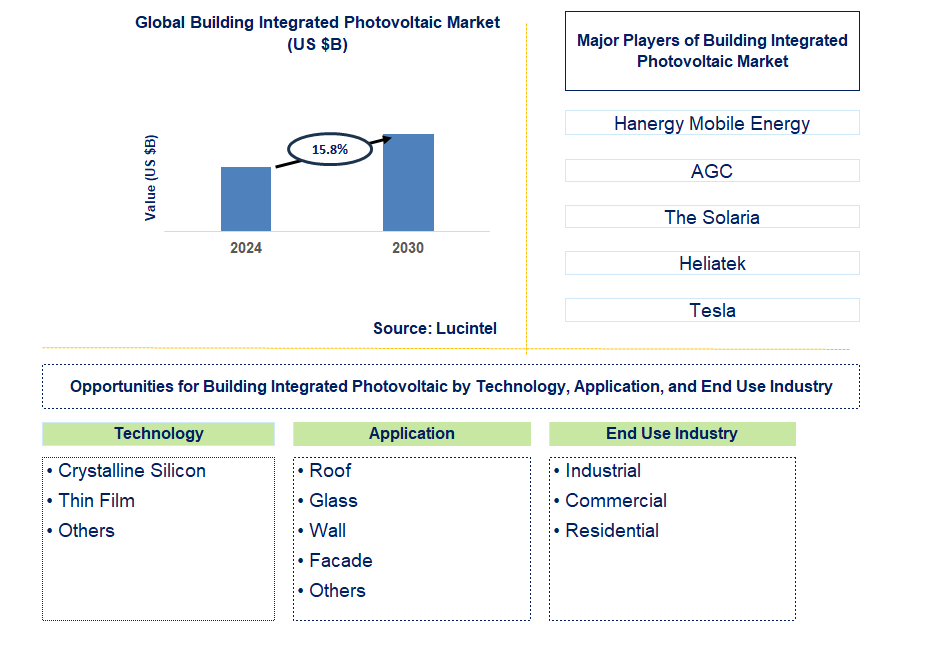
Key data points: The growth forecast = 15.8% annually next 6 years. Scroll below to get more insights. This market report covers trends, opportunities, and forecast in the global building integrated photovoltaic market to 2030 by technology (crystalline silicon, thin film , and others), application (roof, glass, wall, facade, and others), end use industry (industrial, commercial, and residential), and region (North America, Europe, Asia Pacific, and the Rest of the World)
We'll send your sample report shortly.
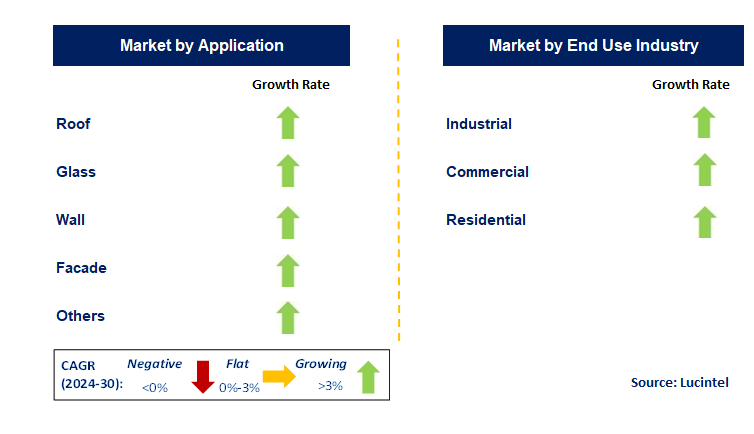
• Lucintel forecasts that roof installation segment is expected to witness the highest growth over the forecast period due to enhanced strength and superior aesthetic charm in integrated roofs and skylights.
• Through this market, industrial will remain the largest segment due to increasing utilization to decrease dependence on non-renewable energy sources.
• Europe is expected to witness the highest growth over the forecast period due to positive perception of renewable energy combined with consumer awareness regarding it. A more than 150-page report is developed to help in your business decisions.
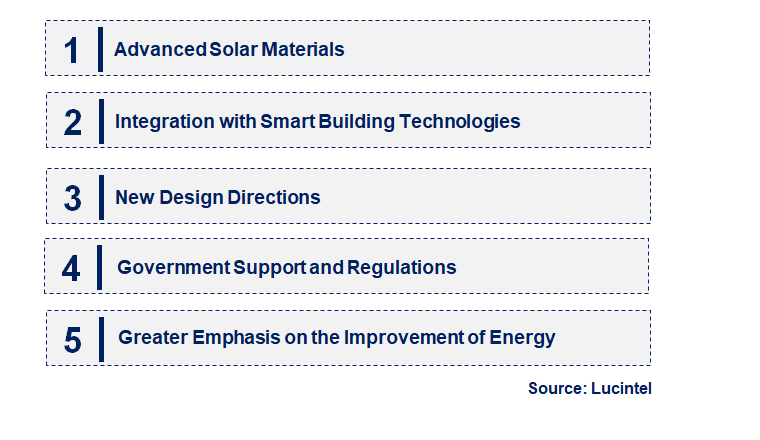
• Advanced Solar Materials: Solar material technologies, such as detachable and transparent solar systems, add more flexibility to BIPV systems. Incorporating these materials into windows and facades will increase the use of solar energy technologies and materials in cities.
• Integration with Smart Building Technologies: There is an increasing convergence of BIPV systems with smart building technologies, including energy management systems and building control systems. This leads to more efficient utilization of energy rather than just building energy usage to satisfy the energy demands of the building.
• New Design Directions: The latest improvements in BIPV technology include the development of solar systems that have a pleasing appearance and serve as an integral part of the building. This focus on solar integration addresses the issue of how to incorporate solar panels while enhancing the overall architecture.
• Government Support and Regulations: Various nations are enacting policies, structures, regulations, and provisions that encourage the use of BIPV in construction. Such policies consist of tax breaks, financial incentives, and laws requiring the incorporation of renewable energy into building projects, thereby facilitating the adoption of BIPV systems in both new and refurbishment projects.
• Greater Emphasis on the Improvement of Energy Efficiency: The increasing energy performance of building-integrated photovoltaic (BIPV) systems is enhancing performance innovations. Developments in the efficiency of the panels, alongside integration strategies, have made it possible for buildings to enhance power self-sufficiency and reduce operational costs. These trends are redefining the building integrated photovoltaic market through restructuring and optimizing construction practices, improving technology, integrating photovoltaics into construction structures, and enhancing the appearance of the systems. They are furthering the implementation of BIPV solutions and contributing positively towards achieving sustainable boundaries in building construction.
• Development of Solar Windows: The transparent solar panel technology has progressed to the extent that it can be embedded within windows and on facades. This enables the high-performance envelopes of buildings to do more than just the conventional function of enclosing them; they also create energy, thus extending the capabilities of BIPV systems.
• Solar Facade Systems: New and improved designs are being developed in solar façades to enhance the performance of BIPV systems. These improvements have made it easier to incorporate solar panels into buildings, thereby increasing energy harvesting and efficiency as well as the aesthetics of the buildings.
• BIPV Projects on a Large Scale: The implementation of large BIPV projects, especially in cities, demonstrates how solar technology can be optimally integrated into high-rise buildings and other commercial properties. These projects are accelerating market acceptance and innovation of the technology.
• Government Policies and Incentives: Recent attempts by governments through policies and incentives to promote the use of renewable energy resources are also helping increase the use of BIPV systems within building construction. These include financial assistance, tax exemptions, and policies on the use of solar PV in the construction or alteration of new or old structures.
• Integration with Energy Management Systems: BIPV systems are being combined with energy management systems, improving both the productivity and effectiveness of their use. This trend entails improved devices that ensure maximum energy efficiency indoors, as less energy waste will be reported. These major breakthroughs will continue to enhance the building integrated photovoltaic market through advancements in technologies, a growing scope of applications, and favorable government initiatives alongside large-scale projects. They are aiding in the wider acceptance of renewable energy-based technologies for use in the construction and remodeling of buildings.
• Commercial Buildings: Building integrated photovoltaic systems have huge potential for development in the office segment, where the large surface areas of roofs and walls yield ample opportunities for harvesting solar energy. This application opens possibilities for cutting down energy expenses as well as enhancing the green elements of commercial real estate.
• Residential Buildings: A growing sector is the installation of BIPV systems in residential buildings, as people seek greener ways to provide energy to their homes. Retrofitting existing structures and new residential construction with BIPV systems are opportunities available due to the increasing public demand for clean energy.
• High-Rise Buildings: There is potential for the employment of BIPV systems in high-rise buildings, which will enable the maximization of solar energy utilization in urban settings. This application is particularly useful in cities where there is a high concentration of buildings, leaving very little land for conventional solar farms.
• Architectural Integration: Embedded photovoltaic cells are slowly beginning to find their way into traditional building materials, such as roofing slates and wall facades. This combination makes it possible to design functional solar devices in an eye-catching manner and integrate them easily into the building, rather than using conventional mounted devices.
• Civic and Infrastructure Projects: Large-scale government and civil engineering projects offer BIPV systems great opportunities. With significant financial outlays over the course of a project and ambitions for sustainable development, such projects are very suitable for deploying modern solar technologies. The above-mentioned growth opportunities also offer a positive outlook on the different areas that BIPV systems will impact in the future. Taking into account commercial, residential, and high-rise applications, and capitalizing on government and infrastructure developments, the acceleration of the BIPV industry is inevitable.
• Technological Advancements: The market for building integrated photovoltaics is growing due to improvements in BIPV technology, such as high-efficiency solar panels and better integration techniques. These advancements make BIPV systems more efficient and usable for buildings.
• Government Incentives: Adoption of BIPV systems has been facilitated by favorable government policies and incentives in the form of subsidies and tax credits. These policies enable many developers and homeowners to ease their financial burdens, thereby increasing the market.
• Growing Focus on Sustainability: The trends aiming at sustainability and energy efficiency in construction projects have increased the demand for BIPV systems. Such renewable energy building solutions help achieve efficiency and compliance with environmental standards as well as legal provisions.
• Cost Reductions: The gradual decline in the overall costs associated with procuring solar technology and its installation is making BIPV systems more accessible. They are increasingly becoming economically desirable as their costs continue to decline.
• Urbanization and Energy Demand: Busy metropolitan areas are providing a market for BIPV systems due to urbanization and increasing energy requirements. Incorporating solar energy in building forms enables the achievement of energy goals without causing excessive land consumption. Challenges in the building integrated photovoltaic market are:
• High Initial Costs: The cost of some BIPV systems can become a barrier, especially for small projects. Even with decreasing costs, installation and integration still require a substantial initial investment, which is a hurdle.
• Complex Installation: Designing, bringing, and integrating BIPV systems into buildings comes with complications and requires specific skill sets. Such complications may cause delays in the installation process as well as increase labor costs.
• Regulatory Hurdles: Various regulations regarding BIPV systems can prove to be significant limitations. The variations in building codes, building standards, and incentive programs across different geographical regions may impede adoption prospects.
• Performance Variability: Additionally, BIPV systems do not perform consistently due to variances in factors such as shading, orientation, and weather conditions. Addressing these performance issues is crucial to ensuring that the returns from BIPV technology are maximized.
• Aesthetic Concerns: Integrating building-integrated solar PV systems with the architecture of buildings can pose a problem, particularly concerning the acceptance of architects and building stakeholders in specialized projects. The drivers and challenges in the BIPV market emphasize that there are risks associated with embracing and including solar technology in the architectural landscape. Measures that can address these factors are necessary to stimulate growth and realize the maximum potential of BIPV solutions in the construction field.
• Hanergy Mobile Energy
• AGC
• The Solaria
• Heliatek
• Tesla
• Ertex Solar
• Onyx Solar
• NanoPV Solar
• Polysolar
• ViaSolis
• Crystalline Silicon
• Thin Film
• Others
• Roof
• Glass
• Wall
• Facade
• Others
• Industrial
• Commercial
• Residential
• North America
• Europe
• Asia Pacific
• The Rest of the World
• United States: In the United States, interest is growing in the incorporation of BIPV systems into the interiors of commercial and residential buildings. Recent advancements include portable transparent solar cells or windows and optimized use of space in buildings harnessing such systems, made possible by both Forte Technologies and supportive government policies promoting renewable energy uptake.
• China: In BIPV deployment, China has advanced beyond other countries in terms of both technology and infrastructure investments. Highlights include urban areas with initiatives such as solar roads and rooftops, particularly in smart city projects by leading players, including Trina Solar.
• India: India is rapidly adopting BIPV technology, driven by a combination of public incentives and increasing energy demand. The government has implemented policies to stimulate solar energy adoption in various sectors, resulting in greater growth opportunities for BIPV systems. Additionally, companies like Tata Power are emerging as significant contributors in this area.
• Japan: Japan has a well-established BIPV market, with a high penetration of solar energy in building designs. The focus is on aesthetics, functionality, and innovation in BIPV systems, with notable progress from major companies like Panasonic.
• Germany: Germany is recognized as a leading country in BIPV technology adoption, with a focus on sustainability and high-quality design. Various companies, including SolarWorld, are at the forefront of providing innovative BIPV solutions in the region. The BIPV market is growing across various countries, driven by technological advancements, increasing energy demands, and strong government support. Major producers and organizations are entering collaborations to develop and implement more effective and efficient BIPV systems globally.


• Hanergy Mobile Energy
• AGC
• The Solaria
• Heliatek
• Tesla
• Ertex Solar
• Onyx Solar
• NanoPV Solar
• Polysolar
• ViaSolis Q5. Which building integrated photovoltaic market segment will be the largest in future? Answer: Lucintel forecasts that roof installation is expected to witness the highest growth over the forecast period due to enhanced strength and superior aesthetic charm in integrated roofs and skylights. Q6. In building integrated photovoltaic market, which region is expected to be the largest in next 5 years? Answer: Europe is expected to witness the highest growth over the forecast period due to positive perception of renewable energy combined with consumer awareness regarding it. Q.7 Do we receive customization in this report? Answer: Yes, Lucintel provides 10% customization without any additional cost.


Choose a license that fits your team. Instant PDF delivery.
Prices exclude taxes. Instant delivery. Custom licensing available on request.
Market Report · July 29, 2026
Market Report · July 20, 2026
Market Report · July 20, 2026
Trusted partner for strategic intelligence and business growth


Receive a complimentary market analysis tailored to your industry. Our analysts will identify key growth opportunities and competitive dynamics specific to your business.

Market size, growth rate, and key trend analysis for your specific sector.

Top competitor positioning and market share analysis.

Strategic recommendations backed by data-driven insights.
Get curated market intelligence and competitive moves straight to your inbox.
By subscribing, you agree to receive our monthly insights. Unsubscribe anytime.
Receive a complimentary market analysis tailored to your industry. Our analysts will identify key growth opportunities and competitive dynamics specific to your business.
Market size, growth rate, and key trend analysis for your specific sector.
Top competitor positioning and market share analysis.
Strategic recommendations backed by data-driven insights.
Get curated market intelligence, emerging trends, and competitive moves straight to your inbox each month.
By subscribing, you agree to receive our monthly insights. Unsubscribe anytime.
We'll send your sample report shortly.