
Market Report · July 22, 2026

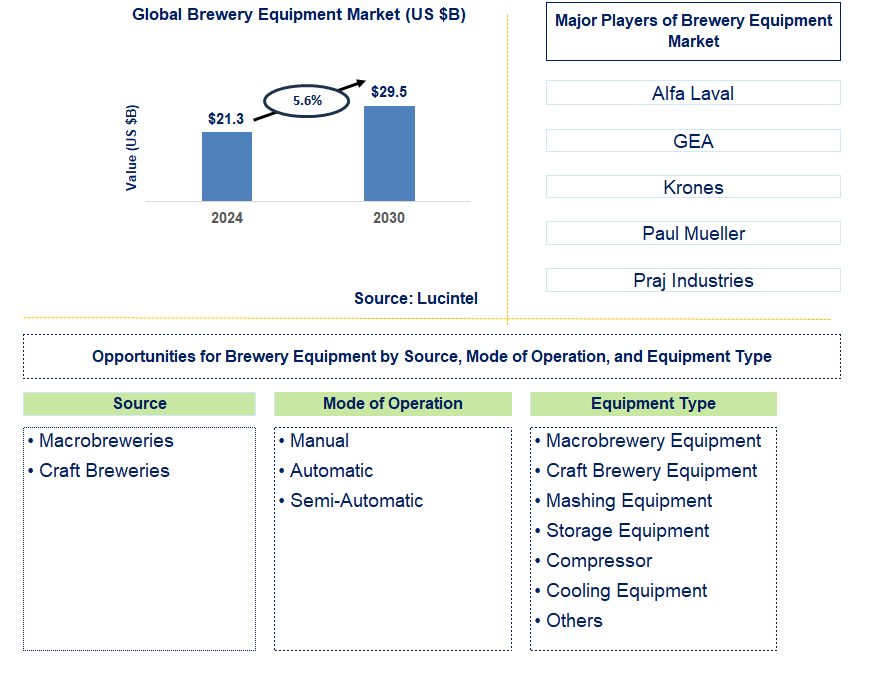
Key data points: The market size in 2030 = $29.5 billion, growth forecast = 5.6% annually for the next 6 years. Scroll below to get more insights. This market report covers trends, opportunities, and forecasts in the global brewery equipment market to 2030 by source (macrobreweries and craft breweries), mode of operation (manual, automatic, and semi-automatic), equipment type (macrobrewery equipment, craft brewery equipment, mashing equipment, storage equipment, compressor, cooling equipment, and others), and region (North America, Europe, Asia Pacific, and the Rest of the World)
We'll send your sample report shortly.
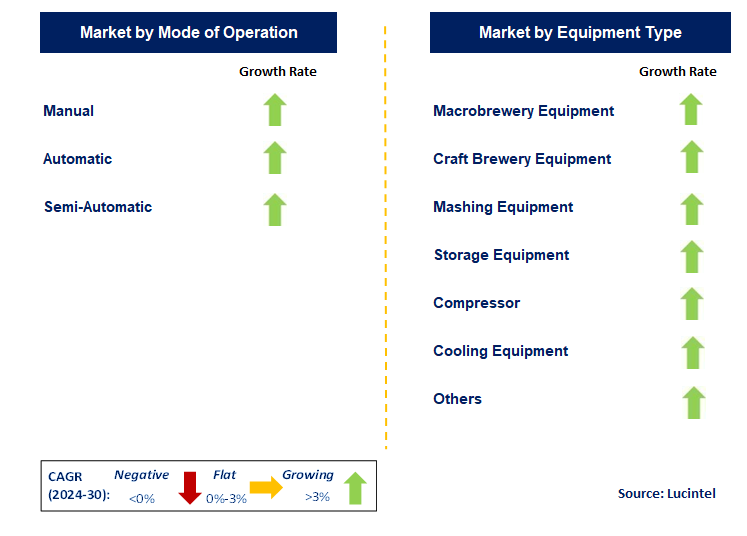
• Lucintel forecasts that, within the mode of operation category, automatic is expected to witness the highest growth over the forecast period because automation helps with titration, conductivity sensor calibration, and chemical concentration calibration, as well as, reduces waste and provides brewers with the exact amount of chemistry, water, and resources they need to manufacture their product.
• In terms of region, Europe is expected to witness the highest growth over the forecast period because of rising beer consumption and the existence of important players in this area. A more than 150-page report is developed to help in your business decisions.
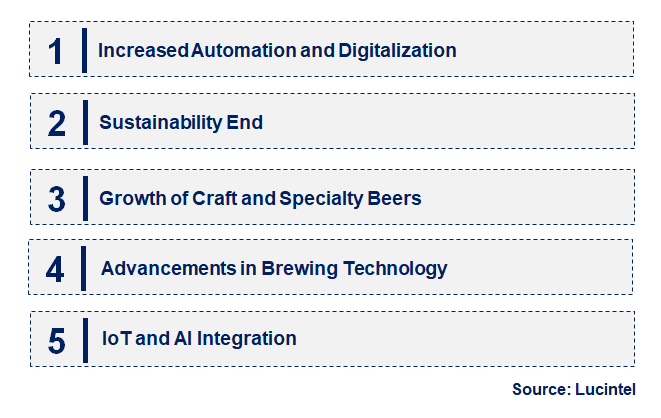
• Increased Automation and Digitalization: Automation and digitalization are transforming brewery operations through advanced control systems, real-time monitoring, and data analytics. Automated systems streamline production processes, increase efficiency, and reduce human error. In addition, digital tools provide valuable insights into brewing conditions and product quality, enabling breweries to optimize their operations and respond effectively to market demand.
• Sustainability Focus: Sustainability is a growing concern in the brewery equipment market. Most breweries invest in devices that reduce water and energy consumption, minimize waste, and utilize recyclable materials whenever possible. Innovations in brewing systems focus on energy efficiency and technologies that enhance water conservation. These trends result from environmental legislation and consumer demand for eco-friendly practices.
• Growth of Craft and Specialty Beers: Craft and specialty beers are driving the design of brewery equipment. A general trend is that equipment can handle a wider variety of beer styles and smaller batch sizes. This trend supports microbreweries and craft beer producers by increasing demand for flexible and scalable brewing systems that can produce diverse, high-quality products.
• Advancements in Brewing Technology: Advances in brewing technology include improved fermentation tanks, high-efficiency boilers, and advanced filtration systems, all of which enhance the brewing process. New technologies allow breweries to manage brewing conditions more precisely, leading to improved consistency and quality. Other novel approaches under exploration include high-pressure fermentation and continuous brewing systems.
• IoT and AI Integration: The integration of IoT and AI technologies in brewing equipment is rapidly improving operational efficiency. IoT devices monitor equipment performance and brewing conditions in real time, while AI algorithms optimize brewing parameters and predict maintenance needs. These integrations enable precision and operational reliability in breweries. Automation and digitalization, sustainability, craft beer growth, brewing technology development, and IoT/AI integration are the current trends shaping the brewery equipment market, driving innovation and improving operational efficiency to meet consumer preferences and environmental objectives.
• Introduction of Advanced Brewing Systems: New, high-tech brewing systems are taking over the market, each with integral digital control and automation. Such systems allow for increased accuracy in brewing, optimization of the production process, and real-time data analysis. Other key features include automated cleaning and sanitation processes that help improve overall efficiency and reduce downtime, thus enhancing the economy of both large and small breweries.
• Increased Emphasis on Sustainability: There is an increased use of equipment that enhances sustainability within breweries. Innovations include brewing systems, water recycling technologies, and waste reduction solutions that are efficient in energy use. These innovations support breweries in meeting environmental regulations and reducing their carbon footprint. They also help target the growing consumer base that demands environmentally friendly production methods.
• Increase in Craft Beer Production: Increased consumption of craft beer, in turn, influences and increases the demand for specialty brewing equipment. New brewing equipment is designed to manage a variety of beers and smaller batch sizes, which supports the expansion of microbreweries and craft beer producers. This development epitomizes the greater trend of personalization and variety in beer offerings.
• Integration of Smart Technologies: The efficiency of brewery operations improves with the help of smart brewing technologies, such as IoT integration and AI in brewing equipment. IoT devices monitor brewing conditions in real time, while AI algorithms optimize brewing parameters and predict maintenance needs. These technologies enhance process precision, save on operational costs, and enable better management of the brewery as a whole.
• Modular and Scalable Systems Development: Modularity and scalability in brewery systems are increasingly allowing brewing companies to progress in any direction. This can include flexibility in production capacity or customization of the brewing environment. Such developments assist startups and established breweries in meeting market demands for growth and expansion. Further advances in brewing systems, a focus on sustainability, the growing demand for craft beer, smart technologies, and modular systems are driving inspiration and change in the brewery equipment market. These developments contribute to changing industry needs and are related to providing more effective and sustainable brewing practices.
• Expansion in Craft Beer and Microbreweries: The demand for craft beer and microbreweries is increasing rapidly, opening up significant opportunities for equipment manufacturing companies. Specially designed and developed equipment, which takes into account the small scale and artisanal production of such breweries, has great potential to capture this ever-expanding market segment. Innovations that support the production of multiple beer styles and can handle small batches may be of interest to craft brewers.
• Adoption of Sustainable Brewing Technologies: The growing focus on sustainability creates a fertile ground for the growth of eco-friendly brewing equipment. Developing and marketing equipment that reduces water and energy consumption, minimizes waste, and uses recyclable materials aligns well with environmental regulations and consumer trends toward sustainable practices. This can help increase market share and create differentiated branding.
• Advanced Automation and Control Systems Integration: This trend will create growth opportunities for advanced automation and control systems in the brewery equipment market. Equipment featuring digital control, real-time monitoring, and data analytics can improve operational efficiency and precision. Such solutions will reduce production processes and operational costs for both large and small breweries.
• Modular and Flexible Systems: Brewing systems are becoming more modular and flexible to meet the demands of diversification and scaling. The development of easy-to-customize, expandable equipment that suits variable production needs allows both new entrants and established breweries to serve a variety of market needs and fuel growth in various segments.
• Focus on Emerging Markets: The emerging markets of Asia-Pacific and Latin America provide significant growth opportunities. With the increasing consumption of beer and the establishment of new breweries in these regions, there is growing demand for modern brewing equipment. Solutions that cater to regional needs and preferences can capture market share in these expanding regions. These five strategic growth opportunities—expansion into craft beer, sustainable technologies, automation integration, modular systems, and emerging markets—highlight key focus areas for driving innovation and growth in the market. Companies can enable growth and maintain their competitive advantage in the evolving brewery equipment market by capitalizing on these opportunities.
• Technological Advancements: Innovations in brewing technology, such as automation, digital control systems, and advanced sensors, spur the market growth rate. In addition, advances in brewing technology have further improved brewing efficiency, enhanced product quality, and reduced operational costs. Real-time monitoring technologies in brewing processes enable the preparation of high-quality, reproducible products.
• Growing Demand for Craft and Specialty Beers: The increasing demand for craft and specialty beers fuels growth in the demand for specialty brewing equipment. Breweries are investing in equipment that supports a wide variety of beer styles and reduces batch sizes, driving innovation and growth in the market. This all bodes well for consumer trends toward variety and personalization in beer.
• Sustainability Focus: With the rise in emphasis on sustainability and environmental regulations, the demand for eco-friendly brewing machinery has increased. Technologies that reduce water and energy use, reduce waste, and provide recyclable materials are in line with the expectations of consumers and regulatory demands. Sustainability efforts also help grow the market and differentiate brands.
• Brewery Operations Expansion: Large breweries and microbreweries are still opening up more opportunities for equipment manufacturers. Breweries, during the expansion phase, have a growing demand for advanced and expandable equipment. It is due to such expansion that market growth is further supported and helps in investing in newer technologies and systems.
• Disposable Incomes on the Rise: There is an increase in disposable income, especially in emerging markets, which is increasing demand for premium and craft beers. Increased consumer expenses give the breweries the impetus to invest in further sophisticated equipment and thus increase their capacity. This ultimately leads to market growth, eventually creating interest in new brewing solutions. Challenges in the brewery equipment market are:
• High Equipment Costs: The cost of sophisticated brewing equipment is very high for small and start-up breweries. Due to high capital expenditure, advanced technologies are restricted in terms of access, thus hampering profitability. The equipment manufacturers should deliver value with reduced performance at low costs.
• Regulatory Compliance: This is a problem for equipment manufacturers and breweries alike, who need to navigate a very complex regulatory requirement and standards landscape. To that end, for equipment design and manufacturing, meeting various health, safety, and environmental regulations adds money to development and operational costs. The cost of keeping up with these involves continual investment in and attention to the changing industry standards.
• Integration of Technologies: After all, the integration of new technologies into already existing systems is difficult to manage. Some incompatibility issues along with the requirement of seamless integration may negatively impact operational efficiency and performance of equipment. Such challenges require careful planning and investment in compatible technologies. Major drivers, including technological advances, demand in craft beers, emphasis on sustainability, brewery expansion, and increasing incomes, all serve to drive brewery equipment market growth. The problems include high equipment costs, regulatory compliance issues, and the integration of technologies—all these dynamics in the marketplace can impact the market. Success and growth in the dynamic marketplace need to address all these factors.
• Alfa Laval
• GEA
• Krones
• Paul Mueller
• Praj Industries
• Meura
• Della Toffola
• Criveller
• LEHUI
• Macrobreweries
• Craft Breweries
• Manual
• Automatic
• Semi-Automatic
• Macrobrewery Equipment
• Craft Brewery Equipment
• Mashing Equipment
• Storage Equipment
• Compressor
• Cooling Equipment
• North America
• Europe
• Asia Pacific
• The Rest of the World
• United States: While the brewery equipment market continues to rise in the U.S., automation and digital control systems are in growing demand. This has led to an increased tendency for breweries to adopt advanced brewing systems along with integrated software for process optimization and real-time monitoring. A new direction for the latest equipment is also focused on sustainability by reducing water and energy consumption. Furthermore, craft breweries continue to develop and drive the market towards more specialized and flexible brewing solutions.
• China: With rapid urbanization and the growth of the middle class, there has been a tremendous increase in beer consumption, leading to the unprecedented expansion of China's brewery equipment market. Other recent developments involve advanced brewing technologies and large-scale production systems. Chinese breweries are investing in automation and increasing efficiency as a means of raising production capacity and consistency in products. The growing interest in craft beers will also drive demand for equipment that can produce a range of beer styles.
• Germany: Germany is renowned for its brewing tradition and is focused on increasing brewing efficiency and sustainability. Recent developments include the use of Industry 4.0 technologies such as IoT and AI in brewing to increase precision and automation. German breweries are implementing various eco-friendly equipment that reduces carbon footprints through systems that optimize energy use and waste management. Quality and innovation remain a high priority in the market.
• India: The brewery equipment market in India is driven by the growing fondness for beer among its young population and an increase in disposable incomes. Recent launches include brewing systems that are scalable yet affordable for both small and large-scale breweries. Technological development has improved the efficiency and consistency of brewing systems. Growing importance is being placed on enhancing quality control and automating production processes.
• Japan: The beer brewing equipment market in Japan is precision-based and focused on quality, reflecting the country's commitment to fine craftsmanship. Recent developments include the adoption of advanced brewing technologies that enhance the efficiency and consistency of beer production. New equipment to meet the rising demand for both craft and premium beers is also being explored by Japanese breweries. Automation systems and improved brewing methods contribute to higher quality output and operational efficiencies.


• Alfa Laval
• GEA
• Krones
• Paul Mueller
• Praj Industries
• Meura
• Della Toffola
• Criveller
• LEHUI Q6. Which brewery equipment market segment will be the largest in future? Answer: Lucintel forecasts that automatic is expected to witness highest growth over the forecast period because automation helps with titration, conductivity sensor calibration, and chemical concentration calibration, as well as, reduces waste and provides brewers with the exact amount of chemistry, water, and resources they need to manufacture their product. Q7. In brewery equipment market, which region is expected to be the largest in next 6 years? Answer: Europe is expected to witness highest growth over the forecast period because of rising beer consumption and the existence of important players in this area. Q.8 Do we receive customization in this report? Answer: Yes, Lucintel provides 10% customization without any additional cost.


Choose a license that fits your team. Instant PDF delivery.
Prices exclude taxes. Instant delivery. Custom licensing available on request.
Market Report · July 22, 2026
Market Report · July 22, 2026
Market Report · July 22, 2026
Trusted partner for strategic intelligence and business growth


Receive a complimentary market analysis tailored to your industry. Our analysts will identify key growth opportunities and competitive dynamics specific to your business.

Market size, growth rate, and key trend analysis for your specific sector.

Top competitor positioning and market share analysis.

Strategic recommendations backed by data-driven insights.
Get curated market intelligence and competitive moves straight to your inbox.
By subscribing, you agree to receive our monthly insights. Unsubscribe anytime.
Receive a complimentary market analysis tailored to your industry. Our analysts will identify key growth opportunities and competitive dynamics specific to your business.
Market size, growth rate, and key trend analysis for your specific sector.
Top competitor positioning and market share analysis.
Strategic recommendations backed by data-driven insights.
Get curated market intelligence, emerging trends, and competitive moves straight to your inbox each month.
By subscribing, you agree to receive our monthly insights. Unsubscribe anytime.
We'll send your sample report shortly.