
Market Report · July 22, 2026

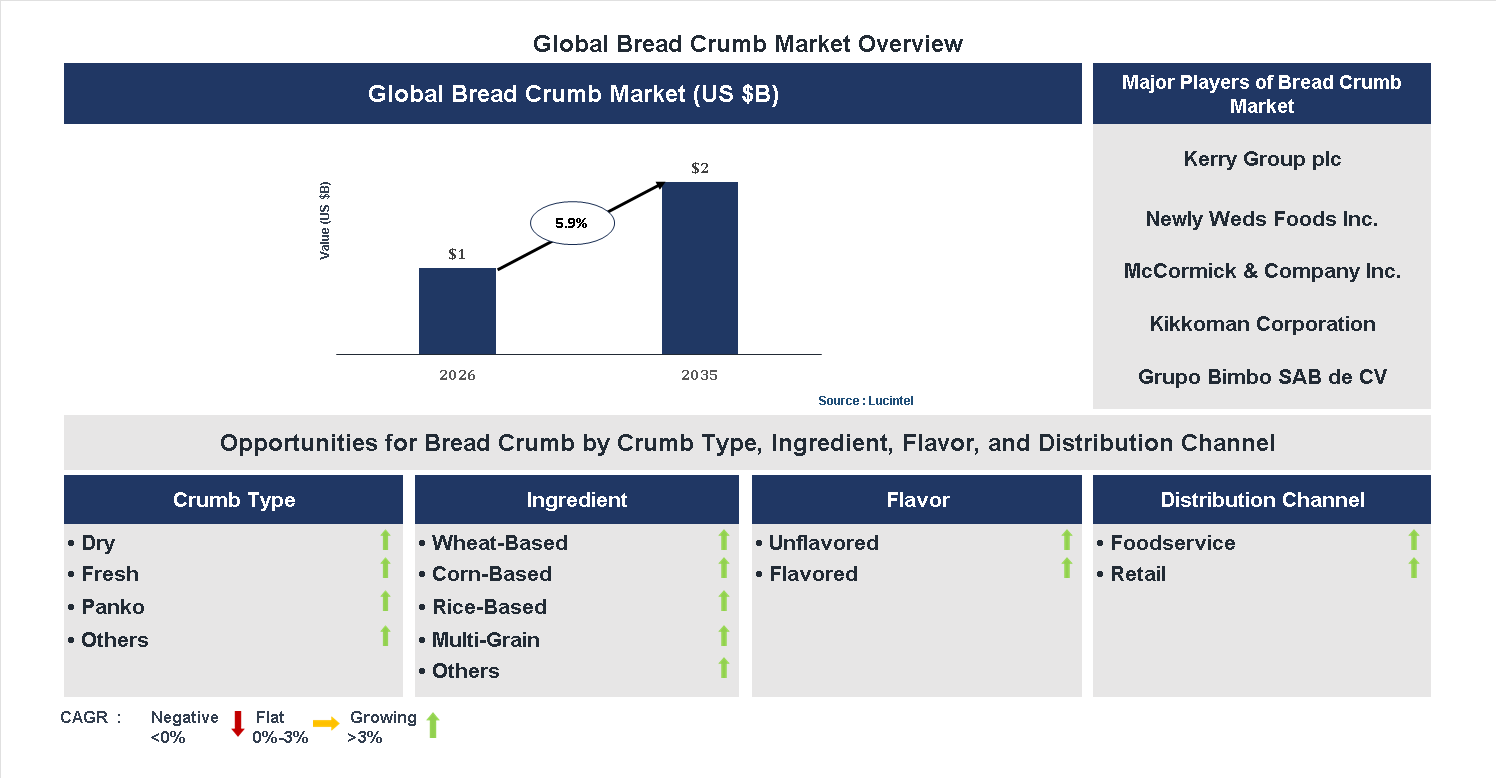
Key data points: The market size in 2035 = $2 billion, growth forecast = 5.9% annually for the next 8 years. Scroll below to get more insights. This market report covers trends, opportunities and forecasts in bread crumb market to 2035 by crumb type (dry, fresh, panko, and others), ingredient (wheat-based, corn-based, rice-based, multi-grain, and others), flavor (unflavored and flavored), distribution channel (foodservice and retail), and region (North America, Europe, Asia Pacific, and the Rest of the World)
We'll send your sample report shortly.
• Lucintel forecasts that, within the crumb type category, panko is expected to witness the highest growth over the forecast period.
• Within the distribution channel category, foodservice is expected to witness higher growth.
• In terms of region, APAC is expected to witness the highest growth over the forecast period. Gain valuable insights for your business decisions with our comprehensive 150+ page report. Sample figures with some insights are shown below.
• Growing Demand for Gluten-Free and Healthier Options: Consumers are increasingly seeking gluten-free, low-carb, and organic bread crumbs. This trend is driven by rising health consciousness and dietary restrictions, prompting manufacturers to develop specialized products. The demand for clean-label ingredients and allergen-free options is also rising, encouraging innovation in product formulations. This shift is expanding the market to include health-focused segments and creating opportunities for niche players to introduce innovative, health-oriented bread crumb varieties.
• Technological Innovations in Production Processes: Advanced manufacturing technologies such as automation, extrusion, and dehydration are improving product quality and consistency. These innovations enable manufacturers to produce bread crumbs with enhanced texture, flavor, and shelf life. Additionally, digital tools are optimizing supply chain management and inventory control, reducing costs and waste. The integration of technology is also facilitating the development of customized bread crumbs tailored to specific culinary applications, thereby broadening product offerings and improving market competitiveness.
• Rising Popularity of Organic and Natural Products: Consumers are increasingly favoring organic and natural bread crumbs free from artificial preservatives and additives. This trend aligns with the broader movement towards clean-label products and sustainable sourcing. Companies are sourcing organic grains and adopting eco-friendly manufacturing practices to meet this demand. The organic segment is witnessing rapid growth, driven by consumer trust and preference for environmentally responsible products, which is reshaping product development and marketing strategies within the market.
• Expansion of Regional and Ethnic Flavors: The market is witnessing diversification through the introduction of regional and ethnic bread crumb flavors, catering to diverse culinary traditions. This includes spicy, herb-infused, and exotic flavor profiles that appeal to adventurous consumers. Such innovation enhances product differentiation and allows brands to target niche markets. The trend also reflects the globalization of cuisine, encouraging manufacturers to develop culturally inspired products that resonate with local tastes and preferences, thereby expanding market reach.
• Sustainability and Eco-Friendly Packaging: Environmental concerns are prompting companies to adopt sustainable practices, including eco-friendly packaging solutions. Recyclable, biodegradable, and minimal packaging options are gaining popularity among consumers. This shift not only reduces environmental impact but also enhances brand image and consumer loyalty. Companies are also exploring upcycling and waste reduction strategies in production processes. The focus on sustainability is reshaping industry standards and influencing consumer purchasing decisions, ultimately driving the market toward more responsible and environmentally conscious practices. These emerging trends are collectively reshaping the bread crumb market by fostering innovation, emphasizing health and sustainability, and expanding regional and flavor diversity. These developments are creating new opportunities for growth, encouraging product differentiation, and aligning the market with evolving consumer values and preferences.

• Growing Demand for Gluten-Free and Health-Conscious Products: The increasing awareness of dietary restrictions and health concerns has led to a surge in gluten-free, organic, and low-sodium bread crumbs. This trend is expanding the market by attracting health-conscious consumers seeking alternatives to traditional bread crumbs. Manufacturers are innovating with plant-based and allergen-free options, which are gaining popularity in both retail and foodservice sectors. This shift is driving product diversification and opening new revenue streams.
• Technological Innovations in Production Processes: Advances in extrusion, coating, and drying technologies are enhancing the quality, shelf life, and functionality of bread crumbs. These innovations enable producers to create customized textures and flavors, catering to specific culinary applications. Improved manufacturing efficiency reduces costs and waste, making products more competitive. Such technological progress is also facilitating the development of specialty bread crumbs, including gluten-free and organic variants, thus broadening market scope.
• Sustainability and Eco-Friendly Packaging Solutions: Consumers and regulators are increasingly demanding sustainable practices, prompting companies to adopt eco-friendly sourcing and packaging. Use of biodegradable, recyclable, and compostable materials is becoming standard, reducing environmental impact. Sustainable sourcing of raw materials, such as organic grains, is also gaining importance. These initiatives enhance brand reputation, meet regulatory requirements, and appeal to environmentally conscious consumers, thereby strengthening market position and fostering long-term growth.
• Expansion of Applications in Foodservice and Industrial Sectors: Bread crumbs are increasingly used beyond traditional frying and breading, including in gluten-free baking, snack coatings, and plant-based meat products. The foodservice industry is adopting innovative bread crumb formulations for healthier and allergen-free options. Industrial applications, such as in pet foods and biodegradable packaging, are also emerging. This diversification is expanding market reach, increasing demand, and encouraging product innovation across multiple sectors.
• Rising Consumer Preference for Natural and Organic Ingredients: The shift towards natural, minimally processed ingredients is influencing bread crumb formulations. Consumers prefer products with recognizable, organic, and non-GMO ingredients, prompting manufacturers to reformulate and label transparently. This trend supports premium pricing and market differentiation. The demand for clean-label products is also encouraging the development of artisanal and specialty bread crumbs, which cater to niche markets and enhance overall market growth. The overall impact of these developments is a dynamic, expanding bread crumb market characterized by innovation, sustainability, and diversified applications. Companies that adapt to consumer preferences and technological advancements are positioned for sustained growth, while the market as a whole benefits from increased product variety and improved quality standards. This evolution is fostering a competitive environment that encourages continuous innovation and market expansion.
• Product Innovation and Diversification Drive Market Expansion: Developing gluten-free, organic, and flavored bread crumbs caters to health-conscious consumers and niche markets. Companies are investing in R&D to create innovative textures and functional ingredients, expanding applications in bakery, snacks, and meat coatings. This diversification attracts a broader customer base, enhances brand loyalty, and opens new revenue streams, ultimately fueling overall market growth.
• Growing Demand for Healthy and Organic Bread Crumbs: Consumers are increasingly seeking healthier food options, prompting manufacturers to produce organic, gluten-free, and low-sodium bread crumbs. These products meet dietary restrictions and health preferences, especially in the bakery and processed food sectors. The rising awareness of clean-label ingredients and natural products is expected to boost sales, encouraging companies to expand their organic product lines and capture a larger share of health-conscious markets.
• Expansion of Bread Crumb Applications in Meat and Snack Industries: Bread crumbs are widely used in meat products, such as meatballs, patties, and sausages, for binding and moisture retention. The snack industry also utilizes bread crumbs for coating and flavor enhancement. Growing demand for ready-to-eat and convenience foods is driving innovation in bread crumb formulations tailored for these applications. This expansion enhances product functionality and opens new growth avenues across multiple food segments.
• Strategic Partnerships and Geographic Expansion Enhance Market Reach: Companies are forming alliances with local distributors and retailers to penetrate emerging markets in Asia, Africa, and Latin America. Strategic collaborations facilitate product distribution, localization, and marketing efforts. Additionally, expanding manufacturing facilities in high-growth regions reduces costs and improves supply chain efficiency. These strategies enable market players to tap into new customer bases, increase market share, and adapt to regional preferences, supporting overall industry growth.
• Adoption of Sustainable and Eco-Friendly Packaging Solutions: As environmental concerns grow, manufacturers are shifting towards sustainable packaging options such as biodegradable, recyclable, and minimal packaging. This aligns with consumer preferences for eco-friendly products and enhances brand reputation. Implementing sustainable practices reduces environmental impact and meets regulatory standards. The focus on eco-conscious packaging is expected to influence purchasing decisions, boost consumer loyalty, and drive market growth by appealing to environmentally aware customers. These strategic growth opportunities collectively position the bread crumb market for sustained expansion by addressing evolving consumer preferences, expanding application scopes, and embracing sustainability. Innovation, health-conscious product development, and geographic diversification are key drivers that will enable market players to capitalize on emerging trends. As companies adapt to these opportunities, the market is poised for robust growth, benefiting stakeholders across the supply chain and fostering a dynamic, competitive landscape.
• Technological Advancements: Innovation in manufacturing processes, such as improved drying and coating techniques, enhances product quality and consistency. Automation and AI-driven quality control reduce costs and increase efficiency, enabling producers to meet rising demand. Packaging innovations extend shelf life and improve convenience, appealing to modern consumers. These technological improvements facilitate product differentiation and help companies stay competitive in a crowded market.
• Growing Consumer Preference for Convenience Foods: Busy lifestyles and urbanization have increased demand for ready-to-use ingredients like bread crumbs. Consumers seek products that are easy to incorporate into recipes, prompting manufacturers to develop diverse flavors and packaging options. This trend supports market expansion as companies innovate to meet evolving culinary needs, including gluten-free and organic bread crumbs, catering to health-conscious segments.
• Rising Demand for Healthy and Organic Products: Increasing awareness about health and wellness has led consumers to prefer organic, gluten-free, and preservative-free bread crumbs. This shift encourages producers to source natural ingredients and adopt cleaner production methods. The demand for healthier options drives product diversification and premium pricing, fostering growth in niche segments within the market.
• Expansion in Foodservice and Retail Sectors: The proliferation of restaurants, cafes, and fast-food outlets boosts demand for bread crumbs as a key ingredient in various dishes. Retail channels, including supermarkets and online stores, are expanding their offerings to include a wide range of bread crumb products. This growth in distribution channels enhances market reach and consumer access, supporting overall market expansion.
• Increasing Focus on Sustainability and Eco-Friendly Practices: Companies are adopting sustainable sourcing of raw materials and eco-friendly manufacturing processes to meet regulatory requirements and consumer expectations. Recycling and waste reduction initiatives are becoming standard, reducing environmental impact. These practices not only improve brand image but also align with global sustainability trends, influencing market competitiveness and long-term growth. The challenges facing the bread crumb market include:
• Stringent Regulatory Standards: Food safety and labeling regulations vary across regions, requiring manufacturers to comply with complex standards. These regulations can increase production costs and create barriers to entry for new players. Non-compliance risks product recalls and legal penalties, impacting profitability and market reputation. Navigating diverse regulatory landscapes demands significant resources and expertise, which can hinder market growth.
• Volatility in Raw Material Prices: Fluctuations in the cost of wheat, bread, and other raw materials directly affect production expenses. Price volatility can lead to increased costs, squeezing profit margins, especially for small and medium-sized enterprises. Companies may face challenges in maintaining competitive pricing while ensuring quality, which can impact overall market stability and growth prospects.
• Intense Market Competition: The bread crumb market is highly competitive, with numerous local and international players vying for market share. Price wars, product innovation, and branding efforts intensify competition, pressuring profit margins. Smaller companies may struggle to compete with established brands that have extensive distribution networks and economies of scale, potentially leading to market consolidation and reduced innovation. The bread crumb market is shaped by technological innovations, changing consumer preferences, and sustainability initiatives, which drive growth and diversification. However, regulatory complexities, raw material price fluctuations, and intense competition pose significant challenges. These factors collectively influence market strategies, product development, and overall industry stability. While opportunities for expansion exist, companies must navigate these drivers and challenges carefully to sustain long-term growth and competitiveness in the evolving market landscape.
• Kerry Group plc
• Newly Weds Foods Inc.
• McCormick & Company Inc.
• Kikkoman Corporation
• Grupo Bimbo SAB de CV
• Goya Foods Inc.
• Premier Foods Group Limited
• George Weston Foods Ltd.
• Orkla ASA
• Dr. Schar
• Dry
• Fresh
• Panko
• Others
• Wheat-Based
• Corn-Based
• Rice-Based
• Multi-Grain
• Others
• Unflavored
• Flavored
• Foodservice
• Retail
• North America
• Europe
• Asia Pacific
• The Rest of the World
• United States: The US bread crumb market has seen a surge in organic and gluten-free products, driven by health-conscious consumers. Innovative packaging solutions improve shelf life and convenience. Major players are investing in plant-based and clean-label options to meet demand. E-commerce sales are growing rapidly, expanding market reach. Additionally, there is increased focus on sustainable sourcing and eco-friendly manufacturing practices. Food safety regulations are strict, prompting companies to adopt advanced quality control measures. The market is also witnessing a trend toward premium and artisanal bread crumbs, catering to gourmet and restaurant sectors.
• China: Chinas bread crumb market is expanding due to rising urbanization and changing dietary habits. There is a growing preference for convenience foods, boosting demand for ready-to-use bread crumbs. Local manufacturers are investing in product innovation, including flavored and seasoned varieties. The market benefits from increasing exports and partnerships with international brands. Consumer awareness about food safety is prompting stricter quality standards. The adoption of automated production processes enhances efficiency. Additionally, the market is witnessing a shift toward healthier options, such as low-sodium and gluten-free bread crumbs, to cater to health-conscious consumers.
• Germany: In Germany, the bread crumb market is characterized by a focus on organic and sustainable products. Consumers prefer high-quality, natural ingredients, prompting manufacturers to emphasize transparency and traceability. There is a rising demand for gluten-free and allergen-free options, driven by health concerns. Innovation in flavor profiles and packaging is prominent. The market also benefits from a strong foodservice sector, including bakeries and restaurants. Regulatory compliance with EU standards ensures product safety and quality. Sustainability initiatives, such as biodegradable packaging, are gaining importance, aligning with Germanys environmental commitments.
• India: The Indian bread crumb market is experiencing rapid growth due to increasing urbanization and Western dietary influences. The demand for ready-to-cook and processed foods is fueling market expansion. Local manufacturers are introducing flavored and spiced bread crumbs to cater to regional tastes. The market is driven by the expanding fast-food and snack industries. Price sensitivity remains a key factor, leading to the popularity of affordable options. There is a rising trend toward organic and health-oriented products, although mainstream products dominate. Investments in modern manufacturing facilities and quality assurance are enhancing product standards.
• Japan: Japans bread crumb market is characterized by innovation and health consciousness. There is a strong preference for gluten-free, low-sodium, and organic options. The market benefits from a sophisticated food industry that emphasizes quality and safety. Functional bread crumbs with added nutrients are gaining popularity. Packaging innovations focus on convenience and freshness preservation. The foodservice sector, including cafes and restaurants, drives demand for premium and artisanal bread crumbs. Sustainability practices, such as eco-friendly packaging, are increasingly adopted. The market also sees growth in specialty products tailored for specific dietary needs and culinary applications.


• Kerry Group plc
• Newly Weds Foods Inc.
• McCormick & Company Inc.
• Kikkoman Corporation
• Grupo Bimbo SAB de CV
• Goya Foods Inc.
• Premier Foods Group Limited
• George Weston Foods Ltd.
• Orkla ASA
• Dr. Schar Q6. Which bread crumb market segment will be the largest in future? Answer: Lucintel forecasts that, within the crumb type category, panko is expected to witness the highest growth over the forecast period. Q7. In bread crumb market, which region is expected to be the largest in next 5 years? Answer: In terms of region, APAC is expected to witness the highest growth over the forecast period. Q8. Do we receive customization in this report? Answer: Yes, Lucintel provides 10% customization without any additional cost.


Choose a license that fits your team. Instant PDF delivery.
Prices exclude taxes. Instant delivery. Custom licensing available on request.
Market Report · July 22, 2026
Market Report · July 22, 2026
Market Report · July 22, 2026
Trusted partner for strategic intelligence and business growth


Receive a complimentary market analysis tailored to your industry. Our analysts will identify key growth opportunities and competitive dynamics specific to your business.

Market size, growth rate, and key trend analysis for your specific sector.

Top competitor positioning and market share analysis.

Strategic recommendations backed by data-driven insights.
Get curated market intelligence and competitive moves straight to your inbox.
By subscribing, you agree to receive our monthly insights. Unsubscribe anytime.
Receive a complimentary market analysis tailored to your industry. Our analysts will identify key growth opportunities and competitive dynamics specific to your business.
Market size, growth rate, and key trend analysis for your specific sector.
Top competitor positioning and market share analysis.
Strategic recommendations backed by data-driven insights.
Get curated market intelligence, emerging trends, and competitive moves straight to your inbox each month.
By subscribing, you agree to receive our monthly insights. Unsubscribe anytime.
We'll send your sample report shortly.