
Market Report · May 18, 2026

This market report covers trends, opportunities, and forecasts in the global brass solenoid valve market to 2031 by operating technology (direct, semi-direct, and indirect), end use industry (water & wastewater, chemical & petrochemical, automotive, medical, pharmaceutical, power generation, and food & beverages), and region (North America, Europe, Asia Pacific, and the Rest of the World)
We'll send your sample report shortly.
![Brass Solenoid Valve Market Trend and Forecast by End Use Industry [Value from 2019 to 2031]:](https://lucintel.com/images/Brass-Solenoid-Valve-Technology-Market-Segment.png "Brass Solenoid Valve Market Trend and Forecast by End Use Industry [Value from 2019 to 2031]:")
• Integration of IoT and Smart Valve Technology: The internet of things (IoT) technology is revolutionizing the brass solenoid valve's way of working. Smart valves with real-time monitoring and remote control features make predictive maintenance possible, thereby reducing downtime and cost of operations. This trend is particularly significant in industries that require high precision, such as pharmaceuticals and water treatment.
• Energy-Efficient Designs: Manufacturers are increasingly designing energy-efficient solenoid valves that consume less power during their operation. Low-power coils, advanced material compositions, and many other innovations are paving the way for industries to meet the global sustainability goal, thus reducing environmental impacts and energy expenses.
• Growth of Miniature Solenoid Valves: Miniaturization is becoming increasingly popular, especially in healthcare and electronics, where compact and accurate flow control is essential. The smaller valves, however, maintain functionality, fulfilling the space and weight requirements of modern equipment. That's why they are gaining more applications in niche areas.
• Increasing Demand for Corrosion-Resistant Valves: To improve performance and life, manufacturers are emphasizing corrosion-resistant brass solenoid valves. Coating technologies and alloy compositions are being improved to make these valves resistant to aggressive chemicals and harsh environments, thereby expanding their applications in chemical and marine industries.
• Customization and Industry-Specific Solutions: The demand for custom solutions is increasing. The manufacturers are providing industry-specific designs. From high-temperature valves for industrial applications to specialized valves for food and beverage industries, this also indicates the need for versatile and better performance. These technological and material advancements have significantly altered the brass solenoid valve market. IoT integration, energy efficiency, miniaturization, corrosion resistance, and customization drive innovation, making it possible for manufacturers to meet the demands of the ever-changing industrial market. These trends, at maturity, are reshaping the market landscape by enhancing efficiency and expanding applications in various sectors.
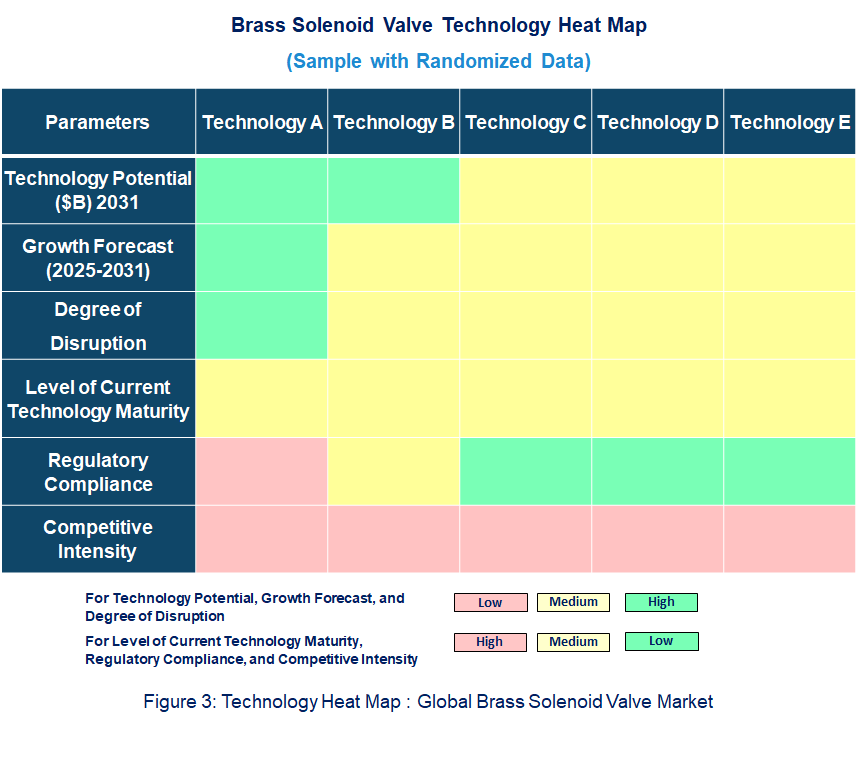
• Potential in Technology: This market holds vast OT potential. By incorporating IoT, AI, and real-time analytics, OT-enabled solenoid valves deliver unprecedented operating insights that allow industries to further optimize flow control, boost energy efficiency, and cut operational costs. The above innovations are expected to propel the adoption of solutions across smart infrastructure and industrial automation applications.
• Degree of Disruption: The adoption of OT is highly disruptive to traditional systems. Equipping smart brass solenoid valves with sensors and connectivity, predictive maintenance, and remote operation are possible features that challenge legacy systems in the offering of enhanced capabilities with Industry 4.0 frameworks.
• Current Technology Maturity Level: OT for brass solenoid valves is at the growth stages. Basic automation is generally adopted, but there are still evolving functionalities with the integration of machine learning into its advanced functionalities.
• Regulatory Compliance: Regulatory standards are changing to meet data security and interoperability requirements so that these systems can be safely and efficiently deployed.
• Emerson Electric Co.: Emerson has recently introduced a new line of low-power solenoid valves that are specifically designed for water and wastewater management applications. The valves emphasize energy efficiency with reliability, which is the global goal for sustainability.
• Schlumberger Limited: The company launched high-performance solenoid valves for the petrochemical industry. These valves are designed to operate under extreme temperatures and pressures to ensure efficiency in challenging operating conditions.
• General Electric (GE): GE has bolstered its solenoid valve portfolio by adding IoT capabilities, which allow customers to monitor and predict conditions in real-time. It is particularly significant for those applications in power generation or automotive, where uptime is paramount.
• Curtiss-Wright Corporation: Curtiss-Wright has added corrosion-resistant brass valves to its solenoid valve portfolio for the food and beverage industry. It is designed to meet aggressive hygiene and safety requirements to appeal to manufacturers.
• ALFA LAVAL: ALFA LAVAL launched a solenoid valve range designed to meet the requirements of medical and pharmaceutical applications, where precision and flow control are key. This product highlights the increasing demand for robust solutions in health-critical applications.
• IMI plc: IMI launched semi-direct solenoid valve technology that bridges the gap between direct and indirect actuation, offering improved versatility and reduced maintenance costs for end-users.
• LESER GmbH & Co.KG: LESER developed compact brass solenoid valves suitable for mobile and industrial applications. These valves focus on durability and lightweight construction to meet the needs of the automotive industry, which is changing its demands.
• The Weir Group PLC: The Weir Group launched smart solenoid valve solutions integrated with advanced sensors for real-time data collection. These valves are designed to optimize performance and minimize downtime in chemical and power generation industries.
• Forbes Marshall: Forbes Marshall developed solenoid valves that feature advanced noise reduction characteristics for industrial use. Such valves are helpful for a safer and more efficient work environment, especially in loud decibel areas.
• Bosch Rexroth: Bosch Rexroth released a new generation of energy-saving solenoid valves, with innovative magnetic technology. This line addresses the increased need for sustainability in the automotive and automation sectors.
• Increasing Automation Across Industries: Demand in sectors like manufacturing, automotive, and water management is pushing the brass solenoid valves due to automation in these areas. The valve allows precise control of fluid and gas, improving efficiency and minimizing human intervention. This also falls in line with the increasing trend of smart factories and automated systems.
• Growing Industrial Applications: The flexibility of brass solenoid valves in handling diversified fluids and gases makes them applicable in a wide range of applications, including oil & gas, HVAC, and pharmaceuticals. Strong performance and reliability are two significant factors in satisfying the critical demands of these industries.
• Integration with advanced Smart Technology: Integration with IoT and smart systems is elevating the functionality of brass solenoid valves. Real-time monitoring and remote control capabilities are enhancing operational efficiency, enabling predictive maintenance, and reducing downtime, especially in high-precision industries like healthcare and electronics. Challenges in the brass solenoid valve market are:
• High Competition from Alternative Materials: Brass solenoid valves are challenged by stainless steel and plastic valves, which are cheaper or better for certain applications. This competition forces manufacturers to innovate and differentiate their products to keep market share.
• Unstable Raw Material Prices: The cost of brass, an essential raw material, is highly volatile due to market fluctuations and supply chain issues. This variability impacts production costs, creating pricing challenges for manufacturers and potentially deterring small-scale industries from adopting these valves.
• Stringent Regulatory Standards: Compliance with environmental and safety regulations adds complexities to the manufacturing process. Ensuring that brass solenoid valves meet stringent standards can increase production costs and prolong development cycles and is a challenge for the market players. The brass solenoid valve market is at a crossroads, driven by automation, industrial expansion, and technological innovation while contending with material competition, cost pressures, and regulatory hurdles. It will be interesting to see how market players navigate these factors to adapt and innovate, thus shaping the future of the industry.
• Emerson Electric
• Schlumberger Limited
• General Electric
• Curtiss-Wright Corporation
• Alfa Laval
• Imi
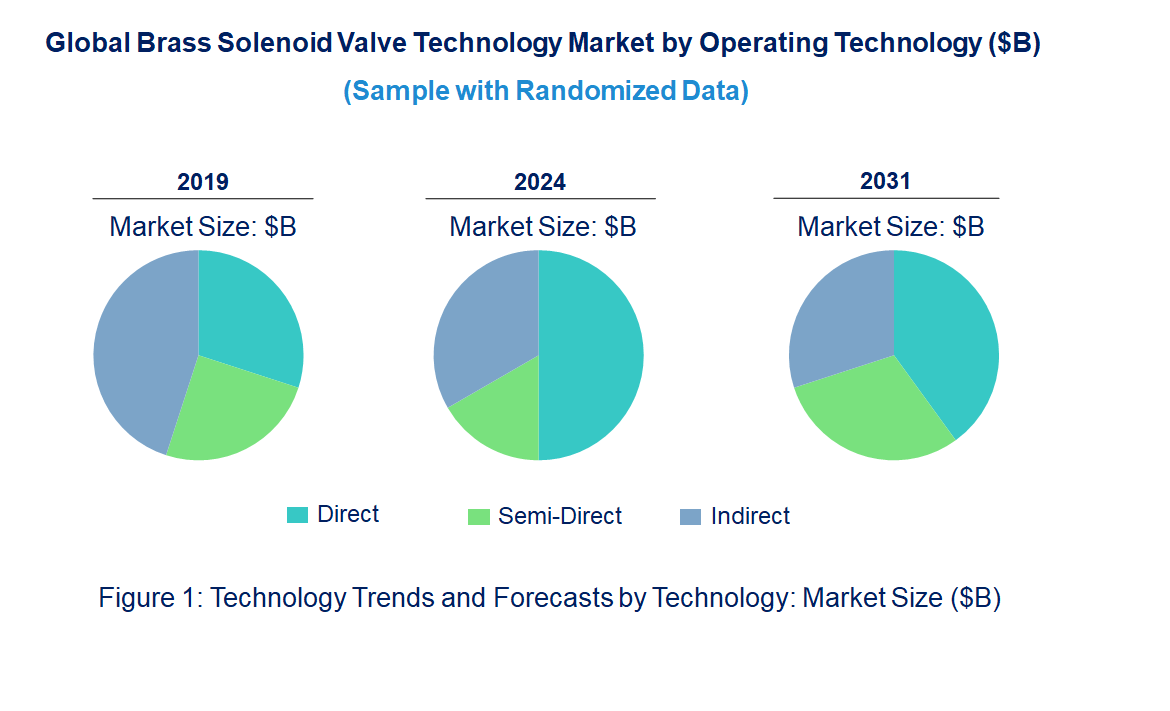
• Technology Readiness: Direct valves are highly ready in terms of readiness, and they can be easily integrated into other automation-intensive industries. Semi-direct valves come moderately mature, and where the application requires balanced performance, they are the right choice. Indirectly, valves are highly mature for cost-effective and low-pressure environments. Each has its challenges in competitive intensity and regulatory compliance, cut across automation, HVAC, and water management solutions.
• Competitive Intensity and Regulatory Compliance: All types of brass solenoid valves have robust competitive intensity. In industry areas, direct valves undergo competition from high-precision solutions in automation. In middle-range applications, such valves compete based on issues regarding energy efficiency and the attainment of balanced performance. Being low-cost, indirect valves lead to low applications while remaining under strict regulation in each technology. They center compliance on safety, sustainability environmental, and interoperability issues.
• Disruption Potential: Brass solenoid valve technologies differ considerably by type regarding their disruption potential. Direct-acting valves can provide instantaneous response and thus have the greatest disruption in precision industries as well as challenge conventional valve systems. Semi-direct valves blend operational efficiency with modest scalability and have been influenced, therefore, by the HVAC and water system markets. Indirect valves tend to dominate low-pressure applications as their cost effectiveness shapes affordability-driven markets where such solutions are essential.
• Direct
• Semi-Direct
• Indirect
• Water & Wastewater
• Chemical & Petrochemical
• Automotive
• Medical
• Pharmaceutical
• Power Generation
• Food & Beverages
• North America
• Europe
• Asia Pacific
• The Rest of the World
• Latest Developments and Innovations in the Brass Solenoid Valve Technologies
• Companies / Ecosystems
• Strategic Opportunities by Technology Type


Choose a license that fits your team. Instant PDF delivery.
Prices exclude taxes. Instant delivery. Custom licensing available on request.
Market Report · May 18, 2026
Market Report · May 18, 2026
Market Report · May 18, 2026
Trusted partner for strategic intelligence and business growth


Receive a complimentary market analysis tailored to your industry. Our analysts will identify key growth opportunities and competitive dynamics specific to your business.

Market size, growth rate, and key trend analysis for your specific sector.

Top competitor positioning and market share analysis.

Strategic recommendations backed by data-driven insights.
Get curated market intelligence and competitive moves straight to your inbox.
By subscribing, you agree to receive our monthly insights. Unsubscribe anytime.
Receive a complimentary market analysis tailored to your industry. Our analysts will identify key growth opportunities and competitive dynamics specific to your business.
Market size, growth rate, and key trend analysis for your specific sector.
Top competitor positioning and market share analysis.
Strategic recommendations backed by data-driven insights.
Get curated market intelligence, emerging trends, and competitive moves straight to your inbox each month.
By subscribing, you agree to receive our monthly insights. Unsubscribe anytime.
We'll send your sample report shortly.