
Report Feature
Brake Power Regulator Trends and Forecast
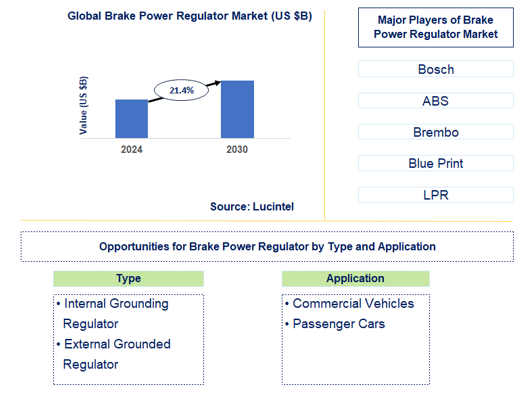
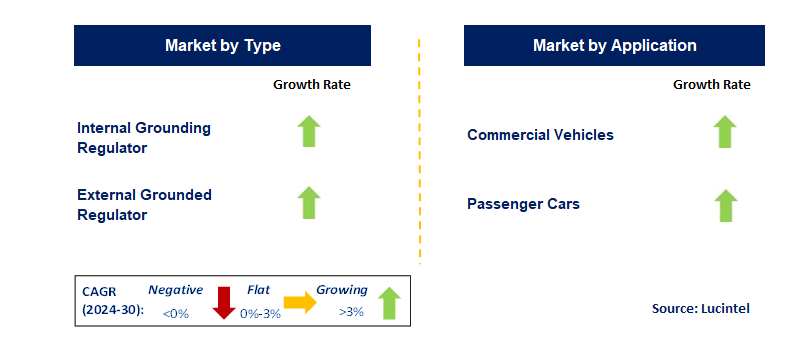
The future of the global brake power regulator market looks promising with opportunities in the commercial vehicle and passenger car markets. The global brake power regulator market is expected to grow with a CAGR of 21.4% from 2024 to 2030. The major drivers for this market are increasing emphasis on vehicle safety and regulatory standards, rising demand for advanced braking systems in the automotive industry, and technological advancements enabling enhanced precision and efficiency in brake power regulation.• Lucintel forecasts that, within the type category, within the type category, within the type category, internal grounding regulator is expected to witness higher growth over the forecast period.
• Within the application category, commercial vehicle is expected to witness higher growth.
• In terms of regions, APAC is expected to witness the highest growth over the forecast period. Gain valuable insights for your business decisions with our comprehensive 150+ page report.
Emerging Trends in the Brake Power Regulator Market
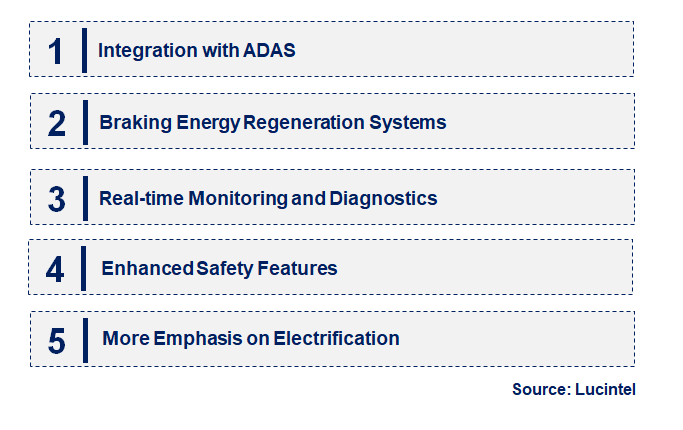
The Brake Power Regulator market is undergoing a significant transformation due to advancements in technology and changing automotive needs. As vehicles become more sophisticated and regulatory standards evolve, the demand for innovative and efficient brake power regulation solutions is rising. Here are five key trends shaping the market:• Integration with ADAS: Most modern vehicles incorporate brake power regulators with advanced driver-assistance systems. This enables finer control and extends safety features, such as automatic emergency braking, which have increased vehicle safety and reduced accident rates.
• Braking Energy Regeneration Systems: Brake power regulators, especially in electric and hybrid vehicles, are finding increased applications in regenerative braking systems, where energy is recovered during braking and utilized to improve vehicle efficiency by reducing overall energy consumption.
• Real-time Monitoring and Diagnostics: The evolution of IoT has ensured that the monitoring and diagnostics of brake power regulators can be done in real time. This trend permits predictive maintenance and immediate attention to potential issues, thereby reducing downtime and increasing vehicle reliability.
• Enhanced Safety Features: New developments focus on enhancing safety features in brake power regulators, such as automatic load sensing and adaptive braking adjustments. These features improve vehicle control and stability, addressing increasing safety regulations and consumer demands.
• Increased Emphasis on Electrification: The penetration of electric vehicles is driving new designs of brake power regulators. Component suppliers are designing regulators that can work with EV-specific features, such as regenerative braking and mechanical wear reduction. These trends are pushing the brake power regulator market to integrate new technologies, increase safety, and maintain vehicle efficiency. The focus on ADAS, regenerative braking, and real-time diagnostics is changing the function of brake power management and reflects broader changes in automotive technology.
Recent Developments in the Brake Power Regulator Market
The Brake Power Regulator market is experiencing rapid advancements driven by technological innovations and evolving automotive requirements. Recent developments are enhancing brake system efficiency, safety, and integration capabilities, reflecting broader trends in the automotive industry. Here are five key recent developments in this field:• Advanced Electronic Integration: Recent developments have integrated electronic controls with brake power regulators. This offers improved performance along with added safety features, enhancing precision in braking and vehicle stability, creating a trend within the high demand for more automotive safety systems.
• Development of Regenerative Braking: In this respect, brake power regulators are developing regenerative braking features. Regenerative braking is a technology that captures energy from braking for reuse, thereby improving overall vehicle efficiency and helping to achieve greener transportation solutions.
• Higher Robustness for Harsh Conditions: New models feature higher resistance to support harsh driving conditions. Such ruggedized regulators provide more reliability in various environments, targeting markets that face challenging on-road conditions.
• Compatibility with ADAS: New designs in brake power regulators are increasingly compatible with advanced driver-assistance systems. This increases overall vehicle safety as these features are valued, including automatic emergency braking and adaptive cruise control.
• Compliance with Regulations and Standards: Recent developments are responding to the call for stricter regulatory standards. Designs for brake power regulators aim to meet new safety and performance regulations while adhering to global automotive standards. These developments are enhancing technology, safety, and efficiency in the brake power regulator market. The focus on electronic integration, regenerative braking, and compliance with regulations is driving growth and innovation in the industry.
Strategic Growth Opportunities for Brake Power Regulator Market
The Brake Power Regulator market is poised for growth due to the increasing emphasis on vehicle safety, efficiency, and advanced technologies. Key applications are expanding, creating opportunities for innovation and market expansion. Here are five key growth opportunities by application:• EV Integration: Growth opportunities are substantial for developing brake power regulators designed specifically for electric vehicles. These regulators must focus on increased use of regenerative braking and high efficiency due to the surging growth of EVs.
• Hybrid Vehicle Technologies: The hybrid vehicle market presents another area of opportunity for advanced brake power regulators capable of supporting both electric and combustion engine functions. Innovations in this arena continue to improve braking efficiency and overall vehicle performance.
• Advanced Safety Systems: Brake power regulators that integrate advanced safety systems like ADAS create avenues for investment. These systems enhance vehicle control and safety, leading to further advancements in sophisticated driver-assistance technologies.
• Global Development of Infrastructure: The expansion of infrastructure projects across different geographies opens opportunities for durable and high-performance brake power regulators. Manufacturers can focus on targeting emerging markets with solutions for diverse driving conditions.
• Regulatory Compliance: Ensuring that brake power regulators meet the evolving safety and environmental regulations is a potential growth area. Companies that innovate to meet these requirements will gain a competitive advantage in global markets. The reshaping of the market for growth opportunities in brake power regulators drives advanced technologies, the inclusion of safety features, and regulatory compliance. An active pursuit across geographical regions toward EV integration, hybrid technologies, and infrastructure development propels the market toward expanded growth and innovation.
Brake Power Regulator Market Driver and Challenges
The Brake Power Regulator market is influenced by various technological, economic, and regulatory factors that drive growth and present challenges. Understanding these drivers and challenges is crucial for navigating the market effectively. The factors responsible for driving the brake power regulator market include:• Technological Advancements: Innovations in electronic and regenerative braking technologies are steering development in the market. These innovations provide features like increased performance, efficiency, and safety that meet the requirements of modern vehicles.
• Improvement in Safety Standards: Enhanced safety standards in many countries drive innovation, leading to better brake power regulators equipped with improved safety features. Conformity to such standards is key to market entry and expansion.
• Growth of Electric and Hybrid Vehicle Markets: Emerging markets for electric and hybrid vehicles are increasing demand for specialized brake power regulators. Such vehicles require regulators capable of supporting regenerative braking and high-efficiency operation.
• Infrastructure Development: Continuous investments in railway and transportation infrastructure provide broader avenues for advanced brake power regulators. New and upgraded systems call for better strength and performance.
• Consumer Demand for Advanced Features: Consumer expectations are increasing for advanced safety features and high-performance tools. This drives the demand for innovative brake power regulators. Manufacturers strive to provide solutions that work in tandem with ADAS and other technologies. Challenges in the brake power regulator market include:
• High Development Costs: Advanced technologies for brake power regulators can be costly to develop. Innovation must balance with manufacturers' affordability.
• Complications in Integration with Existing Systems: Advanced technologies for brake power regulators must be integrated with other onboard systems of the vehicle. The compatibility and seamless operation of such integrations vary across different vehicle platforms.
• Issues of Regulatory Compliance: Variations in safety and environmental regulations around the world complicate compliance. Manufacturers must consider diverse requirements to gain approval and acceptance in the marketplace. Technological advancements, safety standards, and market growth are the main drivers that will ensure growth in the brake power regulator market. However, considerable development costs and regulatory compliance challenges impact market dynamics. Addressing these factors is essential for the market's growth and successful innovation.
List of Brake Power Regulator Companies
Companies in the market compete on the basis of product quality offered. Major players in this market focus on expanding their manufacturing facilities, R&D investments, infrastructural development, and leverage integration opportunities across the value chain. Through these strategies brake power regulator companies cater increasing demand, ensure competitive effectiveness, develop innovative products & technologies, reduce production costs, and expand their customer base. Some of the brake power regulator companies profiled in this report include-• Bosch
• ABS
• Brembo
• Blue Print
• LPR
• Delphi
• TRW
• Ate
• Triscan
• Textar
Brake Power Regulator by Segment
The study includes a forecast for the global brake power regulator market by type, application, and region.Brake Power Regulator Market by Type [Analysis by Value from 2018 to 2030]:
• Internal Grounding Regulator
• External Grounded Regulator
Brake Power Regulator Market by Application [Analysis by Value from 2018 to 2030]:
• Commercial Vehicles
• Passenger Cars
Brake Power Regulator Market by Region [Analysis by Value from 2018 to 2030]:
• North America
• Europe
• Asia Pacific
• The Rest of the World
Country Wise Outlook for the Brake Power Regulator Market
The market for brake power regulators is dynamic, reflecting continuous changes in automotive technologies, regulatory changes, and increased safety awareness. Major markets include the United States, China, Germany, India, and Japan, with key developments within them reflecting innovations aimed at enhancing vehicle safety, performance, and efficiency. This dynamic landscape signifies a significant transformation in how brake power is regulated and managed globally.• United States: In the U.S., there has been a surge in integrating advanced brake power regulators with electronic stability control systems. Recent developments include the adoption of adaptive braking technologies, which enhance safety and performance, contributing to improved vehicle control and reduced stopping distances.
• China: China is experiencing rapid expansion in brake power regulator technologies, driven by the rapidly growing automotive market. New developments focus on integrating AI-driven systems for predictive maintenance and real-time adjustments, aiming to enhance safety and operational effectiveness amid a rapid rise in vehicle ownership.
• Germany: The market is concentrating on innovative brake power regulators for electric and hybrid vehicles. Recent developments include enhancements to regenerative braking systems, aimed at improving energy efficiency and lowering wear on conventional braking components. This aligns with Germany's initiatives for sustainable automotive solutions.
• India: The Indian market for brake power regulators is expanding with affordable product solutions aimed at diverse driving conditions. Recent announcements include ruggedized regulators designed to improve braking performance in challenging urban and rural environments.
• Japan: Japan's market emphasizes high-precision and advanced safety features. Recent developments include regulators with quick response times and their integration with advanced driver-assistance systems, reflecting Japan's commitment to automotive technology and safety.

Features of the Global Brake Power Regulator Market
Market Size Estimates: Brake power regulator market size estimation in terms of value ($B). Trend and Forecast Analysis: Market trends (2018 to 2023) and forecast (2024 to 2030) by various segments and regions. Segmentation Analysis: Brake power regulator market size by type, application, and region in terms of value ($B). Regional Analysis: Brake power regulator market breakdown by North America, Europe, Asia Pacific, and Rest of the World. Growth Opportunities: Analysis of growth opportunities in different types, applications, and regions for the brake power regulator market. Strategic Analysis: This includes M&A, new product development, and competitive landscape of the brake power regulator market. Analysis of competitive intensity of the industry based on Porter’s Five Forces model.If you are looking to expand your business in this market or adjacent markets, then contact us. We have done hundreds of strategic consulting projects in market entry, opportunity screening, due diligence, supply chain analysis, M & A, and more.

FAQ
Q1. What is the growth forecast for brake power regulator market? Answer: The global brake power regulator market is expected to grow with a CAGR of 21.4% from 2024 to 2030. Q2. What are the major drivers influencing the growth of the brake power regulator market? Answer: The major drivers for this market are increasing emphasis on vehicle safety and regulatory standards, rising demand for advanced braking systems in the automotive industry, and technological advancements enabling enhanced precision and efficiency in brake power regulation. Q3. What are the major segments for brake power regulator market? Answer: The future of the brake power regulator market looks promising with opportunities in the commercial vehicle and passenger car markets. Q4. Who are the key brake power regulator market companies? Answer: Some of the key brake power regulator companies are as follows:• Bosch
• ABS
• Brembo
• Blue Print
• LPR
• Delphi
• TRW
• Ate
• Triscan
• Textar Q5. Which brake power regulator market segment will be the largest in future? Answer: Lucintel forecasts that, within the type category, internal grounding regulator is expected to witness higher growth over the forecast period. Q6. In brake power regulator market, which region is expected to be the largest in next 5 years? Answer: In terms of region, APAC is expected to witness the highest growth over the forecast period. Q.7 Do we receive customization in this report? Answer: Yes, Lucintel provides 10% customization without any additional cost.
Table of Contents
Methodology
- In-depth interviews of the major players in this market
- Detailed secondary research from competitors’ financial statements and published data
- Extensive searches of published works, market, and database information pertaining to industry news, company press releases, and customer intentions
- A compilation of the experiences, judgments, and insights of Lucintel’s professionals, who have analyzed and tracked this market over the years.


Buy Now
Choose a license that fits your team. Instant PDF delivery.
Prices exclude taxes. Instant delivery. Custom licensing available on request.
Key Questions
- • What are some of the most promising, high-growth opportunities for the brake power regulator market by type (internal grounding regulator and external grounded regulator), application (commercial vehicles and passenger cars), and region (North America, Europe, Asia Pacific, and the Rest of the World)?
- • Which segments will grow at a faster pace and why?
- • Which region will grow at a faster pace and why?
- • What are the key factors affecting market dynamics? What are the key challenges and business risks in this market?
- • What are the business risks and competitive threats in this market?
- • What are the emerging trends in this market and the reasons behind them?
- • What are some of the changing demands of customers in the market?
- • What are the new developments in the market? Which companies are leading these developments?
- • Who are the major players in this market? What strategic initiatives are key players pursuing for business growth?
- • What are some of the competing products in this market and how big of a threat do they pose for loss of market share by material or product substitution?
- • What M&A activity has occurred in the last 5 years and what has its impact been on the industry? For any questions related to Brake Power Regulator Market, Brake Power Regulator Market Size, Brake Power Regulator Market Growth, Brake Power Regulator Market Analysis, Brake Power Regulator Market Report, Brake Power Regulator Market Share, Brake Power Regulator Market Trends, Brake Power Regulator Market Forecast, Brake Power Regulator Market Companies, write Lucintel analyst at email: helpdesk@lucintel.com. We will be glad to get back to you soon.


