
Market Report · July 29, 2026

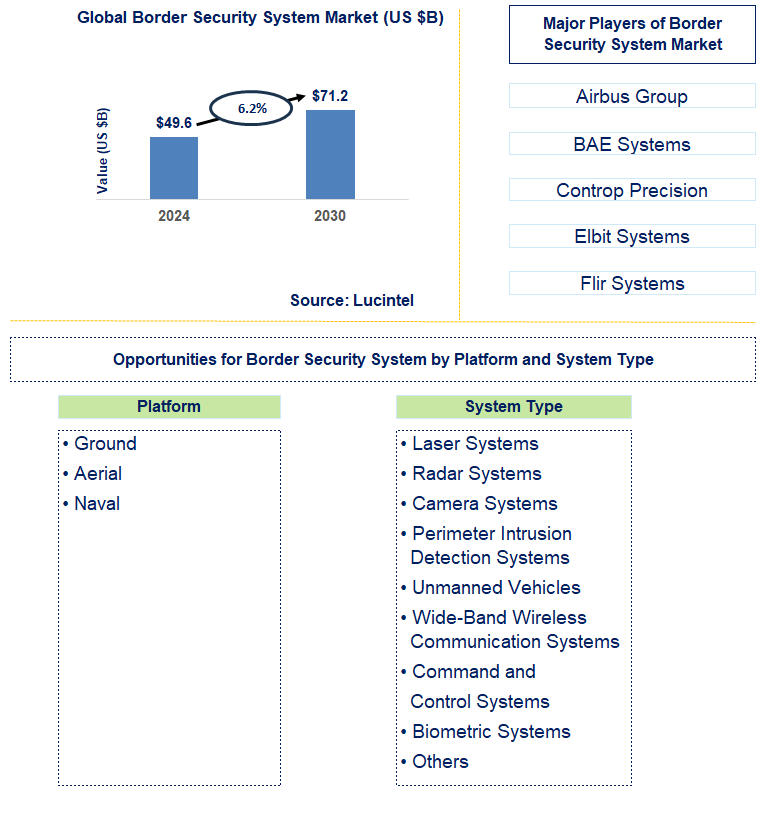
Key data points: The market size in 2030 = $71.2 billion, growth forecast = 6.2% annually next 6 years. Scroll below to get more insights. This market report covers trends, opportunities, and forecasts in the global border security system market to 2030 by platform (ground, aerial, and naval), system type (laser systems, radar systems, camera systems, perimeter intrusion detection systems, unmanned vehicles, wide-band wireless communication systems, command and control systems, biometric systems, and others), and region (North America, Europe, Asia Pacific, and the Rest of the World)
We'll send your sample report shortly.
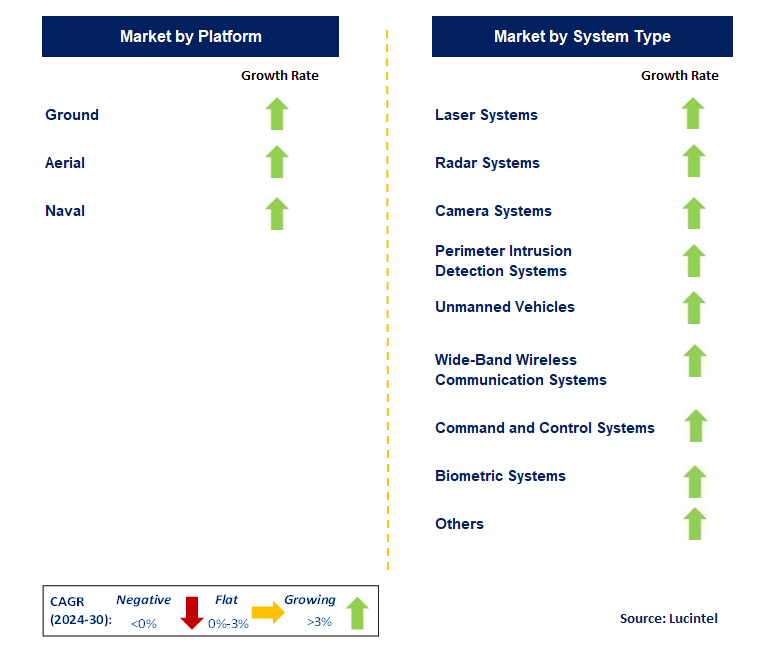
• Lucintel forecasts that within the platform category, ground is expected to witness highest growth over the forecast period due to increasing use of border security systems that detect and monitor activity on the ground.
• Within the system types category, Unmanned vehicle is expected to witness highest growth over the forecast period due to its major application in border security for tasks including optical imaging, reconnaissance, and surveillance.
• In terms of regions, North America is expected to witness highest growth over the forecast period due to increasing use of advanced security measures at borders, supportive government investment in homeland security, and presence of key players. Gain valuable insights for your business decisions with our comprehensive 150+ page report.
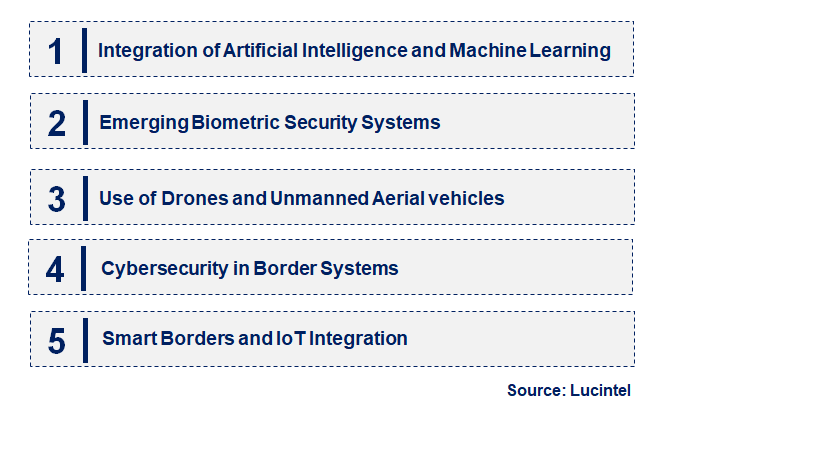
• Integration of Artificial Intelligence and Machine Learning: The development of a combination of artificial intelligence and machine learning is becoming more common in most border security systems, enhancing the accuracy of threat and predictive analytics. This development is resulting in the advent of self-contained border surveillance systems that detect and respond to possible threats independently of human input.
• Emerging Biometric Security Systems: There is an increase in the usage of biometric technologies, such as facial recognition and fingerprint scans, to identify persons. These systems have been found to be efficient in confirming a person's identity, which is why their use in border crossing stations is increasing to promote speedy immigration processing while enhancing security.
• Use of Drones and Unmanned Aerial Vehicles: The deployment of drones and UAVs in border surveillance is now developing, facilitating close monitoring and helping to cover large areas rapidly. Such technologies are more effective in areas along borders that are difficult to reach and garrison.
• Cybersecurity in Border Systems: The expansion of interconnection among border protection systems has created a strong need for a well-equipped cybersecurity policy. Combating cyberattacks on these systems has moved to the forefront, and governments are beginning to develop strong encryption and cyber threat detection systems.
• Smart Borders and IoT Integration: The idea of smart borders, which is based on the application of IoT, envisions the formation of an interoperable structure of cameras and sensors. This method helps in gathering and analyzing information in real time, thus enhancing the understanding of the situation and the timeliness of the response.
• Integrated Border Management Systems: Comprehensive border management systems that combine different technologies, such as surveillance, biometrics, and data analysis, into one framework are being embraced by governments. This development aims to improve the efficiency and effectiveness of border security operations through enhanced collaboration.
• Geopolitical Tensions Driving Technological Advancements in Border Security: It is further observed that geopolitical pressures are the reason for countries improving technology for border security. Such a trend is particularly notable in areas where previous borders have been altered or contested, necessitating a high level of monitoring and surveillance. These trends are altering the course of the Border Security System market, leading towards more unified, automated, and sophisticated technologies that address contemporary border security problems.
• Advancement in AI-Powered Surveillance Technologies: Surveillance systems are advancing significantly, with improvements in machine learning increasing the systems' ability to identify and address threats. This feature is especially beneficial in increasing the extent of real-time surveillance and decreasing human involvement.
• Expansion of Biometric Border Controls: The introduction of biometric technologies at ports of entry is on the rise, providing a more secure and faster method for identity confirmation. This development is not only improving the orderly flow of immigrants but also enhancing security.
• Growth of Autonomous Border Surveillance: Autonomous surveillance systems, such as drones and ground robots, are also being embraced. Aerial systems particularly fill the gap of inaccessible or otherwise undesired border coverage by human patrols, making them an important asset for border patrols.
• Integration of Cybersecurity in Border Systems: With the integration of different systems within border security, the aspect of cybersecurity, aimed at defending against external attacks, has gained increased attention. This is leading to the development of better and more secure systems for border management.
• Adoption of Smart Border Technologies: Smart border technologies, such as IoT technologies for active monitoring and analysis of large volumes of data, are slowly being adopted. This has improved the effectiveness of border security efforts and the comprehension of situations.
• Funding of Holistic Border Management Measures: Governments are putting in place holistic border management measures that incorporate several technologies into one system. This is enhancing cooperation and the level of efficiency among border security activities.
• Geopolitical Tensions Triggering Ground Security Technological Transformations: Geopolitical tensions are also outlined as forces of change in border security system technologies, triggering the evolution of newer and better systems. Such transformations have been particularly noticed in areas considered high security risks. These changes are, however, also altering the analytics of the Border Security System market, with new technologies and systems being designed to meet the new requirements for border safety and security emerging.
• Biometric Border Control Systems: There is an increased uptake of biometric systems at border control points. These systems ensure faster and safer verification of people’s identities, reducing verification fraud and increasing the effectiveness of the border control process. The development of this sector is founded on improvements in technologies such as face recognition and fingerprint scanning.
• Use of Automated Devices: The use of automated devices, which include aerial drones and contemporary ground robots to monitor border lines, has been witnessed recently. These devices are meant to traverse as much of the border lines as possible, even in areas with adverse geography, and are being assimilated into national interest strategies.
• Enhancing Cybersecurity of Border Defence Systems: With an increasingly integrated approach to border security systems, there has been a demand for measures that ensure such systems are safe from threats. This growth opportunity can be attributed to the need for encrypting layers, mechanisms for recognizing threats, and architectures for such biometric systems.
• Technologies for Smart Borders: There seems to be an increasing interest in the concept of smart borders, which would incorporate several IoT devices and provide data in real time across the entire span of borders beyond the monitoring nation’s territories. This area of growth is driven by an increasing demand for quality services coupled with cost-effectiveness in border management and the broad spectrum of border security.
• Multi-Functional Border Management Systems: There is an additional area of growth in developing multiple border management systems, including but not limited to surveillance, biometrics, and data analytical systems. These are also described as platform systems, offering a comprehensive model of border security that enhances joint operations. The infrastructure development of the Border Security System market is increasingly supported by these strategic growth thrusts, leading to the provision of sophisticated and integrated solutions that address modern border security challenges.
• Airbus Group
• BAE Systems
• Controp Precision Technologies
• Elbit Systems
• Flir Systems
• Israel Aerospace Industries
• Leonardo
• Lockheed Martin
• Moog
• Northrop Grumman
• Ground
• Aerial
• Naval
• Laser Systems
• Radar Systems
• Camera Systems
• Perimeter Intrusion Detection Systems
• Unmanned Vehicles
• Wide-Band Wireless Communication Systems
• Command and Control Systems
• Biometric Systems
• Others
• North America
• Europe
• Asia Pacific
• The Rest of the World
• United States: U.S. border security has increasingly fast-tracked the facilitation and deployment of newer technologies, such as drones equipped with artificial intelligence and biometric machines. Other recent advances include the employment of autonomous systems and improved data analytics for real-time monitoring of regions, indicating an evolving pattern of border management more oriented towards technology.
• China: In China, border control measures have addressed issues of implementing surveillance technologies, exploiting artificial intelligence and facial recognition, as well as using big data analytics. The country has extended its narrowband high-tech border control systems across its borders, especially in areas with political frictions, emphasizing the importance of using technology to enforce restrictive border policies.
• Germany: Germany has strengthened its border security systems with the incorporation of smart border techniques, such as automated border control (ABC) systems and additional surveillance systems. Attention has primarily been given to ensuring that border checks operate with better efficiency and effectiveness in response to increasing migration and security issues within the European Union.
• India: India has anchored its national border security structure on the modernization of border security devices, prioritizing smart fencing, integrated surveillance technologies, and the employment of drones. The country has also invested in enhancing its border facilities to effectively respond to cross-border issues, especially in hotspots.
• Japan: Japan has been nationalizing its border security policies by enhancing border security in land, sea, and air through biometric identification technologies and the installation of geographical area surveillance systems. Other current activities include a border security management strategy integrating and utilizing artificial intelligence (AI) and Internet of Things (IoT) systems for border area control and defense against both ground and airborne intrusions.


• Airbus Group
• BAE Systems
• Controp Precision Technologies
• Elbit Systems
• Flir Systems
• Israel Aerospace Industries
• Leonardo
• Lockheed Martin
• Moog
• Northrop Grumman Q6. Which border security system market segment will be the largest in future? Answer: Lucintel forecasts that ground is expected to witness highest growth over the forecast period due to increasing use of border security systems that detect and monitor activity on the ground. Q7. In border security system market, which region is expected to be the largest in next 5 years? Answer: North America is expected to witness highest growth over the forecast period due to increasing use of advanced security measures at borders, supportive government investment in homeland security, and presence of key players. Q.8 Do we receive customization in this report? Answer: Yes, Lucintel provides 10% customization without any additional cost.


Choose a license that fits your team. Instant PDF delivery.
Prices exclude taxes. Instant delivery. Custom licensing available on request.
Market Report · July 29, 2026
Market Report · July 20, 2026
Market Report · July 20, 2026
Trusted partner for strategic intelligence and business growth


Receive a complimentary market analysis tailored to your industry. Our analysts will identify key growth opportunities and competitive dynamics specific to your business.

Market size, growth rate, and key trend analysis for your specific sector.

Top competitor positioning and market share analysis.

Strategic recommendations backed by data-driven insights.
Get curated market intelligence and competitive moves straight to your inbox.
By subscribing, you agree to receive our monthly insights. Unsubscribe anytime.
Receive a complimentary market analysis tailored to your industry. Our analysts will identify key growth opportunities and competitive dynamics specific to your business.
Market size, growth rate, and key trend analysis for your specific sector.
Top competitor positioning and market share analysis.
Strategic recommendations backed by data-driven insights.
Get curated market intelligence, emerging trends, and competitive moves straight to your inbox each month.
By subscribing, you agree to receive our monthly insights. Unsubscribe anytime.
We'll send your sample report shortly.