
Market Report · July 31, 2026

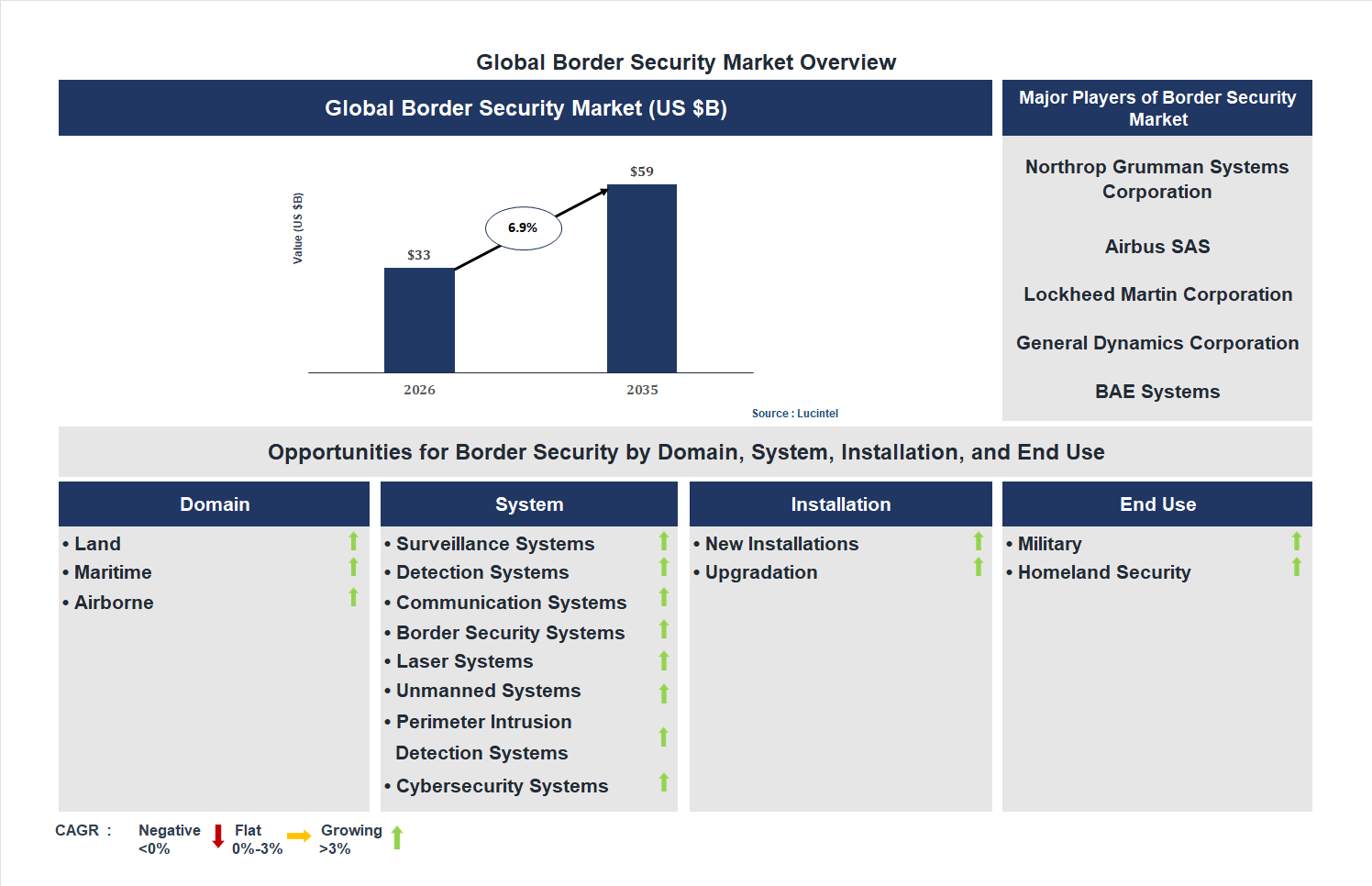
Key data points: The market size in 2035 = $59 billion, growth forecast = 6.9% annually for the next 8 years. Scroll below to get more insights. This market report covers trends, opportunities and forecasts in border security market to 2035 by domain (land, maritime, and airborne), system (surveillance systems, detection systems, communication systems, border security systems, laser systems, unmanned systems, perimeter intrusion detection systems, and cybersecurity systems), installation (new installations and upgradation), end use (military and homeland security), and region (North America, Europe, Asia Pacific, and the Rest of the World)
We'll send your sample report shortly.
• Lucintel forecasts that, within the domain category, land is expected to witness the highest growth over the forecast period.
• Within the end use category, military is expected to witness higher growth.
• In terms of region, APAC is expected to witness the highest growth over the forecast period. Gain valuable insights for your business decisions with our comprehensive 150+ page report. Sample figures with some insights are shown below.
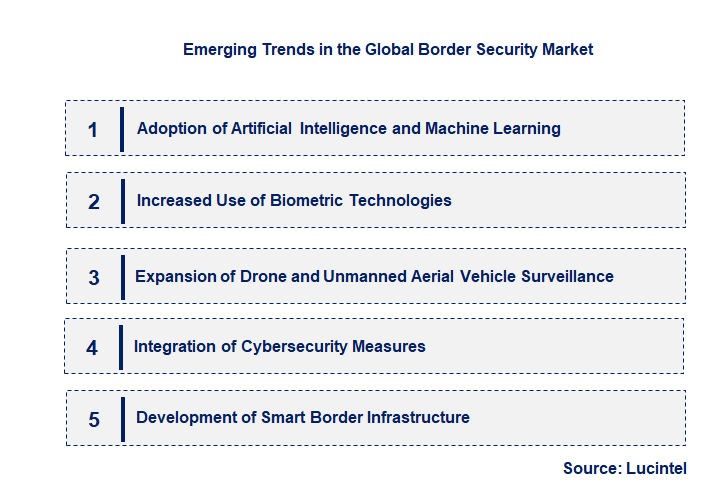
• Adoption of Artificial Intelligence and Machine Learning: AI and ML are revolutionizing border security by enabling real-time data analysis, predictive analytics, and automated threat detection. These technologies improve accuracy and response times, reducing reliance on manual processes. AI-powered surveillance systems can identify suspicious activities, recognize faces, and analyze behavioral patterns, enhancing overall effectiveness. The integration of AI also facilitates better resource allocation and operational efficiency, making border security more proactive rather than reactive. This trend is expected to continue expanding as AI capabilities advance and costs decrease, offering significant benefits for national security agencies.
• Increased Use of Biometric Technologies: Biometric systems such as fingerprint, facial recognition, iris scans, and voice recognition are becoming standard in border control processes. These technologies provide rapid and accurate identification, reducing fraud and enhancing security. Biometric data integration with immigration and customs systems streamlines passenger processing and improves border crossing efficiency. Governments are investing in biometric infrastructure at airports, seaports, and land crossings to strengthen identity verification. The adoption of biometric solutions also supports international cooperation and data sharing, facilitating smoother and more secure border management while addressing privacy concerns through regulatory frameworks.
• Expansion of Drone and Unmanned Aerial Vehicle (UAV) Surveillance: Drones and UAVs are increasingly deployed for border monitoring due to their ability to cover large and difficult terrains quickly and cost-effectively. Equipped with high-resolution cameras, thermal imaging, and sensors, these aerial platforms provide real-time surveillance and intelligence gathering. They are particularly useful in remote or rugged border areas where traditional patrols are challenging. The use of drones enhances situational awareness, supports rapid response to incursions, and reduces manpower requirements. As drone technology advances, their integration into border security systems is expected to grow, offering scalable and flexible surveillance solutions.
• Integration of Cybersecurity Measures: As border security systems become more digitized, protecting these networks from cyber threats has become critical. Cybersecurity measures are being integrated into border infrastructure to prevent hacking, data breaches, and system disruptions. This includes deploying firewalls, encryption, intrusion detection systems, and regular security audits. Cyber threats can compromise sensitive data and operational capabilities, making robust cybersecurity essential for maintaining trust and functionality. Governments are also establishing protocols for incident response and collaboration with cybersecurity agencies. The emphasis on cybersecurity is reshaping the market by creating demand for specialized solutions and skilled personnel to safeguard border security assets.
• Development of Smart Border Infrastructure: The trend toward smart borders involves deploying interconnected sensors, IoT devices, and data analytics to create intelligent border management systems. These systems enable continuous monitoring, automated alerts, and data-driven decision-making. Smart infrastructure includes integrated surveillance cameras, sensor networks, and communication platforms that work seamlessly to detect and respond to threats. This approach enhances efficiency, reduces human error, and provides comprehensive situational awareness. Countries are investing in smart border projects to improve security, facilitate trade, and streamline immigration processes. The evolution toward intelligent infrastructure is transforming border security into a more proactive, efficient, and technologically advanced domain. These emerging trends are fundamentally reshaping the border security market by integrating advanced technologies, enhancing operational efficiency, and addressing evolving threats. The adoption of AI, biometrics, drone surveillance, cybersecurity, and smart infrastructure is creating a more secure, responsive, and interconnected border management landscape. These developments are not only improving national security but also fostering international cooperation and innovation, positioning the market for sustained growth and technological leadership.
• Growing Geopolitical Tensions: The rise in international conflicts and border disputes is prompting countries to upgrade security infrastructure, leading to increased demand for advanced border control solutions. This trend enhances national security, deters illegal crossings, and supports sovereignty. The market benefits from sustained government investments, fostering innovation in surveillance and detection technologies. As tensions persist, the market is expected to expand further, attracting new entrants and technological collaborations.
• Technological Innovations in Surveillance: The integration of AI, drones, and sensor-based systems is revolutionizing border monitoring. These technologies enable real-time tracking, automated threat detection, and reduced manpower costs. Enhanced surveillance capabilities improve response times and operational efficiency. The adoption of biometric systems like facial recognition and fingerprint scanning further strengthens security. This technological shift is driving market growth, encouraging R&D investments, and expanding the scope of border security solutions globally.
• Increasing Adoption of Biometric Systems: Biometric identification methods are becoming standard in border security to ensure accurate and swift verification processes. Fingerprint, facial, and iris recognition systems are reducing identity fraud and illegal crossings. Governments are deploying these systems at checkpoints, airports, and border crossings, improving overall security and efficiency. The demand for portable and integrated biometric devices is rising, creating opportunities for manufacturers. This trend enhances border integrity and supports international travel and trade facilitation.
• Expansion of Automated Border Control (ABC) Systems: Automated systems streamline border crossings by reducing wait times and increasing throughput. Self-service kiosks, e-gates, and biometric verification stations are increasingly adopted at airports and land borders. These systems improve user experience, reduce staffing costs, and enhance security screening accuracy. The deployment of ABC systems is expanding in emerging markets, driven by government initiatives and technological advancements. This growth is transforming border management into a more efficient, secure, and user-friendly process.
• Rising Focus on Cybersecurity and Data Management: As border security systems become more digitized, protecting sensitive data from cyber threats is critical. Governments are investing in cybersecurity infrastructure to safeguard biometric data, surveillance feeds, and operational information. Data management solutions enable seamless integration of various security systems, improving coordination and response. The emphasis on cybersecurity is fostering innovation in encryption, threat detection, and secure communication protocols. This focus ensures the resilience of border security infrastructure amid increasing cyber risks. The overall impact of these developments is a more secure, efficient, and technologically advanced border security market. Enhanced security measures support national sovereignty, facilitate international trade, and improve migration management. Continuous innovation and investment are expected to drive market growth, attract new players, and foster global cooperation. These advancements are shaping a safer and more interconnected world, with significant implications for regional stability and economic development.
• Advanced Surveillance Technologies for Enhanced Border Monitoring: The adoption of sophisticated surveillance systems, including drones, thermal imaging, and radar, offers real-time monitoring capabilities. These technologies improve detection accuracy, reduce response times, and cover difficult terrains such as deserts, mountains, and dense forests. Governments are investing in integrated command centers that combine multiple data sources for comprehensive situational awareness, thereby strengthening border security and reducing illegal activities.
• Deployment of Biometric and Identity Verification Systems: Biometric solutions like facial recognition, fingerprint scanning, and iris recognition are increasingly used for identity verification at border crossings. These systems facilitate faster processing, improve accuracy, and enhance security by preventing identity fraud. The integration of biometric data with immigration databases enables authorities to track and identify individuals more efficiently, supporting counter-terrorism efforts and immigration control.
• Implementation of AI and Data Analytics for Predictive Border Security: AI-powered analytics enable predictive modeling of potential threats and illegal crossings based on historical data, behavioral patterns, and environmental factors. These insights help authorities allocate resources more effectively and respond proactively to emerging risks. Machine learning algorithms continuously improve detection capabilities, making border security more adaptive and resilient against evolving tactics used by criminals and traffickers.
• Expansion of Infrastructure and Physical Barriers in High-Risk Areas: Building physical barriers such as fences, walls, and vehicle barriers in strategic locations deters illegal crossings and enhances control. Infrastructure development includes upgrading border checkpoints, roads, and surveillance towers to support rapid deployment and maintenance. These measures are particularly crucial in regions with high migration flows or security threats, providing a tangible deterrent and facilitating law enforcement operations.
• Integration of IoT and Smart Technologies for Real-Time Border Management: IoT devices, sensors, and connected cameras enable continuous monitoring of border zones, providing real-time data to security personnel. Smart technologies facilitate automated alerts for suspicious activities, environmental changes, or breaches, allowing swift action. The deployment of these interconnected systems enhances situational awareness, reduces manpower requirements, and improves overall operational efficiency in complex border environments. The overall impact of these growth opportunities is a more secure, efficient, and technologically advanced border security landscape. They enable governments to better address emerging threats, optimize resource allocation, and improve response times. As these innovations continue to evolve, the market is poised for sustained expansion, fostering safer borders and more resilient national security frameworks.
• Technological Innovation: The integration of advanced technologies such as AI, machine learning, and IoT enhances border surveillance, threat detection, and response capabilities. These innovations enable real-time monitoring, automated threat identification, and improved data analytics, making border security more efficient and effective. Governments are investing in these technologies to combat illegal crossings, human trafficking, and smuggling, thereby fueling market growth. The rapid pace of technological evolution ensures continuous improvements and new product development, attracting significant investments and expanding market opportunities.
• Increasing Security Threats: Rising concerns over terrorism, illegal immigration, and transnational crimes are compelling nations to strengthen their border security measures. The growing frequency and sophistication of security threats necessitate advanced solutions to prevent breaches and illegal activities. This heightened threat perception drives governments to adopt comprehensive border security systems, including surveillance drones, biometric verification, and integrated command centers, thereby expanding the market. The need for proactive security measures directly correlates with increased market demand for innovative border security solutions.
• Government Initiatives and Funding: Governments worldwide are prioritizing border security through policy reforms, strategic initiatives, and increased funding allocations. These investments support the deployment of modern security infrastructure, personnel training, and technological upgrades. International collaborations and funding programs further bolster market growth by facilitating the adoption of best practices and advanced systems. Such proactive governmental support accelerates market expansion, ensuring that border security remains a national priority amid evolving threats and geopolitical tensions.
• Growing Cross-Border Trade and Migration: The surge in cross-border trade and migration necessitates robust border management systems to facilitate legitimate movement while preventing illegal activities. Efficient border security solutions are essential for streamlining customs procedures, ensuring compliance, and maintaining economic stability. The increasing volume of trade and migration flows compels authorities to adopt scalable, integrated security systems, thereby expanding the market. This trend underscores the importance of balancing security with facilitation, prompting continuous innovation and investment in border security infrastructure.
• Technological Adoption in Emerging Markets: Rapid economic growth and urbanization in emerging markets are driving the adoption of advanced border security technologies. These regions are investing in modern surveillance, biometric systems, and integrated security networks to address increasing security challenges. The adoption of these technologies not only enhances border management but also opens new market opportunities for vendors. As emerging markets prioritize security to support economic development, the market experiences significant growth, driven by both government initiatives and private sector involvement. The challenges facing the border security market include:
• High Implementation Costs: Deploying advanced border security systems involves substantial capital expenditure, including procurement, installation, and maintenance costs. Many countries, especially developing ones, face budget constraints that limit their ability to invest in comprehensive security infrastructure. These high costs can delay or restrict the adoption of new technologies, hindering market growth. Additionally, ongoing operational expenses and the need for specialized personnel further complicate budget planning, making cost management a critical challenge for stakeholders.
• Privacy and Ethical Concerns: The deployment of biometric identification, surveillance cameras, and data analytics raises significant privacy issues. Public apprehension regarding data security, surveillance overreach, and misuse of personal information can lead to resistance against certain security measures. Regulatory frameworks around data privacy vary across regions, complicating implementation. Balancing security needs with individual rights remains a delicate challenge, potentially delaying or restricting the deployment of advanced border security solutions and impacting market expansion.
• Regulatory and Political Barriers: Differing national policies, international treaties, and political considerations can impede the adoption of border security technologies. Regulatory hurdles, bureaucratic delays, and diplomatic tensions may restrict cross-border cooperation and technology transfer. These barriers can slow down the deployment of integrated security systems and limit market growth, especially in regions with complex geopolitical landscapes. Navigating diverse regulatory environments requires strategic planning and collaboration, which can be time-consuming and costly. The border security market is shaped by rapid technological advancements, increasing security threats, and proactive government initiatives, all of which drive growth. However, high implementation costs, privacy concerns, and regulatory barriers pose significant challenges. The interplay of these factors influences market dynamics, requiring stakeholders to innovate continuously while addressing regulatory and ethical issues. Overall, the markets future depends on balancing technological progress with cost-efficiency and privacy considerations, ensuring sustainable growth and enhanced border security worldwide.
• Northrop Grumman Systems Corporation
• Airbus SAS
• Lockheed Martin Corporation
• General Dynamics Corporation
• BAE Systems
• Thales
• RTX Corporation
• Elbit Systems Ltd.
• RAFAEL Advanced Defense Systems Ltd.
• Teledyne FLIR LLC
• Land
• Maritime
• Airborne
• Surveillance Systems
• Detection Systems
• Communication Systems
• Border Security Systems
• Laser Systems
• Unmanned Systems
• Perimeter Intrusion Detection Systems
• Cybersecurity Systems
• New Installations
• Upgradation
• Military
• Homeland Security
• North America
• Europe
• Asia Pacific
• The Rest of the World
• United States: The US border security market has seen substantial investments in advanced surveillance technologies, including drone surveillance and biometric systems. The Department of Homeland Security has increased funding for border wall construction and smart fencing. Innovations in AI-powered monitoring and data analytics are being integrated to improve threat detection and response times. The US also emphasizes cybersecurity measures to protect border infrastructure from cyber threats, reflecting a comprehensive approach to border security.
• China: China has rapidly expanded its border security infrastructure, focusing on high-tech surveillance and border control systems. The country has deployed extensive CCTV networks, facial recognition, and AI-driven monitoring along its borders, especially in sensitive regions like Xinjiang. China is also investing in automated border control gates and integrated security platforms to enhance efficiency and control. The government emphasizes technological sovereignty and self-reliance in border security solutions.
• Germany: Germanys border security market is driven by increased migration and EU regulations. The country has upgraded its surveillance infrastructure with advanced CCTV and biometric systems at key entry points. Germany collaborates with neighboring countries to strengthen border management through shared intelligence and integrated systems. The focus is on balancing security with privacy concerns, leading to the adoption of innovative, privacy-preserving technologies such as facial recognition with strict data protection measures.
• India: India is significantly enhancing its border security with a focus on its long and porous borders. The government has deployed biometric-based e-visa systems, drone surveillance, and sensor-based monitoring along borders with Pakistan and China. The development of integrated border management systems and the use of AI for threat detection are key priorities. India also emphasizes capacity building and infrastructure development to address security challenges effectively.
• Japan: Japans border security market is characterized by advanced technological integration, including biometric passports, facial recognition, and AI-based surveillance systems. The country has increased security measures at airports and seaports to prevent illegal entry and smuggling. Japan invests in cutting-edge technology to enhance border control efficiency while maintaining strict privacy standards. The focus remains on safeguarding against regional threats and ensuring smooth international travel.


• Northrop Grumman Systems Corporation
• Airbus SAS
• Lockheed Martin Corporation
• General Dynamics Corporation
• BAE Systems
• Thales
• RTX Corporation
• Elbit Systems Ltd.
• RAFAEL Advanced Defense Systems Ltd.
• Teledyne FLIR LLC Q6. Which border security market segment will be the largest in future? Answer: Lucintel forecasts that, within the domain category, land is expected to witness the highest growth over the forecast period. Q7. In border security market, which region is expected to be the largest in next 8 years? Answer: In terms of region, APAC is expected to witness the highest growth over the forecast period. Q8. Do we receive customization in this report? Answer: Yes, Lucintel provides 10% customization without any additional cost.


Choose a license that fits your team. Instant PDF delivery.
Prices exclude taxes. Instant delivery. Custom licensing available on request.
Market Report · July 31, 2026
Market Report · July 31, 2026
Market Report · July 31, 2026
Trusted partner for strategic intelligence and business growth


Receive a complimentary market analysis tailored to your industry. Our analysts will identify key growth opportunities and competitive dynamics specific to your business.

Market size, growth rate, and key trend analysis for your specific sector.

Top competitor positioning and market share analysis.

Strategic recommendations backed by data-driven insights.
Get curated market intelligence and competitive moves straight to your inbox.
By subscribing, you agree to receive our monthly insights. Unsubscribe anytime.
Receive a complimentary market analysis tailored to your industry. Our analysts will identify key growth opportunities and competitive dynamics specific to your business.
Market size, growth rate, and key trend analysis for your specific sector.
Top competitor positioning and market share analysis.
Strategic recommendations backed by data-driven insights.
Get curated market intelligence, emerging trends, and competitive moves straight to your inbox each month.
By subscribing, you agree to receive our monthly insights. Unsubscribe anytime.
We'll send your sample report shortly.