
Report Feature
BNC Receptacle Market Trends and Forecast
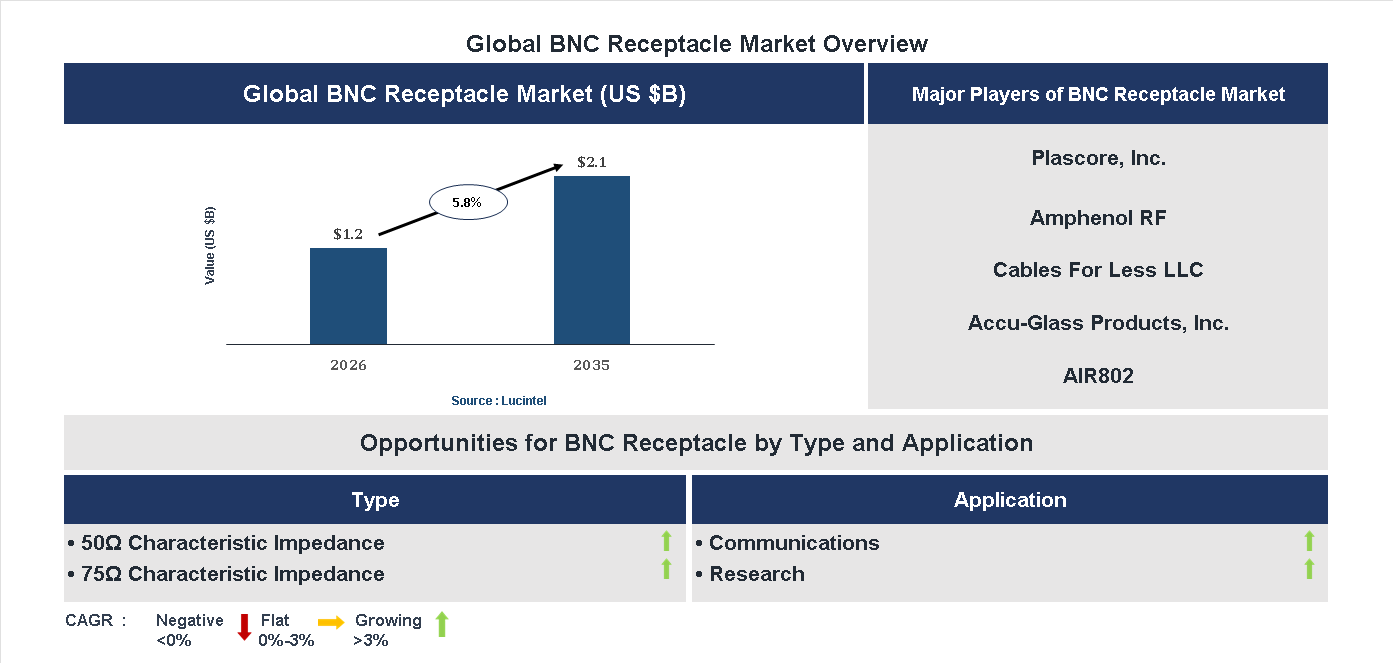
The future of the global BNC receptacle market looks promising with opportunities in the communication and research markets. The global BNC receptacle market is expected to reach an estimated $2.1 billion by 2035 with a CAGR of 5.8% from 2026 to 2035. The major drivers for this market are the increasing demand for high frequency, the rising adoption of video surveillance systems, and the growing deployment of broadcast communication infrastructure.• Lucintel forecasts that, within the type category, 50ω characteristic impedance is expected to witness higher growth over the forecast period.
• Within the application category, communication is expected to witness higher growth.
• In terms of region, APAC is expected to witness the highest growth over the forecast period. Gain valuable insights for your business decisions with our comprehensive 150+ page report. Sample figures with some insights are shown below.
Emerging Trends in the BNC Receptacle Market
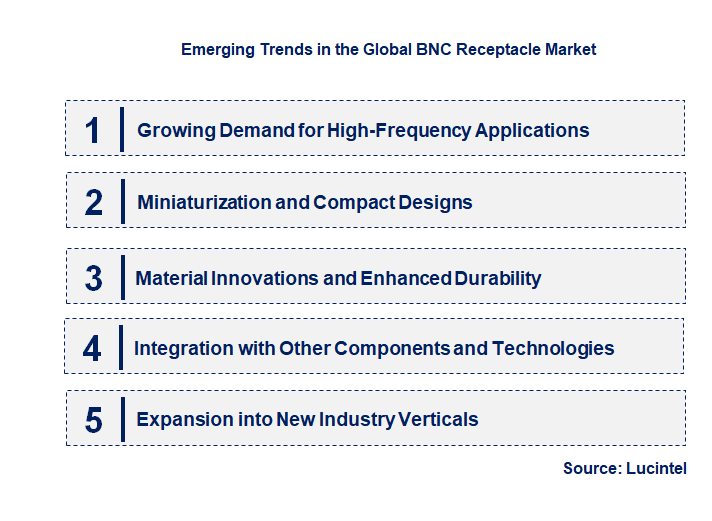
The BNC receptacle market is experiencing rapid evolution driven by technological advancements, increasing demand for high-frequency applications, and the need for reliable connectivity solutions across various industries. As electronic devices become more sophisticated, the market is adapting to new standards and expanding its product offerings. Innovations in materials, miniaturization, and integration are also shaping the landscape. These developments are not only enhancing performance but also opening new opportunities in sectors such as telecommunications, broadcasting, and aerospace. Understanding these emerging trends is crucial for stakeholders aiming to stay competitive and leverage new market potentials effectively.• Growing Demand for High-Frequency Applications: The increasing need for high-frequency data transmission in telecommunications and broadcasting is driving the demand for BNC receptacles capable of supporting higher bandwidths. These connectors are essential for RF and microwave applications, where signal integrity and minimal loss are critical. As 5G networks and high-definition broadcasting expand, the market is witnessing a surge in specialized BNC connectors designed for these demanding environments. This trend enhances connectivity performance and opens avenues for advanced communication systems, making high-frequency compatibility a key focus for manufacturers.
• Miniaturization and Compact Designs: The trend toward smaller, more compact electronic devices necessitates miniaturized BNC receptacles. Manufacturers are developing smaller connectors that maintain performance while fitting into space-constrained applications such as portable devices, drones, and wearable technology. This miniaturization improves device portability and integration, reducing overall system size and weight. It also enables new product designs and enhances user experience. As consumer electronics and IoT devices proliferate, the demand for compact BNC connectors is expected to grow, influencing product development strategies across the industry.
• Material Innovations and Enhanced Durability: Advances in materials, such as high-performance plastics and corrosion-resistant metals, are improving the durability and reliability of BNC receptacles. These innovations extend the lifespan of connectors, especially in harsh environments like outdoor, industrial, or aerospace applications. Enhanced materials also contribute to better electrical performance and reduced signal loss. This trend ensures that BNC connectors can withstand extreme conditions, reducing maintenance costs and increasing system reliability. As industries prioritize durability and longevity, material innovation remains a critical focus for market growth.
• Integration with Other Components and Technologies: The integration of BNC receptacles with other electronic components and technologies is facilitating more streamlined and efficient systems. For example, integrated connectors with built-in shielding or combined with active components are emerging to improve signal quality and simplify assembly processes. This trend supports the development of compact, multifunctional devices and reduces overall system complexity. It also enables easier installation and maintenance, which is particularly valuable in complex or large-scale deployments. Integration trends are thus enhancing the versatility and functionality of BNC connectors in various applications.
• Expansion into New Industry Verticals: The BNC receptacle market is expanding beyond traditional sectors like broadcasting and telecommunications into emerging fields such as aerospace, defense, medical devices, and IoT. These industries require specialized connectors that meet stringent standards for performance, safety, and reliability. For instance, aerospace applications demand connectors that withstand extreme conditions, while medical devices require biocompatible and sterilizable options. This diversification broadens market opportunities and encourages innovation tailored to specific industry needs. As new verticals adopt BNC technology, the market is poised for sustained growth and diversification. These emerging trends are significantly reshaping the BNC receptacle market by enhancing performance, enabling miniaturization, improving durability, fostering integration, and expanding industry applications. These developments are driving innovation, opening new market segments, and ensuring that BNC connectors continue to meet the evolving demands of modern electronic systems.
Recent Development in the BNC Receptacle Market
The BNC receptacle market is experiencing rapid growth driven by technological advancements and increasing demand across various sectors. Innovations in design and manufacturing are enhancing performance and reliability, attracting new applications. The expansion of communication infrastructure and the rise of high-frequency data transmission are fueling market opportunities. Additionally, the integration of BNC connectors in emerging technologies and the focus on miniaturization are shaping future growth prospects. These developments are transforming the landscape, making BNC receptacles more versatile and essential in modern electronic systems.• Growing Demand in Communication and Broadcasting: The increasing need for high-quality, reliable connections in broadcasting, CCTV, and telecommunication systems is boosting BNC receptacle adoption. Enhanced performance standards and compatibility with high-frequency signals are driving market growth. As industries demand more efficient data transmission, the market benefits from innovations that improve signal integrity and ease of installation. This trend is expected to continue, expanding the market’s reach into new sectors and applications.
• Technological Innovations in Design and Materials: Advances in materials science and design are leading to more durable, corrosion-resistant BNC receptacles. These innovations improve performance in harsh environments, such as outdoor or industrial settings. The development of miniaturized and high-frequency variants caters to the growing demand for compact, high-performance connectors. These technological improvements are increasing product lifespan and reliability, thereby expanding market opportunities and enabling new applications in sensitive and demanding environments.
• Expansion of 5G and High-Frequency Networks: The rollout of 5G networks and the proliferation of high-frequency data transmission are significantly impacting the BNC receptacle market. These technologies require connectors capable of handling higher bandwidths with minimal signal loss. The development of specialized BNC connectors for 5G infrastructure and testing equipment is creating new revenue streams. This trend is expected to accelerate as global communication networks upgrade, further boosting demand for advanced BNC solutions.
• Integration in Emerging Technologies: BNC receptacles are increasingly integrated into emerging fields such as IoT, aerospace, and defense. Their ability to provide reliable, high-frequency connections makes them suitable for complex systems requiring precision and durability. The adoption of BNC connectors in these sectors is driven by the need for secure, high-performance interfaces. As these technologies evolve, the market will benefit from new product developments tailored to specialized applications, expanding the overall market size.
• Focus on Miniaturization and Portability: The trend toward smaller, more portable electronic devices is influencing BNC receptacle design. Manufacturers are developing compact, lightweight connectors that maintain high performance. This focus on miniaturization is opening new markets in consumer electronics, portable testing equipment, and wearable devices. The demand for space-saving solutions is expected to grow, encouraging innovation and increasing the market’s scope in various high-tech applications. These recent developments are significantly transforming the BNC receptacle market by enhancing performance, expanding application areas, and enabling integration into emerging technologies. Innovations in design, materials, and miniaturization are driving growth, while the expansion of high-frequency networks like 5G is creating new opportunities. Overall, these advancements are making BNC connectors more versatile, reliable, and essential, ensuring sustained market growth and increased adoption across diverse industries.
Strategic Growth Opportunities in the BNC Receptacle Market
The BNC receptacle market is experiencing significant growth driven by increasing demand across various industries such as telecommunications, broadcasting, and security systems. Technological advancements and the need for reliable, high-quality connections are fueling innovation and expansion. Market players are focusing on product development, strategic partnerships, and geographic expansion to capitalize on emerging opportunities. As the digital infrastructure evolves, the markets potential for growth remains robust, offering numerous avenues for companies to enhance their offerings and capture new customer segments.• Growing Adoption in Telecommunications and Data Centers: The increasing deployment of high-speed data networks and data centers is driving demand for BNC receptacles. These components are essential for RF and coaxial connections, ensuring signal integrity and minimal loss. As telecom infrastructure expands globally, the need for reliable, durable, and high-performance BNC connectors grows, creating opportunities for manufacturers to innovate with enhanced materials and designs tailored for high-frequency applications.
• Expansion in Broadcast and Media Industry Applications: The broadcast and media sectors rely heavily on BNC receptacles for video and audio signal transmission. The rising demand for high-definition and 4K content delivery necessitates advanced connectors that support high bandwidth and minimal interference. Market growth is fueled by technological upgrades in broadcasting equipment and the increasing adoption of digital transmission systems, prompting manufacturers to develop specialized, ruggedized BNC connectors suitable for demanding environments.
• Increasing Use in Security and Surveillance Systems: The proliferation of security cameras and surveillance infrastructure is a key growth driver for BNC receptacles. These connectors are vital for transmitting high-quality video signals over coaxial cables. As security systems become more sophisticated, requiring higher resolution and real-time monitoring, the demand for reliable, weather-resistant, and easy-to-install BNC connectors is rising. This trend presents opportunities for product innovation focused on durability and ease of integration.
• Rising Demand for Miniaturized and High-Performance Connectors: The trend toward compact, high-performance BNC receptacles is driven by the need for space-saving solutions in modern electronic devices. Applications in aerospace, military, and portable equipment require smaller, lightweight connectors without compromising performance. Manufacturers are investing in miniaturization technologies and materials to meet these specifications, opening new markets and expanding the application scope of BNC receptacles in various high-tech sectors.
• Strategic Partnerships and Geographic Expansion Opportunities: Companies are forming strategic alliances and expanding into emerging markets to increase their market share. Developing regions present untapped opportunities due to growing infrastructure projects and increasing adoption of digital communication systems. Collaborations with local distributors and investments in manufacturing facilities enable companies to reduce costs, improve supply chain efficiency, and customize products for regional needs, thereby strengthening their competitive position globally. These growth opportunities collectively enhance the markets potential by addressing evolving technological demands and expanding application areas. Innovation in product design, strategic collaborations, and geographic expansion are key strategies that will enable market players to capitalize on emerging trends. As industries continue to digitize and modernize, the BNC receptacle market is poised for sustained growth, driven by the need for reliable, high-performance connectivity solutions across diverse sectors.
BNC Receptacle Market Driver and Challenges
The BNC receptacle market is influenced by a variety of technological, economic, and regulatory factors that shape its growth and development. Advances in communication technology and the increasing demand for high-frequency data transmission are driving innovation and adoption. Economic factors such as rising infrastructure investments and the proliferation of wireless networks further propel market expansion. Regulatory standards and safety protocols also impact product design and compliance requirements. However, the market faces challenges including technological obsolescence, supply chain disruptions, and stringent regulatory compliance, which can hinder growth. Understanding these drivers and challenges is essential for stakeholders to navigate the evolving landscape effectively. The factors responsible for driving the BNC receptacle market include:• Technological Advancements: The rapid evolution of communication and broadcasting technologies necessitates high-quality, reliable connectors like BNC receptacles. Innovations in materials and manufacturing processes improve performance, durability, and frequency handling capabilities, making these components essential in modern applications such as CCTV, radio, and test equipment. As technology advances, demand for more sophisticated and miniaturized BNC connectors increases, fueling market growth. The integration of smart features and enhanced shielding also contributes to improved signal integrity, further boosting adoption across various sectors.
• Growing Infrastructure Development: Increasing investments in telecommunications, broadcasting, and security infrastructure worldwide are significant drivers. Governments and private enterprises are expanding network coverage, upgrading existing systems, and deploying new technologies like 5G, which require reliable connectors. BNC receptacles are critical in these setups for ensuring stable connections and high-quality signal transmission. The expansion of data centers, surveillance systems, and broadcast facilities directly correlates with rising demand, supporting sustained market growth.
• Rising Adoption in Consumer Electronics: The proliferation of consumer electronics such as home security systems, audio-visual equipment, and wireless communication devices is boosting demand for BNC receptacles. Consumers and businesses seek reliable, high-performance connectors for seamless connectivity and enhanced user experience. The increasing trend toward smart homes and IoT devices further amplifies the need for robust connectors capable of supporting high-frequency signals, thereby expanding the market scope.
• Increasing Focus on Quality and Standards: Stringent regulatory standards and quality benchmarks across industries compel manufacturers to adopt high-quality BNC receptacles. Compliance with international standards ensures safety, reliability, and performance, which are critical in applications like aerospace, defense, and medical devices. This focus on quality drives innovation in product design and material selection, fostering market growth while also creating opportunities for premium product segments.
• Expansion of Wireless and Satellite Communications: The surge in wireless communication networks and satellite-based services necessitates reliable RF connectors like BNC receptacles. These connectors are essential for signal integrity in antennas, satellite dishes, and RF testing equipment. As demand for high-speed, high-capacity wireless networks increases, so does the need for durable, high-performance connectors, propelling market expansion in telecommunications and aerospace sectors. The challenges facing the BNC receptacle market include:
• Technological Obsolescence: Rapid technological changes can render existing BNC receptacles outdated, leading to increased R&D costs and product redesigns. Manufacturers must continuously innovate to keep pace with evolving standards and customer requirements, which can be resource-intensive. Failure to adapt may result in loss of market share and reduced competitiveness, especially as newer connector types with enhanced features emerge.
• Supply Chain Disruptions: The global supply chain for electronic components has been increasingly vulnerable to disruptions caused by geopolitical tensions, pandemics, and logistical issues. Shortages of raw materials, manufacturing delays, and transportation bottlenecks can lead to product shortages and increased costs. These disruptions hinder timely delivery and can impact customer satisfaction, ultimately affecting market stability and growth prospects.
• Stringent Regulatory Compliance: Increasing regulatory requirements related to safety, electromagnetic compatibility, and environmental standards impose additional burdens on manufacturers. Compliance involves significant testing, certification, and documentation efforts, which can delay product launches and increase costs. Navigating diverse international standards also complicates global market expansion, posing a challenge for companies aiming for widespread adoption. The BNC receptacle market is driven by technological innovation, infrastructure expansion, and increasing demand across various sectors. However, it faces challenges such as rapid obsolescence, supply chain vulnerabilities, and regulatory complexities. These factors collectively influence market dynamics, requiring stakeholders to adapt strategically. While growth opportunities remain substantial, addressing these challenges is crucial for sustained success. Overall, the markets future will depend on how effectively companies innovate and navigate regulatory and supply chain hurdles in an increasingly connected world.
List of BNC Receptacle Companies
Companies in the market compete on the basis of product quality offered. Major players in this market focus on expanding their manufacturing facilities, R&D investments, infrastructural development, and leverage integration opportunities across the value chain. With these strategies BNC receptacle companies cater increasing demand, ensure competitive effectiveness, develop innovative products & technologies, reduce production costs, and expand their customer base. Some of the BNC receptacle companies profiled in this report include-• Plascore, Inc.
• Amphenol RF
• Cables For Less LLC
• Accu-Glass Products, Inc.
• AIR802
• Centric RF
• DDK Ltd.
• Japan Aviation Electronics Industry
• Welotec GmbH
• HB Radiofrequency
BNC Receptacle Market by Segment
The study includes a forecast for the global BNC receptacle market by type, application, and region.BNC Receptacle Market by Type [Value from 2019 to 2035]:
• 50Ω Characteristic Impedance
• 75Ω Characteristic Impedance
BNC Receptacle Market by Application [Value from 2019 to 2035]:
• Communications
• Research
BNC Receptacle Market by Region [Value from 2019 to 2035]:
• North America
• Europe
• Asia Pacific
• The Rest of the World
Country Wise Outlook for the BNC Receptacle Market
The BNC receptacle market has experienced significant shifts driven by technological advancements, increasing demand for high-speed data transmission, and evolving industry standards. As digital infrastructure expands globally, key players are innovating to meet the needs of telecommunications, broadcasting, and data centers. Market dynamics are also influenced by regional policies, economic growth, and the adoption of new communication technologies. These developments reflect a broader trend toward enhanced connectivity and improved performance in electronic and communication systems across major economies. Understanding regional trends is crucial for stakeholders aiming to capitalize on emerging opportunities and navigate competitive landscapes effectively.• United States: The US market has seen increased adoption of high-frequency BNC receptacles for 5G infrastructure and data centers. Innovations focus on improved durability and signal integrity, with major companies investing in R&D. Regulatory standards are evolving to support faster deployment of broadband networks, boosting market growth. The rise of IoT devices also drives demand for reliable connectors in various applications, including security and surveillance systems.
• China: China’s BNC receptacle market is expanding rapidly due to government initiatives to upgrade telecommunications infrastructure and smart city projects. Local manufacturers are enhancing product quality and expanding their distribution networks. The market benefits from increased investments in broadcasting and surveillance sectors, with a focus on cost-effective, high-performance solutions. E-commerce and industrial automation also contribute to rising demand.
• Germany: The German market emphasizes high-quality, precision-engineered BNC connectors for professional broadcasting and industrial applications. There is a growing trend toward miniaturization and enhanced shielding to meet stringent European standards. The adoption of 4K and 8K broadcasting technologies has spurred demand for advanced connectors. Sustainability and eco-friendly manufacturing practices are increasingly prioritized by industry players.
• India: India’s BNC receptacle market is driven by expanding telecom infrastructure, cable TV, and security sectors. The government’s Digital India initiative promotes digital connectivity, fueling demand for reliable connectors. Local manufacturers are focusing on cost-effective, durable products suitable for diverse environments. The growth of smart cities and the increasing adoption of surveillance systems further boost market prospects.
• Japan: Japan’s market is characterized by high technological standards and innovation in BNC receptacles for broadcasting, aerospace, and industrial automation. There is a focus on miniaturization, high-frequency performance, and environmental resistance. The adoption of 8K broadcasting and advanced security systems has increased demand for sophisticated connectors. Japanese companies are also investing in sustainable manufacturing practices to meet global environmental standards.

Features of the Global BNC Receptacle Market
Market Size Estimates: BNC receptacle market size estimation in terms of value ($B). Trend and Forecast Analysis: Market trends (2019 to 2025) and forecast (2026 to 2035) by various segments and regions. Segmentation Analysis: BNC receptacle market size by type, application, and region in terms of value ($B). Regional Analysis: BNC receptacle market breakdown by North America, Europe, Asia Pacific, and Rest of the World. Growth Opportunities: Analysis of growth opportunities in different types, applications, and regions for the BNC receptacle market. Strategic Analysis: This includes M&A, new product development, and competitive landscape of the BNC receptacle market. Analysis of competitive intensity of the industry based on Porter’s Five Forces model.
FAQ
Q1. What is the BNC receptacle market size? Answer: The global BNC receptacle market is expected to reach an estimated $2.1 billion by 2035. Q2. What is the growth forecast for BNC receptacle market? Answer: The global BNC receptacle market is expected to grow with a CAGR of 5.8% from 2026 to 2035. Q3. What are the major drivers influencing the growth of the BNC receptacle market? Answer: The major drivers for this market are the increasing demand for high frequency, the rising adoption of video surveillance systems, and the growing deployment of broadcast communication infrastructure. Q4. What are the major segments for BNC receptacle market? Answer: The future of the BNC receptacle market looks promising with opportunities in the communication and research markets. Q5. Who are the key BNC receptacle market companies? Answer: Some of the key BNC receptacle companies are as follows:• Plascore, Inc.
• Amphenol RF
• Cables For Less LLC
• Accu-Glass Products, Inc.
• AIR802
• Centric RF
• DDK Ltd.
• Japan Aviation Electronics Industry
• Welotec GmbH
• HB Radiofrequency Q6. Which BNC receptacle market segment will be the largest in future? Answer: Lucintel forecasts that, within the type category, 50ω characteristic impedance is expected to witness higher growth over the forecast period. Q7. In BNC receptacle market, which region is expected to be the largest in next 5 years? Answer: In terms of region, APAC is expected to witness the highest growth over the forecast period. Q8. Do we receive customization in this report? Answer: Yes, Lucintel provides 10% customization without any additional cost.
Table of Contents
List of Figures
List of Tables
Methodology
- In-depth interviews of the major players in this market
- Detailed secondary research from competitors’ financial statements and published data
- Extensive searches of published works, market, and database information pertaining to industry news, company press releases, and customer intentions
- A compilation of the experiences, judgments, and insights of Lucintel’s professionals, who have analyzed and tracked this market over the years.


Buy Now
Choose a license that fits your team. Instant PDF delivery.
Prices exclude taxes. Instant delivery. Custom licensing available on request.
Key Questions
- • What are some of the most promising, high-growth opportunities for the BNC receptacle market by type (50ω characteristic impedance and 75ω characteristic impedance), application (communications and research), and region (North America, Europe, Asia Pacific, and the Rest of the World)?
- • Which segments will grow at a faster pace and why?
- • Which region will grow at a faster pace and why?
- • What are the key factors affecting market dynamics? What are the key challenges and business risks in this market?
- • What are the business risks and competitive threats in this market?
- • What are the emerging trends in this market and the reasons behind them?
- • What are some of the changing demands of customers in the market?
- • What are the new developments in the market? Which companies are leading these developments?
- • Who are the major players in this market? What strategic initiatives are key players pursuing for business growth?
- • What are some of the competing products in this market and how big of a threat do they pose for loss of market share by material or product substitution?
- • What M&A activity has occurred in the last 7 years and what has its impact been on the industry? For any questions related to BNC Receptacle Market, BNC Receptacle Market Size, BNC Receptacle Market Growth, BNC Receptacle Market Analysis, BNC Receptacle Market Report, BNC Receptacle Market Share, BNC Receptacle Market Trends, BNC Receptacle Market Forecast, BNC Receptacle Companies, write Lucintel analyst at email: helpdesk@lucintel.com. We will be glad to get back to you soon.


