
Market Report · July 29, 2026

Key data points: The growth forecast = 15.6% annually for the next 7 years. Scroll below to get more insights. This market report covers trends, opportunities and forecasts in bluetooth low energy IC market to 2031 by type (single-mode and dual-mode), application (consumer electronics, automotive, healthcare, smart home, industrial automation, and others), end use (BFSI, retail, IT & telecommunications, and others), and region (North America, Europe, Asia Pacific, and the Rest of the World)
We'll send your sample report shortly.
• Lucintel forecasts that, within the type category, single-mode is expected to witness higher growth over the forecast period.
• Within the end use category, BFSI is expected to witness the highest growth.
• In terms of region, North America is expected to witness the highest growth over the forecast period. Gain valuable insights for your business decisions with our comprehensive 150+ page report. Sample figures with some insights are shown below.
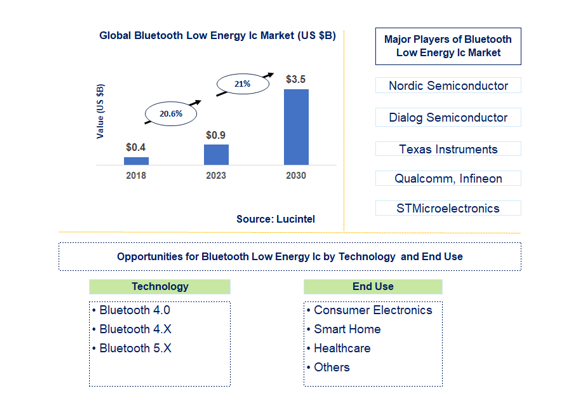
• Advancements in Range and Power Efficiency: Manufacturers are focusing on improving BLEs communication range while maintaining its hallmark low power consumption. New developments in antenna design and signal processing are extending the effective range of BLE devices without significantly increasing power consumption. This improvement makes BLE even more versatile for applications in smart homes, wearables, and industrial IoT, where longer-range connectivity is crucial.
• Integration with Mesh Networking: BLE mesh networking is an emerging trend that allows multiple devices to communicate over a larger area, creating interconnected networks. This is especially important for smart home and building automation systems, where a large number of devices need to communicate with one another. The introduction of mesh capabilities is expanding the bluetooth low energy IC market, making it a more flexible solution for IoT systems.
• Wearable and Health Monitoring Devices: BLE is becoming the standard for connectivity in health and fitness devices such as smartwatches, fitness trackers, and remote patient monitoring systems. The integration of BLE into medical devices allows for continuous data collection, remote monitoring, and health tracking. With growing health consciousness and aging populations, the demand for BLE-enabled medical devices is surging, presenting a significant growth opportunity for BLE IC manufacturers.
• Support for Low-Latency Applications: As applications requiring low latency, such as augmented reality (AR) and virtual reality (VR), become more mainstream, BLE ICs are evolving to support faster data transmission and lower latency. These improvements are crucial for real-time interactions in gaming, healthcare, and industrial applications. As BLE technology adapts to support these emerging use cases, it is likely to open up new markets and expand its presence in consumer electronics.
• Security and Privacy Enhancements: With the growing use of BLE in connected devices, the importance of secure communication has become paramount. BLE ICs are being developed with stronger encryption protocols and enhanced security features to protect sensitive data. This is particularly important in applications like healthcare, smart homes, and financial services, where privacy and data security are crucial. Manufacturers are investing in developing more secure BLE ICs to address rising concerns over data breaches and cyberattacks. These emerging trends in the bluetooth low energy IC market highlight the increasing demand for enhanced connectivity, power efficiency, and security. The focus on improving range, integrating mesh networking, supporting low-latency applications, and enhancing security is expanding BLE’s potential applications and solidifying its role in the future of IoT, wearables, healthcare, and beyond. As these trends continue to evolve, BLE IC technology will become even more integral to the growth of connected ecosystems and smart devices.
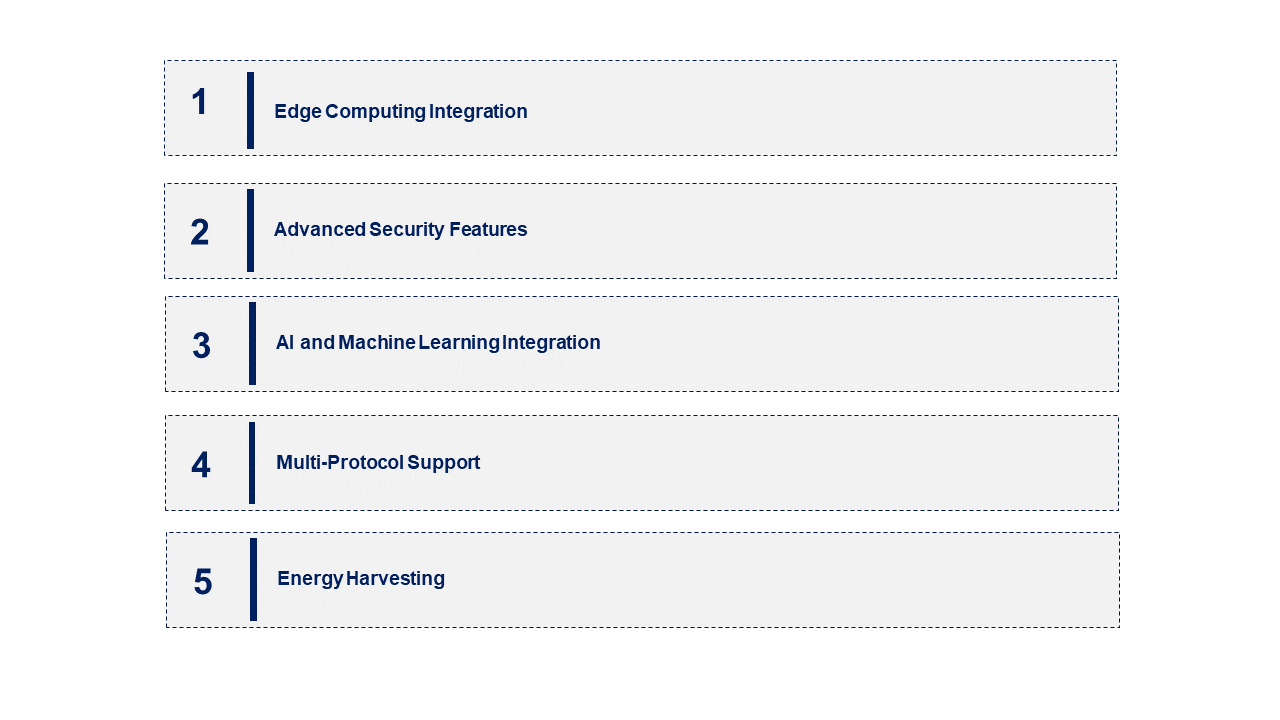
• Introduction of BLE 5.0 and 5.1: BLE 5.0 and the subsequent BLE 5.1 standard have significantly improved communication range, speed, and positioning accuracy. BLE 5.1 introduces Angle of Arrival (AoA) and Angle of Departure (AoD) technology for more precise location tracking. These advancements enhance the performance of BLE devices in applications like asset tracking, smart homes, and retail, offering users more accurate location-based services while maintaining low power consumption.
• Miniaturization of BLE ICs: Manufacturers are making significant strides in miniaturizing BLE ICs, allowing them to be embedded into smaller, more compact devices. This trend is particularly relevant for wearable technologies, such as smartwatches and fitness trackers, where size and form factor are crucial. As BLE ICs become smaller and more integrated, the potential for embedding them in a broader range of consumer and industrial devices increases.
• Low Power Consumption and Extended Battery Life: New innovations in power management and energy-efficient design are extending the battery life of BLE-enabled devices. This is especially important for wearable devices, remote sensors, and medical applications where long battery life is critical. The introduction of ultra-low-power BLE ICs is helping to reduce the frequency of battery replacements, improving the user experience in devices like health monitors, wearables, and IoT sensors.
• Expansion of BLE in Automotive Applications: BLE ICs are being integrated into a growing range of automotive applications, such as keyless entry, infotainment, and vehicle-to-vehicle communication. BLE technology allows for seamless connectivity with mobile devices, enabling features like remote diagnostics, car tracking, and personalized in-car experiences. As automotive manufacturers increasingly adopt BLE for connected car technologies, this market segment is expected to continue growing.
• Enhanced Security Features: With the increasing use of BLE in sensitive applications like healthcare and financial services, security is becoming a key focus. BLE ICs are incorporating enhanced encryption, authentication, and privacy protocols to safeguard against cyber threats. New BLE standards are focusing on improving data protection in connected devices, ensuring that personal and sensitive information is securely transmitted over wireless networks. Recent developments in the bluetooth low energy IC market reflect a clear shift toward enhanced functionality, miniaturization, energy efficiency, and security. As Bluetooth standards evolve and new features are added, BLE is becoming an even more integral technology for a wide range of applications, from healthcare to automotive. The continued focus on low power consumption, expanded range, and improved security is positioning BLE ICs as a cornerstone of the growing IoT ecosystem.
• Healthcare and Medical Devices: BLE is rapidly becoming the preferred communication protocol for healthcare and medical devices, particularly in wearables, remote monitoring, and telemedicine applications. The ability to track vital signs, such as heart rate and blood sugar, through BLE-enabled devices is helping improve patient outcomes. With an aging population and growing healthcare demands, BLE ICs are positioned to support a surge in connected health devices, offering a significant growth opportunity.
• Smart Homes and IoT Devices: The rise of smart homes and IoT ecosystems is one of the key drivers of growth in the bluetooth low energy IC market. BLE’s energy efficiency and low-cost implementation make it ideal for connecting a wide variety of devices, including thermostats, lights, locks, and security cameras. As the smart home market expands, BLE will play a crucial role in enabling seamless communication and interoperability among connected devices.
• Automotive Applications: The automotive industry presents substantial growth opportunities for BLE ICs, particularly in applications like keyless entry, in-vehicle connectivity, and vehicle tracking. With the growing trend of connected vehicles, BLE technology will enable smoother interaction between vehicles and mobile devices, allowing for remote diagnostics, location-based services, and infotainment features. As car manufacturers adopt more wireless technologies, the automotive sector is becoming a significant growth area for BLE ICs.
• Wearables and Consumer Electronics: BLE is a core technology in wearables such as smartwatches, fitness trackers, and headphones. As consumer electronics continue to evolve, there is an increasing demand for low-power wireless connectivity in personal gadgets. BLEs ability to deliver long battery life while maintaining seamless communication makes it an essential component in the next generation of wearable technologies.
• Industrial and Asset Tracking Applications: BLE is being increasingly used in industrial IoT (IIoT) applications, including asset tracking, fleet management, and equipment monitoring. BLEs low-power, long-range capabilities make it an ideal solution for tracking and managing assets across large facilities or transportation networks. As industries embrace digital transformation, the demand for BLE-enabled tracking solutions will continue to grow. The bluetooth low energy IC market is seeing significant growth across various sectors, driven by increasing demand for connectivity, energy-efficient communication, and low-cost solutions. The expansion of BLE in healthcare, smart homes, automotive, wearables, and industrial IoT represents a wide array of strategic growth opportunities. As the adoption of connected devices continues to rise, BLE will play an increasingly crucial role in enabling the seamless communication that underpins these innovations.
• Qualcomm Inc.
• Nordic Semiconductor ASA
• Texas Instruments Inc.
• NXP Semiconductors N.V.
• Broadcom Inc.
• STMicroelectronics N.V.
• Dialog Semiconductor PLC
• Microchip Technology Inc.
• Cypress Semiconductor Corporation
• Silicon Labs
• Single-Mode
• Dual-Mode
• Consumer Electronics
• Automotive
• Healthcare
• Smart Home
• Industrial Automation
• Others
• BFSI
• Retail
• IT & Telecommunications
• Others
• North America
• Europe
• Asia Pacific
• The Rest of the World
• United States: In the United States, the bluetooth low energy IC market is seeing significant expansion, primarily due to the proliferation of smart home technologies and wearables. Major players like Qualcomm and Broadcom are driving innovation, focusing on ultra-low power consumption and enhanced connectivity. The demand for BLE ICs in applications such as healthcare, fitness tracking, and automotive is also on the rise, supporting the broader growth of the market.
• China: China is rapidly emerging as a dominant player in the bluetooth low energy IC market, driven by strong demand for IoT and consumer electronics. The country’s substantial manufacturing base allows for competitive pricing and mass production of BLE-enabled devices. Additionally, government initiatives to boost the adoption of smart cities and connected infrastructure are further accelerating the demand for Bluetooth solutions.
• Germany: Germanys bluetooth low energy IC market is largely influenced by its automotive, industrial, and healthcare sectors. Innovations in connected vehicle technologies, Industry 4.0, and medical devices are the primary drivers. Germany is also focusing on the integration of BLE technology into factory automation systems and medical equipment, promoting greater efficiency and performance. German companies are investing in R&D to expand the functionality and interoperability of BLE solutions.
• India: Indias bluetooth low energy IC market is growing rapidly due to increasing penetration of smartphones, wearables, and smart home devices. Rising disposable income and a growing tech-savvy population contribute to the adoption of BLE-enabled devices. Additionally, India’s burgeoning startup ecosystem is fostering innovation in BLE applications across various sectors, including healthcare and agriculture.
• Japan: Japan has long been a leader in consumer electronics, and its bluetooth low energy IC market continues to thrive due to increasing demand for connected devices. With a focus on smart homes, healthcare, and automotive applications, Japan is investing in advanced BLE technologies to enhance user experiences. The country’s strong infrastructure for research and development supports continuous innovation in this sector.


• Qualcomm Inc.
• Nordic Semiconductor ASA
• Texas Instruments Inc.
• NXP Semiconductors N.V.
• Broadcom Inc.
• STMicroelectronics N.V.
• Dialog Semiconductor PLC
• Microchip Technology Inc.
• Cypress Semiconductor Corporation
• Silicon Labs Q5. Which bluetooth low energy IC market segment will be the largest in future? Answer: Lucintel forecasts that, within the type category, single-mode is expected to witness higher growth over the forecast period. Q6. In bluetooth low energy IC market, which region is expected to be the largest in next 5 years? Answer: In terms of region, North America is expected to witness the highest growth over the forecast period. Q7. Do we receive customization in this report? Answer: Yes, Lucintel provides 10% customization without any additional cost.


Choose a license that fits your team. Instant PDF delivery.
Prices exclude taxes. Instant delivery. Custom licensing available on request.
Market Report · July 29, 2026
Market Report · July 20, 2026
Market Report · July 20, 2026
Trusted partner for strategic intelligence and business growth


Receive a complimentary market analysis tailored to your industry. Our analysts will identify key growth opportunities and competitive dynamics specific to your business.

Market size, growth rate, and key trend analysis for your specific sector.

Top competitor positioning and market share analysis.

Strategic recommendations backed by data-driven insights.
Get curated market intelligence and competitive moves straight to your inbox.
By subscribing, you agree to receive our monthly insights. Unsubscribe anytime.
Receive a complimentary market analysis tailored to your industry. Our analysts will identify key growth opportunities and competitive dynamics specific to your business.
Market size, growth rate, and key trend analysis for your specific sector.
Top competitor positioning and market share analysis.
Strategic recommendations backed by data-driven insights.
Get curated market intelligence, emerging trends, and competitive moves straight to your inbox each month.
By subscribing, you agree to receive our monthly insights. Unsubscribe anytime.
We'll send your sample report shortly.