
Market Report · July 22, 2026

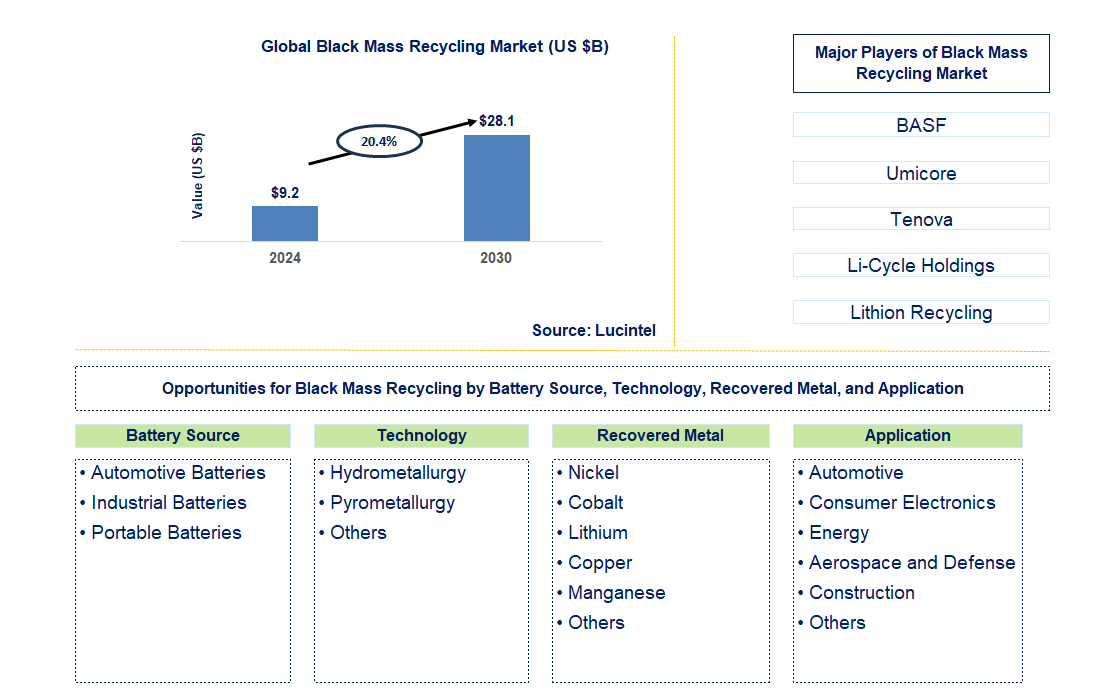
Key data points: The market size in 2030 = $28.1 billion, growth forecast = 20.4% annually for the next 6 years. Scroll below to get more insights. This market report covers trends, opportunities, and forecasts in the global black mass recycling market to 2030 by battery source (automotive batteries, industrial batteries, and portable batteries), technology (hydrometallurgy, pyrometallurgy, and others), recovered metal (nickel, cobalt, lithium, copper, manganese, and others), application (automotive, consumer electronics, energy, aerospace and defense, construction, and others), and region (North America, Europe, Asia Pacific, and the Rest of the World)
We'll send your sample report shortly.
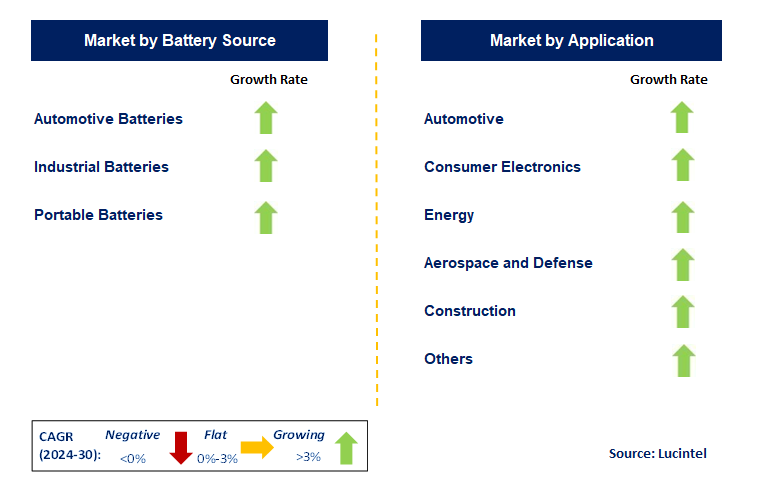
• Lucintel forecasts that, within the battery source category, automotive battery is expected to witness the highest growth over the forecast period.
• Within the application, automotive is expected to witness the highest growth over the forecast period.
• In terms of regions, APAC is expected to witness highest growth over the forecast period. Gain valuable insight for your business decisions with our comprehensive 150+ page report
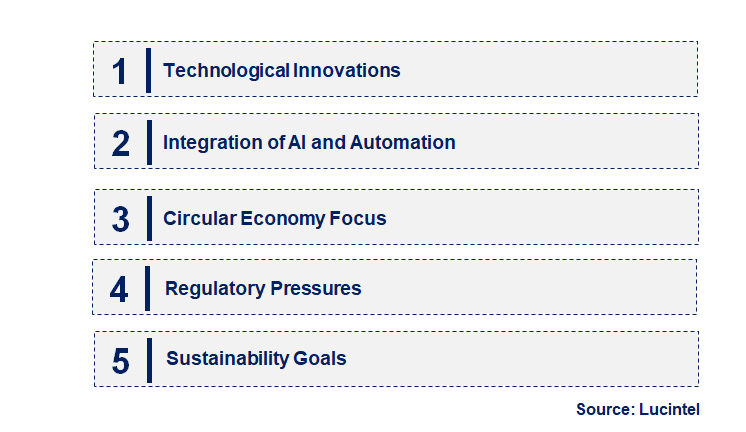
• Technological innovations: Advancements in hydrometallurgical and pyrometallurgical processes enhance the efficiency of metal recovery from black mass.
• Integration of AI and automation: The use of artificial intelligence and robotics streamlines the sorting and processing of black mass, improving accuracy and efficiency.
• Circular economy focus: Companies increasingly adopt closed-loop recycling systems to reduce waste and recycle black mass back into the production cycle.
• Regulatory pressures: Stricter regulations and government incentives drive investment in advanced recycling technologies and infrastructure.
• Sustainability goals: The emphasis on sustainability pushes companies to enhance the recovery of valuable metals and reduce environmental impact. Emerging trends in the black mass recycling market highlight a shift towards technological innovation, regulatory compliance, and sustainability, driving advancements in the field.
• Advanced recovery techniques: Companies adopt new recovery methods, such as direct recycling, to efficiently extract metals from black mass.
• Large-scale facilities: Major players establish state-of-the-art recycling plants to handle increasing volumes of black mass and improve recovery rates.
• Government support: Increased government funding and incentives support research and development in black mass recycling technologies.
• Collaborative projects: Partnerships between technology firms and automotive manufacturers enhance the recycling of black mass from electric vehicle batteries.
• Innovation in processing equipment: The development of new processing equipment improves the efficiency and scalability of black mass recycling operations.
• Focus on environmental impact: There is a growing focus on minimizing environmental impact by reducing the carbon footprint associated with black mass recycling. Recent developments in black mass recycling showcase advancements in recovery techniques, infrastructure growth, and government support, driving the evolution of the market.
• Battery recycling: Expanding technologies for recycling black mass from lithium-ion and other batteries offer significant growth potential due to increasing battery use.
• Electronic waste: Developing methods to process black mass from electronic waste can address the growing volume of discarded electronics.
• Automotive sector: Innovations in black mass recycling for automotive batteries and components can support the transition to electric vehicles and sustainable practices.
• Consumer electronics: Opportunities exist in recycling black mass from consumer electronics like smartphones and laptops, driven by high turnover rates.
• Industrial equipment: Advanced recycling techniques for black mass from industrial machinery enhance resource recovery and sustainability.
• Material recovery facilities: Investing in recycling infrastructure and processing facilities improves the efficiency of black mass recycling operations. The black mass recycling market offers strategic growth opportunities in key applications, driven by technological advancements and increasing demand for sustainable recycling solutions.
• Regulatory support: Increasing regulations and government incentives for recycling technologies are driving market growth.
• Technological advancements: Innovations in recycling processes and recovery techniques are enhancing efficiency and scalability.
• Sustainability initiatives: A growing focus on sustainability and resource conservation is promoting the adoption of black mass recycling technologies.
• Rising e-waste: The increasing volume of electronic waste provides a steady supply of black mass and drives the need for advanced recycling solutions.
• Investment in research and development: Significant private and public investment in research and development is fueling technological advancements in black mass recycling. Challenges in the black mass recycling market are:
• High costs: The initial capital expenditure for advanced recycling technologies can be a barrier to entry.
• Technical complexity: The complexity of processing black mass and extracting valuable metals presents technical challenges.
• Infrastructure gaps: Insufficient recycling infrastructure and facilities can limit the scalability of black mass recycling operations.
• Market volatility: Fluctuations in the prices of recovered metals can impact the financial viability of recycling projects.
• Regulatory variability: Navigating different regulatory standards and requirements across regions can be challenging. While the black mass recycling market is driven by regulatory support, technological advancements, and sustainability goals, it faces challenges related to costs, technical complexity, and infrastructure, which need to be addressed for continued growth and efficiency.
• BASF
• Umicore
• Tenova
• Li-Cycle Holdings
• Lithion Recycling
• AKKUSER
• Duesenfeld
• Aqua Metals
• SungEel Hi-Tech
• Fortum
• Automotive Batteries
• Industrial Batteries
• Portable Batteries
• Hydrometallurgy
• Pyrometallurgy
• Others
• Nickel
• Cobalt
• Lithium
• Copper
• Manganese
• Others
• Automotive
• Consumer Electronics
• Energy
• Aerospace and Defense
• Construction
• Others
• North America
• Europe
• Asia Pacific
• The Rest of the World
• USA: In the United States, the black mass recycling market has seen significant advancements, particularly in battery recycling. American Battery Technology Company has pioneered a novel process for extracting valuable metals from black mass, which is the residue from spent lithium-ion batteries. Redwood Materials has launched a large-scale recycling facility in Nevada, focusing on the recovery of lithium, cobalt, and nickel from black mass. The Biden Administration has prioritized investment in critical mineral recycling through the Infrastructure Investment and Jobs Act, supporting research and development in advanced recycling technologies. Additionally, several U.S. firms collaborate with automotive manufacturers to enhance the recycling of EV batteries.
• China: China has made considerable progress in black mass recycling due to its large-scale battery production and consumption. GEM Co. Ltd. has implemented advanced black mass recycling technologies to recover metals like lithium, cobalt, and nickel from spent batteries. The Chinese government has introduced policies to promote the development of recycling technologies, including subsidies for black mass recycling ventures. Additionally, China's focus on environmental protection has led to the establishment of recycling centers specifically designed to handle black mass from electronic waste. Companies are exploring closed-loop recycling systems to enhance the efficiency of metal recovery.
• India: In India, the black mass recycling market is evolving with new initiatives and technological advancements. Sresta and Ecosphere Technologies are developing innovative methods to recover valuable metals from black mass, particularly from electronic waste. The Indian government has launched the National E-Waste Management Rules, emphasizing improved recycling practices and technology adoption. Additionally, companies like Tata Chemicals invest in research to enhance black mass processing techniques. Efforts are also underway to establish recycling facilities focusing on the efficient extraction of metals from black mass generated by the growing use of electronic devices.
• Japan: Japan is advancing in black mass recycling through technological innovation and strategic initiatives. Panasonic and NEC are developing cutting-edge technologies for recovering metals from black mass generated by used batteries and electronic waste. The Japanese government has introduced policies to support the growth of recycling technologies, including the Resource Recycling Law, which promotes efficient recycling practices. Additionally, Japan's research institutions focus on enhancing the efficiency of black mass processing and metal recovery. Companies are investing in automation and robotics to improve the sorting and processing of black mass materials.


• BASF
• Umicore
• Tenova
• Li-Cycle Holdings
• Lithion Recycling
• AKKUSER
• Duesenfeld
• Aqua Metals
• SungEel Hi-Tech
• Fortum Q6. Which black mass recycling market segment will be the largest in future? Answer: Lucintel forecasts that automotive battery is expected to witness the highest growth over the forecast period. Q7. In black mass recycling market, which region is expected to be the largest in next 5 years? Answer: In terms of regions, APAC is expected to witness highest growth over the forecast period. Q.8 Do we receive customization in this report? Answer: Yes, Lucintel provides 10% customization without any additional cost.


Choose a license that fits your team. Instant PDF delivery.
Prices exclude taxes. Instant delivery. Custom licensing available on request.
Market Report · July 22, 2026
Market Report · July 22, 2026
Market Report · July 22, 2026
Trusted partner for strategic intelligence and business growth


Receive a complimentary market analysis tailored to your industry. Our analysts will identify key growth opportunities and competitive dynamics specific to your business.

Market size, growth rate, and key trend analysis for your specific sector.

Top competitor positioning and market share analysis.

Strategic recommendations backed by data-driven insights.
Get curated market intelligence and competitive moves straight to your inbox.
By subscribing, you agree to receive our monthly insights. Unsubscribe anytime.
Receive a complimentary market analysis tailored to your industry. Our analysts will identify key growth opportunities and competitive dynamics specific to your business.
Market size, growth rate, and key trend analysis for your specific sector.
Top competitor positioning and market share analysis.
Strategic recommendations backed by data-driven insights.
Get curated market intelligence, emerging trends, and competitive moves straight to your inbox each month.
By subscribing, you agree to receive our monthly insights. Unsubscribe anytime.
We'll send your sample report shortly.