
Market Report · July 29, 2026

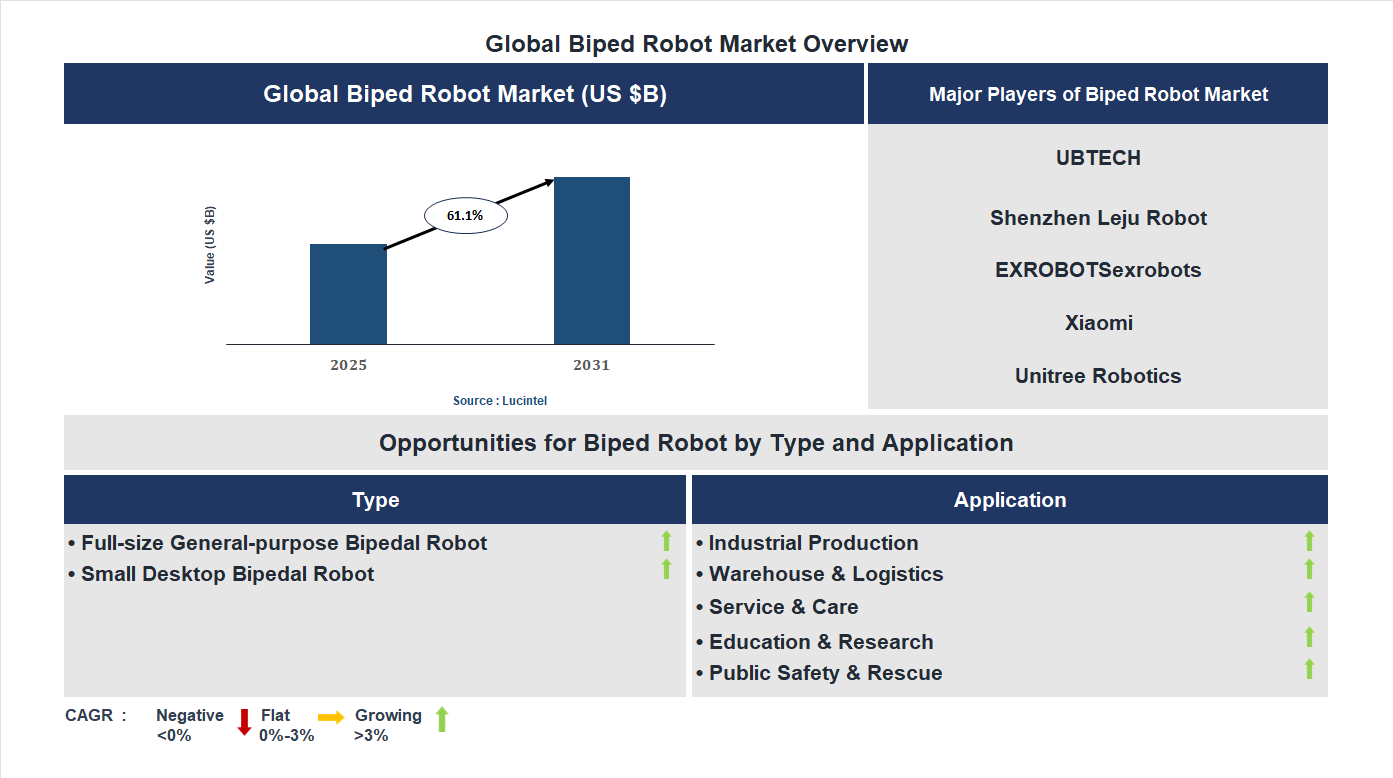
Key data points: The growth forecast = 61.1% annually for the next 7 years. Scroll below to get more insights. This market report covers trends, opportunities and forecasts in biped robot market to 2031 by type (full-size general-purpose bipedal robot and small desktop bipedal robot), application (industrial production, warehouse & logistics, service & care, education & research, and public safety & rescue), and region (North America, Europe, Asia Pacific, and the Rest of the World)
We'll send your sample report shortly.
• Lucintel forecasts that, within the type category, small desktop bipedal robot is expected to witness higher growth over the forecast period.
• Within the application category, education & research is expected to witness the highest growth.
• In terms of region, APAC is expected to witness the highest growth over the forecast period. Gain valuable insights for your business decisions with our comprehensive 150+ page report. Sample figures with some insights are shown below.
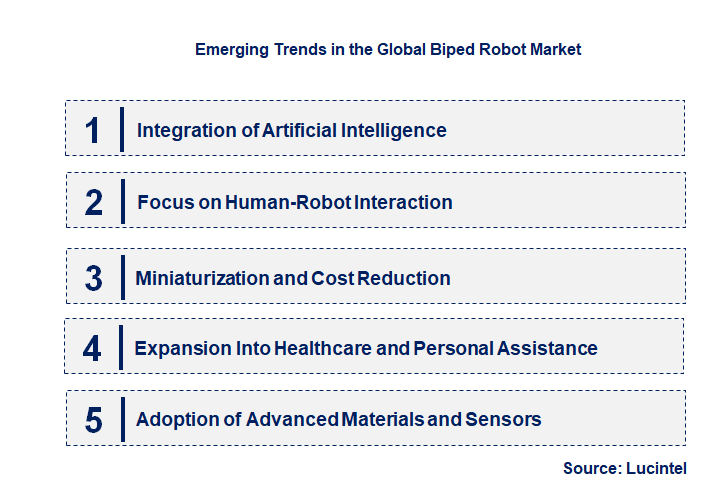
• Integration of Artificial Intelligence: AI is increasingly embedded in biped robots to enhance autonomy and decision-making capabilities. This integration allows robots to perform complex tasks, adapt to new environments, and interact more naturally with humans. AI-driven biped robots are improving in areas such as navigation, object recognition, and speech processing, making them suitable for applications like customer service, healthcare assistance, and security. The impact is significant, as AI enables more intelligent, versatile, and responsive robots, broadening their usability and acceptance across industries.
• Focus on Human-Robot Interaction: Advances in HRI are making biped robots more user-friendly and capable of engaging with humans seamlessly. Developers are emphasizing natural language processing, emotional recognition, and intuitive interfaces to improve communication. This trend enhances user experience, especially in sectors like healthcare, education, and entertainment, where robots serve as companions or assistants. The improved interaction capabilities foster greater trust and adoption, ultimately expanding the market by making robots more accessible and effective in social contexts.
• Miniaturization and Cost Reduction: Technological innovations are enabling the development of smaller, more affordable biped robots. Miniaturization of components, along with mass production techniques, is decreasing manufacturing costs, making these robots accessible to a broader audience. This trend is particularly impactful for consumer markets, educational institutions, and small businesses seeking cost-effective robotic solutions. As prices decline, adoption accelerates, and new use cases emerge, fueling market growth and encouraging innovation in design and functionality.
• Expansion into Healthcare and Personal Assistance: Biped robots are increasingly being tailored for healthcare and personal assistance roles. They assist elderly and disabled individuals, provide physical therapy, and support daily activities. This trend is driven by aging populations and the need for cost-effective, reliable care solutions. The impact includes improved quality of life for users, reduced caregiver burden, and new business opportunities for companies developing specialized robots. As these robots become more capable and affordable, their integration into healthcare systems is expected to grow significantly.
• Adoption of Advanced Materials and Sensors: The use of cutting-edge materials and sensors is enhancing robot durability, flexibility, and sensory perception. Lightweight composites, flexible joints, and high-precision sensors enable biped robots to perform more complex and dynamic movements. This trend improves stability, safety, and adaptability in various environments, including uneven terrains and crowded spaces. The impact is a broader application scope, increased operational efficiency, and improved safety standards, making biped robots more reliable and versatile in real-world scenarios. In summary, these emerging trends are fundamentally reshaping the biped robot market by making robots smarter, more interactive, affordable, and adaptable. They are expanding the applications across industries, improving user experiences, and driving market growth. As these developments continue, the market is poised for significant transformation, with biped robots becoming integral to everyday life and industrial processes.
• Advancements in Artificial Intelligence: Integration of AI has enabled biped robots to perform complex tasks with higher autonomy and decision-making capabilities, improving their usefulness in real-world applications and increasing market adoption.
• Enhanced Mobility and Balance Technologies: Innovations in sensors and actuators have significantly improved robots stability and agility, allowing them to navigate diverse terrains and perform intricate movements, broadening their application scope.
• Cost Reduction and Mass Production: Efforts to streamline manufacturing processes have lowered production costs, making biped robots more affordable for small and medium enterprises, thus expanding market reach and adoption.
• Application Expansion in Healthcare and Service Sectors: Deployment of biped robots in healthcare for patient assistance and in service industries for customer interaction has increased, demonstrating their versatility and driving market growth.
• Integration with IoT and Cloud Computing: Connecting biped robots to IoT networks and cloud platforms has enhanced their data processing, remote control, and maintenance capabilities, leading to smarter and more efficient robotic systems. These developments are collectively transforming the biped robot market by making robots more intelligent, affordable, and versatile. They are accelerating adoption across diverse sectors, fostering innovation, and paving the way for widespread integration of biped robots into everyday life and industry operations.
• Expansion in Healthcare Applications: Biped robots are increasingly used for patient assistance, rehabilitation, and elderly care. Their ability to mimic human movement enhances interaction and support, leading to improved patient outcomes and operational efficiency in healthcare facilities.
• Industrial Automation and Manufacturing: Integration of biped robots in manufacturing processes boosts productivity and precision. Their ability to perform complex tasks and navigate dynamic environments reduces labor costs and enhances safety standards.
• Service and Hospitality Sectors: Biped robots are transforming customer service by providing information, guiding visitors, and delivering goods. Their human-like interaction capabilities improve customer experience and operational efficiency in hotels, airports, and retail outlets.
• Defense and Security Applications: Biped robots are being deployed for surveillance, reconnaissance, and disaster response. Their mobility and adaptability in challenging terrains enhance safety and operational effectiveness in security missions.
• Research and Development in Human-Robot Interaction: Advancements in AI and machine learning are improving robot autonomy and interaction. This fosters more natural and effective communication between humans and robots, expanding their application scope and acceptance. In summary, these growth opportunities are significantly impacting the biped robot market by expanding its application base, increasing adoption across sectors, and driving technological innovation. As these opportunities mature, they are expected to accelerate market growth, create new revenue streams, and establish biped robots as integral components in diverse industries worldwide.
• Technological Innovation: The rapid development of robotics, AI, and sensor technologies enhances biped robot capabilities, making them more adaptable and efficient. These innovations enable applications in healthcare, entertainment, and industrial automation, fueling market growth. As technology becomes more affordable and sophisticated, companies can develop more advanced robots, increasing adoption rates. The integration of machine learning allows for improved autonomy and decision-making, further expanding use cases. Continuous R&D investments are expected to sustain this momentum, making biped robots more accessible and functional across diverse sectors.
• Rising Industrial Automation Demand: Industries such as manufacturing, logistics, and healthcare are increasingly adopting automation solutions to improve efficiency and reduce labor costs. Biped robots, with their human-like mobility, are particularly suited for tasks requiring interaction with human environments. The demand for automation in warehouses, delivery services, and healthcare facilities is a significant driver. As companies seek to optimize operations, the deployment of biped robots is expected to grow, supported by government incentives and industry initiatives aimed at modernizing infrastructure.
• Increasing Investment and Funding: Venture capital, government grants, and corporate investments are fueling innovation and commercialization of biped robots. Funding supports startups and established companies in developing more capable and affordable robots. This influx of capital accelerates product development cycles and expands market reach. Strategic partnerships and collaborations also enhance technological capabilities and market penetration. As investment continues to rise, the market is poised for rapid expansion, with new entrants and innovative solutions emerging regularly.
• Growing Applications in Healthcare and Service Sectors: Biped robots are increasingly used in healthcare for patient assistance, rehabilitation, and eldercare, as well as in service industries like hospitality and retail. Their human-like movement and interaction capabilities make them ideal for roles that require social engagement. The aging population and rising healthcare costs are driving demand for robotic solutions that can provide support and improve quality of life. Similarly, service robots are enhancing customer experiences in various settings, creating new revenue streams and market opportunities. The challenges facing this biped robot market include:-
• High Development and Manufacturing Costs: Developing advanced biped robots involves significant investment in research, materials, and manufacturing processes. The complexity of designing robots that can mimic human movement and adapt to diverse environments increases costs. These expenses can limit market entry for smaller firms and slow down widespread adoption. Additionally, maintenance and upgrade costs further add to the financial burden, making affordability a key concern for end-users and investors alike.
• Technical and Safety Challenges: Ensuring the reliability, safety, and robustness of biped robots remains a major hurdle. Complex algorithms and hardware must work seamlessly to prevent malfunctions that could cause harm or operational failures. Regulatory bodies require rigorous testing and certification, which can delay deployment. Moreover, developing robots capable of safe interaction with humans in unpredictable environments demands ongoing innovation and risk management, posing significant technical challenges.
• Regulatory and Ethical Concerns: The deployment of biped robots raises questions about safety standards, privacy, and ethical use. Governments and regulatory agencies are working to establish guidelines, but inconsistencies and evolving policies can create uncertainty. Ethical issues related to job displacement, decision-making autonomy, and human-robot interaction also pose societal challenges. Navigating these regulatory and ethical landscapes requires careful planning and compliance, which can slow market growth and innovation. In summary, the biped robot market is driven by technological advancements, increasing automation demand, and rising investments, which collectively foster growth and innovation. However, high costs, technical complexities, and regulatory uncertainties present significant challenges that could impede progress. The interplay of these factors will shape the market’s evolution, requiring stakeholders to balance innovation with risk management. Overall, the market holds substantial potential for expansion, provided that these drivers are harnessed effectively and challenges are addressed through strategic efforts.
• UBTECH
• Shenzhen Leju Robot
• EXROBOTSexrobots
• Xiaomi
• Unitree Robotics
• Shanghai FOURIER
• Shanghai AgiBot
• Shanghai Kepler
• MagicLab
• Beijing Iron Man Technology Co., Ltd
• Full-size General-purpose Bipedal Robot
• Small Desktop Bipedal Robot
• Industrial Production
• Warehouse & Logistics
• Service & Care
• Education & Research
• Public Safety & Rescue
• North America
• Europe
• Asia Pacific
• The Rest of the World
• United States: The US market has seen rapid innovation with major tech companies and startups developing advanced biped robots equipped with AI and machine learning. There is a focus on integrating robots into healthcare, defense, and service sectors, alongside increased government funding for robotics research. Companies like Boston Dynamics have pioneered highly agile robots, pushing the boundaries of mobility and autonomy. The US also emphasizes regulatory frameworks to ensure safety and ethical use of robots, fostering a conducive environment for market growth.
• China: China is rapidly expanding its biped robot industry through substantial government investments and strategic initiatives. The country aims to become a global leader in robotics by 2025, focusing on industrial automation, logistics, and consumer applications. Chinese firms are developing cost-effective robots with enhanced stability and adaptability, targeting mass deployment in manufacturing and service sectors. The government’s "Made in China 2025" plan emphasizes robotics innovation, leading to increased domestic production and international collaborations to accelerate technological advancements.
• Germany: Germanys market is characterized by a strong emphasis on industrial automation and precision engineering. Leading automotive and manufacturing companies are integrating biped robots to improve efficiency and safety. Germany invests heavily in research collaborations between academia and industry, fostering innovations in robot design, control systems, and human-robot interaction. The country’s focus on sustainability and Industry 4.0 initiatives has driven the adoption of intelligent biped robots in smart factories, enhancing productivity and reducing operational costs.
• India: India is witnessing a growing interest in biped robots driven by the need for automation in manufacturing, healthcare, and defense. The government’s "Make in India" initiative encourages local development and deployment of robotics solutions. Indian startups and research institutions are developing affordable, lightweight robots suitable for diverse applications, including elder care and logistics. The market is also benefiting from increased foreign investment and collaborations, aiming to bridge the technological gap and promote indigenous innovation in robotics.
• Japan: Japan remains a pioneer in robotics, with a long-standing tradition of developing humanoid and biped robots. The focus is on enhancing robot-human interaction, especially in elder care and service industries amid an aging population. Japanese companies are advancing in robot dexterity, sensory perception, and AI integration. The government supports robotics through policies promoting innovation and international cooperation. Japan’s market continues to lead in research, with a strong emphasis on creating robots that can seamlessly assist humans in daily life and work environments.


• UBTECH
• Shenzhen Leju Robot
• EXROBOTSexrobots
• Xiaomi
• Unitree Robotics
• Shanghai FOURIER
• Shanghai AgiBot
• Shanghai Kepler
• MagicLab
• Beijing Iron Man Technology Co., Ltd Q5. Which biped robot market segment will be the largest in future? Answer: Lucintel forecasts that, within the type category, small desktop bipedal robot is expected to witness higher growth over the forecast period. Q6. In biped robot market, which region is expected to be the largest in next 5 years? Answer: In terms of region, APAC is expected to witness the highest growth over the forecast period. Q7. Do we receive customization in this report? Answer: Yes, Lucintel provides 10% customization without any additional cost.


Choose a license that fits your team. Instant PDF delivery.
Prices exclude taxes. Instant delivery. Custom licensing available on request.
Market Report · July 29, 2026
Market Report · July 20, 2026
Market Report · July 20, 2026
Trusted partner for strategic intelligence and business growth


Receive a complimentary market analysis tailored to your industry. Our analysts will identify key growth opportunities and competitive dynamics specific to your business.

Market size, growth rate, and key trend analysis for your specific sector.

Top competitor positioning and market share analysis.

Strategic recommendations backed by data-driven insights.
Get curated market intelligence and competitive moves straight to your inbox.
By subscribing, you agree to receive our monthly insights. Unsubscribe anytime.
Receive a complimentary market analysis tailored to your industry. Our analysts will identify key growth opportunities and competitive dynamics specific to your business.
Market size, growth rate, and key trend analysis for your specific sector.
Top competitor positioning and market share analysis.
Strategic recommendations backed by data-driven insights.
Get curated market intelligence, emerging trends, and competitive moves straight to your inbox each month.
By subscribing, you agree to receive our monthly insights. Unsubscribe anytime.
We'll send your sample report shortly.