
Market Report · July 22, 2026

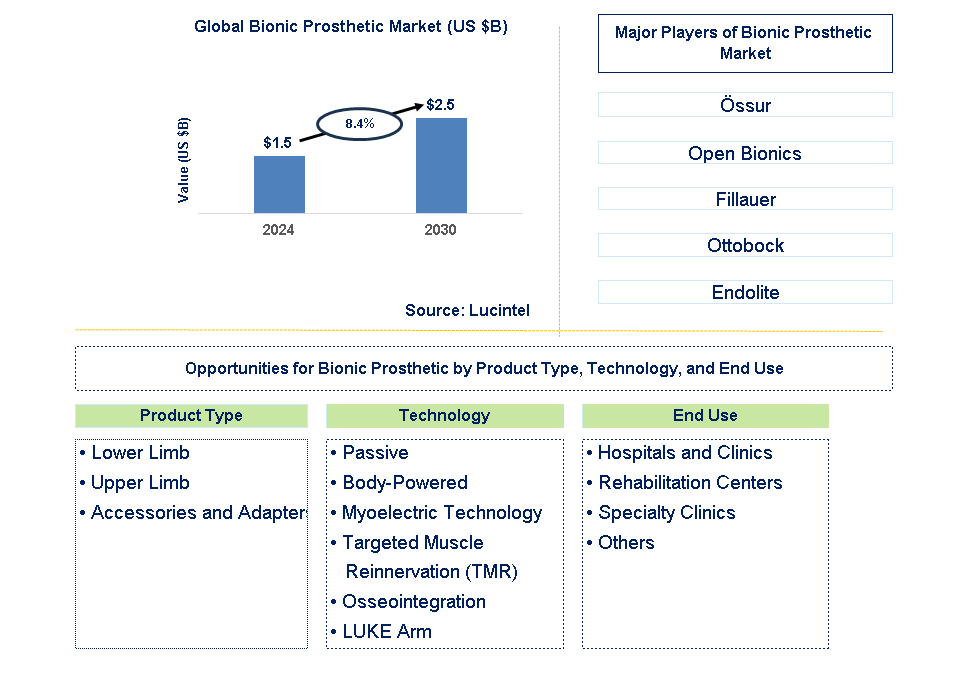
Key data points: The market size in 2030 = $2.4 billion, growth forecast = 8.4% annually next 6 years. Scroll below to get more insights. This market report covers trends, opportunities, and forecast in the global bionic prosthetic market to 2030 by product type (lower limb, upper limb, and accessories and adapters), technology (passive, body-powered, myoelectric technology, targeted muscle reinnervation (TMR), osseointegration, and luke arm), end use (hospitals and clinics, rehabilitation centers, specialty clinics, and others), and region (North America, Europe, Asia Pacific, and the Rest of the World)
We'll send your sample report shortly.
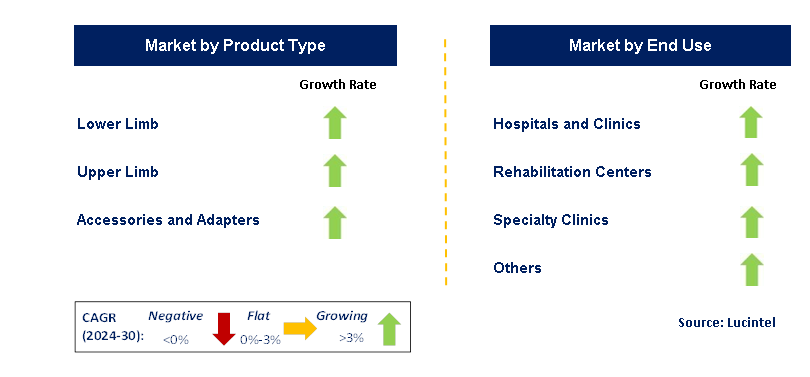
• Lucintel forecasts that lower limb is expected to witness the highest growth over the forecast period.
• Within this market, hospital and clinic is expected to witness the highest growth over the forecast period.
• North America will remain the largest region over the forecast period.
• USA: Advancements of bionic prosthetics in the US are focused on integration with AI and machine learning to enhance functionality. Such companies are developing prosthetics that can learn their user's movements, providing a realistic experience. In addition to regulatory approvals that have recently accelerated the speed for market, accessibility to advanced technologies such as myoelectric prosthetics is achievable. Collaborations between tech companies and healthcare providers are also paving ways for innovations targeted at optimizing patient outcomes.
• China: The market for bionic prosthetics is growing at a lightning pace in China, with increasing investment in health technology and an increase in the number of manufacturers. Recent Trends include the launching of affordable, quality prosthetics to cater to variety needs of consumers. The market has also been driven by policies related to government policies for the up-scaling of healthcare infrastructure. Advances in materials and manufacturing processes are also moving towards building prosthetic devices that become lighter yet stronger, thereby making it more comfortable for users while improving mobility.
• Germany: Germany is indeed the true leader in bionic prosthetics innovation, especially with precision engineering and sources of high quality materials. Some of the latest improvements offered in prosthetics are related to advanced features on sensors and connectivity, so that they can be more integratively mixed with the movements of the users. The German market is now very eco-friendly, such that manufacturers are now researching for an eco-friendly material for use in the production process. Research institutions work well with industries so that Germany remains at the top of bionic prosthetic industry.
• India: The bionic prosthetic market in India is highly on the rise because the awareness level and access to advanced healthcare solutions have improved significantly. Recently, low-cost prosthetic options are making high quality affordable for the masses. Local startups are emerging with adapted solutions for regional needs. Such patient outcomes and government initiatives for rehabilitation services are fueling further growth in the market.
• Japan: Japan Bionic prosthetic market is quite technological with robotics and artificial intelligence integration. The latest innovations have led to the possibility of manufacturing prosthetics to replicate actual limb movement with high accuracy. Companies are focusing on friendlier designs so that elderly patients can cope better. High demand in Japan because of an aging population forces innovation, and companies have research investments in the development of a new generation of prosthetics which provides improved mobility and independence.
• Incorporation of AI and Machine Learning: It now connects AI and machine learning that can allow the prosthetic to learn from your movements as you use the device. In other words, this technology provides more functionality that will make an experience more natural and responsive. Such that the prosthetics can change their analytical data in real time and hence effectively respond to the various activities that would make it usable and patient friendly.
• Customization and Personalization: The trend is now more of personalization bionic prosthetics. Personalization enables users to choose and obtain the features which best suit them personally. This trend makes a lot of sense because design and functionality are tailored to suit the taste and lifestyle of an individual; therefore, it enhances comfort and acceptance by the user. This personalized solution has proven to be critical in patient-centered outcomes.
• Sustainability of Materials and Production: The market for bionic prosthetics has become more sustainable because manufacturers use environment-friendly materials and processes during production. Therefore, leaving as little an environmental footprint as possible with high-quality output becomes a major commitment. Meeting demands from conscious consumers while ensuring long-term sustainability for the industry itself can be accomplished through sustainable practices.
• Telemedicine and Remote Monitoring: Telemedicine in bionic prosthetics allows for distance monitoring and consultations; thus enhancing patient care as well as follow-up. Such a trend enables health providers to monitor user progress and adjust prosthetic settings while at a distance thus enhancing the overall management of prosthetic use. Where opportunities to access specialty care can be limited, telehealth solutions have a very high value.
• Technology Interfaces with Healthcare: What is happening is that bionic prosthetic companies are now attempting to collaborate with both healthcare service providers and technology companies, which fosters innovation. It fuels such a proactive attitude toward developing leading-edge products that integrate technological capabilities with clinical knowledge. Such alliances of business associates are also required for testing newly developed products against the needs of the users as well as against regulatory benchmarks so that they help effectively in patient care.
These trends reshape the bionic prosthetic market, driving innovation, improving user experience, and advocating for sustainable practices. In this regard, the future development of bionic prosthetics for people facing mobility challenges would be more accessible.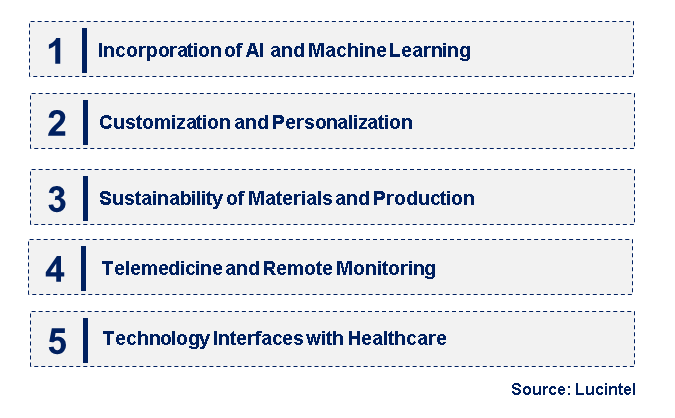
• Introduction of Myoelectric Prosthetics: Recent developments include myoelectric prosthetics, which have initiated electricity signals from the user's muscles to control motion. This ability significantly increases dexterity and enables more natural motion, further improving the functional capabilities of amputees. As these technologies become increasingly common, they are dramatically changing lives and restoring independence for amputees.
• Intelligent Prosthetics Development: New smart prosthetics are being designed with sensor and connectivity features, and they are so intelligent that they can analyze data in real time and have adaptive control. These can change according to the terrain or activity and hence improve user experience greatly. They add a lot more IoT technology, which helps monitor and maintain the device, thus improving reliability.
• Development in 3D Printing Technology: For example, bionic prosthetics are now poised to be revolutionized in the help of 3D printing technology for rapid prototyping and further customization. This reduces costs and allows for production of very lightweight prosthetics tailored to individual users with high personalization. As 3D printing becomes popular, the market will be enhanced in terms of accessibility and cost.
• More Rehabilitation Solutions Focus: Moreover, there is an increasing focus on rehabilitation solutions which accompany bionic prosthetics. Integrated therapy programs and training tools developed help the user adapt better to their devices. A holistic approach can stimulate recovery and improve overall satisfaction with the prosthetic experience.
• Market Access Expands Internationally: Manufacturers are interested in making bionic prosthetics more accessible to emerging markets. These companies are looking for more affordable and flexible solutions as companies seek greater penetration and to fulfill the needs of amputees around the globe. It is in this sense that further expansion is needed to enhance healthcare equity through the spread of these technological advancements among different populations.
These developments are dramatically reshaping the bionic prosthetic market by improving functionality, access, and customer satisfaction. Moving into the future, there will be further growth and transformations in the market through future innovations.• Emerging Markets Growth: The major growth opportunity can be identified in emerging markets, where access to advanced prosthetic solutions is still relatively low. Affordable and culturally acceptable bionic prosthetics allow manufacturers to reach new customer bases, potentially improving health care accessibility for amputees.
• Telehealth Integration Enhancements: Telehealth solutions offer an integration of the provision of telehealth into bionic prosthetic management and, hence, afford opportunities that improve the monitoring and follow-up care for patients. The use of remote technology in consultations and adjustments enables health providers to realize improved outcomes and satisfaction levels for increased demand in novel prosthetic solutions.
• Tailor-made Solutions: Customisable bionic prosthetics can be offered to increase user acceptance and comfort that result from satisfying individual preferences and needs. A trend that is being taken forward allows manufacturers to be different within a competitive market by prioritizing the concept of personalization and user-centered design.
• Focus on Rehabilitation Services: Investing in rehabilitation services that complement bionic prosthetics will be a strategic opportunity for healthcare providers as well as manufacturers. The introduction of integrated training programs and therapy solutions will contribute toward a much more effective deployment of bionic prosthetics while delivering better outcomes for patients.
• Collaboration with Research Institutions: This collaboration with research institutes brings innovation in bionic prosthetics and enables innovative solutions for the next generation of prosthetics. Thus, through such partnerships, access to research and technologies that are placed at the cutting edge will be realized; products meet user needs and regulatory requirements as they evolve.
These strategic growth opportunities are impacting the bionic prosthetic market because they call for innovation, access, and patient care. Stakeholders are utilizing these trends to expand further and shape the market.• Össur
• Open Bionics
• Fillauer
• Ottobock
• Endolite
• Mobius Bionics
• Bionic Prosthetics & Orthotics Group
• Prosthetic Orthotic Solutions International
• BionicM
• Steeper
• Lower Limb
• Upper Limb
• Accessories and Adapters
• Passive
• Body-Powered
• Myoelectric Technology
• Targeted Muscle Reinnervation (TMR)
• Osseointegration
• LUKE Arm
• Hospitals and Clinics
• Rehabilitation Centers
• Specialty Clinics
• Others
• North America
• Europe
• Asia Pacific
• The Rest of the World
• Lucintel forecasts that lower limb is expected to witness the highest growth over the forecast period.
• Within this market, hospital and clinic is expected to witness the highest growth over the forecast period.
• North America will remain the largest region over the forecast period.


• Össur
• Open Bionics
• Fillauer
• Ottobock
• Endolite
• Mobius Bionics
• Bionic Prosthetics & Orthotics Group
• Prosthetic Orthotic Solutions International
• BionicM
• Steeper
Q6. Which bionic prosthetic market segment will be the largest in future?

Choose a license that fits your team. Instant PDF delivery.
Prices exclude taxes. Instant delivery. Custom licensing available on request.
Market Report · July 22, 2026
Market Report · July 22, 2026
Market Report · July 22, 2026
Trusted partner for strategic intelligence and business growth


Receive a complimentary market analysis tailored to your industry. Our analysts will identify key growth opportunities and competitive dynamics specific to your business.

Market size, growth rate, and key trend analysis for your specific sector.

Top competitor positioning and market share analysis.

Strategic recommendations backed by data-driven insights.
Get curated market intelligence and competitive moves straight to your inbox.
By subscribing, you agree to receive our monthly insights. Unsubscribe anytime.
Receive a complimentary market analysis tailored to your industry. Our analysts will identify key growth opportunities and competitive dynamics specific to your business.
Market size, growth rate, and key trend analysis for your specific sector.
Top competitor positioning and market share analysis.
Strategic recommendations backed by data-driven insights.
Get curated market intelligence, emerging trends, and competitive moves straight to your inbox each month.
By subscribing, you agree to receive our monthly insights. Unsubscribe anytime.
We'll send your sample report shortly.