
Market Report · July 29, 2026

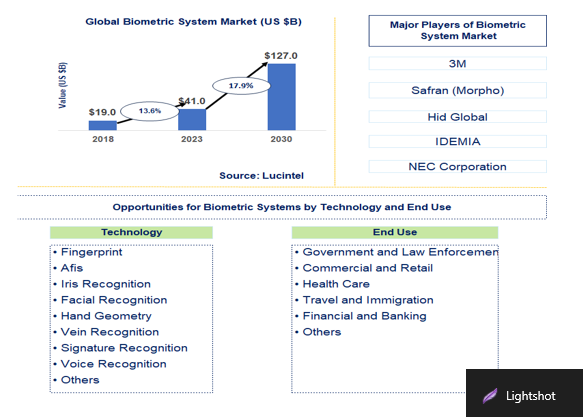
Key data points: The market size in 2024 = $127 billion, growth forecast = 17.9% annually next 7 years. Scroll below to get more insights. This market report covers trends, opportunities, and forecast in the global biometric system market to 2030 by technology (fingerprint, AFIS, iris recognition, facial recognition, hand geometry, vein recognition, signature recognition, voice recognition, and others), end use (government and law enforcement, commercial and retail, health care, travel and immigration, financial and banking, and others), and region (North America, Europe, Asia Pacific, and the Rest of the World)
We'll send your sample report shortly.
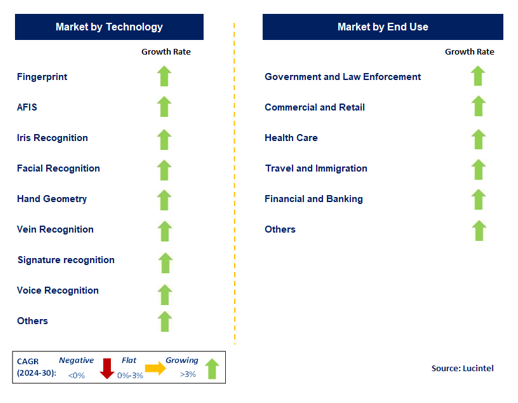
• Lucintel forecasts that AFIS will remain the largest segment over the forecast period due to increasing demand in various law enforcement and civil applications.
• Within this market, government and law enforcement will remain the largest segment due to rapid adoption of biometric technologies by government and law enforcement agencies.
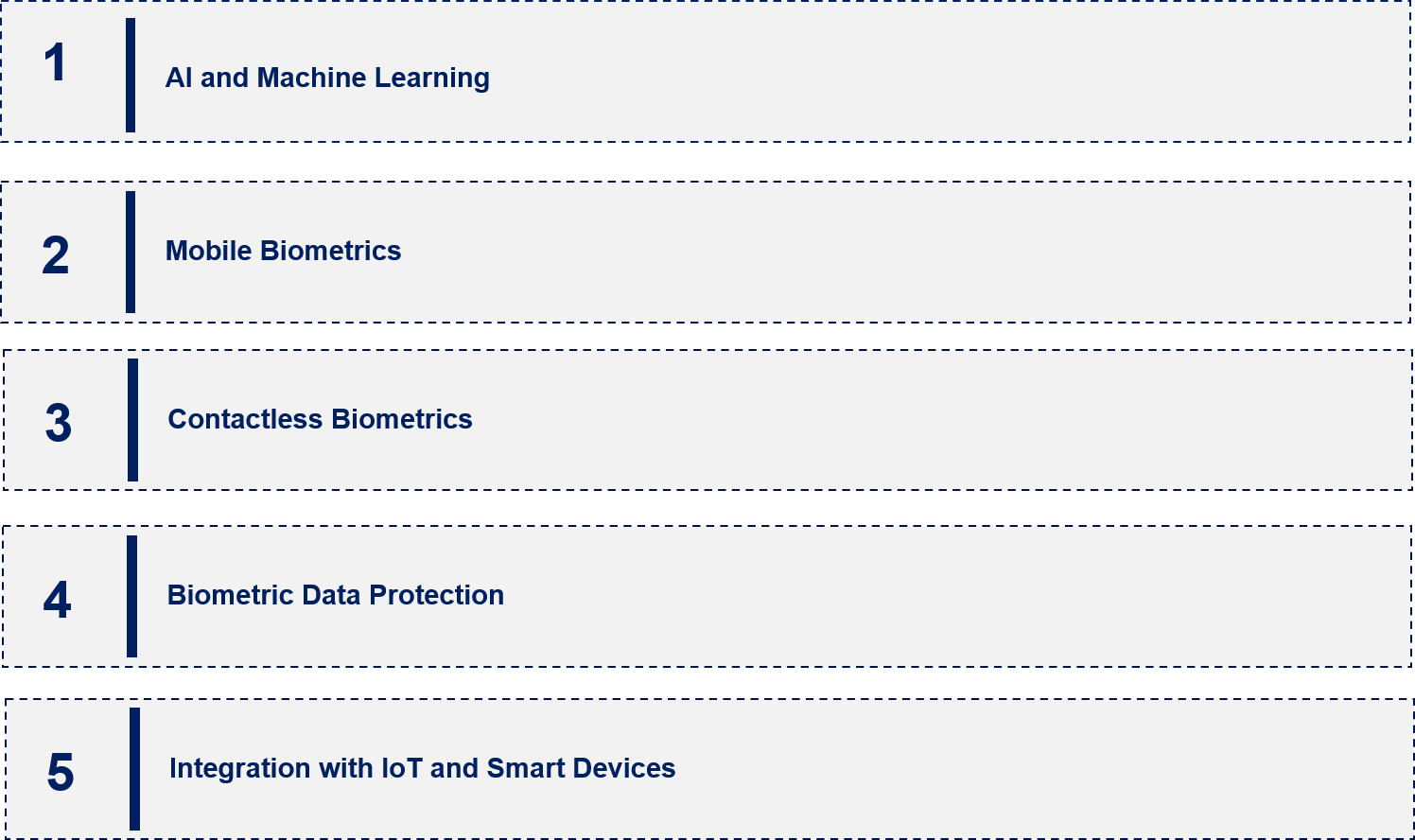
• AI and Machine Learning: AI utilization and incorporation of ML algorithms in order to improve accuracy and rapidity of biometric recognition.
• Mobile Biometrics: Increasing use of smartphones and wearable devices for secure access with payment transactions through mobile biometrics.
• Contactless Biometrics: Rise in the number of contactless biometric solutions (like facial recognition, iris scanning) due to hygiene concerns as well as COVID-19 safety protocols.
• Biometric Data Protection: Regulations governing data privacy and protection have a bearing on the design of biometric systems to ensure they are compliant while inspiring trust from users.
• Integration with IoT and Smart Devices: As such, it is now possible for one to use their biometric information through Internet of Things (IoT) gadgets and smart-home technology.
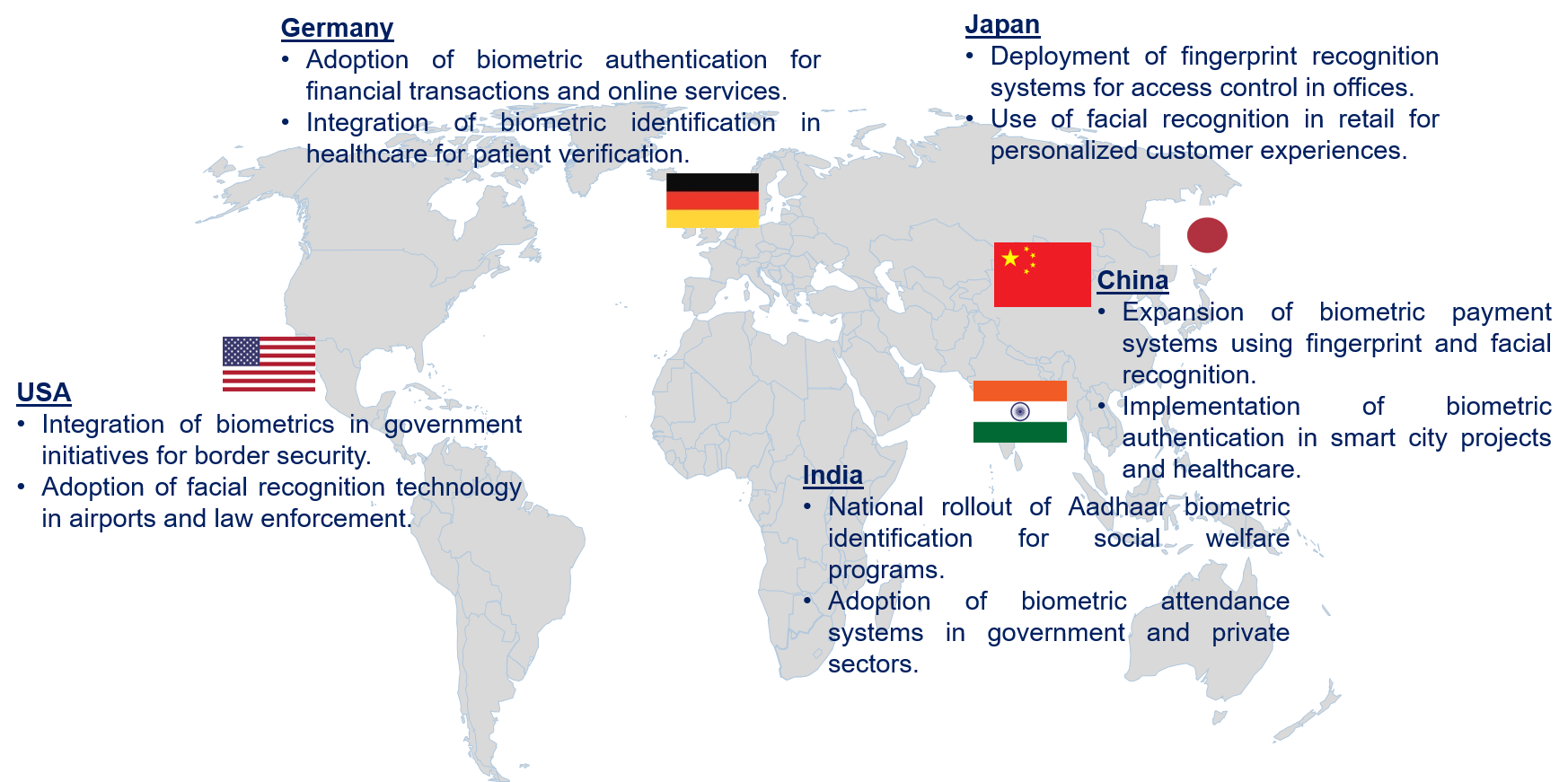
• Advances in Facial Recognition: Accuracy and speed have been improved in facial recognition technology, with a wider range of applications across different industries like retail, healthcare, and security.
• Mobile Device Biometrics Integration: Smartphone manufacturers are driving up the adoption finger printing and face recognition for secure mobile payments as well as device accessibility.
• Regulatory Developments: The development of stricter data privacy regulations such as GDPR in Europe has influenced biometric system designs that promote user consent and protection of data.
• AI and Machine Learning: The integration of AI-driven algorithms to improve the accuracy of biometric authentication especially in complex environments and multimodal biometric systems.
• Healthcare Expansion: Use of biometrics systems for patient identification, access control to healthcare facilities as well as securing electronic health records (EHRs).
• Financial Services: The financial sector has immense potential for biometric technology with a key focus on security and customer experience. To counteract fraud, boost transaction protection and simplify user authentication processes, such as in banking and payment systems, biometric identification methods like fingerprint, facial recognition and voice recognition are being integrated. The reason for this is that with the emergence of mobile banking and digital payments biometrics provide a secure way to verify identities without the use of traditional PINs or passwords.
• Government and Law Enforcement: In different parts of the world government agencies have started employing biometric systems in their operations such as border control, national identification programs and law enforcement. Facial recognition, fingerprint scanning among other things ensures accuracy while verifying identity which in turn enhances security as well as tracking individuals of interest. Additionally, there is a growing trend towards integrating biometrics into public safety initiatives and emergency response systems to improve operational efficiency and public security measures.
• Healthcare: Biometrics are used by the health industry for patient identification purposes; access control in hospitals; secure management of electronic health records (EHR). Biometrics allows accurate identification of patients thus reducing medical errors while at the same time enabling data protection through allowing controlled access to sensitive information. As healthcare institutions move towards digitization and interoperability, it becomes important to use biometrics to ensure regulatory compliance with standards such as HIPAA (Health Insurance Portability Accountability Act) which safeguard patient privacy concerns.
• Smartphones and IoT Devices: Biometric authentication has become pervasive on smartphones and IoT devices that enable secure personal device access; smart homes; connected cars etc. Such technologies make it possible to authenticate users seamlessly while providing personalized experiences using fingerprint sensors, facial recognition cameras, voice prints among others. This is because with the spread of IoT devices all over the globe including reliance on digital ecosystems – these include biometric systems that can enhance data security within connected environments thereby foster trust among users.
• Retail And Hospitality: In retailing and the hospitality sector, biometrics are employed to authenticate customers, control access and provide personalized experiences. By promoting secure transactions, smoothening hotel check-ins and providing convenient yet secure authentication methods that enhance customer loyalty programs, biometric systems have played a significant role in this area. There is also a shift of focus by retailers towards biometrics as tool for fighting fraud and enhancing operational efficiencies in customer data management as well as transaction handling. By strategically focusing on these growth opportunities, biometric system market providers can enhance product innovation, expand market reach through diverse sector applications, and strengthen partnerships for robust implementation and integration solutions, ensuring sustained growth and market leadership.
• 3M Cogent, Inc.
• Safran (Morpho)
• Hid Global
• IDEMIA
• NEC Corporation
• Thales Group
• Bio-Key, International Inc. These companies have established themselves as leaders in the biometric system industry, with extensive product portfolios, global presence, and strong research and development capabilities. They continually strive to enhance their market positions through strategic partnerships, mergers and acquisitions, and product innovations. The market share dynamics within the biometric system market are evolving, with the entry of new players and the emergence of innovative biometric system technologies. Additionally, collaborations between material suppliers, manufacturers, and end-users are fostering technological advancements and expanding market opportunities.
• Fingerprint
• AFIS
• Iris Recognition
• Facial Recognition
• Hand Geometry
• Vein Recognition
• Signature Recognition
• Voice Recognition
• Others
• Government and Law Enforcement
• Commercial and Retail
• Health Care
• Travel and Immigration
• Financial and Banking
• Others
• North America
• Europe
• Asia Pacific
• The Rest of the World
• 3M
• Safran (Morpho)
• Hid Global
• IDEMIA
• NEC Corporation
• Thales Group
• Bio-Key International Q6. Which biometric system market segment will be the largest in future? Answer: Lucintel forecasts that AFIS will remain the largest segment over the forecast period due to increasing demand in various law enforcement and civil applications. Q7. In biometric system market, which region is expected to be the largest in next 5 years? Answer: APAC is expected to witness the highest growth over the forecast period due to increasing air traffic. Q8. Do we receive customization in this report? Answer: Yes, Lucintel provides 10% customization without any additional cost.


Choose a license that fits your team. Instant PDF delivery.
Prices exclude taxes. Instant delivery. Custom licensing available on request.
Market Report · July 29, 2026
Market Report · July 20, 2026
Market Report · July 20, 2026
Trusted partner for strategic intelligence and business growth


Receive a complimentary market analysis tailored to your industry. Our analysts will identify key growth opportunities and competitive dynamics specific to your business.

Market size, growth rate, and key trend analysis for your specific sector.

Top competitor positioning and market share analysis.

Strategic recommendations backed by data-driven insights.
Get curated market intelligence and competitive moves straight to your inbox.
By subscribing, you agree to receive our monthly insights. Unsubscribe anytime.
Receive a complimentary market analysis tailored to your industry. Our analysts will identify key growth opportunities and competitive dynamics specific to your business.
Market size, growth rate, and key trend analysis for your specific sector.
Top competitor positioning and market share analysis.
Strategic recommendations backed by data-driven insights.
Get curated market intelligence, emerging trends, and competitive moves straight to your inbox each month.
By subscribing, you agree to receive our monthly insights. Unsubscribe anytime.
We'll send your sample report shortly.