
Market Report · July 29, 2026

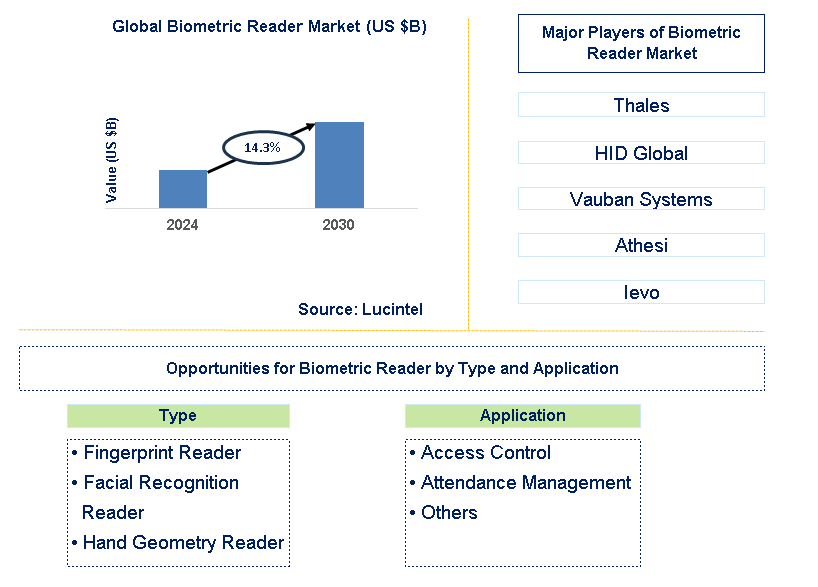
Key data points: The growth forecast = 14.3% annually for the next 6 years. Scroll below to get more insights. This market report covers trends, opportunities, and forecasts in the global biometric reader market to 2030 by type (fingerprint reader, facial recognition reader, and hand geometry reader), application (access control, attendance management, and others), and region (North America, Europe, Asia Pacific, and the Rest of the World)
We'll send your sample report shortly.
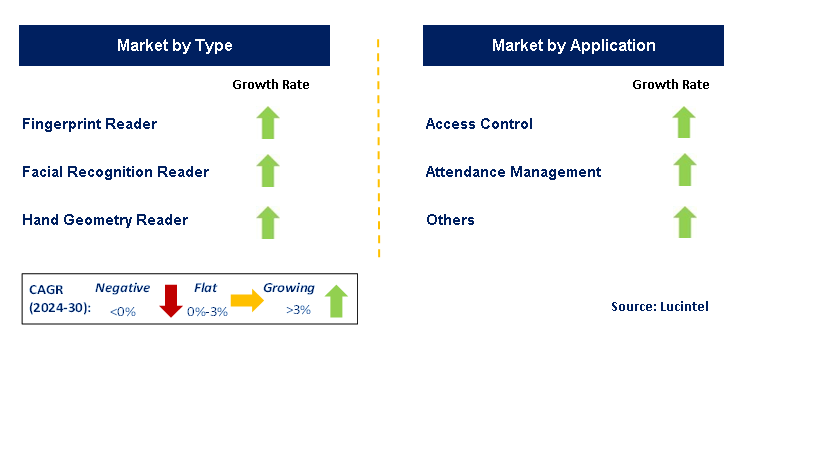
• Lucintel forecasts that, within the type category, fingerprint reader is expected to witness the highest growth over the forecast period.
• Within the application category, access control is expected to witness a higher growth.
• In terms of regions, APAC is expected to witness highest growth over the forecast period. Gain valuable insight for your business decisions with our comprehensive 150+ page report
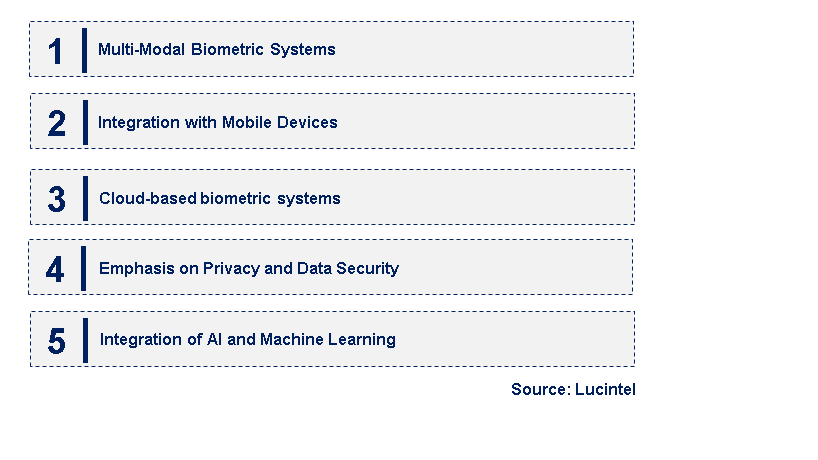
• Multi-Modal Biometric Systems: Currently, these are the trending subjects that combine different biometric modalities, such as fingerprint and facial recognition. This allows for higher accuracy and reliability at even high-security sites, minimizing the chances of false positives.
• Integration with Mobile Devices: Integration with mobile devices is also a popular trend. The combination of biometric readers with smartphones and tablets provides users with convenience, enabling secure authentication for mobile payments, application access, and several other activities that encourage users' eventual adoption in everyday transactions.
• Cloud-Based Biometric Systems: The advantages of cloud-based biometric systems include easy management and scalability. Companies can utilize cloud services to store and analyze biometric data within a completely secure environment; hence, it helps improve operational efficiency and minimizes overall costs by reducing expenses associated with on-premises systems.
• Emphasis on Privacy and Data Security: With the growing concern over data privacy, there has been a surge in interest in designing biometric solutions compliant with stringent data protection regulations. Companies are therefore investing in technologies that ensure proper handling of user-related data along with obtaining due consent, thus building trust in biometric systems.
• Integration of AI and Machine Learning: AI and machine learning algorithms are being used in biometric systems to enhance their precision and effectiveness. These technologies continuously learn from user behavior, which in turn improves performance in biometric readers and reduces the likelihood of errors. The newer trends emerging in the market change the landscape of the biometric reader market, innovating and upgrading users' experiences while addressing security and privacy needs in application use.
• Launch of Advanced Facial Recognition Systems: Recently, companies have introduced advanced facial recognition systems that rely on deep learning algorithms. They work under any lighting condition and can recognize faces from various angles. This further enhances safety measures in both public and private sectors.
• Introduction of Contactless Biometric Readers: The market has introduced contactless biometric readers that can authenticate from a distance. This is particularly relevant in the context of the current pandemic, as it minimizes the potential for virus spread while ensuring robust access control security.
• Development of Portable Biometric Devices: Manufacturers have developed portable biometric devices over the last decade, allowing authentication to be conducted on-the-move. This brings tremendous flexibility to field applications, enabling organizations to check identities from a distance while maintaining the structure and security of operations.
• Improvements in Mobile Biometric Authentication: Improvements in mobile biometric authentication are quite recent, with enhanced algorithms for fingerprint and facial recognition observed. Concurrently, there is a growing demand for secure solutions in mobile payments, leading towards user-friendly and secure transactions.
• Integration of Biometric Systems with IoT: The integration of biometric readers with IoT devices creates smarter environments. This development enables connectivity that allows data sharing, facilitates automated access control, and enhances consumer experience in smart homes and businesses. These recent developments significantly impact the biometric reader market, advancing its capabilities through products designed to meet the needs of diverse consumers and businesses.
• Government and Public Sector: The unmet demand for reliable identification in government services, such as immigration control and law enforcement, presents a significant opportunity for growth. Biometric readers offer increased security and streamline processes in these sectors.
• Banking and Financial Services: The banking sector continues to adopt biometric readers for secure transactions and customer authentication. One area of opportunity lies in developing advanced biometric solutions that improve user experience and reduce fraud.
• Healthcare Applications: The healthcare industry recognizes the opportunities that biometric identification provides in improving patient safety and managing records. Potential opportunities for biometric readers include enhancing access control and streamlining patient interactions for better overall health delivery.
• Retail Sector: The retail industry is deploying biometrics in customer loyalty applications and secure retail payment transactions. This represents a significant growth area, as advancements in biometric systems facilitate seamless integration into existing retail environments.
• Smart Home and IoT Integration: With advanced smart home technologies, there is a panorama of opportunities for biometric readers to create integrated solutions for smart living environments, supporting manufacturers' growth in this burgeoning market. These strategic growth opportunities focus on the potential expansion of the biometric reader market, compelling manufacturers to innovate and adapt their offerings to meet varied application needs.
• Increasing Security Concerns: Rising security threats and the need for reliable identification systems are driving demand for biometric readers across various sectors. Organizations are investing in biometric solutions to enhance security and mitigate risks.
• Technological Advancements: Continuous advancements in biometric technologies, such as AI and machine learning, are improving the accuracy and efficiency of biometric systems. These innovations encourage organizations to adopt biometric solutions for various applications.
• Adoption Rate of Mobile Payment Systems: There is a rapid increase in the adoption of mobile payment solutions that facilitate safe transactions as acceptance of biometric readers grows. The banking and retail industries are particularly prominent in this regard.
• Compliance with Regulations: Growing data privacy and security regulations are compelling organizations to invest in biometric solutions that adhere to these norms. Compliance with such standards helps build user-market trust.
• Increased Investment in Smart Technologies and IoT Applications: Investment in smart technologies and IoT applications has opened new avenues for biometric solutions that enhance user experience and security, acting as a catalyst for innovation in the biometric reader market. Challenges in the biometric reader market include:
• Data Privacy: Biometric readers face significant challenges regarding data privacy. Concerns about the collection, storage, and use of biometric data are raising apprehensions among users, often leading to resistance to adoption.
• Integration Complexities: Integrating biometric systems with existing infrastructure can be challenging. Careful implementation is necessary to ensure that these systems work harmoniously with current infrastructure without disrupting business operations.
• High Installation Costs: The installation cost of biometric solutions is high, presenting a barrier for small and medium-sized businesses. Manufacturers need to focus on creating more economical solutions. The interplay between these drivers and challenges significantly affects the biometric reader market. Stakeholders can exploit this interplay to better formulate strategies and ensure sustainable growth in such a dynamic market.
• Thales
• HID Global
• Vauban Systems
• Athesi
• Ievo
• Aratek
• ZKTeco
• Changchun Hongda
• Miaxis Biometrics
• China Vision
• Fingerprint Reader
• Facial Recognition Reader
• Hand Geometry Reader
• Access Control
• Attendance Management
• Others
• North America
• Europe
• Asia Pacific
• The Rest of the World
• United States: The United States is approaching saturation in the biometric reader market, with increased security measures in the government, healthcare, and finance sectors driving rapid growth. Another advancement is the introduction of multi-modal biometric systems, including fingerprint, facial, and iris identification, which enhance accuracy. Companies are also targeting the development of contactless biometric readers to mitigate health risks associated with physical contact. Additionally, collaborations between technology companies and law enforcement agencies are fostering innovation and development in public safety applications.
• China: China leads the biometric reader market, with widespread and diversified applications, ranging from finance and transport to smart cities. Recent developments relate to enhancements in facial recognition, supported by powerful AI algorithms. The Chinese government is promoting the use of biometric readers in public spaces, strengthening security and surveillance. Meanwhile, integration with mobile payment platforms is gaining momentum, making payments more straightforward and boosting user convenience.
• Germany: Growth in Germany's biometric reader market is significantly influenced by data privacy and regulatory concerns. Recent innovations include biometric solutions designed to achieve high-security levels while adhering to strict GDPR regulations. Companies are investing in technologies that enhance the speed and accuracy of biometric identification, particularly in applications focused on access control and authentication. Furthermore, companies integrating biometric readers with smart home technologies are gaining popularity due to the high levels of convenience and security they provide to consumers.
• India: With the development of digital identification and security initiatives by the Indian government, biometric readers are increasingly prevalent in various Indian markets. The introduction of the Aadhaar system has led to widespread adoption of biometric solutions in sectors such as banking, telecommunications, and public services. Recently introduced portable biometric devices make it easier for businesses to authenticate users in remote areas. Lastly, increased affordability and enhanced technology continue to drive the adoption of biometric readers among small and medium enterprises.
• Japan: Japan's biometric reader market is highly innovative and technology-oriented. Recent developments include the integration of biometric systems into IoT devices, providing users with seamless experiences in intelligent environments. Most Japanese manufacturers are working to improve the speed and accuracy of fingerprint and facial recognition technologies used in retail and banking applications. Additionally, the demand for biometric solutions in the healthcare sector has increased due to an aging population and the need for easier access to services.


• Thales
• HID Global
• Vauban Systems
• Athesi
• Ievo
• Aratek
• ZKTeco
• Changchun Hongda
• Miaxis Biometrics
• China Vision Q5. Which biometric reader market segment will be the largest in future? Answer: Lucintel forecasts that, within the type category, fingerprint reader is expected to witness the highest growth over the forecast period. Q6. In biometric reader market, which region is expected to be the largest in next 5 years? Answer: In terms of regions, APAC is expected to witness highest growth over the forecast period. Q7. Do we receive customization in this report? Answer: Yes, Lucintel provides 10% customization without any additional cost.


Choose a license that fits your team. Instant PDF delivery.
Prices exclude taxes. Instant delivery. Custom licensing available on request.
Market Report · July 29, 2026
Market Report · July 20, 2026
Market Report · July 20, 2026
Trusted partner for strategic intelligence and business growth


Receive a complimentary market analysis tailored to your industry. Our analysts will identify key growth opportunities and competitive dynamics specific to your business.

Market size, growth rate, and key trend analysis for your specific sector.

Top competitor positioning and market share analysis.

Strategic recommendations backed by data-driven insights.
Get curated market intelligence and competitive moves straight to your inbox.
By subscribing, you agree to receive our monthly insights. Unsubscribe anytime.
Receive a complimentary market analysis tailored to your industry. Our analysts will identify key growth opportunities and competitive dynamics specific to your business.
Market size, growth rate, and key trend analysis for your specific sector.
Top competitor positioning and market share analysis.
Strategic recommendations backed by data-driven insights.
Get curated market intelligence, emerging trends, and competitive moves straight to your inbox each month.
By subscribing, you agree to receive our monthly insights. Unsubscribe anytime.
We'll send your sample report shortly.