
Market Report · May 18, 2026

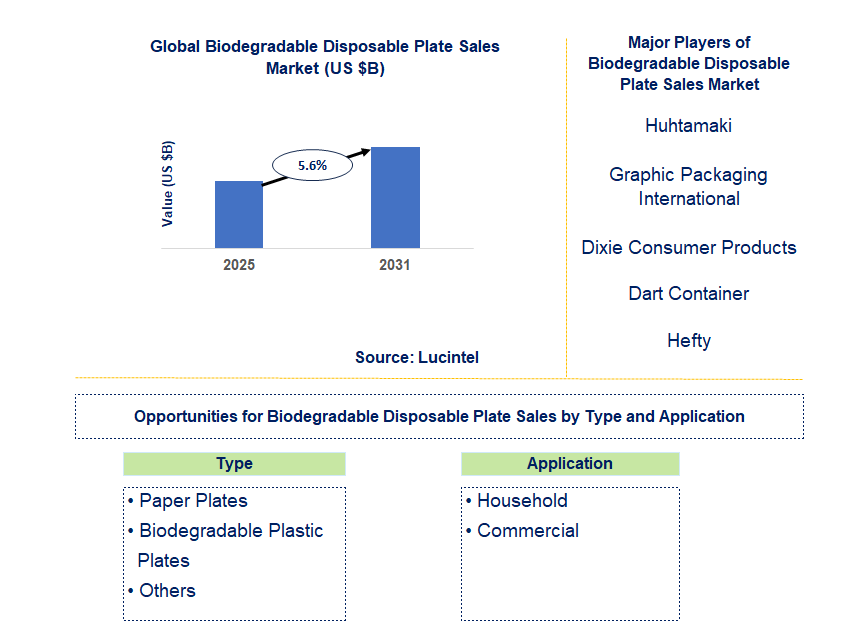
Key data points: The growth forecast = 5.6% annually for the next 7 years. Scroll below to get more insights. This market report covers Trends, opportunities and forecasts in biodegradable disposable plate sales market to 2031 by type (paper plates, biodegradable plastic plates, and others), application (household and commercial), and region (North America, Europe, Asia Pacific, and the Rest of the World)
We'll send your sample report shortly.
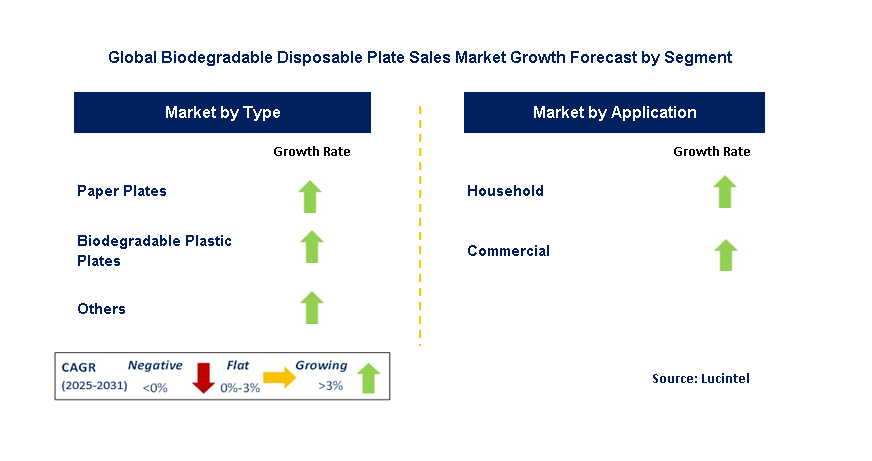
• Lucintel forecasts that, within the type category, paper plate is expected to witness higher growth over the forecast period due to the rising demand for eco-friendly materials.
• Within the application category, commercial is expected to witness higher growth.
• In terms of region, North America is expected to witness the highest growth over the forecast period.
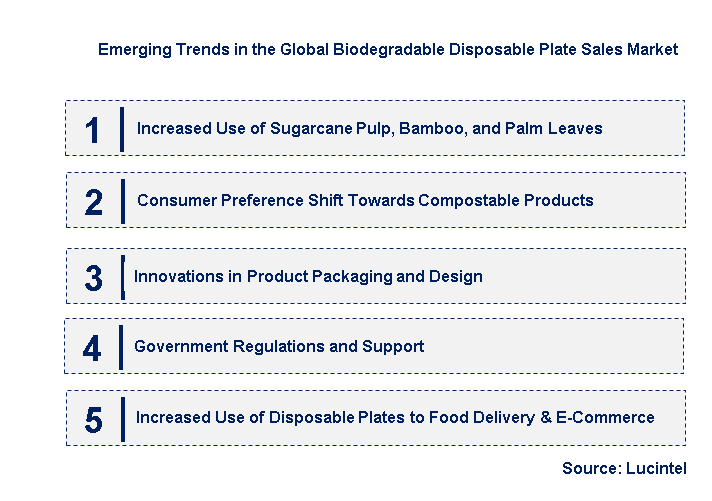
• Increased Use of Sugarcane Pulp, Bamboo, and Palm Leaves: There is an increasing use of plant components, such as sugarcane pulp, bamboo, and palm leaves, in the production of biodegradable plates. Such materials are sustainable and can be renewed and composted, which is optimal for environmentally friendly consumers. The increase in the use of plant components enables manufacturers to decrease the amount of artificial materials used and at the same time comply with increasing legal and consumer demands.
• Consumer Preference Shift Towards Compostable Products: With sustainability being the talk of the town, consumers are looking for not only biodegradable but also compostable products. Comparing compostable plates with plastic and foam plates, compostable plates are much more environmentally friendly as they can break down into organic matter. Products under this category are in high demand due to growing consumer knowledge regarding environment destruction from plastic products. In order to satisfy this demand, manufacturers are implementing these products into their catalogs.
• Innovations in Product Packaging and Design: Companies from all over are trying to improve the design and functional features of biodegradable plates in order to enhance user experience and overall satisfaction. Innovative designs these days include sturdier plates that are microwave safe, leak proof, and visually appealing. To keep up with competition in a stagnant market, product differentiation through design improvements is vital. This is especially true in the food service industry where the durability of products and the appeal to consumers is critical for market success.
• Government Regulations and Support: Governments globally are intensifying efforts to minimize plastic waste and encourage the use of biodegradable products. For instance, the ban on single-use plastics, coupled with subsidies for biodegradable substitutes, is increasing the need for biodegradable disposable plates. European, North American, and Asian markets adjust their business plans to comply with these plastics regulations while simultaneously appealing to environmentally-friendly consumers.
• Increased Use of Disposable Plates to Food Delivery & E-Commerce: Biodegradable disposable plates became more popular due to the rise in food delivery businesses and online commerce. As more people start to purchase takeout and delivery meals, there is also a growing market for single-use biodegradable food containers. For the food service industry, biodegradable plates provide an environmentally sustainable substitute to traditional foam and plastic containers. The growing significance of online shopping in cities is expected to boost the development of this market. The evolution takes into consideration changes in emerging trends like increased demand for compostable products, innovations in packaging, regulation support, plant-based materials, e-commerce, and food delivery. These trends indicate a paradigm shift toward sustainability and eco-friendly consumption which compels companies to create innovative solutions to serve the market demand. The market for biodegradable disposable plates is bound to grow at a considerable rate with the increase of these trends.
• Encouraging Regulations for Biodegradable Products: Countries in the world, especially America, Europe, and Asia are starting to pass rules that aim to lessen the amount of plastic waste, while also searching for biodegradable alternatives. Laws that restrict the use of single-use plastic plates and cutlery are helping to increase the use of biodegradable plates in many industries. Such laws increase the need for environmentally friendly packaging, in turn forcing manufacturers to produce biodegradable packaging that complies with the regulations.
• Development of Material Techniques: Innovative technologies in the production of biodegradable materials are of great significance for the growth of the market. To elaborate, manufacturers are now using innovative bagasse (sugar cane fiber) along with bamboo and palm leaves to produce strong compostable and biodegradable plates. Such materials are comparatively more sustainable than traditional plastic or foam plates, thus enabling manufacturers to cater to the increasing demand for sustainable products.
• Increase in Consumer Awareness and Eco-Consciousness: Growing vigilance concerning pollution and environmental destruction is propelling the sales of sustainable and biodegradable products. Ecologically conscious consumers now prefer disposable biodegradable plates for both foodservice and retail purposes. This positive change in the behavior of consumers is motivating manufacturers to diversify their ranges of products by introducing more biodegradable packaging and thus aid further in the growth of the market.
• Rise of Sustainable Foodservice Chains: This trend is bound to continue as more companies try to proactively lessen their negative environmental effects and satisfy the needs of green consumers. In particular, the foodservice industry in North America and Europe is now widely replacing single-use polystyrene foam foodservice items with biodegradable disposable plates that meet the foodservice operators’ sustainability objectives. Most foodservice operators and restaurants are now phasing in the use of eco-friendly packaging materials, which increases the demand for biodegradable products.
• Making Innovation Investments for New Product Design: To remain relevant in the market, manufacturers are making aggressive investments towards product innovation and design. Designs of new biodegradable plates are underway to enhance their delectability, functionality, and performance. In the current market, enhanced durability, leak resistance, and microwave safety are becoming common. These innovations are helping to position biodegradable plates as realistic and sustainable options with several benefits, especially for food service providers and consumers. There are a variety of factors which include government policies, material technology advances, heightened consumer awareness, the growth of eco-friendly food service chains, and perpetual product innovation which are changing the sales dynamics of Biodegradable Disposable Plates. These factors indicate a progressive move toward the adoption of sustainable materials where manufacturers are increasingly available in the market with innovative sustainable, durable, and eco-friendly products.
• Expansion in the Food Sector: Biodegradable disposable plates are in demand in the Food Service sector. The rise of eco friendly restaurants leads to a higher use of compostable plates by restaurants, caterers and food delivery services. This is in response to growing consumer needs and government policies. There is a gap in the supply side if manufacturers catered more biodegradable plates suited for the foodservice industries.
• Increasing Consumption in E-commerce and Delivery Services: Use of plates is soaring as E-commerce and delivery services gain popularity. There is a growing need for fast delivery of food leading to increased use of take out food with single serve biodegradable packages. Food delivery services would increase customer satisfaction if they partnered with the sellers and used the packaging.
• Chances in Hospitality and Event Management: The hospitality and events industry creates growing demand for the use of biodegradable disposable plates. Today, more hotels, event managers, and caterers are switching to biodegradable disposables due to an ever-increasing focus on sustainability and waste reduction. Likewise, manufacturers can customize their product line by providing aesthetically appealing and biodegradable plates tailored for high-end events and functions, thus capturing this market segment.
• Pay Attention to Foreign Markets: The worldwide demand for biodegradable disposables creates an opportunity for manufacturers to venture into foreign markets. Developing countries with an emerging middle-class population tend to raise the level of awareness regarding sustainability, thus, providing a huge opportunity. For these markets, manufacturers can develop affordable biodegradable plates that comply with local environmental regulations and consumer expectations.
• Creative Developments in Plate Branding and Packaging: Developments in the design and branding of biodegradable plates create an opportunity for manufacturers. By concentrating on aesthetic appeal coupled with durability and functional product features, manufacturers can attract consumers while achieving product differentiation. They can also sell branded biodegradable packages to businesses and, thus, establish a strong market identity while helping build customer loyalty through sustainable branding. There are many opportunities for growth in the Biodegradable Disposable Plate Sales Market especially in sectors such as foodservice, e-commerce, hospitality, and other global markets. Sustainability, innovation, and venturing into new markets are strategies that manufacturers can use to capitalize on these opportunities to increase sales and satisfy changing consumer preferences for eco-friendly solutions.
• Huhtamaki
• Graphic Packaging International
• Dixie Consumer Products
• Dart Container
• Hefty
• Hosti International
• CKF
• Solia
• Duni Group
• Swantex
• Paper Plates
• Biodegradable Plastic Plates
• Others
• Household
• Commercial
• North America
• Europe
• Asia Pacific
• The Rest of the World
• United States: The requirement for biodegradable disposable plates in the United States is on the rise significantly due to growing environmental consciousness alongside changes in regulations. A number of states have already put into place or are planning to implement regulations restricting the use of single-use plastic plates, thereby making it easier for businesses as well as people to shift towards biodegradable products. The introduction of new materials like sugarcane pulp, cornstarch and bamboo has enabled differentiation of products in the market leading to higher competition. The growing number of sustainability oriented customers especially in the foodservice and hospitality sectors have made corporations spend their resources abundantly in eco-friendly product lines. There is also growing consumer demand for compostable and recyclable products in the U.S. market.
• China: As one of the largest producers and consumers of disposable products, China's market is rapidly expanding for biodegradable products due to increasing government regulations. The Chinese government has adopted policies to minimize the improper use of plastics while promoting biodegradables in various industries. As a result, the market of biodegradable disposable plates is growing at an unprecedented rate as local suppliers are adopting new technologies to increase output. Additionally, the growth of e-commerce and food delivery businesses is driving the market for single use biodegradable tableware, mainly in the urban regions.
• Germany: Germany is the forerunner of environmental sustainability with respect to modern economic technologies. Their need for biodegradable disposable plates is increasing continuously. Due to the ever-tightening European Union regulations on the use of certain plastic products, as well as sustained commitment at a national level, Germany has moved towards the acceptance of biodegradables. Local suppliers have responded to the eco-friendly plate demand by manufacturing them from renewable resources like palm leaves, bamboo, and waste produced from agriculture. Moreover, the campaigns on plastic waste have increased the supply in the international market as well as in the domestic market
• India: Sales of biodegradable disposable plates in India are on the rise as the country continues to address issues with plastic waste. Plastic pollution is becoming a large issue, especially in urban areas, leading a lot of businesses to shift towards more sustainable and eco-friendly products like biodegradable plates. Government policy changes, such as the banning of plastic products in some states and a national drive towards sustainability, have also accelerated this shift. There’s a growing use of bagasse and areca palm leaves, which can be turned into biodegradable cups and plates. The increasing number of environmentally responsible consumers and growing understanding of the effects of plastic is expanding the market.
• Japan: The market of biodegradable disposable plates in Japan is growing because of greater consumer interest in sustainable products combined with government efforts to reduce plastic waste. The Japanese government has set bold goals towards decreasing plastic use, as well as increasing investment in green substitutes for the food service and retail industries. Some manufacturers are already producing plates from sugarcane, bamboo, and starch. Demand for disposable biodegradable plates is high in the hospitality and catering sectors and among environmentally conscious consumers. In addition, Japan’s strong culture of waste management and recycling is supporting the sustainability trend, which further drives the growth of biodegradable packaging products.


• Huhtamaki
• Graphic Packaging International
• Dixie Consumer Products
• Dart Container
• Hefty
• Hosti International
• CKF
• Solia
• Duni Group
• Swantex Q5. Which biodegradable disposable plate sales market segment will be the largest in future? Answer: Lucintel forecasts that, within the type category, paper plate is expected to witness higher growth over the forecast period due to the rising demand for eco-friendly materials. Q6. In biodegradable disposable plate sales market, which region is expected to be the largest in next 5 years? Answer: In terms of region, North America is expected to witness the highest growth over the forecast period. Q7. Do we receive customization in this report? Answer: Yes, Lucintel provides 10% customization without any additional cost.


Choose a license that fits your team. Instant PDF delivery.
Prices exclude taxes. Instant delivery. Custom licensing available on request.
Market Report · May 18, 2026
Market Report · May 18, 2026
Market Report · May 18, 2026
Trusted partner for strategic intelligence and business growth


Receive a complimentary market analysis tailored to your industry. Our analysts will identify key growth opportunities and competitive dynamics specific to your business.

Market size, growth rate, and key trend analysis for your specific sector.

Top competitor positioning and market share analysis.

Strategic recommendations backed by data-driven insights.
Get curated market intelligence and competitive moves straight to your inbox.
By subscribing, you agree to receive our monthly insights. Unsubscribe anytime.
Receive a complimentary market analysis tailored to your industry. Our analysts will identify key growth opportunities and competitive dynamics specific to your business.
Market size, growth rate, and key trend analysis for your specific sector.
Top competitor positioning and market share analysis.
Strategic recommendations backed by data-driven insights.
Get curated market intelligence, emerging trends, and competitive moves straight to your inbox each month.
By subscribing, you agree to receive our monthly insights. Unsubscribe anytime.
We'll send your sample report shortly.