
Market Report · July 29, 2026

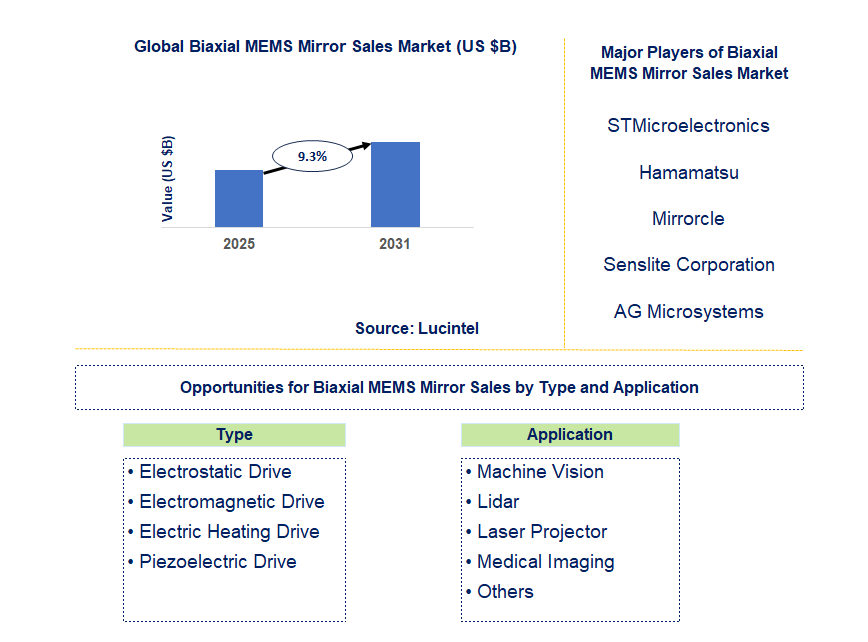
Key data points: The growth forecast = 9.3% annually for the next 7 years. Scroll below to get more insights. This market report covers Trends, opportunities and forecasts in biaxial MEMS mirror sales market to 2031 by type (electrostatic drive, electromagnetic drive, electric heating drive, and piezoelectric drive), application (machine vision, lidar, laser projector, medical imaging, and others), and region (North America, Europe, Asia Pacific, and the Rest of the World)
We'll send your sample report shortly.
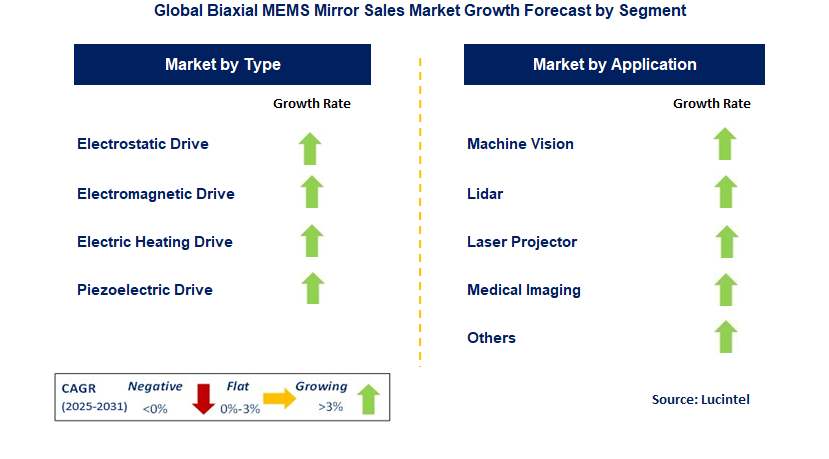
• Lucintel forecasts that, within the type category, electrostatic drive is expected to witness the highest growth over the forecast period due to the growing demand for precise and low-power optical system.
• Within the application category, lidar is expected to witness the highest growth due to the increasing demand for autonomous vehicle.
• In terms of region, North America is expected to witness the highest growth over the forecast period due to the rising demand for advanced technology.
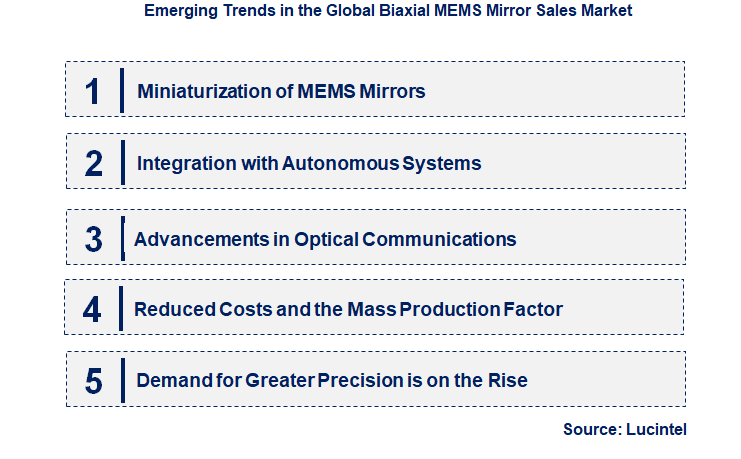
• Miniaturization of MEMS Mirrors: The size reduction tendency represents a significant movement in the Biaxial MEMS Mior market. With shifts toward smaller and more compact devices, MEMS mirrors are being designed to fit into smaller and smaller spaces. This trend is especially pronounced in consumer electronics, telecommunications, and automotive industries, which often have strict weight and size restrictions. This trend increases the effectiveness and lowers the costs associated with manufacturing MEMS mirrors, allowing for greater versatility in a wider range of uses.
• Integration with Autonomous Systems: Biaxial MEMS mirrors are being applied to autonomous systems, particularly in robotics and automotive fields. In self-driving cars, MEMS mirrors are an integral part of LiDAR systems that aid in environmental perceptions for navigation and safety. MEMS mirrors have the required accuracy, dimensions, and effectiveness to autonomously process data in real-time. This is likely to expand with the growing use of self-driving vehicles and robotics in manufacturing and logistics.
• Advancements in Optical Communications: The requirement for high-speed internetworking and advanced telecommunication increases the focus on optical communication systems. Biaxial MEMS mirrors are essential components for these systems as they allow efficient light switching in fiber optics. This is supported by the global rollout of 5G networks, which increases the need for data centers capable of enormous amounts of information processing. To address the requirements for modern telecommunications, MEMs mirrors are being utilized to augment the effectiveness, bandwidth and dependability of optical communication systems.
• Reduced Costs and the Mass Production Factor: One of the major tendencies in the Biaxial MEMS Mirror sector is the concentration on cost production through mass production. Industry players are focusing on building scalable supply chains as unit sales of MEMS mirrors increase with the adoption of MEMS technology. These reductions in cost enable MEMS mirrors to be used in more devices, such as consumer electronics, medical equipment, and industrial automation tools. The adoption of low cost MEMS solutions is leading to increased usage, especially in developing nations.
• Demand for Greater Precision is on the Rise: The need for precise and extremely reliable MEMS mirrors is on the rise in the aerospace, medical, and defense sectors. The development of microfabridation processes have enabled manufacturers to deliver MEMS mirrors with greater accuracy, stability, and performance in harsh environments. This shift is particularly important for military use, where MEMS mirrors are incorporated in laser systems and optical imaging devices for reconnaissance, targeting, and communication. The market for biaxial MEMS mirrors sales is emerging as an increasing number of trends shift the market towards achieving improved operational characteristics of cost-effectiveness and increased range of applications for use of MEMS mirrors. Furthermore, increased focus on microminiaturization, coupling with autonomous systems, and progress in optical communication drives innovation in major segments such as automotive, telecommunication, and medical devices. The stronger demand for accuracy and economical solutions aids in further expansion of the market and provides numerous opportunities for manufacturers to implement new applications and broaden their scope internationally.
• Development of High-Performance MEMS Mirrors for Automotive LiDAR: A notable improvement in the biaxial MEMS mirror imdustry is designing and manufacturing high-precision LiDAR mirrors for autonomous vehicles. The use of MEMS mirrors is helping to enhance the resolution, scanning speed, and accuracy of LiDAR systems. These mirrors are needed for the accurate 3D mapping of the surroundings necessary for the navigation and safety of autonomous cars. Continuous efforts in this direction are making MEMS mirrors a major contributor of self-driving car technologies.
• Advancements in Optical MEMS for Telecommunications: Big leaps have been made on the optical MEMS component of telecommunications like the mirrored devices that enable high speed optical network switches and 5G infrastructure. MEMS mirrors are now incorporated in optical switches that are fundamental in signal routing in fiber optic networks. These changes will increase the effectiveness, speed, and accuracy of telecommunication which is increasingly important with rising bandwidth demand. This situation is to be expected due to international 5G deployments encouraging the use of MEMS based optical systems.
• Expansion of Manufacturing Capabilities for MEMS Mirrors: To meet the MEMS mirror demand from different sectors, industries are expanding their investment in manufacturing MEMS mirrors, which includes building new plants, improving manufacturing technologies, and collaborations for production scale-up. These enhanced capabilities will enable the companies to serve the increasing demand for MEMS mirrors in automotive, telecommunications, and consumer electronics industries. The increased investment is also reducing the cost of manufacturing MEMS mirrors which makes them suitable for more applications.
• Use of MEMS Mirrors in Medical Imaging Devices: MEMS mirrors are generating increasing interest as components in medical devices for endoscopes and microscopes to increase imaging accuracy. These mirrors help focus light on the area of interest, thus increasing the image resolution. This advancement leads to precise diagnosis and treatment changes in medical procedures. As the need for precision imaging and less invasive procedures increases, MEMS mirrors will support innovation in the design of medical devices.
• The Production of MEMS Mirrors: Achieving sustainability within the manufacturing processes of MEMS mirrors has remained a challenge. Firms are making strides in reducing the carbon footprint of MEMS production by incorporating green materials and sustainable manufacturing techniques. These efforts include employing safe materials and refining the production steps to reduce excess waste. With growing environmental issues, there is bound to be a shift in consumer and business demand for products that are more sustainable, which will propel this advancement further. The progress reported in the sales of biaxial MEMS mirrors portray the dynamics of innovation and proliferation in the use of the MEMS mirror technology. With the integration of MEMS mirrors into different industries, like automotive LiDAR or telecommunications, medical imaging, and green manufacturing, MEMS mirrors are quickly becoming essential components of many industries. Without a doubt, further progress in technology and increased productivity will enhance the contribution of MEMS mirrors in providing the next innovative solutions for various industries.
• Automotive Industry: Self-Driving Cars: The new-age automotive industry is using MEMS mirrors in the LiDAR systems of autonomous cars. As more and more innovative self-driving cars are being developed, these mirrors are critical to improve sensor accuracy and performance. Their small size and energy-efficient characteristics allow them to be easily integrated into modern vehicles. The heightened focus on the autonomous vehicle market will require advanced safety measures along with real-time data analysis, consequently boosting the demand for MEMS mirrors further.
• Consumer Electronics: Augmented Reality (AR) and Virtual Reality (VR): You will find significant growth in the applications of AR and VR technology in the electronics sector. The success of these technologies depends in great measure upon MEMS mirrors (especially biaxial mirrors) because these devices enable more efficient image projection and display. In AR/VR headsets, MEMS are mirrors that manage illumination and light as well as serve to mitigate latency and image blurring at the single user level which is invaluable. The broadening application of augment reality and virtual reality technologies in entertainment, education, and healthcare will increase the need for MEMS mirrors even more.
• Medical Devices: Minimally Invasive Surgery: In medicine, MEMS mirrors are nowadays incorporated in endoscopes and robotic-assisted surgery systems. As compact and precise devices, MEMS mirrors bring benefits in imaging and risk mitigation during procedures. While MEMS mirrors makes imaging more accurate and procedure risks lower, the general trend towards more efficiency will meet increased demand for treatment with ultrafast, low impact, minimally invasive surgery, particularly in diagnostics and treatment.
• Aerospace and Defense Industies: Communication Between Satellites MEMS mirrors are important in satellite communication systems. They are capable of light path adjustment, area scanning, and communication with satellites using very little power. As the number of satellites increases and there is a higher demand for data transfer, the use of MEMS mirrors will increase in military and commercial aerospace sectors, which will subsequently increase growth in the market.
• Optical Networking: Satellite Data Centers: Due to the increase in the number of satellite data centers, as well as the demand for data access, MEMS mirrors are becoming an essential part of the optical networking system. MEMS mirrors make it possible to reduce the time spent on energy-consuming routing and switching operations of optical signals. MEMS mirrors will become more relevant in the optimization of network performance with the increased demand for internet and cloud services, which in turn will make satellite data centers more efficient. Developments in the automotive, consumer electronics, medical devices, aerospace, and optical networking sectors create new possibilities which will lead to growth in the Biaxial MEMS Mirror market. As technology continues transforming these industries, the need to innovate and enhance performance will require the implementation of MEMS mirrors. Focusing on operational technology growth will provide firms with market opportunities and these firms will benefit from the growing market.
• STMicroelectronics
• Hamamatsu
• Mirrorcle
• Senslite Corporation
• AG Microsystems
• Maradin
• OQmented
• Xi'an Zhisensor Technologies
• Silicon Vision Microsystem
• Suzhou Bonphot Optoelectronics
• Electrostatic Drive
• Electromagnetic Drive
• Electric Heating Drive
• Piezoelectric Drive
• Machine Vision
• Lidar
• Laser Projector
• Medical Imaging
• Others
• North America
• Europe
• Asia Pacific
• The Rest of the World
• United States: In the United States, the market concerning sales of biaxial MEMS mirrors has experienced a phenomenal increase owing to the advancements made within the domains of telecommunications and defense. Firms have been spending a lot of money towards the miniaturization of MEMS mirrors so that they can be used as components for laser systems, optical communications, and even imaging devices. Furthermore, the ultrasound and imaging sectors benefit from advanced semiconductor manufacturing, which allows low-cost mass fabrication of MEMS mirrors. Moreover, the adoption of High Precision Optical Instruments by the defense and aerospace sectors of the economy is growing, and this is increasing the demand for MEMS mirrors because of their advanced optical systems.
• China: The growth of the electronics sector and Oligarch support has helped China strengthen its foothold in the biaxial MEMS mirror sales market. The country appears to be making progress in advancing MEMS technologies for consumer electronics, telecommunications, and robotics. Many domestic firms are not only developing and selling MEMS mirrors, but are also branding themselves as international sellers. The Chinese government’s focus on building 5G networks has also increased the use of MEMS mirrors in China for use in optical networking, and innovations in mass production are enabling more cost-effective MEMS solutions, further integration.
• Germany: Due to its competence in precision engineering and strong manufacturing sector, Germany remains a powerhouse in the biaxial MEMS mirror sales market. Several industries have also increased their purchase of MEMS mirrors, including automotive, industrial automation, and medical devices. German firms are focusing on the production of MEMS mirrors that have high reliability and efficiency and can perform in extreme environmental conditions like very high and low temperatures or significant amounts of vibrations. Moreover, the application of MEMS technology in optical sensors for automotive use is accelerating the market, particularly with the development of autonomous vehicles and ADAS.
• India: The Indian market for Biaxial MEMS mirrors is underdeveloped at the moment, but its growth potential is positive with increased funding of the Telecommunications and semiconductor industries. India is becoming a low-cost manufacturing site for MEMS mirrors for both local and international markets. High Growth is anticipated with the increasing demand for telecommunications and high-speed data transfer and optical communication technologies. Opportunities exist in the infrastructure, robotics & automation digitalization, and smart city construction with the advancement of artificial intelligence in MEMS applications is supported by the Indian government's policies.
• Japan: Japan is a strong market for biaxial MEMS mirrors due to their extensive use in automotive, robotics, and consumer electronics. Japanese firms are applying innovations in optical MEMS to vehicles, for example, LiDAR sensors in self-driving cars. Moreover, Japan’s focus on mechanical engineering has helped create effective MEMS mirrors for industrial and medical scopes. The nation’s position as a leader in robotics also increases the need for MEMS mirrors because these systems require dependable, compact optical components to improve their performance and functionality.


• STMicroelectronics
• Hamamatsu
• Mirrorcle
• Senslite Corporation
• AG Microsystems
• Maradin
• OQmented
• Xi'an Zhisensor Technologies
• Silicon Vision Microsystem
• Suzhou Bonphot Optoelectronics Q5. Which biaxial MEMS mirror sales market segment will be the largest in future? Answer: Lucintel forecasts that, within the type category, electrostatic drive is expected to witness the highest growth over the forecast period due to the growing demand for precise and low-power optical system. Q6. In biaxial MEMS mirror sales market, which region is expected to be the largest in next 5 years? Answer: In terms of region, North America is expected to witness the highest growth over the forecast period due to the rising demand for advanced technology. Q7. Do we receive customization in this report? Answer: Yes, Lucintel provides 10% customization without any additional cost.


Choose a license that fits your team. Instant PDF delivery.
Prices exclude taxes. Instant delivery. Custom licensing available on request.
Market Report · July 29, 2026
Market Report · July 20, 2026
Market Report · July 20, 2026
Trusted partner for strategic intelligence and business growth


Receive a complimentary market analysis tailored to your industry. Our analysts will identify key growth opportunities and competitive dynamics specific to your business.

Market size, growth rate, and key trend analysis for your specific sector.

Top competitor positioning and market share analysis.

Strategic recommendations backed by data-driven insights.
Get curated market intelligence and competitive moves straight to your inbox.
By subscribing, you agree to receive our monthly insights. Unsubscribe anytime.
Receive a complimentary market analysis tailored to your industry. Our analysts will identify key growth opportunities and competitive dynamics specific to your business.
Market size, growth rate, and key trend analysis for your specific sector.
Top competitor positioning and market share analysis.
Strategic recommendations backed by data-driven insights.
Get curated market intelligence, emerging trends, and competitive moves straight to your inbox each month.
By subscribing, you agree to receive our monthly insights. Unsubscribe anytime.
We'll send your sample report shortly.