
Market Report · May 18, 2026

This market report covers trends, opportunities, and forecasts in the global beam field homogenizer market to 2031 by technology (batch beam field homogenizers, continuous beam field homogenizers, multi-stage beam field homogenizers, and oscillating beam field homogenizers), end use industry (pharamaceuticals, biotechnology, food and beveages, cosmetics, and chemicals), and region (North America, Europe, Asia Pacific, and the Rest of the World)
We'll send your sample report shortly.
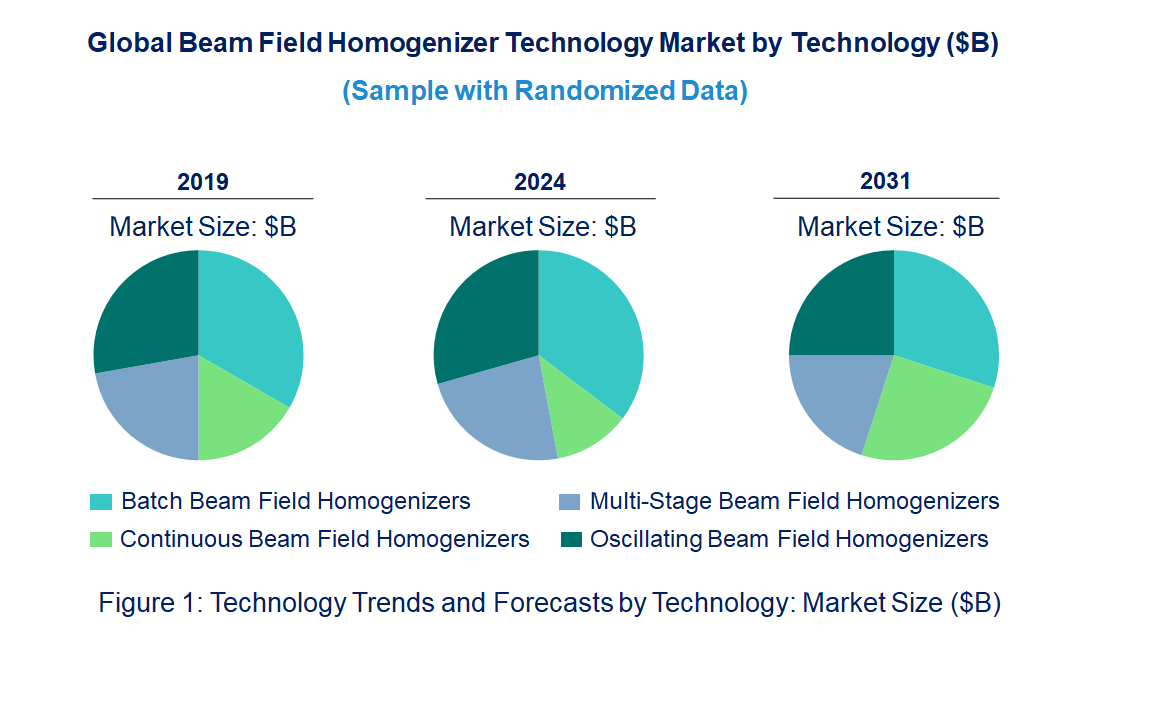
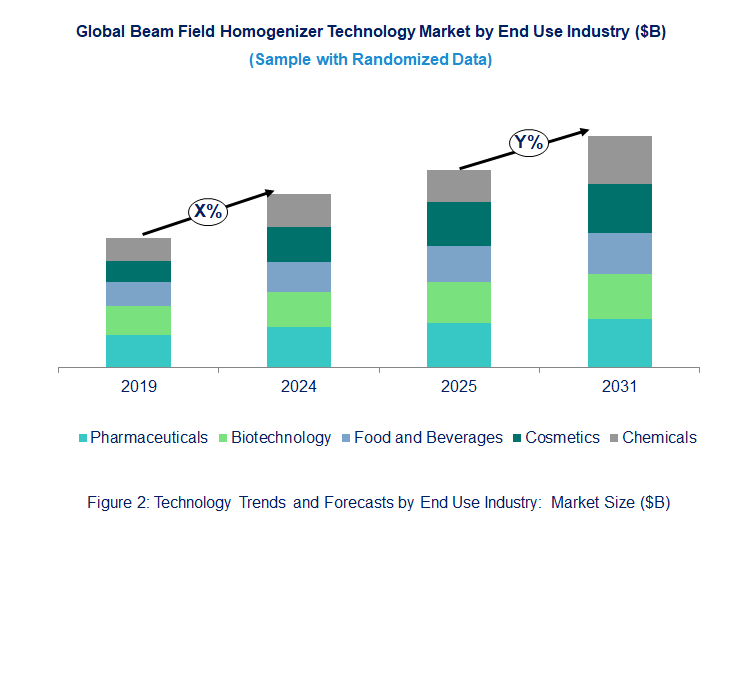
• Trending toward Continuous Homogenization: Continuous beam field homogenizers are gaining popularity by having consistent and scalable process operations. Continuous systems have relatively greater throughput and better integrations in large-scale environments like the pharmaceutical and food industries in comparison to batch systems.
• Automation and Smart Technologies: Automation is increasingly being integrated into beam field homogenizers, allowing for more accurate control of the homogenization process. IoT-enabled homogenizers are being developed to monitor key parameters such as pressure, temperature, and flow rate, ensuring constant output and minimizing human error in the biotechnology and chemical industries.
• Multi-stage homogenization for complex applications. Multi-stage beam field homogenizers are increasingly used, especially in cosmetics and food and beverage companies, for processing complex formulations to create finer and more uniform particle sizes, thereby enhancing the quality and stability of emulsions, suspensions, and creams.
• Energy Efficiency and Sustainability: With growing pressure on industries to reduce energy consumption and environmental impact, energy-efficient homogenization technologies are gaining ground. Low-energy consumption homogenizers and green technologies are becoming essential for industries such as food and beverages and chemicals, where energy use is a significant cost driver.
• Customization and Modular Systems: With the growing need for customized solutions, manufacturers have started offering modular beam field homogenizers. The systems can be customized as per specific process requirements in different sectors, such as pharmaceuticals, biotechnology, and cosmetics, to better integrate them with diverse production lines. The trends in technology in the beam field homogenizer market are the broader trend toward scalable, energy-efficient, and customizable solutions. The growing demand from industries for higher performance and greater flexibility will drive continuous systems, smart technologies, and multi-stage homogenization that will remake the market and enhance efficiency across all sectors.
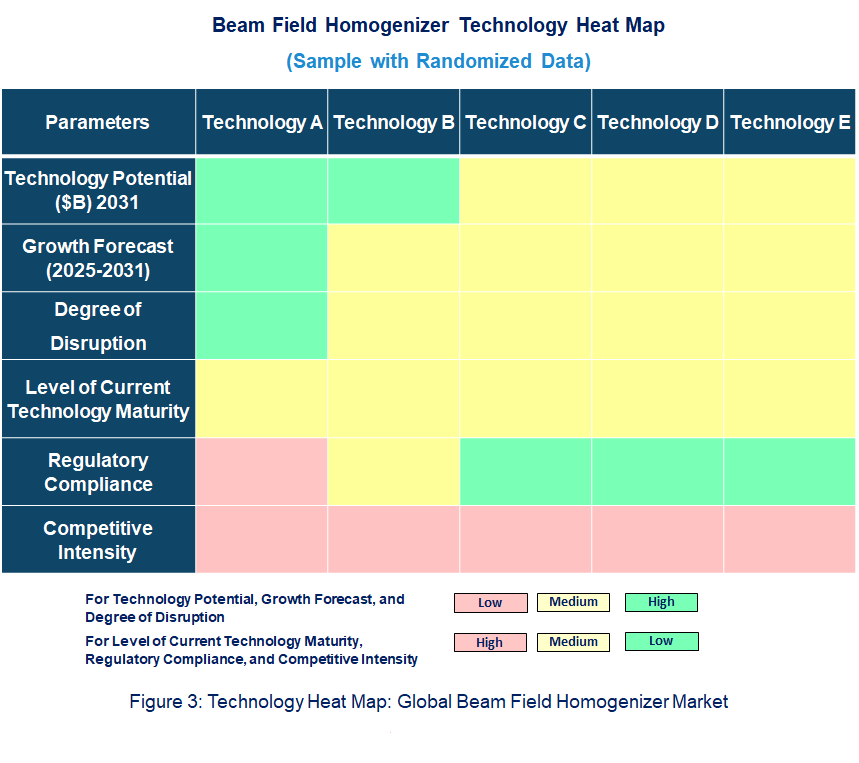
• Technology Potential: The innovation potential in beam field homogenizer technology is huge. Innovations focus on improving efficiency, reducing divergence, and achieving better uniformity across diverse wavelengths. Emerging technologies such as micro-optics, adaptive optics, and diffractive optical elements hold promising advancements in creating more precise and compact homogenizers.
• Disruption degree. Disruption level: middle The traditional optical systems, especially refractive optics and beam-shaping devices, are widely employed, but newer solutions like diffractive optical elements (DOEs) and micro-lens arrays could drastically improve performance, allowing for more compact and cost-effective systems. This change may reshape the laser manufacturing and medical diagnostics industries.
• Current Technology Maturity: The maturity is diversified. Basic beam homogenizers are well-established and used in commercial applications, whereas DOEs or newer techniques are still maturing and entering into more specialized markets. Their maturity has advanced but not yet reached the apex of mass adoption.
• Compliance with Regulatory Requirements: Safety standards in regulatory requirements primarily concern laser-based technologies, including radiation safety and environmental regulations. In sensitive applications, beam homogenizers are getting used, so there must be conformance to international safety and quality standards.
• Frymaster: Frymaster has developed advanced continuous beam field homogenizers, which are designed for high-throughput food processing. These systems are particularly recommended for uniform texture creation of products like sauces and dressings. The introduction of these machines has significantly increased the production capacity within the food and beverage industry.
• Robot Coupe: Robot Coupe has expanded its product line with modular homogenization systems that can be adapted to specific applications. It offers greater flexibility in pharmaceutical and cosmetic manufacturing by producing high-quality emulsions with controlled particle size and consistency.
• Calemard: Calemard has developed multi-stage beam field homogenizers for complex formulations in biotechnology and cosmetics. Their systems allow for enhanced processing of emulsions and suspensions, providing better stability and homogeneity in high-end cosmetic products.
• American Eagle Equipment: American Eagle has developed energy-efficient homogenizers that emphasize saving energy without sacrificing throughput. These systems are especially useful in chemical processing and food manufacturing, where energy savings directly translate to operational cost savings.
• Univex: Univex has launched a new range of automated beam field homogenizers with smart technologies, which enable real-time monitoring. These units are ideal for pharmaceutical applications, where consistency and precision are crucial for improved process control and better-quality products.
• Dito Sama Srl: Dito Sama Srl has led the way in the development of high-capacity batch homogenizers that are highly effective in the biotechnology sector. These systems are designed to meet the rigorous demands of vaccine and biological production, where even particle size distribution is critical for product efficacy.
• Mueller: Mueller’s oscillating beam field homogenizers make waves in the food and beverage market, where the accuracy of texture and consistency is maintained in food products. Smoother processing and high flexibility in throughput and type of product are also offered with their oscillating technology.
• Waring: Waring introduced continuous beam field homogenizers in new lines, primarily tailored for high-viscosity application fields, cosmetics, and pharmaceuticals. These machines enhance the processing speed of their counterparts while offering better uniformity to manufacturers to meet strict product specifications, leading to efficiency gains.
• Inotech: Inotech launched customizable multi-stage beam field homogenizers for food and beverage production applications. With these systems, fine particle size reduction is easily controlled to attain better product texture and shelf life, making them suitable for sensitive foodstuffs such as dairy and beverages.
• Blendtech: Blendtech has developed intelligent homogenization systems, coupled with the integration of IoT technologies, which enhance process control. Such systems provide excellent application possibilities in chemical processing, where consistency is very important. Remote monitoring of variables helps improve operational efficiency and minimize the risks of human error. The conclusion reveals evolution coming from the key players. Namely, Frymaster and Robot Coupe have evolved together with Inotech in upgrading beam field homogenizers up to the level of achieving scalability, efficiency, and customization. These innovations really can help manufacturers meet the surging calls for higher quality, rapid processes, and stronger energy efficiency in all manufacturing sectors.
• Technological developments in precision engineering: The development of laser and beam technology has made homogenizers more efficient and accurate, thus opening new avenues for their use in industries requiring highly precise applications, such as medical devices, aerospace, and semiconductor manufacturing.
• High-precision manufacturing: High-precision production of products is required for industries like semiconductor manufacturing, materials science, and medical applications, like radiation therapy; therefore, there is high demand for these devices during the production process.
• Increasing Adoption of Laser Systems in Medical and Research Applications: The healthcare sector is increasingly adopting laser-based technologies for treatments like surgery, cancer therapy, and diagnostics. Beam Field Homogenizers help improve the quality and effectiveness of laser systems, contributing to the growing demand in this sector.
• Increasing the requirement to attain better product quality from raw material processing. Energy usage in the process leads directly to the quality of the final product in the electronics and automobile sectors. Beam Field Homogenizers are, thus, significant in achieving homogenous processing, leading toward premium product consistency with minimum defects at required levels. Challenges in the beam field homogenizer market are:
• Significant High Capital Intake - The technological aspects of such a beam field homogenizer are typically sophisticated. The products are rather capital-intensive from the initiation process, rendering them very inaccessible to any small organization or startup.
• Regulatory and Safety Considerations: Often, the beam-based technologies require strong safety and regulatory compliance, mainly in healthcare and aerospace markets. This aspect increases operation costs and delays time to market for the new product.
• Technological Complexity and Maintenance: Beam Field Homogenizers are highly specialized systems that need constant maintenance and technical support. The complexity of such systems can limit their usage and can increase operational costs for users, particularly in industries that have limited technical support. The beam field homogenizer market will experience a growth trend due to the development in technology, growing demand in high-precision applications, and adoption in medical and material processing fields. However, high costs, regulatory compliance, and technical complexity may present challenges to market growth, forcing companies to innovate and find cost-effective solutions to fully capitalize on these opportunities. As the market matures, overcoming such challenges will be key to ensuring long-term success and widespread adoption of beam field homogenizer technology."
• Frymaster
• Robot Coupe
• Calemard
• American Eagle Equipment
• Univex
• Dito Sama Srl
• Technology Readiness by Technology Type: Batch Beam Field Homogenizers are mature and widely used in smaller-scale applications. Continuous Beam Field Homogenizers are ready for large-scale industrial use. Multi-Stage systems, though highly effective, are still specialized and less common. Oscillating Beam Field Homogenizers are emerging but not yet fully commercialized. Competitive pressures are rising, and regulatory compliance remains crucial, especially in high-safety industries like medical and aerospace.
• Competitive Intensity and Regulatory Compliance: The Beam Field Homogenizer market is competitive, with Batch and Continuous systems leading. Multi-stage and Oscillating systems are gaining traction for high-precision and flexible applications. Regulatory compliance is vital, especially in medical, aerospace, and industrial sectors, with certifications like ISO and CE being key. Continuous systems face stricter regulatory requirements, while Batch systems have less compliance pressure. Manufacturers must balance innovation with meeting regulatory standards to stay competitive.
• Disruption Potential of Beam Field Homogenizer Technologies: Batch Beam Field Homogenizers are established but limited by throughput. Continuous Beam Field Homogenizers offer higher efficiency, making them ideal for large-scale applications. Multi-stage beam field homogenizers provide precise control over beam uniformity, offering disruption potential for high-performance needs. Oscillating Beam Field Homogenizers offer adaptability, making them attractive for dynamic applications, but are less commonly used. Emerging hybrid technologies may disrupt the market by combining the advantages of these systems.
• Batch Beam Field Homogenizers
• Continuous Beam Field Homogenizers
• Multi-Stage Beam Field Homogenizers
• Oscillating Beam Field Homogenizers
• Pharamaceuticals
• Biotechnology
• Food and beverages
• Cosmetics
• Chemicals
• North America
• Europe
• Asia Pacific
• The Rest of the World
• Latest Developments and Innovations in the Beam Field Homogenizer Technologies
• Companies / Ecosystems
• Strategic Opportunities by Technology Type


Choose a license that fits your team. Instant PDF delivery.
Prices exclude taxes. Instant delivery. Custom licensing available on request.
Market Report · May 18, 2026
Market Report · May 18, 2026
Market Report · May 18, 2026
Trusted partner for strategic intelligence and business growth


Receive a complimentary market analysis tailored to your industry. Our analysts will identify key growth opportunities and competitive dynamics specific to your business.

Market size, growth rate, and key trend analysis for your specific sector.

Top competitor positioning and market share analysis.

Strategic recommendations backed by data-driven insights.
Get curated market intelligence and competitive moves straight to your inbox.
By subscribing, you agree to receive our monthly insights. Unsubscribe anytime.
Receive a complimentary market analysis tailored to your industry. Our analysts will identify key growth opportunities and competitive dynamics specific to your business.
Market size, growth rate, and key trend analysis for your specific sector.
Top competitor positioning and market share analysis.
Strategic recommendations backed by data-driven insights.
Get curated market intelligence, emerging trends, and competitive moves straight to your inbox each month.
By subscribing, you agree to receive our monthly insights. Unsubscribe anytime.
We'll send your sample report shortly.