
Report Feature
Battlefield Management System Market Trends and Forecast
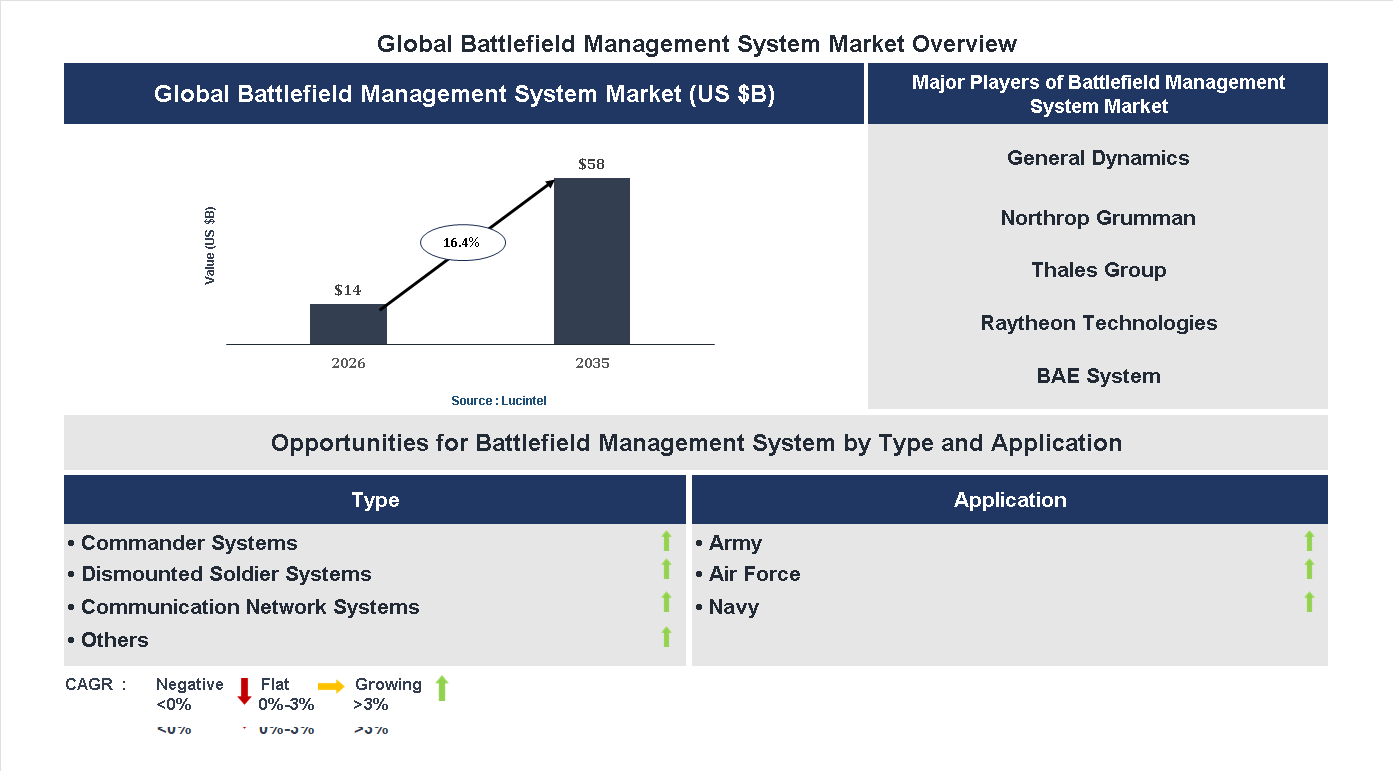
The future of the global battlefield management system market looks promising with opportunities in the army, air force, and navy markets. The global battlefield management system market is expected to reach an estimated $58 billion by 2035 with a CAGR of 16.4% from 2026 to 2035. The major drivers for this market are the increasing demand for real time situational awareness, the rising focus on network centric warfare systems, and the growing adoption of integrated command solutions.• Lucintel forecasts that, within the type category, commander system is expected to witness higher growth over the forecast period.
• Within the application category, army is expected to witness the highest growth.
• In terms of region, APAC is expected to witness the highest growth over the forecast period. Gain valuable insights for your business decisions with our comprehensive 150+ page report. Sample figures with some insights are shown below.
Emerging Trends in the Battlefield Management System Market
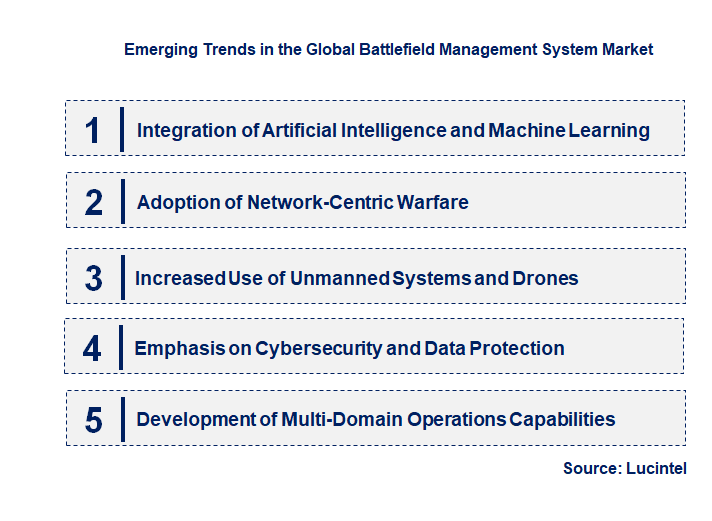
The battlefield management system market is experiencing rapid evolution driven by technological advancements, changing defense strategies, and increasing security concerns worldwide. As military operations become more complex, the demand for integrated, real-time battlefield information systems is surging. Innovations in communication, data analytics, and autonomous systems are transforming traditional battlefield management approaches. These developments are not only enhancing operational efficiency but also improving safety and decision-making capabilities for armed forces. The following key trends highlight the current trajectory of the BMS market and its future potential, reflecting a shift towards more sophisticated, interconnected, and adaptive battlefield solutions.• Integration of Artificial Intelligence and Machine Learning: The incorporation of AI and ML into BMS is revolutionizing battlefield data analysis. These technologies enable real-time threat detection, predictive analytics, and autonomous decision-making, significantly reducing response times. AI-driven systems can analyze vast amounts of data from sensors, drones, and communication networks to provide actionable insights. This trend enhances situational awareness, operational efficiency, and strategic planning, making military forces more agile and responsive in complex combat environments.
• Adoption of Network-Centric Warfare (NCW): The shift towards network-centric warfare emphasizes interconnected systems that share information seamlessly across units. BMS now integrate various communication platforms, sensors, and command centers to create a unified battlefield picture. This connectivity improves coordination, reduces information gaps, and enhances command and control capabilities. As a result, armed forces can execute synchronized operations with higher precision, agility, and adaptability, especially in multi-domain conflicts involving land, sea, air, and cyber operations.
• Increased Use of Unmanned Systems and Drones: The deployment of unmanned aerial vehicles (UAVs), ground robots, and autonomous systems is a significant trend in BMS. These systems provide reconnaissance, surveillance, and target acquisition without risking human lives. BMS now incorporate data from unmanned systems to offer comprehensive battlefield insights. This integration enhances operational reach, reduces response times, and supports autonomous combat functions. The proliferation of drones and robots is transforming traditional battlefield tactics and expanding the scope of battlefield management.
• Emphasis on Cybersecurity and Data Protection: As BMS become more interconnected and reliant on digital infrastructure, cybersecurity has become a critical concern. Protecting sensitive military data from cyber threats, hacking, and electronic warfare is paramount. Advanced encryption, intrusion detection systems, and secure communication protocols are being integrated into BMS. This focus ensures operational integrity, prevents information breaches, and maintains battlefield advantage. Strengthening cybersecurity measures is essential for safeguarding the integrity and reliability of battlefield management systems in modern warfare.
• Development of Multi-Domain Operations (MDO) Capabilities: Modern conflicts require integrated operations across land, sea, air, space, and cyber domains. BMS are evolving to support multi-domain operations by providing a unified platform that manages assets across these domains. This capability allows for coordinated, rapid responses to threats in complex environments. The development of MDO-compatible BMS enhances strategic flexibility, operational resilience, and the ability to conduct joint missions effectively, reflecting a comprehensive approach to contemporary warfare. These emerging trends are fundamentally reshaping the Battlefield Management System market by fostering more integrated, intelligent, and resilient systems. They enable armed forces to operate more efficiently across multiple domains, improve decision-making speed, and enhance battlefield safety. As these innovations continue to evolve, the market is poised for significant growth, driven by the increasing need for advanced defense solutions in a rapidly changing global security landscape.
Recent Development in the Battlefield Management System Market
The battlefield management system market is experiencing rapid growth driven by technological advancements, increasing defense budgets, and the need for enhanced military operational efficiency. Governments worldwide are investing heavily in modernizing their armed forces, emphasizing integrated communication, real-time data sharing, and autonomous systems. These developments are transforming battlefield strategies, improving situational awareness, and ensuring better troop safety. As defense organizations adopt innovative solutions, the market is poised for significant expansion, creating new opportunities for manufacturers and technology providers.• Growing Adoption of Network-Centric Warfare: The integration of advanced communication networks enables real-time data sharing among units, improving coordination and decision-making. This shift enhances operational efficiency and reduces response times, making military operations more effective. The demand for secure, high-speed communication systems is driving innovation in battlefield networks, fostering growth in the BMS market. Sub-segments like tactical radios and satellite communication systems are experiencing increased adoption, contributing to overall market expansion.
• Increasing Investment in Autonomous and Unmanned Systems: Governments are prioritizing autonomous vehicles, drones, and robotic systems to reduce risks to personnel and increase operational capabilities. These systems require sophisticated battlefield management solutions for navigation, target identification, and data integration. The integration of AI and machine learning enhances system responsiveness and accuracy. The deployment of unmanned systems is expected to significantly boost market growth, with applications spanning reconnaissance, logistics, and combat support.
• Advancements in Sensor and Data Analytics Technologies: The development of advanced sensors and data analytics tools allows for better battlefield situational awareness. These technologies enable real-time monitoring of troop movements, environmental conditions, and threat detection. Enhanced data processing capabilities facilitate predictive analytics, improving strategic planning. The integration of IoT devices and big data analytics is creating new opportunities for BMS providers, leading to more intelligent and adaptive battlefield solutions.
• Rising Focus on Cybersecurity and Data Protection: As battlefield systems become more interconnected, the risk of cyber threats increases. Governments are investing in robust cybersecurity measures to safeguard sensitive military data and communication channels. The development of secure, encrypted communication protocols and intrusion detection systems is critical. This focus on cybersecurity is driving innovation in secure hardware and software solutions, ensuring operational integrity and fostering trust in battlefield management systems.
• Expansion of Military Modernization Programs: Countries are launching comprehensive modernization initiatives to upgrade their defense infrastructure, including battlefield management systems. These programs aim to enhance interoperability, upgrade legacy systems, and incorporate cutting-edge technologies like AI and 5G. The modernization efforts are creating a substantial demand for advanced BMS solutions across various military branches, boosting market growth and encouraging technological innovation. These developments are significantly transforming the Battlefield Management System market by enhancing operational efficiency, security, and technological integration. The focus on network-centric warfare, autonomous systems, sensor technologies, cybersecurity, and modernization programs is driving market expansion. As military forces worldwide adopt these innovations, the market is expected to grow rapidly, offering new opportunities for industry players and shaping the future of modern warfare.
Strategic Growth Opportunities in the Battlefield Management System Market
The battlefield management system market is experiencing rapid growth driven by technological advancements, increasing defense budgets, and the need for enhanced battlefield situational awareness. Governments worldwide are investing in integrated systems to improve operational efficiency, safety, and decision-making capabilities. The integration of AI, IoT, and real-time data analytics is transforming military strategies, creating new opportunities for defense contractors and technology providers. This evolving landscape offers significant potential for innovation and expansion across various military applications.• Integration of AI and Machine Learning for Enhanced Situational Awareness: Incorporating AI and ML into BMS enables real-time data processing, predictive analytics, and autonomous decision-making. These technologies improve battlefield awareness, threat detection, and response times, leading to more effective military operations. AI-driven systems can analyze vast data streams from sensors, drones, and communication networks, providing commanders with actionable insights. This integration supports autonomous vehicles, threat identification, and resource allocation, significantly boosting operational efficiency and safety.
• Expansion of Network-Centric Warfare and Interoperability Solutions: The shift towards network-centric warfare emphasizes seamless communication and data sharing among diverse military units and platforms. Developing interoperable BMS solutions allows for integrated command and control, enhancing coordination across land, sea, air, and cyber domains. This opportunity involves creating standardized protocols, secure communication channels, and scalable systems that support joint operations. The growth of such solutions improves tactical agility, reduces response times, and enhances overall mission success.
• Adoption of IoT and Sensor Technologies for Real-Time Data Collection: IoT devices and advanced sensors are increasingly integrated into BMS to gather real-time battlefield data. These technologies enable continuous monitoring of troop movements, equipment status, and environmental conditions. The deployment of connected sensors enhances situational awareness, facilitates predictive maintenance, and improves resource management. This opportunity supports the development of smart battlefield environments, leading to more informed decision-making and increased operational safety.
• Development of Autonomous Vehicles and Drones for Combat Support: Autonomous ground vehicles and aerial drones are transforming battlefield logistics, reconnaissance, and combat operations. These systems reduce human risk, increase operational reach, and provide persistent surveillance. The integration of BMS with autonomous platforms allows for coordinated missions, real-time data sharing, and adaptive responses. This growth area includes unmanned ground vehicles (UGVs), unmanned aerial vehicles (UAVs), and swarms, offering strategic advantages in complex combat scenarios.
• Focus on Cybersecurity and Data Protection in Military Communications: As BMS relies heavily on digital communication networks, cybersecurity becomes critical to prevent cyber threats and data breaches. Developing robust encryption, intrusion detection, and secure communication protocols is essential for safeguarding sensitive military information. This opportunity involves creating resilient systems that can withstand cyber-attacks, ensuring operational continuity and national security. The increasing sophistication of cyber threats underscores the importance of advanced cybersecurity measures in BMS development. The overall growth of the Battlefield Management System market is driven by technological innovation, increased defense spending, and the need for integrated, secure, and autonomous military solutions. These opportunities will enhance battlefield efficiency, safety, and strategic advantage, shaping the future of modern warfare and defense infrastructure.
Battlefield Management System Market Driver and Challenges
The battlefield management system market is influenced by a complex interplay of technological advancements, economic considerations, and regulatory frameworks. Rapid innovations in military technology, increasing defense budgets, and the need for enhanced battlefield situational awareness are key drivers propelling market growth. Conversely, challenges such as high implementation costs, cybersecurity threats, and regulatory hurdles pose significant obstacles. Understanding these factors is crucial for stakeholders aiming to capitalize on opportunities while mitigating risks in this dynamic sector. The evolving geopolitical landscape further amplifies the importance of efficient battlefield management solutions, making it a critical area of focus for defense agencies worldwide. The factors responsible for driving the battlefield management system market include:• Technological Innovation: The integration of advanced technologies such as artificial intelligence, machine learning, and IoT enhances battlefield situational awareness, decision-making, and operational efficiency. These innovations enable real-time data sharing, autonomous systems, and improved communication networks, which are vital for modern warfare. As military forces seek to modernize, the adoption of cutting-edge BMS solutions accelerates, fostering market growth. Continuous R&D investments and technological breakthroughs are expected to sustain this momentum, making innovation a primary driver.
• Increasing Defense Budgets: Governments worldwide are escalating their defense spending to modernize armed forces and upgrade existing military infrastructure. This surge in budgets facilitates the procurement of sophisticated battlefield management systems, including command and control centers, communication networks, and sensor integration. The emphasis on national security and strategic dominance encourages military agencies to invest heavily in BMS, thereby expanding the market. Budget allocations also support research initiatives and the development of customized solutions tailored to specific operational needs.
• Geopolitical Tensions and Conflicts: Rising geopolitical tensions and regional conflicts necessitate advanced battlefield management solutions to ensure tactical superiority. Countries seek to enhance their military capabilities to respond swiftly and effectively to threats, which drives demand for integrated BMS platforms. These systems enable better coordination among various units, improve situational awareness, and facilitate rapid decision-making during crises. As conflicts become more complex, the reliance on sophisticated BMS is expected to grow, fueling market expansion.
• Strategic Alliances and Collaborations: Partnerships between defense contractors, technology providers, and military organizations foster innovation and accelerate deployment of BMS solutions. Collaborative efforts facilitate knowledge sharing, joint R&D projects, and the development of interoperable systems compatible across allied forces. Such alliances also help in navigating regulatory landscapes and securing funding. The trend towards multinational cooperation enhances the scalability and effectiveness of battlefield management systems, thereby propelling market growth. The challenges facing the battlefield management system market include:
• High Implementation and Maintenance Costs: Deploying advanced BMS involves significant capital expenditure on hardware, software, and training. Maintenance and upgrades further add to operational costs, which can be prohibitive for some defense budgets. These financial barriers may delay or limit adoption, especially among smaller or developing nations. The high costs also pose challenges in ensuring system interoperability and long-term sustainability, potentially hindering widespread deployment.
• Cybersecurity Threats: As BMS rely heavily on interconnected networks and data sharing, they are vulnerable to cyberattacks, hacking, and electronic warfare. Breaches can compromise sensitive military information, disrupt operations, and endanger personnel. Ensuring robust cybersecurity measures is complex and costly, requiring continuous updates and threat assessments. The increasing sophistication of cyber threats poses a significant challenge to maintaining the integrity and reliability of battlefield management systems.
• Regulatory and Standardization Issues: The defense sector faces stringent regulatory requirements and complex approval processes across different countries. Lack of standardized protocols for BMS interoperability can hinder integration and deployment, especially in multinational operations. Navigating export controls, compliance standards, and intellectual property rights adds layers of complexity. These regulatory hurdles can delay project timelines, increase costs, and limit the scalability of BMS solutions in diverse operational environments. The battlefield management system market is driven by rapid technological advancements, increased defense spending, geopolitical tensions, and strategic collaborations. However, high costs, cybersecurity vulnerabilities, and regulatory complexities present notable challenges. These factors collectively shape the market landscape, requiring stakeholders to innovate continuously, invest wisely, and navigate regulatory environments effectively. The overall impact is a dynamic, evolving market with significant growth potential, provided that challenges are managed proactively to ensure secure, cost-effective, and interoperable battlefield solutions.
List of Battlefield Management System Companies
Companies in the market compete on the basis of product quality offered. Major players in this market focus on expanding their manufacturing facilities, R&D investments, infrastructural development, and leverage integration opportunities across the value chain. With these strategies battlefield management system companies cater increasing demand, ensure competitive effectiveness, develop innovative products & technologies, reduce production costs, and expand their customer base. Some of the battlefield management system companies profiled in this report include-• General Dynamics
• Northrop Grumman
• Thales Group
• Raytheon Technologies
• BAE System
• Leonardo S.p.A.
• L3Harris Technologies
Battlefield Management System Market by Segment
The study includes a forecast for the global battlefield management system market by type, application, and region.Battlefield Management System Market by Type [Value from 2019 to 2035]:
• Commander Systems
• Dismounted Soldier Systems
• Communication Network Systems
• Others
Battlefield Management System Market by Application [Value from 2019 to 2035]:
• Army
• Air Force
• Navy
Battlefield Management System Market by Region [Value from 2019 to 2035]:
• North America
• Europe
• Asia Pacific
• The Rest of the World
Country Wise Outlook for the Battlefield Management System Market
The battlefield management system market has experienced significant technological advancements and increased adoption across global military forces. Governments are investing heavily in modernizing their defense capabilities to enhance battlefield awareness, communication, and operational efficiency. The integration of AI, IoT, and advanced communication systems has driven innovation, making BMS more sophisticated and reliable. These developments are influenced by geopolitical tensions, technological competition, and the need for rapid decision-making in combat scenarios. As a result, key military powers are focusing on upgrading existing systems and developing new solutions to maintain strategic advantages in modern warfare.• United States: The US has led innovations in BMS, integrating AI and machine learning for real-time data analysis and decision-making. The Department of Defense is investing in next-generation systems that enhance interoperability among allied forces. Recent developments include the deployment of advanced communication networks and sensor integration, improving battlefield situational awareness and command control. The US also emphasizes cybersecurity measures to protect BMS from cyber threats, ensuring operational integrity.
• China: China has rapidly advanced its BMS technology, focusing on automation and network-centric warfare capabilities. The country is developing integrated systems that combine surveillance, communication, and combat management. Recent efforts include deploying AI-powered systems for autonomous decision-making and expanding the use of drones and sensors for enhanced battlefield data collection. China aims to modernize its military infrastructure to match global standards and increase regional influence.
• Germany: Germany has concentrated on enhancing the interoperability and security of its BMS, aligning with NATO standards. Recent developments include the integration of advanced communication systems and secure data sharing platforms. Germany is also investing in research to improve system resilience against cyber-attacks and electronic warfare. The focus remains on ensuring seamless coordination among allied forces and upgrading existing military hardware with cutting-edge BMS technology.
• India: India is rapidly modernizing its defense systems, with a focus on indigenous BMS development. Recent advancements include the integration of AI and IoT for improved battlefield management and situational awareness. The country is also investing in sensor networks and communication infrastructure to support network-centric warfare. Efforts are underway to develop autonomous systems and enhance interoperability with allied forces, aiming to strengthen regional security and strategic autonomy.
• Japan: Japan has prioritized the enhancement of its BMS to address regional security challenges. Recent developments involve deploying advanced communication and sensor systems to improve battlefield situational awareness. Japan is also exploring AI and automation to support decision-making processes. The country emphasizes cybersecurity and system resilience, ensuring its BMS can operate effectively in complex electronic warfare environments. These advancements aim to bolster Japan’s defense capabilities amid regional tensions.

Features of the Global Battlefield Management System Market
Market Size Estimates: Battlefield management system market size estimation in terms of value ($B). Trend and Forecast Analysis: Market trends (2019 to 2025) and forecast (2026 to 2035) by various segments and regions. Segmentation Analysis: Battlefield management system market size by type, application, and region in terms of value ($B). Regional Analysis: Battlefield management system market breakdown by North America, Europe, Asia Pacific, and Rest of the World. Growth Opportunities: Analysis of growth opportunities in different type, application, and regions for the battlefield management system market. Strategic Analysis: This includes M&A, new product development, and competitive landscape of the battlefield management system market. Analysis of competitive intensity of the industry based on Porter’s Five Forces model.
FAQ
Q1. What is the battlefield management system market size? Answer: The global battlefield management system market is expected to reach an estimated $58 billion by 2035. Q2. What is the growth forecast for battlefield management system market? Answer: The global battlefield management system market is expected to grow with a CAGR of 16.4% from 2026 to 2035. Q3. What are the major drivers influencing the growth of the battlefield management system market? Answer: The major drivers for this market are the increasing demand for real time situational awareness, the rising focus on network centric warfare systems, and the growing adoption of integrated command solutions. Q4. What are the major segments for battlefield management system market? Answer: The future of the battlefield management system market looks promising with opportunities in the army, air force, and navy markets. Q5. Who are the key battlefield management system market companies? Answer: Some of the key battlefield management system companies are as follows:• General Dynamics
• Northrop Grumman
• Thales Group
• Raytheon Technologies
• BAE System
• Leonardo S.p.A.
• L3Harris Technologies Q6. Which battlefield management system market segment will be the largest in future? Answer: Lucintel forecasts that, within the type category, commander system is expected to witness higher growth over the forecast period. Q7. In battlefield management system market, which region is expected to be the largest in next 8 years? Answer: In terms of region, APAC is expected to witness the highest growth over the forecast period. Q8. Do we receive customization in this report? Answer: Yes, Lucintel provides 10% customization without any additional cost.
Table of Contents
List of Figures
List of Tables
Methodology
- In-depth interviews of the major players in this market
- Detailed secondary research from competitors’ financial statements and published data
- Extensive searches of published works, market, and database information pertaining to industry news, company press releases, and customer intentions
- A compilation of the experiences, judgments, and insights of Lucintel’s professionals, who have analyzed and tracked this market over the years.


Buy Now
Choose a license that fits your team. Instant PDF delivery.
Prices exclude taxes. Instant delivery. Custom licensing available on request.
Key Questions
- • What are some of the most promising, high-growth opportunities for the battlefield management system market by type (commander systems, dismounted soldier systems, communication network systems, and others), application (army, air force, and navy), and region (North America, Europe, Asia Pacific, and the Rest of the World)?
- • Which segments will grow at a faster pace and why?
- • Which region will grow at a faster pace and why?
- • What are the key factors affecting market dynamics? What are the key challenges and business risks in this market?
- • What are the business risks and competitive threats in this market?
- • What are the emerging trends in this market and the reasons behind them?
- • What are some of the changing demands of customers in the market?
- • What are the new developments in the market? Which companies are leading these developments?
- • Who are the major players in this market? What strategic initiatives are key players pursuing for business growth?
- • What are some of the competing products in this market and how big of a threat do they pose for loss of market share by material or product substitution?
- • What M&A activity has occurred in the last 5 years and what has its impact been on the industry? For any questions related to Battlefield Management System Market, Battlefield Management System Market Size, Battlefield Management System Market Growth, Battlefield Management System Market Analysis, Battlefield Management System Market Report, Battlefield Management System Market Share, Battlefield Management System Market Trends, Battlefield Management System Market Forecast, Battlefield Management System Companies, write Lucintel analyst at email: helpdesk@lucintel.com. We will be glad to get back to you soon.


