
Market Report · July 22, 2026

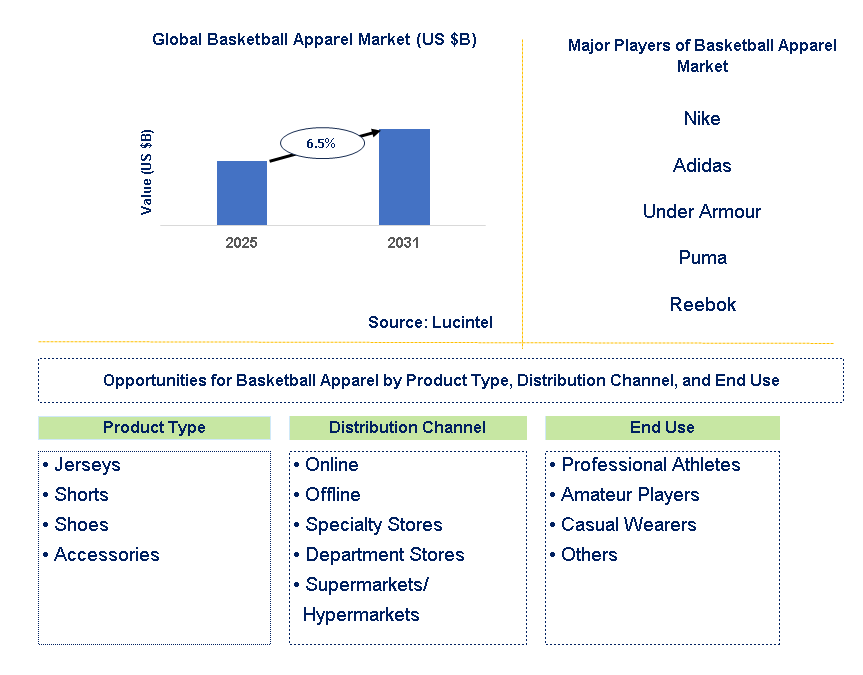
Key data points: The growth forecast = 6.5% annually for the next 7 years. Scroll below to get more insights. This market report covers trends, opportunities and forecasts in basketball apparel market to 2031 by product type (jerseys, shorts, shoes, and accessories), distribution channel (online, offline, specialty stores, department stores, and supermarkets/hypermarkets), end use (professional athletes, amateur players, casual wearers, and others), and region (North America, Europe, Asia Pacific, and the Rest of the World)
We'll send your sample report shortly.
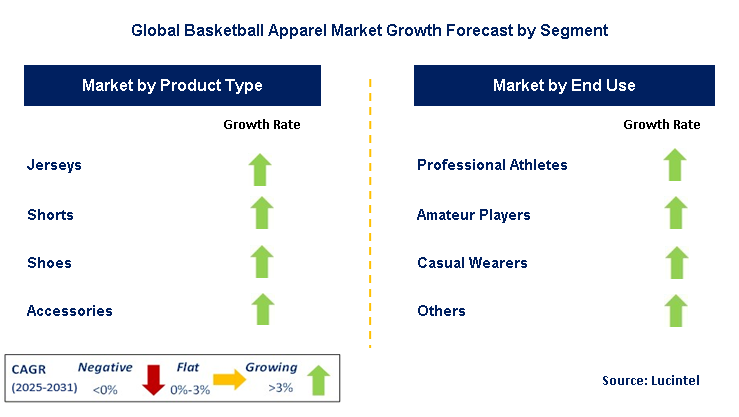
• Lucintel forecasts that, within the product type category, jersey is expected to witness the highest growth over the forecast period.
• Within the end use category, professional athlete is expected to witness the highest growth.
• In terms of region, North America is expected to witness the highest growth over the forecast period. Gain valuable insights for your business decisions with our comprehensive 150+ page report. Sample figures with some insights are shown below.
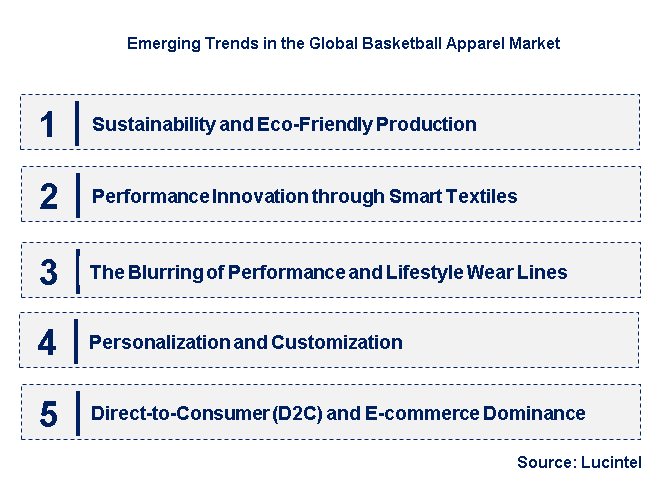
• Sustainability and Eco-Friendly Production: This trend indicates an increasing global conscience regarding the environment. It manifests in basketball wear as brands adopting recycled polyester, organic cotton, and new biodegradable materials. Manufacturing operations are also being rethought to minimize water use, energy, and chemical waste. Consumers are increasingly examining a brand’s environmental legacy, driving demand for supply chain transparency and certifications that guarantee sustainable credentials. It is not only ethical but also an important marketing differentiator
• Performance Innovation through Smart Textiles: In addition to conventional moisture-wicking and breathability, smart fabrics are embedding sophisticated technologies into the fabric itself. This encompasses clothing that has sensors built in to monitor biometric information (heart rate, temperature), control body temperature, or even deliver customized compression based on a person’s physiology. These technologies are designed to improve sport performance, facilitate recovery, and offer real-time feedback to coaches and athletes. The future may hold self-cleaning fabric or materials that respond to environmental conditions.
• The Blurring of Performance and Lifestyle Wear Lines: Basketball clothes no longer stay on the court; basketball clothing is now a part of everyday fashion and streetwear. This phenomenon involves athletic gear designed with aesthetics equally applicable to daily wear, combining comfort, practicality, and style. Brands are designing adaptive pieces that easily commute from training sessions to social events with a need for comfort and the athleisure trend. This has resulted in growing demand for hoodies, track pants, and fashionable sneakers that appeal beyond sport.
• Personalization and Customization: People are increasingly looking for special products that express their personal taste and style. In basketball clothing, this takes the form of possibilities for customization, for example, selecting colors, inserting names and numbers, or even creating individual graphics on jerseys and shorts. New production methods, including 3D printing and digital sublimation, are bringing more possibilities for mass customization, enabling companies to provide more varied personalized choices, fostering a greater emotional connection to the user.
• Direct-to-Consumer (D2C) and E-commerce Dominance: The emergence of D2C models and the evolution of the sophistication of e-commerce platforms have largely transformed the way basketball apparel is sold. The ability of brands to cut out intermediaries, drive direct relationships with customers, gain valuable insights, and present competitive prices is made possible through this. It also enables faster product launches, more focused marketing campaigns, and a more bespoke shopping experience across online channels, social media, and mobile apps, driving market responsiveness. Together, these new trends are individually and collectively transforming the basketball apparel market into a more dynamic, consumer-driven, and technology-based industry. Sustainability strategies are instilling responsible consumption, while performance innovations are advancing athletic potential. The merging of performance and lifestyle wear broadens market penetration, and personalization accommodates individual expression. The predominance of D2C and e-commerce models significantly reconfigures distribution and marketing approaches. Brands that manage to innovate around those changes, combining technology, sustainable practices, and customized experiences, will be well suited to growth and market leadership in the future.
• Technological Advancements in Fabric and Material Science: Current advances in material technology have transformed basketball clothing, extending beyond fundamental moisture-wicking. Such advancements involve the creation of light-weight, airy fabrics with high strength, high-tech compression materials for muscle support and recovery, and high-tech textiles that can control body temperature or monitor performance metrics. These developments translate immediately into better sports performance, enhanced wearer comfort, and a better clothing experience, fueling the demand for high-technology clothing.
• Emergence of Athleisure and Lifestyle Blending: Basketball wear has moved beyond its strictly functional application, evolving to become a major aspect of the larger athleisure and streetwear trends. This has resulted in brands creating products that merge performance functionality seamlessly with fashionable looks, ideal for both on-court play and everyday street wear. The focus is on versatility, comfort, and fashion-driven designs that appeal to a broader consumer audience over and above the sportswear enthusiast, radically opening up the market’s scope and driving product diversification.
• More Emphasis on Sustainability and Ethical Manufacturing: The increasing demand from consumers for products that contribute to sustainability has driven significant evolution in the basketball apparel market: a focus on high-level commitments to sustainability. Brands invest in material such as recycled polyester, organic cotton, and even innovative biodegradable fabrics. There is an ever-increasing edge to more responsible, less-wasting manufacturing techniques on water usage, while fair labor conditions are ensured. This is triggered by consumer power and corporate social responsibility efforts in terms of brand image and purchasing decisions.
• Expansion of Direct-to-Consumer (D2C) Sales Channels: The transition towards D2C retail has been a major shift, enabling basketball apparel brands to have direct engagement with their consumers. This does away with intermediaries, resulting in greater margins for brands and generally competitive prices for consumers. D2C strategies allow brands to collect valuable customer information, customize marketing initiatives, and provide a more customized shopping experience using their own online stores and physical flagship stores, enabling higher brand loyalty and reactivity.
• Influence of Social Media and Endorsements by Athletes: The widespread power of social media and the calculated utilization of athlete endorsements have emerged as key advances in the marketing of basketball wear. Sites such as Instagram, TikTok, and YouTube give brands direct access to connect with target markets and promote new products. Top-level basketball players, professional and prominent amateurs alike, serve as influential brand ambassadors, creating trends and informing purchasing decisions by way of personal look and play. This new digital-led strategy catalyzes product uptake and informs consumer wants. These recent trends are transforming the basketball apparel market significantly through innovation, increasing market segments, and redefining consumer engagement. Technological innovation is enhancing product performance, while the athleisure movement increases consumer reach. Sustainability programs are rewriting the rules of manufacturing and sourcing, an indication of increasing green awareness. The move toward D2C business models is leveling the playing field and giving brands more direct contact with consumers. Lastly, social media and athlete influencer marketing are transforming marketing and trend communication. Altogether, these trends are creating a more dynamic, responsive, and responsibly oriented basketball apparel business.
• Performance Wear for Amateur and Youth Leagues: This segment is a major growth opportunity. Whereas professional athletes are given the best equipment, there exists an untapped market for durable, comfortable, high-performance wear fit for amateur players and youth leagues. These would encompass gear with varying levels of skill, body types, and climate zones. Brands can target affordable price points without sacrificing key performance attributes such as moisture-wicking and breathability, promoting brand loyalty at an early age and responding to the high participation level of the sport.
• Lifestyle and Athleisure Wear: The "athleisure" trend has created vast growth opportunities. Basketball-inspired apparel that flows easily from the court to everyday wear is in high demand. This encompasses fashionable hoodies, track pants, graphic t-shirts, and bomber jackets that draw design inspiration from basketball culture but are acceptable for everyday wear. Such opportunities can be leveraged by brands through partnerships with fashion designers, influencers, and artists to produce collections that resonate with a wider, fashion-oriented consumer base beyond actual players.
• Team Uniforms and Customization: The need for customized clothing and tailored team uniforms represents a strong growth potential. Schools, teams, and even players are looking for distinctive designs that express their personality. This includes providing vast customization capabilities for jerseys, shorts, and warm-ups such as personalized names, numbers, logos, and color combinations. Utilizing sophisticated digital printing and production technology can help enable quick production of customized orders for both large institutions and small, individual team orders.
• Women’s Basketball Attire: The swift expansion of women’s basketball across the world, not just at professional leagues but also at grassroots levels, is an immense, yet widely untapped, expansion opportunity. This entails creating apparel uniquely designed to the woman’s body, providing more sizes, and incorporating patterns that are both performance-enhancing as well as visually appealing. Companies can spend on advertising campaigns that showcase women athletes and develop collections that are empowering for women in sports, catering to their specific needs and desires.
• Sustainable and Eco-Friendly Collections: As more consumers become aware of environmental matters, there is a strategic imperative to create and sell sustainable basketballwear ranges. This requires the use of recycled, organic, or biodegradable materials, ethical production methods, and transparency in the supply chain. Eco-friendly brands can secure environmentally aware consumers, gain competitive advantage, and build a positive brand image, riding a wave of global change towards more responsible consumption practices. These strategic growth options are collectively transforming the basketball apparel market by expanding its scope and appeal. Catering to amateur and youth leagues opens up the core customer base, while embracing athleisure broadens product offerings and accesses new fashion-conscious consumers. Customization addresses individual and team identity, building singular brand connections. The marked growth in women’s basketball provides a critical, underserved market. Lastly, sustainability prioritization not only resonates with consumer values but also fuels innovation in materials and production. Seizing these opportunities will result in a more resilient, diverse, and visionary basketball apparel industry.
• Nike
• Adidas
• Under Armour
• Puma
• Reebok
• Jordan Brand
• ANTA Sports
• Li-Ning
• Champion
• New Balance
• Jerseys
• Shorts
• Shoes
• Accessories
• Online
• Offline
• Specialty Stores
• Department Stores
• Supermarkets/Hypermarkets
• North America
• Europe
• Asia Pacific
• The Rest of the World
• United States: The American basketball apparel industry is still a world leader, with high brand loyalty, heavy investment in athlete endorsement, and a lively streetwear scene. Recent trends involve an increased emphasis on sustainable sourcing and production, growing direct-to-consumer (D2C) sales channels, and greater personalization alternatives for consumers. Brands also use data analysis to better understand consumer tendencies and design more focused product lines, from performance apparel to lifestyle wear that dissolves the boundaries between on-court and off-court fashion.
• China: China’s basketball clothing market is seeing phenomenal growth, driven by a huge and active fan base, growth of domestic leagues, and the power of international NBA icons. Some major trends include the rise of robust domestic brands encroaching on international heavyweights, strong focus on e-commerce and livestreaming for promotions and sales, and the use of traditional Chinese motifs in clothing designs. There is also an emerging trend for premium, high-performance equipment as the sport continues to professionalize.
• Germany: The German basketball apparel market is slowly but surely growing, driven by the widening popularity of the sport, especially among youth, and successful German players in leagues abroad. Trends of late indicate an increasing interest in multifunctional apparel which can switch from court wear to casual wear without any difficulty. Sustainability and ethical production are increasingly becoming considerations for German consumers, and brands are responding by highlighting sustainable materials and transparent supply chains. Technical performance wear niche brands are also gaining ground.
• India: India’s basketball apparel market is still in its infancy stage but has enormous scope for development, fueled by growing disposable incomes, awareness of global sports, and government policy that encourages participation in sports. Recent trends involve an increase in demand for fashion basketball apparel at affordable prices, international brands’ penetration into Tier-2 and Tier-3 towns, and the emerging role of social media in driving consumer behavior. Casual basketball-factored fashion wear is also increasingly popular.
• Japan: Japan’s basketball clothing market is advanced and design-oriented, echoing the nation’s distinctive mix of tradition and technology. Recent trends involve a high premium on technological innovation in fabric and design for improved performance, increasing support for limited-edition and collaborative offerings, and the incorporation of minimalist styles into athletic wear. Japanese consumers also place great value on comfort and resilience, which is behind high demand for high-quality, durable clothing. The market also has a good balance of international and robust local brands.


• Nike
• Adidas
• Under Armour
• Puma
• Reebok
• Jordan Brand
• ANTA Sports
• Li-Ning
• Champion
• New Balance Q5. Which basketball apparel market segment will be the largest in future? Answer: Lucintel forecasts that, within the product type category, jersey is expected to witness the highest growth over the forecast period. Q6. In basketball apparel market, which region is expected to be the largest in next 5 years? Answer: In terms of region, North America is expected to witness the highest growth over the forecast period. Q7. Do we receive customization in this report? Answer: Yes, Lucintel provides 10% customization without any additional cost.


Choose a license that fits your team. Instant PDF delivery.
Prices exclude taxes. Instant delivery. Custom licensing available on request.
Market Report · July 22, 2026
Market Report · July 16, 2026
Market Report · May 18, 2026
Trusted partner for strategic intelligence and business growth


Receive a complimentary market analysis tailored to your industry. Our analysts will identify key growth opportunities and competitive dynamics specific to your business.

Market size, growth rate, and key trend analysis for your specific sector.

Top competitor positioning and market share analysis.

Strategic recommendations backed by data-driven insights.
Get curated market intelligence and competitive moves straight to your inbox.
By subscribing, you agree to receive our monthly insights. Unsubscribe anytime.
Receive a complimentary market analysis tailored to your industry. Our analysts will identify key growth opportunities and competitive dynamics specific to your business.
Market size, growth rate, and key trend analysis for your specific sector.
Top competitor positioning and market share analysis.
Strategic recommendations backed by data-driven insights.
Get curated market intelligence, emerging trends, and competitive moves straight to your inbox each month.
By subscribing, you agree to receive our monthly insights. Unsubscribe anytime.
We'll send your sample report shortly.