
Report Feature
Bar Graph Array Market Trends and Forecast
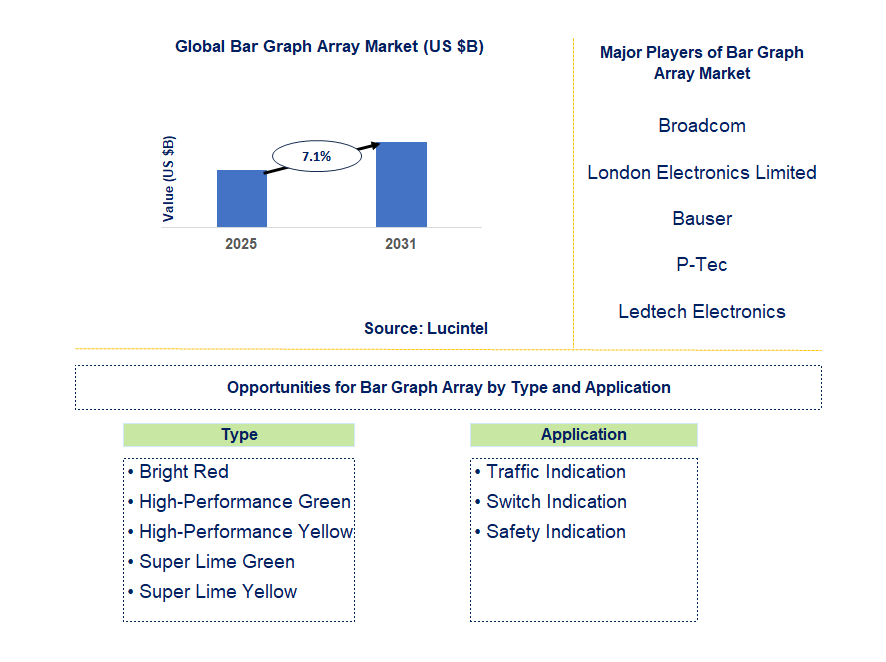
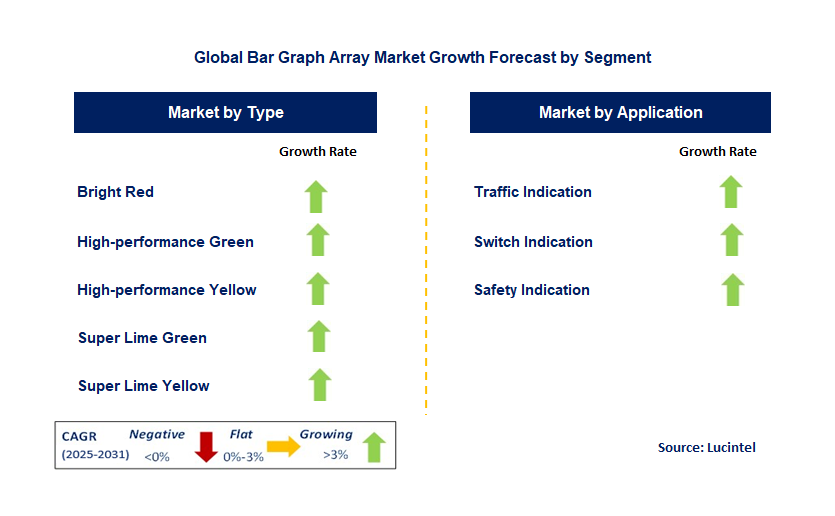
The future of the global bar graph array market looks promising with opportunities in the traffic indication, switch indication and safety indication markets. The global bar graph array market is expected to grow with a CAGR of 7.1% from 2025 to 2031. The major drivers for this market are increasing demand for visual signaling applications, rising adoption of eco-friendly technologies, and growing industrial automation and safety regulations.• Lucintel forecasts that, within the type category, super lime green is expected to witness the highest growth over the forecast period due to its increasing demand in eco-friendly applications.
• Within the application category, safety indication is expected to witness the highest growth due to rising safety standards.
• In terms of region, APAC is expected to witness the highest growth over the forecast period due to rapid industrialization.
Emerging Trends in the Bar Graph Array Market
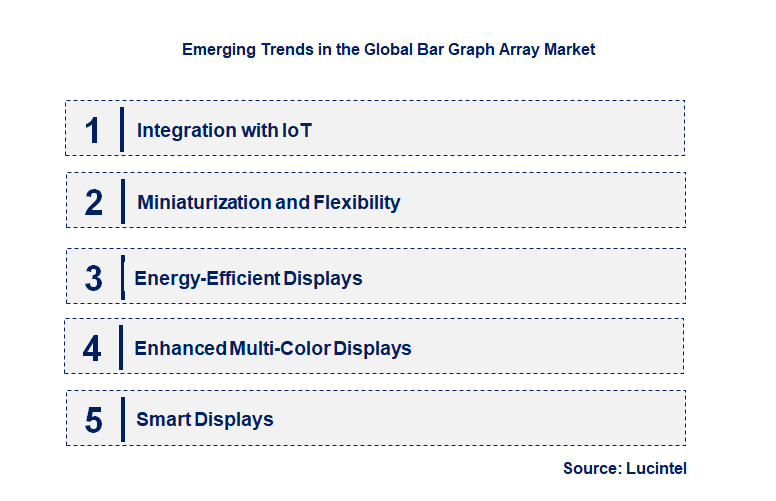
The bar graph array market is evolving with trends that focus on enhancing display functionality, miniaturization, and energy efficiency. As demand rises across various industries, the adoption of new technologies such as smart displays and IoT integration is reshaping the market.• Integration with IoT: As IoT devices become more widespread, bar graph arrays are increasingly being integrated into connected systems. This trend allows for real-time data monitoring and control, enabling smarter, more responsive products in applications such as home automation, healthcare, and automotive systems.
• Miniaturization and Flexibility: The trend of miniaturizing bar graph arrays is driven by the need for compact and versatile displays in mobile and wearable devices. Flexible and smaller designs enable integration into a wide range of applications, offering more options for display placement and interaction.
• Energy-Efficient Displays: As energy efficiency becomes a key concern across industries, bar graph arrays are increasingly designed to consume less power. This is especially important for portable and battery-operated devices, where longer battery life is a top priority.
• Enhanced Multi-Color Displays: The demand for more dynamic and visually appealing displays is pushing manufacturers to develop bar graph arrays with a broader color range. This trend is especially prominent in consumer electronics and automotive applications, where high-contrast, colorful displays are becoming more common.
• Smart Displays: Bar graph arrays are incorporating smart features like touch sensitivity, sensor integration, and connectivity. These developments are making displays more interactive, enabling users to interact directly with the information displayed and enhancing the functionality of various devices. The emerging trends of IoT integration, miniaturization, energy efficiency, multi-color displays, and smart features are shaping the future of the bar graph array market. These innovations are making displays more versatile, responsive, and efficient, driving growth in diverse applications across industries.
Recent Development in the Bar Graph Array Market
The bar graph array market is witnessing dynamic developments as manufacturers work to meet the increasing demand for advanced visual displays. These developments focus on improving performance, enhancing features, and meeting the specific needs of different industries such as automotive, consumer electronics, and industrial applications.• Innovations in Display Technology: Manufacturers are developing advanced bar graph arrays with enhanced resolution, faster response times, and a wider range of colors. This is enabling better visual performance in applications such as automotive dashboards and industrial control panels, where precision and clarity are crucial.
• Rise in Demand for LED Displays: The market is shifting toward LED-based bar graph arrays due to their low power consumption, compact design, and long lifespan. LED displays are becoming increasingly popular in consumer electronics, automotive, and industrial applications, offering energy-efficient and reliable solutions.
• Customization and Adaptability: As industries require more tailored solutions, manufacturers are focusing on producing customizable bar graph arrays. These displays can now be adapted to different shapes, sizes, and colors, allowing them to meet specific customer requirements in diverse applications.
• Focus on Durability: With the increasing use of bar graph arrays in harsh environments such as factories, outdoor equipment, and vehicles, there is a growing emphasis on durability. Companies are developing displays that can withstand extreme temperatures, humidity, and physical stress, ensuring longevity and reliability.
• Technological Integration: Manufacturers are integrating bar graph arrays with advanced technologies like touch interfaces, sensors, and connectivity. These innovations are enhancing the interactivity and functionality of displays, making them more user-friendly and responsive in applications such as home automation and industrial monitoring. The recent developments in display technology, LED adoption, customization, durability, and technological integration are transforming the bar graph array market. These advancements are meeting the growing demand for efficient, versatile, and high-performance displays in various sectors.
Strategic Growth Opportunities in the Bar Graph Array Market
The bar graph array market offers significant growth opportunities, driven by advancements in display technology, consumer demand, and industrial applications. Key growth opportunities lie in sectors such as automotive, consumer electronics, healthcare, and industrial automation.• Automotive Displays: The automotive industry is increasingly adopting bar graph arrays for applications like dashboard displays, vehicle control systems, and infotainment units. This growth opportunity is driven by the need for intuitive, easy-to-read displays that provide critical data to drivers in real-time.
• Wearable Devices: With the rise of wearable technology, bar graph arrays are being incorporated into devices like fitness trackers, smartwatches, and medical monitors. These sensors enable real-time data monitoring, offering consumers more detailed insights into their health and activities.
• Industrial Automation: The adoption of bar graph arrays in industrial automation is growing, particularly for machinery monitoring and control systems. These displays offer a visual representation of critical data, helping operators detect issues and ensure smoother operations.
• Home Automation: Bar graph arrays are becoming integral to smart home systems, where they are used for energy monitoring, security systems, and device control. Their integration into IoT platforms allows users to monitor and manage their home environments more efficiently.
• Consumer Electronics: The demand for bar graph arrays in consumer electronics, such as smartphones, gaming devices, and televisions, is increasing. These displays offer interactive and visually appealing interfaces, enhancing the overall user experience in these products. Strategic growth opportunities in automotive, wearable devices, industrial automation, home automation, and consumer electronics are expanding the bar graph array market. These opportunities reflect the increasing need for high-performance, energy-efficient displays across various sectors, driving innovation and market growth.
Bar Graph Array Market Driver and Challenges
The bar graph array market is influenced by various drivers and challenges, including technological advancements, market demand for energy-efficient displays, and regulatory considerations. Addressing these factors is key to the continued growth of the market. The factors responsible for driving the bar graph array market include: 1. Technological Advancements: Continuous improvements in display technology, such as better resolution, faster refresh rates, and enhanced color accuracy, are driving market growth. These advancements enable more precise and dynamic displays, which are particularly important for automotive, consumer electronics, and industrial applications. 2. Demand for Energy-Efficient Displays: As energy efficiency becomes a priority across industries, bar graph arrays are being designed to consume less power. This makes them ideal for battery-operated devices, smart systems, and other applications where energy consumption is a key concern. 3. Growth in Consumer Electronics: The increasing demand for interactive, visually appealing displays in smartphones, gaming devices, and smart devices is driving the growth of the bar graph array market. Manufacturers are focusing on creating more sophisticated displays to enhance user experience in these products. 4. Industrial Automation Needs: As industries increasingly adopt automation, the demand for visual monitoring systems, including bar graph arrays, is growing. These displays provide real-time data visualization for equipment monitoring, predictive maintenance, and process control in industrial environments. 5. Integration with IoT Systems: The rise of the Internet of Things (IoT) is contributing to the market’s growth, as bar graph arrays are integrated into connected systems for real-time monitoring and control. This trend is driving demand for smarter, more responsive display solutions across various industries. Challenges in the bar graph array market are: 1. High Development Costs: Developing advanced bar graph arrays with improved features and capabilities can be expensive. High production costs may limit the affordability of these systems, especially for smaller businesses and startups. 2. Technological Complexity: As bar graph arrays become more advanced, they require more complex technologies for integration with other systems. This can lead to longer development cycles and increased costs, particularly for customized applications. 3. Market Competition: The bar graph array market is competitive, with numerous manufacturers offering similar products. Companies must focus on differentiation through innovation, cost efficiency, and quality to remain competitive in this market. Technological advancements, demand for energy-efficient displays, growth in consumer electronics, industrial automation, and IoT integration are driving the bar graph array market. However, challenges such as high development costs, technological complexity, and market competition need to be addressed for continued growth in the sector.List of Bar Graph Array Companies
Companies in the market compete on the basis of product quality offered. Major players in this market focus on expanding their manufacturing facilities, R&D investments, infrastructural development, and leverage integration opportunities across the value chain. With these strategies bar graph array companies cater increasing demand, ensure competitive effectiveness, develop innovative products & technologies, reduce production costs, and expand their customer base. Some of the bar graph array companies profiled in this report include-• Broadcom
• London Electronics Limited
• Bauser
• P-Tec
• Ledtech Electronics
• FEMA Electronics Corporation
• Gems Sensors & Controls
• Kingbright
• American Opto Plus Led Corporation
• Levelese
Bar Graph Array Market by Segment
The study includes a forecast for the global bar graph array market by type, application, and region.Bar Graph Array Market by Type [Value from 2019 to 2031]:
• Bright Red
• High-Performance Green
• High-Performance Yellow
• Super Lime Green
• Super Lime Yellow
Bar Graph Array Market by Application [Value from 2019 to 2031]:
• Traffic Indication
• Switch Indication
• Safety Indication
Bar Graph Array Market by Region [Value from 2019 to 2031]:
• North America
• Europe
• Asia Pacific
• The Rest of the World
Country Wise Outlook for the Bar Graph Array Market
The bar graph array market has been growing with the increasing demand for visual display systems, particularly in applications like automotive, consumer electronics, and industrial equipment. This trend is fueled by the need for compact, energy-efficient, and multifunctional visual display systems in various sectors. Countries such as the United States, China, Germany, India, and Japan are leading the development of these systems.• United States: In the United States, the bar graph array market is expanding due to the increasing demand for LED displays in automotive, industrial, and consumer applications. Manufacturers are focusing on enhancing the resolution, color range, and energy efficiency of these displays. Moreover, there is a growing interest in incorporating smart features, such as IoT connectivity, into bar graph arrays.
• China: China’s bar graph array market is experiencing significant growth, driven by its manufacturing capabilities and the widespread adoption of consumer electronics. With the rapid development of smart devices, China is seeing increased demand for customizable and efficient display systems. Innovations in miniaturization and multi-color displays are helping to drive the market forward in both industrial and consumer applications.
• Germany: Germany is investing heavily in the bar graph array market, particularly in the automotive sector, where there is a growing need for sophisticated visual displays. German manufacturers are focusing on improving display clarity, durability, and integration with other vehicle systems. Additionally, there is a strong emphasis on energy-efficient solutions for industrial applications.
• India: In India, the bar graph array market is being driven by the growth of the consumer electronics and industrial sectors. The demand for cost-effective, high-performance displays is rising as India becomes a major hub for manufacturing smartphones, televisions, and other electronic devices. The government’s push for digitalization is also supporting the growth of display technologies, including bar graph arrays.
• Japan: Japan’s bar graph array market is growing due to its strong electronics and automotive industries. Japanese companies are focusing on high-quality, energy-efficient displays that integrate seamlessly into consumer electronics, automotive systems, and industrial equipment. Additionally, Japan is leading innovations in flexible and OLED bar graph arrays, which offer greater design versatility.

Features of the Global Bar Graph Array Market
Market Size Estimates: Bar graph array market size estimation in terms of value ($B). Trend and Forecast Analysis: Market trends (2019 to 2024) and forecast (2025 to 2031) by various segments and regions. Segmentation Analysis: Bar graph array market size by type, application, and region in terms of value ($B). Regional Analysis: Bar graph array market breakdown by North America, Europe, Asia Pacific, and Rest of the World. Growth Opportunities: Analysis of growth opportunities in different type, application, and regions for the bar graph array market. Strategic Analysis: This includes M&A, new product development, and competitive landscape of the bar graph array market. Analysis of competitive intensity of the industry based on Porter’s Five Forces model.
FAQ
Q1. What is the growth forecast for bar graph array market? Answer: The global bar graph array market is expected to grow with a CAGR of 7.1% from 2025 to 2031. Q2. What are the major drivers influencing the growth of the bar graph array market? Answer: The major drivers for this market are increasing demand for visual signaling applications, rising adoption of eco-friendly technologies, and growing industrial automation and safety regulations. Q3. What are the major segments for bar graph array market? Answer: The future of the bar graph array market looks promising with opportunities in the traffic indication, switch indication and safety indication markets. Q4. Who are the key bar graph array market companies? Answer: Some of the key bar graph array companies are as follows:• Broadcom
• London Electronics Limited
• Bauser
• P-Tec
• Ledtech Electronics
• FEMA Electronics Corporation
• Gems Sensors & Controls
• Kingbright
• American Opto Plus Led Corporation
• Levelese Q5. Which bar graph array market segment will be the largest in future? Answer: Lucintel forecasts that, within the type category, super lime green is expected to witness the highest growth over the forecast period due to its increasing demand in eco-friendly applications. Q6. In bar graph array market, which region is expected to be the largest in next 5 years? Answer: In terms of region, APAC is expected to witness the highest growth over the forecast period due to rapid industrialization. Q7. Do we receive customization in this report? Answer: Yes, Lucintel provides 10% customization without any additional cost.
Table of Contents
Methodology
- In-depth interviews of the major players in this market
- Detailed secondary research from competitors’ financial statements and published data
- Extensive searches of published works, market, and database information pertaining to industry news, company press releases, and customer intentions
- A compilation of the experiences, judgments, and insights of Lucintel’s professionals, who have analyzed and tracked this market over the years.


Buy Now
Choose a license that fits your team. Instant PDF delivery.
Prices exclude taxes. Instant delivery. Custom licensing available on request.
Key Questions
- • What are some of the most promising, high-growth opportunities for the bar graph array market by type (bright red, high-performance green, high-performance yellow, super lime green, and super lime yellow), application (traffic indication, switch indication, and safety indication), and region (North America, Europe, Asia Pacific, and the Rest of the World)?
- • Which segments will grow at a faster pace and why?
- • Which region will grow at a faster pace and why?
- • What are the key factors affecting market dynamics? What are the key challenges and business risks in this market?
- • What are the business risks and competitive threats in this market?
- • What are the emerging trends in this market and the reasons behind them?
- • What are some of the changing demands of customers in the market?
- • What are the new developments in the market? Which companies are leading these developments?
- • Who are the major players in this market? What strategic initiatives are key players pursuing for business growth?
- • What are some of the competing products in this market and how big of a threat do they pose for loss of market share by material or product substitution?
- • What M&A activity has occurred in the last 5 years and what has its impact been on the industry? For any questions related to Bar Graph Array Market, Bar Graph Array Market Size, Bar Graph Array Market Growth, Bar Graph Array Market Analysis, Bar Graph Array Market Report, Bar Graph Array Market Share, Bar Graph Array Market Trends, Bar Graph Array Market Forecast, Bar Graph Array Companies, write Lucintel analyst at email: helpdesk@lucintel.com. We will be glad to get back to you soon.


