
Market Report · September 17, 2025

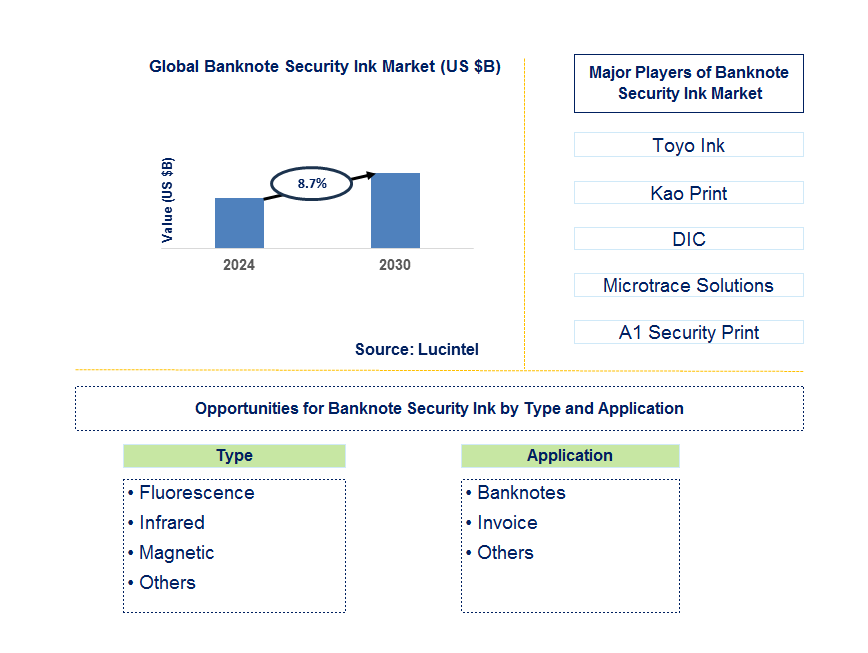
Key data points: The growth forecast = 8.7% annually next 6 years. Scroll below to get more insights. This market report covers trends, opportunities, and forecasts in the global banknote security ink market to 2030 by type (fluorescence, infrared, magnetic, and others), application (banknotes, invoice, and others), and region (North America, Europe, Asia Pacific, and the Rest of the World)
We'll send your sample report shortly.
• APAC will remain the largest region over the forecast period due to strong domestic demand, encouraging laws, and a solid foundation in manufacturing. Gain valuable insight for your business decisions with our comprehensive 150+ page report
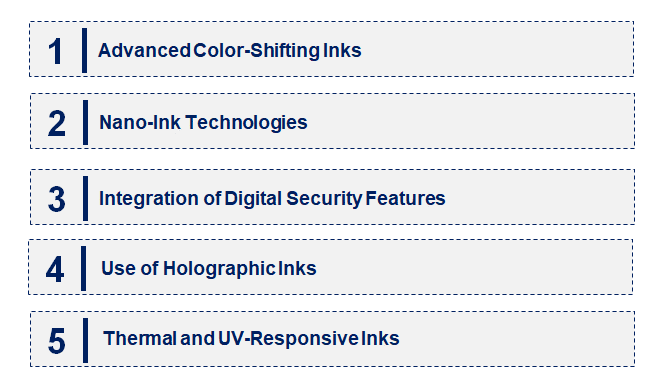
• Advanced Color-Shifting Inks: The growth of superior color-shifting inks is a key trend currently emerging. When tilted, these ink colors change, creating a dynamic visual effect that is hard to reproduce. This characteristic enhances security by offering an immediate method for public verification while complicating matters for those who would like to counterfeit money. The technology behind these inks uses special pigments and micro-encapsulation techniques, adding another layer of difficulty for copycats.
• Nano-Ink Technologies: Nanoinks are increasingly being used in banknote production due to their superior security capabilities. These inks contain nanoparticles that can generate intricate patterns and security features visible only under certain conditions. This enables the inclusion of features such as micro-text and hidden images, which are hard for counterfeiters to copy, thus offering a higher degree of protection against counterfeiting.
• Integration of Digital Security Features: Banknotes are now incorporating digital security traits, such as embedded RFID chips and digital watermarks. These features can be checked using specific gadgets to determine if they are genuine. The combination of traditional ink security measures with digital technologies provides two layers of protection, making counterfeiting harder and less likely.
• Use of Holographic Inks: More banknote designs include holographic inks. Through these inks, three-dimensional images on the notes change as they are tilted or rotated. The use of complex visual effects on holograms has become almost impossible to duplicate, making them very secure for these reasons. This trend reveals an increased reliance on visual and tactile forms of security aimed at combating the highly sophisticated methods used by counterfeiters.
• Thermal and UV-Responsive Inks: There is an increase in popularity among inks that respond to thermal or ultraviolet (UV) light. These types of inks may reveal hidden marks or alter color when exposed to different lighting sources, thereby suiting both covert and overt means for enhancing security purposes. Multi-layered verification methods underscore the need for multi-faceted security solutions. These trends fundamentally reshape the banknote security ink market by introducing advanced technologies and materials that significantly improve the level of currency security offered. The integration shows a shift toward more intricate protective measures such as color-shifting, nano, digital, holographic, and responsive inks, which provide a strong "fortress" against increasingly complicated counterfeiting threats.
• Enhanced Color-Shifting Inks: One major development in banknote security technology has been the introduction of enhanced color-shifting inks. They have dynamic effects that change colors when viewed from different angles. This allows any member of the public to easily verify the authenticity of banknotes using these simple color-changing ink designs. The advanced pigments and micro-encapsulation techniques employed in improved color-shifting inks present challenges that are difficult for counterfeiters to overcome.
• Nano-Ink Innovations: Innovations in nano-inks have led to the development of inks that contain nanoparticles, enabling complex security features. These nano-inks can include tiny writings, hidden images, or intricate patterns that cannot be seen by the naked eye. By making such features difficult for fraudsters to reproduce accurately, the deployment of nano-inks considerably improves the safety level associated with banknotes.
• Digital Integration: Banknote security has greatly improved with the integration of digital enhancement features, including embedded transponder chips and digital watermarks that can verify authenticity through scanning with specialized peripherals. This development adds an extra layer of protection to supplement traditional ink methods, making it difficult for counterfeiters to produce forged notes that can pass as legitimate.
• Advanced Holographic Inks: The introduction of advanced holographic inks has enhanced banknotes with three-dimensional images and visual effects that change when the note is tilted. These inks are highly effective at preventing counterfeiting, as they contain complex visual patterns that are difficult to reproduce holographically. By incorporating more secure holographic features into their design, advanced holographic inks promote overall banknote security and provide another means of authentication.
• Responsive Thermal and UV Inks: The development of inks that respond to thermal and UV light is a significant advancement today. These inks reveal hidden elements or change colors when specific light is applied, thereby adding another level of safety. Covert verification using this technology enables both active and passive identification tests on notes, increasing the complexity for counterfeiters who wish to replicate these responses accurately. These recent developments in the banknote security ink market demonstrate how security technology within the sector continues to evolve. The industry is combating counterfeit currency and ensuring global currency safety by introducing improved color-shifting inks, nano-inks, digital elements, holographic features, and responsive thermal and UV inks, among others.
• Adoption of Nano-Ink Technologies: The banknote security ink market has great potential for nano-ink technologies. These inks are based on nanoparticles that ensure high-resolution patterns and features that are very hard to reproduce by fraudsters. They also enable micro-texts, hidden images, or complex color shifts, thus fulfilling the purposes of note security. The microscopic embedding of these characteristics gives them an advantage over counterfeiting. As banks and governments seek more robust security solutions, the demand for nano-ink technologies is expected to grow, presenting opportunities for innovation and market expansion.
• Expanding Digital Security Features: There are substantial prospects in integrating digital security features like RFID chips embedded in banknotes and digital watermarks. Consequently, these techniques allow banknotes to be verified online using electronic devices, in addition to traditional inks, thus providing an additional layer of security. The expansion of digital features can help address deficiencies associated with purely physical solutions while developing holistic approaches to authenticating currency. This trend is particularly relevant as the financial sector increasingly adopts digital solutions. Manufacturers that develop and integrate these technologies will be well-positioned to meet the evolving needs of central banks and financial institutions.
• Development of Advanced Holographic Inks: Advanced holographic inks represent another key growth area within the banknote security ink market. These three-dimensional images move or change as a result of tilting or movement of the notes on which they are printed. Their complexity makes it quite difficult to counterfeit them, making them an effective means of ensuring safety. The development of new holographic ink technologies that offer even more intricate and dynamic visual effects can enhance the security of banknotes and attract interest from governments seeking to upgrade their currency systems. This growth opportunity is driven by the need for increasingly sophisticated anti-counterfeiting measures.
• Use of Thermal and UV-Responsive Inks: The use of thermal and UV-responsive inks in banknotes offers a versatile growth opportunity. These inks reveal hidden features or change color when exposed to heat or UV light, adding multiple layers of security. The ability to incorporate these responsive elements into banknote designs allows for both overt and covert verification methods. As counterfeiting techniques become more advanced, the demand for these inks is likely to increase, driving growth in this application. Manufacturers who can provide innovative and efficient thermal and UV-responsive inks will find significant opportunities in this market.
• Customization for Emerging Markets: This growth opportunity arises from the customization of banknote security inks for emerging markets that are looking to improve their currency security levels. Emerging markets have been adopting more advanced security technologies in a bid to fight counterfeiting and secure their economies. For instance, they can develop new growth areas by providing specialized solutions that meet these specific market needs, such as inexpensive but highly secure inks. In this regard, there is a need to develop scalable and adaptable security solutions tailored to suit multi-currency demands and varying levels of security among emerging economies. These dynamic characteristics of the banknote security ink industry highlight strategic growth opportunities for companies that can leverage them. By focusing on nano-inks, digital security features, holographic technologies, responsive inks, and customization for emerging markets, businesses can capitalize on the growing demand for high-security feature systems. These advancements not only address issues raised by sophisticated counterfeiters but also serve as catalysts for innovation and expansion in the market, thereby improving currency safety in the future.
• Toyo Ink
• Kao Print
• DIC
• Microtrace Solutions
• A1 Security Print
• SICPA
• NanoMatriX
• Linduch Technology
• Gleitsmann Security Inks
• Authentix
• Fluorescence
• Infrared
• Magnetic
• Others
• Banknotes
• Invoice
• Others
• North America
• Europe
• Asia Pacific
• The Rest of the World
• United States: In recent years, developments have included the incorporation of advanced color-shifting inks and infrared-readable features into banknotes. The Federal Reserve and the Bureau of Engraving and Printing (BEP) have introduced these technologies aimed at making it harder to counterfeit money and improving overall U.S. dollar security. Additionally, emphasis is being placed on incorporating dynamic security threads that change color when tilted, thereby enhancing resistance against counterfeiting.
• China: China has led in implementing high-tech security inks, notably through the adoption of nano-ink technology. Its central bank, the PBOC, has used this type of ink that can only be seen under specific lighting conditions, along with microtext and inks with complex holograms, among others. These improvements are part of a larger Chinese strategy for modernizing its currency system while also combating counterfeiting.
• Germany: Among other new features deployed by Germany are ultraviolet (UV) and infrared inks, which offer enhanced protection against counterfeiting. The Bundesbank’s approach to the Euro includes several multi-level security elements, such as complex color-changing inks and hidden text that reveals itself only under UV light. This ensures that the Euro remains a step ahead of counterfeiting threats.
• India: Major developments include the introduction of advanced security inks featuring color-shifting technology and latent image techniques. The RBI has chosen to enhance its currency with microprinting and threads visible under UV light, in response to security upgrading measures proactively taken by the Indian central bank against counterfeiting activities targeting Rupee notes.
• Japan: The Bank of Japan has been at the forefront of high-tech security features such as holographic inks and thermal-sensitive color-changing inks. The latest 10,000 yen banknotes incorporate advanced security measures that make counterfeiting almost impossible, thus protecting the integrity and trustworthiness of the currency.


• Toyo Ink
• Kao Print
• DIC
• Microtrace Solutions
• A1 Security Print
• SICPA
• NanoMatriX
• Linduch Technology
• Gleitsmann Security Inks
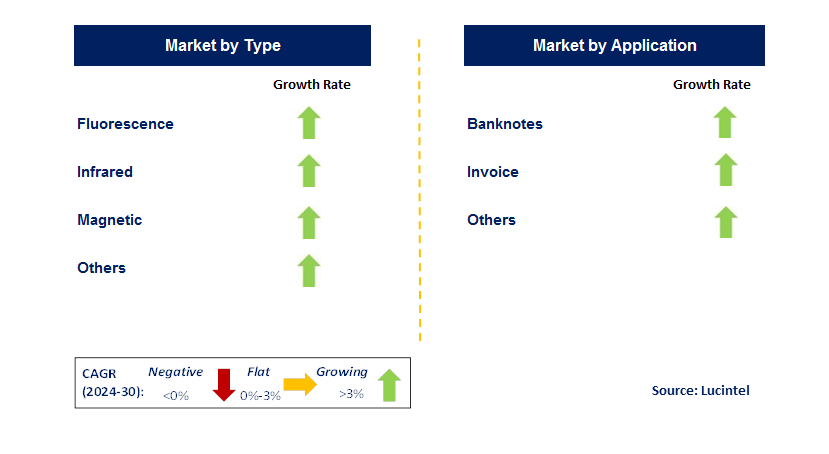
• Authentix Q5. Which banknote security ink market segment will be the largest in future? Answer: Lucintel forecasts that magnetic is expected to witness the highest growth over the forecast period. Q6. In banknote security ink market, which region is expected to be the largest in next 5 years? Answer:
• APAC will remain the largest region over the forecast period due to strong domestic demand, encouraging laws, and a solid foundation in manufacturing. Q7. Do we receive customization in this report? Answer: Yes, Lucintel provides 10% customization without any additional cost.


Choose a license that fits your team. Instant PDF delivery.
Prices exclude taxes. Instant delivery. Custom licensing available on request.
Market Report · September 17, 2025
Market Report · August 14, 2025
Market Report · July 31, 2025
Trusted partner for strategic intelligence and business growth


Receive a complimentary market analysis tailored to your industry. Our analysts will identify key growth opportunities and competitive dynamics specific to your business.

Market size, growth rate, and key trend analysis for your specific sector.

Top competitor positioning and market share analysis.

Strategic recommendations backed by data-driven insights.
Get curated market intelligence and competitive moves straight to your inbox.
By subscribing, you agree to receive our monthly insights. Unsubscribe anytime.
Receive a complimentary market analysis tailored to your industry. Our analysts will identify key growth opportunities and competitive dynamics specific to your business.
Market size, growth rate, and key trend analysis for your specific sector.
Top competitor positioning and market share analysis.
Strategic recommendations backed by data-driven insights.
Get curated market intelligence, emerging trends, and competitive moves straight to your inbox each month.
By subscribing, you agree to receive our monthly insights. Unsubscribe anytime.
We'll send your sample report shortly.