
Market Report · July 31, 2026

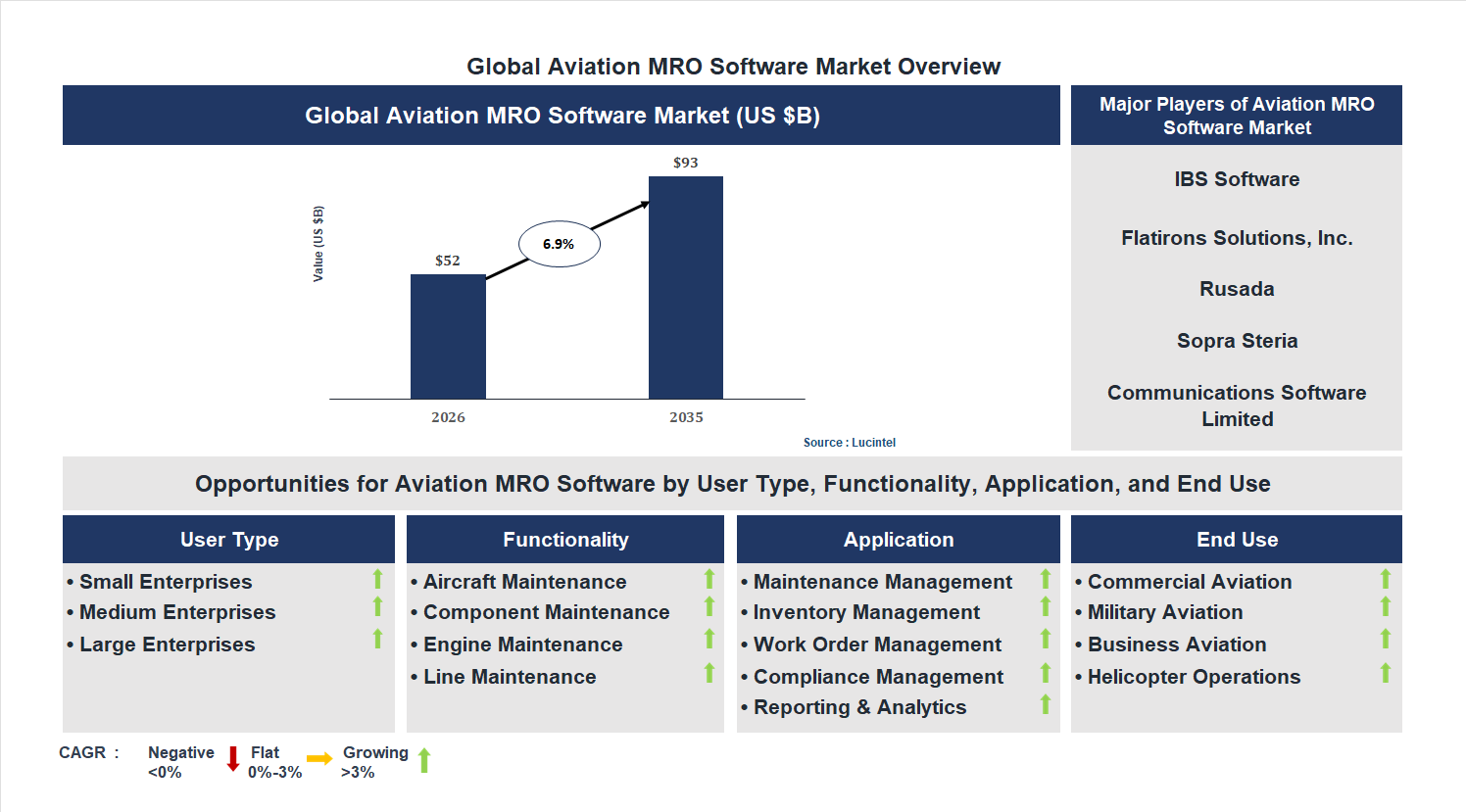
Key data points: The market size in 2035 = $93 billion, growth forecast = 6.9% annually for the next 8 years. Scroll below to get more insights. This market report covers trends, opportunities and forecasts in aviation MRO software market to 2035 by user type (small enterprises, medium enterprises, and large enterprises), functionality (aircraft maintenance, component maintenance, engine maintenance, and line maintenance), application (maintenance management, inventory management, work order management, compliance management, and reporting & analytics), end use (commercial aviation, military aviation, business aviation, and helicopter operations), and region (North America, Europe, Asia Pacific, and the Rest of the World)
We'll send your sample report shortly.
• Lucintel forecasts that, within the user type category, large enterprise is expected to witness the highest growth over the forecast period.
• Within the end use category, commercial aviation is expected to witness the highest growth.
• In terms of region, North America is expected to witness the highest growth over the forecast period. Gain valuable insights for your business decisions with our comprehensive 150+ page report. Sample figures with some insights are shown below.
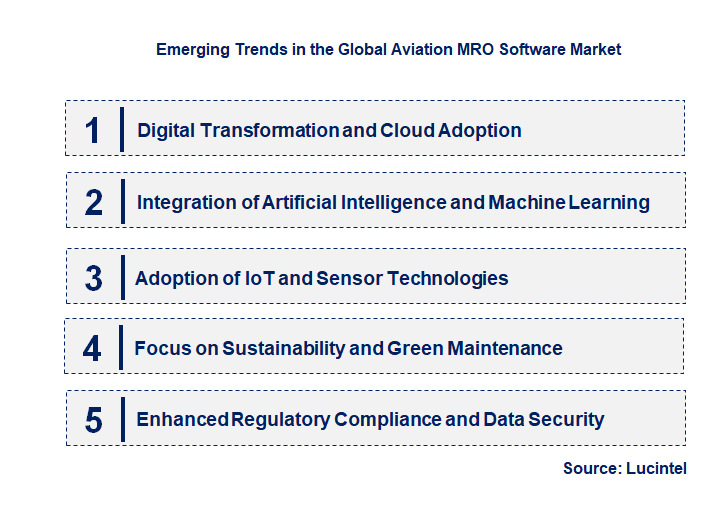
• Digital Transformation and Cloud Adoption: The shift towards cloud-based MRO solutions is enabling real-time data access, improved collaboration, and scalability. Cloud platforms reduce infrastructure costs and facilitate remote monitoring and management of maintenance activities. This trend supports faster deployment, easier updates, and enhanced data security, making MRO operations more flexible and responsive to changing demands. As airlines and MRO providers increasingly adopt cloud solutions, the industry benefits from improved operational efficiency and reduced downtime, fostering a more agile maintenance environment.
• Integration of Artificial Intelligence and Machine Learning: AI and ML are revolutionizing predictive maintenance by analyzing vast amounts of operational data to forecast equipment failures before they occur. This proactive approach minimizes unplanned downtime and reduces maintenance costs. AI-driven analytics also optimize inventory management and streamline workflows. The impact is significant, as it enhances safety, improves turnaround times, and lowers operational expenses. As AI integration deepens, MRO software becomes smarter, enabling more precise decision-making and resource allocation.
• Adoption of IoT and Sensor Technologies: The deployment of IoT sensors in aircraft components provides continuous monitoring of equipment health. These sensors generate real-time data that feed into MRO software, enabling condition-based maintenance. This trend improves accuracy in diagnosing issues, reduces unnecessary inspections, and extends asset lifespan. The impact on the market includes increased maintenance precision, cost savings, and enhanced safety standards. IoT integration is transforming traditional maintenance practices into more predictive and data-driven processes, leading to more efficient resource utilization.
• Focus on Sustainability and Green Maintenance: Environmental concerns are prompting the adoption of eco-friendly practices within the MRO sector. Software solutions now incorporate features for tracking carbon footprints, optimizing fuel efficiency, and managing waste. Green maintenance initiatives reduce environmental impact and comply with evolving regulations. This trend influences market growth by encouraging investments in sustainable technologies and practices. It also appeals to environmentally conscious stakeholders, positioning companies as responsible industry leaders committed to reducing their ecological footprint.
• Enhanced Regulatory Compliance and Data Security: As regulatory standards become more stringent, MRO software is evolving to ensure compliance through automated reporting and documentation. Data security is also a priority, with advanced encryption and cybersecurity measures protecting sensitive information. These developments help companies avoid penalties and maintain operational integrity. The impact includes increased trust from clients and regulators, streamlined compliance processes, and reduced risk of data breaches. This trend underscores the importance of robust, secure, and compliant software solutions in maintaining industry standards and fostering market confidence. These emerging trends are collectively transforming the aviation MRO software market by making maintenance processes more intelligent, efficient, and sustainable. Digital and cloud technologies enable greater flexibility and collaboration, while AI, IoT, and predictive analytics enhance operational precision. Focus on sustainability aligns industry practices with environmental goals, and improved compliance and security measures ensure regulatory adherence. Together, these developments are driving a more innovative, cost-effective, and resilient aviation maintenance industry, positioning it for sustained growth and technological leadership in the future.
• Cloud-Based Solutions: Enhancing Flexibility and Accessibility: Cloud-based MRO software allows airlines and maintenance providers to access real-time data from any location, improving operational flexibility. These platforms facilitate seamless collaboration, reduce infrastructure costs, and enable scalable solutions tailored to organizational needs. The shift to cloud technology also supports remote diagnostics and predictive maintenance, leading to faster decision-making and minimized downtime. As a result, cloud adoption is significantly boosting efficiency and operational agility in the aviation MRO sector.
• Artificial Intelligence and Machine Learning Integration: Improving Predictive Maintenance: AI and ML are increasingly integrated into MRO software to analyze vast amounts of data for predictive maintenance. This technology enables early detection of component failures, reducing unplanned outages and maintenance costs. It also optimizes inventory management by predicting spare parts requirements. The impact is a more proactive maintenance approach, enhanced safety, and reduced aircraft downtime. These innovations are transforming traditional reactive maintenance into a predictive, data-driven process, offering competitive advantages to early adopters.
• IoT and Sensor Technologies: Real-Time Monitoring and Data Collection: IoT devices and sensors are being deployed on aircraft to monitor systems continuously. This real-time data collection allows for immediate detection of anomalies, improving maintenance accuracy and response times. IoT-enabled MRO solutions facilitate condition-based maintenance, extending component life and reducing unnecessary inspections. The integration of IoT enhances operational transparency, safety, and efficiency, enabling maintenance teams to make informed decisions quickly. This technological shift is significantly advancing the precision and effectiveness of aircraft maintenance.
• Digital Twin Technology: Simulating Maintenance Scenarios: Digital twin technology creates virtual replicas of aircraft and components for simulation and analysis. This allows maintenance teams to predict potential issues, optimize repair procedures, and plan maintenance schedules more effectively. Digital twins improve accuracy in diagnostics and reduce maintenance time by enabling virtual testing before physical intervention. The technology also supports training and skill development for technicians. Its adoption is leading to more efficient, cost-effective maintenance processes and improved aircraft reliability, marking a major innovation in aviation MRO.
• Regulatory Compliance and Data Security: Ensuring Safe and Secure Operations: As digital solutions proliferate, regulatory bodies are emphasizing compliance with safety standards and data security protocols. MRO software must adhere to strict regulations to ensure data integrity, privacy, and cybersecurity. Enhanced compliance measures foster trust among stakeholders and prevent operational disruptions caused by security breaches. The focus on regulatory adherence is driving the development of secure, compliant software solutions, which are crucial for maintaining market confidence and ensuring safe, reliable aviation maintenance operations. The overall impact of these developments is a more efficient, cost-effective, and safer aviation MRO market. Adoption of advanced technologies is enabling predictive and real-time maintenance, reducing downtime, and improving safety standards. These innovations are fostering competitive advantages for market players and supporting the industrys shift toward digital transformation, ultimately leading to a more resilient and responsive aviation maintenance ecosystem.
• Digital Transformation in Maintenance Operations: The adoption of advanced MRO software enables airlines and maintenance providers to digitize workflows, improve data accuracy, and reduce downtime. Cloud-based solutions facilitate real-time tracking, predictive maintenance, and streamlined inventory management, leading to cost savings and enhanced safety. This digital shift is driven by the need for operational efficiency and regulatory compliance, creating substantial growth opportunities across commercial and military aviation sectors.
• Integration of Artificial Intelligence and Machine Learning: AI and ML technologies are revolutionizing aviation MRO by enabling predictive analytics, automated diagnostics, and optimized scheduling. These innovations help identify potential failures before they occur, reducing unscheduled repairs and operational disruptions. The deployment of AI-driven tools enhances decision-making, improves safety standards, and lowers maintenance costs, opening new avenues for growth in both commercial and defense aviation markets.
• Expansion of Cloud-Based MRO Solutions: Cloud technology offers scalable, flexible, and cost-effective platforms for managing maintenance data, inventory, and compliance documentation. It allows for seamless collaboration among stakeholders, including OEMs, airlines, and maintenance providers. The adoption of cloud-based MRO software supports remote diagnostics and real-time updates, which are crucial for global operations. This trend is expected to accelerate growth, especially among small to medium-sized operators seeking affordable, efficient solutions.
• Growing Demand for Customizable and Industry-Specific Software: The aviation industry requires tailored MRO solutions that address unique operational needs, regulatory standards, and fleet types. Vendors are developing customizable platforms that integrate with existing systems and support specific aircraft models, maintenance procedures, and compliance requirements. This flexibility enhances user experience and operational efficiency, fostering market expansion as operators seek solutions aligned with their specific workflows and regulatory environments.
• Increasing Focus on Sustainability and Green Maintenance: Environmental concerns are prompting the adoption of eco-friendly MRO practices and software that support sustainable operations. These solutions facilitate efficient resource management, waste reduction, and compliance with environmental regulations. Software that tracks carbon footprint and promotes green maintenance practices is gaining traction, especially among airlines aiming to meet sustainability targets. This focus on eco-conscious operations presents new growth opportunities within the aviation MRO software market. The overall market is poised for significant expansion as these opportunities drive innovation, efficiency, and sustainability. Companies investing in advanced, customizable, and environmentally friendly solutions will likely gain competitive advantages. The integration of emerging technologies and industry-specific needs will shape the future landscape, fostering continued growth and transformation across the aviation maintenance sector.
• Technological Innovation: The integration of AI, IoT, and big data analytics enables predictive maintenance, reducing downtime and operational costs. These technologies facilitate real-time monitoring and data-driven decision-making, leading to more efficient maintenance schedules. As airlines and MRO providers seek to optimize their operations, the adoption of advanced software solutions accelerates, fostering market growth. The continuous evolution of technology ensures that MRO software remains aligned with industry needs, offering enhanced accuracy, automation, and safety features.
• Increasing Fleet Size and Age: The global expansion of airline fleets, coupled with aging aircraft, necessitates more frequent and complex maintenance activities. This growth drives demand for sophisticated MRO software capable of managing extensive maintenance records, compliance documentation, and lifecycle management. As fleet sizes expand, airlines require scalable solutions that can handle increased data volumes and maintenance schedules, thereby fueling market expansion. The aging fleet also emphasizes the need for predictive maintenance tools to prevent costly failures and extend aircraft lifespan.
• Regulatory Compliance and Safety Standards: Stringent safety regulations and environmental standards compel airlines and MRO providers to adopt compliant software solutions. These systems help ensure adherence to international standards such as FAA, EASA, and ICAO regulations by automating documentation, reporting, and audit processes. Compliance reduces legal risks and enhances safety, making advanced MRO software indispensable. As regulatory landscapes evolve, the market witnesses increased demand for adaptable, compliant software that can quickly incorporate new standards.
• Digital Transformation in Aviation: The shift towards digitalization across the aviation sector encourages the adoption of integrated MRO software platforms. These platforms facilitate seamless data sharing, automation, and remote diagnostics, improving operational efficiency. Digital transformation initiatives also support predictive analytics and machine learning, enabling proactive maintenance strategies. As airlines and MRO providers embrace digital tools, the market experiences accelerated growth driven by the need for smarter, more connected maintenance solutions.
• Cost Optimization and Operational Efficiency: Airlines and MRO organizations aim to minimize maintenance costs while maximizing aircraft availability. Advanced MRO software offers features like inventory management, workflow automation, and resource planning, which streamline operations and reduce waste. The ability to optimize maintenance schedules and inventory levels directly impacts profitability. As competitive pressures intensify, the demand for cost-effective, efficient software solutions continues to rise, propelling market growth. The challenges facing the aviation MRO software market include:
• High Implementation and Maintenance Costs: Deploying advanced MRO software involves significant initial investment in hardware, software licenses, and training. Ongoing maintenance, updates, and customization further add to costs, which can be prohibitive for smaller operators. These financial barriers may slow adoption, especially in emerging markets or among budget-conscious organizations. Balancing cost with technological benefits remains a key challenge for market players seeking widespread adoption.
• Data Security and Privacy Concerns: The reliance on cloud-based and interconnected systems exposes sensitive maintenance data to cybersecurity threats. Data breaches can compromise safety, operational integrity, and customer trust. Ensuring robust security measures and compliance with data privacy regulations is critical but challenging, especially as cyber threats evolve. Addressing these concerns is vital for fostering confidence among users and expanding market penetration.
• Integration with Legacy Systems: Many airlines and MRO providers still operate with legacy systems that are incompatible with modern MRO software. Integrating new solutions with existing infrastructure can be complex, costly, and time-consuming. Compatibility issues may lead to operational disruptions and increased implementation risks. Overcoming these integration challenges is essential for seamless digital transformation and sustained market growth. The aviation MRO software market is shaped by rapid technological advancements, expanding fleets, regulatory demands, digital transformation, and cost considerations. While these drivers present significant growth opportunities, challenges such as high costs, security concerns, and system integration issues pose hurdles. Addressing these challenges through innovation, strategic investments, and robust security measures will be crucial for sustained market expansion. Overall, the markets future hinges on balancing technological progress with effective management of associated risks, ensuring enhanced safety, efficiency, and profitability in aviation maintenance operations.
• IBS Software
• Flatirons Solutions, Inc.
• Rusada
• Sopra Steria
• Communications Software Limited
• Aviation Intertec Services
• GE Aviation
• BytzSoft Technologies Pvt. Ltd.
• Lufthansa Technik AG
• Tracware Limited
• Small Enterprises
• Medium Enterprises
• Large Enterprises
• Aircraft Maintenance
• Component Maintenance
• Engine Maintenance
• Line Maintenance
• Maintenance Management
• Inventory Management
• Work Order Management
• Compliance Management
• Reporting & Analytics
• Commercial Aviation
• Military Aviation
• Business Aviation
• Helicopter Operations
• North America
• Europe
• Asia Pacific
• The Rest of the World
• United States: The US market has seen rapid adoption of AI-driven MRO software, with major airlines investing in predictive maintenance tools to reduce downtime and costs. Leading tech firms are partnering with aviation companies to develop integrated platforms that enhance real-time data analysis. Regulatory bodies are also promoting digital standards, encouraging innovation. Additionally, the US government is supporting startups focused on aviation software solutions through grants and incentives, fostering a competitive and innovative environment.
• China: China’s aviation MRO software market is expanding swiftly, driven by government initiatives to modernize its aviation infrastructure. Major airlines are adopting cloud-based and IoT-enabled solutions to improve maintenance efficiency and safety. Local software providers are gaining ground by offering cost-effective, tailored solutions that meet domestic regulatory standards. The Chinese government’s focus on digital transformation in aviation is encouraging investments in AI and big data analytics, positioning China as a key player in the global MRO software landscape.
• Germany: Germany’s market emphasizes high-quality, reliable MRO software solutions, supported by its strong aerospace manufacturing sector. Companies are integrating advanced analytics and automation to optimize maintenance schedules and reduce operational costs. The country’s focus on sustainability is also influencing software development, with an emphasis on energy-efficient and environmentally friendly solutions. Collaboration between industry players and research institutions is fostering innovation, ensuring Germany remains at the forefront of aviation maintenance technology.
• India: India’s aviation MRO software market is witnessing rapid growth due to increasing airline traffic and modernization efforts. The adoption of cloud-based and mobile solutions is rising, enabling real-time maintenance tracking and improved operational efficiency. Domestic software providers are expanding their offerings to cater to the growing demand for cost-effective, scalable solutions. Government initiatives aimed at boosting the aviation sector are also encouraging investments in digital MRO solutions, with a focus on skill development and technology adoption.
• Japan: Japan’s market is characterized by the integration of advanced robotics and AI into MRO software, driven by its strong aerospace and manufacturing sectors. Companies are focusing on predictive maintenance and automation to enhance safety and reduce costs. The country’s emphasis on innovation and quality is reflected in the development of highly sophisticated, reliable software solutions. Collaboration between industry and academia is fostering cutting-edge research, positioning Japan as a leader in high-tech aviation maintenance solutions.


• IBS Software
• Flatirons Solutions, Inc.
• Rusada
• Sopra Steria
• Communications Software Limited
• Aviation Intertec Services
• GE Aviation
• BytzSoft Technologies Pvt. Ltd.
• Lufthansa Technik AG
• Tracware Limited Q6. Which aviation MRO software market segment will be the largest in future? Answer: Lucintel forecasts that, within the user type category, large enterprise is expected to witness the highest growth over the forecast period. Q7. In aviation MRO software market, which region is expected to be the largest in next 8 years? Answer: In terms of region, North America is expected to witness the highest growth over the forecast period. Q8. Do we receive customization in this report? Answer: Yes, Lucintel provides 10% customization without any additional cost.


Choose a license that fits your team. Instant PDF delivery.
Prices exclude taxes. Instant delivery. Custom licensing available on request.
Market Report · July 31, 2026
Market Report · July 31, 2026
Market Report · July 31, 2026
Trusted partner for strategic intelligence and business growth


Receive a complimentary market analysis tailored to your industry. Our analysts will identify key growth opportunities and competitive dynamics specific to your business.

Market size, growth rate, and key trend analysis for your specific sector.

Top competitor positioning and market share analysis.

Strategic recommendations backed by data-driven insights.
Get curated market intelligence and competitive moves straight to your inbox.
By subscribing, you agree to receive our monthly insights. Unsubscribe anytime.
Receive a complimentary market analysis tailored to your industry. Our analysts will identify key growth opportunities and competitive dynamics specific to your business.
Market size, growth rate, and key trend analysis for your specific sector.
Top competitor positioning and market share analysis.
Strategic recommendations backed by data-driven insights.
Get curated market intelligence, emerging trends, and competitive moves straight to your inbox each month.
By subscribing, you agree to receive our monthly insights. Unsubscribe anytime.
We'll send your sample report shortly.