
Market Report · July 31, 2026

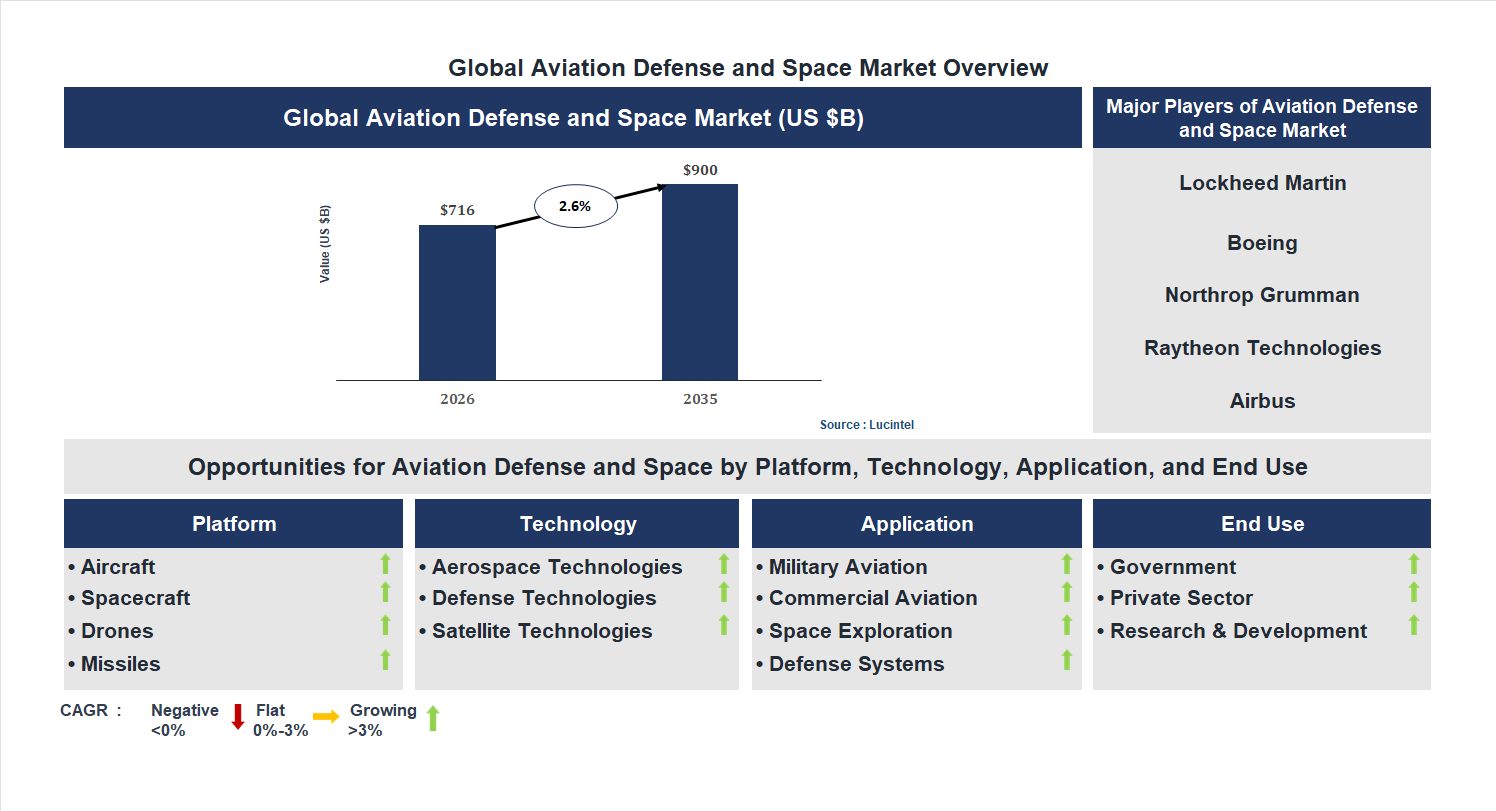
Key data points: The market size in 2035 = $900 billion, growth forecast = 2.6% annually for the next 8 years. Scroll below to get more insights. This market report covers trends, opportunities and forecasts in aviation defense and space market to 2035 by platform (aircraft, spacecraft, drones, and missiles), technology (aerospace technologies, defense technologies, and satellite technologies), application (military aviation, commercial aviation, space exploration, and defense systems), end use (government, private sector, and research & development), and region (North America, Europe, Asia Pacific, and the Rest of the World)
We'll send your sample report shortly.
• Lucintel forecasts that, within the platform category, aircraft is expected to witness the highest growth over the forecast period.
• Within the end use category, government is expected to witness the highest growth.
• In terms of region, North America is expected to witness the highest growth over the forecast period. Gain valuable insights for your business decisions with our comprehensive 150+ page report. Sample figures with some insights are shown below.
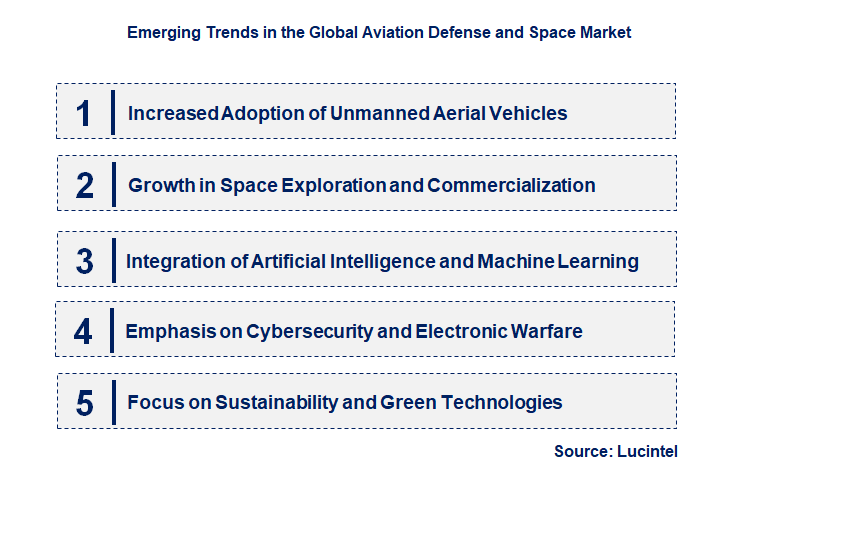
• Increased Adoption of Unmanned Aerial Vehicles (UAVs): UAVs are becoming integral to military operations, offering advantages such as reduced risk to personnel, cost-effectiveness, and enhanced surveillance capabilities. Advances in drone technology, including AI integration and longer endurance, are expanding their roles in reconnaissance, combat, and logistics. This trend is prompting defense budgets to prioritize UAV development, leading to innovations in autonomous flight and swarm technology. The proliferation of UAVs is also influencing strategic doctrines and operational tactics, making them a critical component of modern defense systems.
• Growth in Space Exploration and Commercialization: Governments and private companies are investing heavily in space exploration, satellite deployment, and space-based services. This trend is driven by the need for secure communication, Earth observation, and navigation systems. The rise of commercial space ventures, such as satellite constellations for global internet coverage, is democratizing access to space and fostering new business models. Enhanced launch capabilities and reduced costs are enabling more frequent missions, which are vital for military surveillance, scientific research, and commercial applications, thereby expanding the market scope.
• Integration of Artificial Intelligence and Machine Learning: AI and ML are revolutionizing aviation, defense, and space operations by enabling smarter decision-making, predictive maintenance, and autonomous systems. These technologies improve mission accuracy, reduce operational costs, and enhance safety protocols. For example, AI-driven data analysis helps in threat detection and situational awareness, while autonomous aircraft and spacecraft are becoming more prevalent. The integration of AI is also facilitating real-time data processing and adaptive systems, which are critical for complex missions and battlefield scenarios, thus significantly boosting operational efficiency.
• Emphasis on Cybersecurity and Electronic Warfare: As digital systems become central to defense and space operations, cybersecurity threats are escalating. The market is witnessing increased investments in protecting communication networks, satellites, and control systems from cyber-attacks and electronic warfare tactics. Innovations include advanced encryption, cyber defense platforms, and electronic countermeasures. This trend underscores the importance of resilient infrastructure and the development of offensive and defensive electronic warfare capabilities, which are essential for maintaining strategic superiority in a digitally interconnected environment.
• Focus on Sustainability and Green Technologies: Environmental concerns and regulatory pressures are prompting the industry to adopt sustainable practices. Innovations include the development of eco-friendly aircraft, alternative fuels, and energy-efficient systems for space missions. Governments and companies are investing in research to reduce carbon footprints and improve fuel efficiency, aligning with global climate goals. This trend is influencing design standards, operational procedures, and supply chain management, ultimately leading to a more sustainable and resilient aviation, defense, and space industry. These emerging trends are collectively transforming the aviation defense and space market by fostering innovation, enhancing operational capabilities, and promoting sustainability. They are driving a shift towards smarter, more autonomous, and environmentally conscious systems, which will shape the future landscape of defense and space exploration. Stakeholders who adapt to these trends will be better positioned to capitalize on new opportunities and maintain strategic advantages in this evolving market.
• Emerging Satellite Technologies: Expanding Capabilities in Communication and Earth Observation: The development of advanced satellite technologies is revolutionizing communication, navigation, and earth observation. Miniaturized satellites and improved launch systems enable cost-effective deployment, enhancing global connectivity and data collection. These innovations support military surveillance, disaster management, and environmental monitoring, creating lucrative opportunities for defense contractors and space agencies. The growth of small satellite constellations is particularly impactful, offering real-time data and improved resilience against cyber threats.
• Autonomous Aircraft and Drones: Transforming Military and Civil Operations: The integration of autonomous aircraft and drones is reshaping defense and civil aviation. These systems offer enhanced surveillance, reconnaissance, and logistics capabilities, reducing human risk and operational costs. Advances in AI and sensor technology enable precise navigation and target identification. Military applications include border security and battlefield intelligence, while civil uses involve infrastructure inspection and delivery services. The proliferation of autonomous systems is expected to significantly improve operational efficiency and open new revenue streams for manufacturers.
• Next-Generation Defense Systems: Enhancing Security and Combat Effectiveness: The development of next-generation defense systems, including hypersonic weapons, directed energy, and advanced missile defense, is strengthening national security. These systems provide faster response times, increased accuracy, and better survivability against emerging threats. Governments are investing heavily in research and development to maintain strategic superiority. The integration of these technologies into existing defense infrastructure is creating a competitive market, fostering innovation, and expanding opportunities for defense contractors globally.
• Space Exploration and Commercialization: Unlocking New Market Opportunities: The renewed focus on space exploration, driven by government agencies and private companies, is opening new markets for launch services, satellite manufacturing, and space tourism. Innovations in reusable rocket technology are reducing costs, making space more accessible. Commercial ventures aim to establish lunar bases, asteroid mining, and Mars exploration, creating a multi-billion-dollar industry. These developments are attracting investments, fostering international collaborations, and expanding the scope of commercial and scientific activities beyond Earth.
• Cybersecurity and Data Protection in Defense: Securing Critical Infrastructure and Data: As defense systems become more digitized, cybersecurity has become a top priority. Protecting sensitive data, communication networks, and autonomous systems from cyber threats is crucial for operational integrity. Advanced encryption, threat detection, and AI-driven security solutions are being implemented to safeguard national security assets. The increasing sophistication of cyberattacks is prompting continuous innovation in defense cybersecurity, creating a growing market for specialized solutions and services that ensure resilience against emerging digital threats. These developments are significantly transforming the aviation, defense, and space markets by fostering innovation, enhancing security, and expanding exploration capabilities. They are driving growth across sectors, attracting investments, and creating new opportunities for industry players worldwide. The market is becoming more dynamic, competitive, and technologically advanced, positioning it for sustained expansion in the coming years.
• Increasing Demand for Military Aircraft and Drones: The rising need for advanced military aircraft, unmanned aerial vehicles (UAVs), and surveillance drones is a key growth driver. Countries are investing heavily in next-generation fighter jets, stealth aircraft, and autonomous systems to enhance national security. The integration of AI, sensors, and communication systems in these platforms improves operational efficiency and situational awareness, creating opportunities for manufacturers to develop innovative, lightweight, and fuel-efficient solutions tailored to diverse defense needs.
• Expansion of Satellite and Space Infrastructure: Growing investments in satellite technology and space infrastructure are opening new markets. Governments and private companies are deploying communication, navigation, and Earth observation satellites to support military operations, commercial activities, and scientific research. The development of small satellites, mega-constellations, and reusable launch vehicles reduces costs and increases deployment frequency, enabling rapid expansion of space-based services and fostering collaborations between aerospace firms and space agencies.
• Advancements in Missile Defense and Cybersecurity: The increasing threat of missile attacks and cyber warfare necessitates sophisticated defense systems. Development of advanced missile defense interceptors, radar systems, and electronic warfare solutions is a priority. Cybersecurity measures for aerospace and defense networks are also critical, prompting investments in secure communication channels and threat detection. These innovations enhance national security, protect critical assets, and create opportunities for defense contractors to deliver integrated, multi-layered defense solutions.
• Growing Adoption of Unmanned and Autonomous Systems: The deployment of unmanned systems across military and commercial applications is accelerating. Autonomous aircraft, underwater vehicles, and ground robots are used for reconnaissance, logistics, and combat missions. Advances in AI, machine learning, and sensor technology enable these systems to operate independently or collaboratively, reducing human risk and operational costs. This trend drives demand for reliable, scalable, and adaptable autonomous platforms, fostering innovation in hardware, software, and integration services.
• Increasing Focus on Space Exploration and Commercialization: The surge in space exploration initiatives by government agencies and private firms is creating lucrative opportunities. Missions to Mars, lunar exploration, and asteroid mining are expanding the scope of space activities. Commercial space tourism, satellite servicing, and in-orbit manufacturing are emerging markets. These developments require specialized launch vehicles, spacecraft, and ground systems, encouraging partnerships and investments that will shape the future landscape of the space economy. The overall impact of these opportunities is a robust, innovative, and expanding aviation defense and space market. Companies that leverage technological advancements, strategic collaborations, and emerging sub-segments will be well-positioned to capitalize on the increasing demand for advanced defense and space solutions, ensuring sustained growth and competitiveness in this evolving industry.
• Technological Innovation: The continuous development of advanced aerospace and defense technologies, such as stealth, AI, and autonomous systems, enhances operational efficiency and capabilities, fueling market growth. Governments and private players invest heavily in R&D to stay ahead, leading to a surge in innovative product offerings. These technological advancements enable better surveillance, combat, and space exploration, creating new revenue streams and expanding market reach.
• Increasing Defense Budgets: Countries worldwide are increasing their defense spending to modernize their military infrastructure and enhance national security. This rise in budgets supports procurement of advanced aircraft, satellites, and defense systems, directly boosting market demand. Governments prioritize strategic dominance, which drives investments in cutting-edge defense and space technologies, fostering a competitive environment and encouraging innovation.
• Geopolitical Tensions and Security Concerns: Rising geopolitical conflicts and regional tensions compel nations to strengthen their defense capabilities. This heightened focus on security leads to increased procurement of military aircraft, space assets, and defense systems. The need for rapid deployment and advanced surveillance tools further accelerates market growth, as countries seek to safeguard their interests and maintain strategic superiority.
• Space Exploration and Commercialization: The growing interest in space exploration, satellite deployment, and commercial space activities opens new avenues for market expansion. Governments and private companies are investing in space missions, satellite technology, and related infrastructure. This trend not only boosts demand for space-specific defense systems but also fosters innovation in launch technologies and satellite manufacturing, contributing significantly to market growth. The challenges facing the aviation defense and space market include:-
• Regulatory and Compliance Complexities: The aviation, defense, and space sectors are heavily regulated, with stringent safety, security, and environmental standards. Navigating these regulations can delay product development, increase costs, and restrict market entry for new players. Evolving policies and international treaties add layers of complexity, requiring continuous compliance efforts that can hinder rapid innovation and deployment.
• High Capital and R&D Costs: Developing advanced defense and space technologies demands substantial investment in research, development, and manufacturing infrastructure. These high costs pose barriers for smaller firms and can limit market competition. Additionally, long development cycles and uncertain government procurement processes can impact profitability and market stability, challenging sustained growth.
• Rapid Technological Obsolescence: The fast pace of technological change in aerospace and defense sectors can render existing systems obsolete quickly. Companies face pressure to continuously innovate and upgrade their offerings, which increases R&D expenses and operational risks. This rapid obsolescence can lead to increased costs and reduced return on investment, complicating long-term planning and market stability. The aviation defense and space market is driven by technological innovation, increased defense spending, geopolitical tensions, and space commercialization. However, regulatory hurdles, high R&D costs, and rapid technological obsolescence present significant challenges. These factors collectively shape a highly dynamic environment where strategic agility and innovation are crucial. While growth prospects remain promising, stakeholders must navigate complex regulatory landscapes and technological risks to capitalize on emerging opportunities and sustain competitive advantage in this evolving market.
• Lockheed Martin
• Boeing
• Northrop Grumman
• Raytheon Technologies
• Airbus
• Thales
• Leonardo
• Aircraft
• Spacecraft
• Drones
• Missiles
• Aerospace Technologies
• Defense Technologies
• Satellite Technologies
• Military Aviation
• Commercial Aviation
• Space Exploration
• Defense Systems
• Government
• Private Sector
• Research & Development
• North America
• Europe
• Asia Pacific
• The Rest of the World
• United States: The U.S. continues to lead in aerospace innovation, investing heavily in next-generation fighter jets like the F-35 and F-35B, and expanding its space exploration programs through NASA and private partnerships. Recent advancements include the development of hypersonic weapons and increased focus on unmanned aerial vehicles (UAVs) for defense applications. The U.S. also emphasizes space situational awareness and satellite resilience, with new satellite constellations being launched to enhance global communications and surveillance capabilities.
• China: China has made significant strides in military aviation and space technology, launching its own aircraft carriers and developing advanced fighter jets such as the J-20. The country is also rapidly expanding its space program, including lunar and Mars missions, and deploying a new generation of communication and reconnaissance satellites. China’s focus on indigenous technology and strategic missile systems aims to bolster its regional and global military influence.
• Germany: Germany is prioritizing modernization of its defense aircraft fleet, including upgrades to Eurofighter Typhoons and the development of next-generation combat aircraft. The country is also investing in space technology, particularly in satellite communications and Earth observation systems, to support both military and civilian applications. Germany’s emphasis on European defense collaboration aims to strengthen its strategic autonomy and technological capabilities.
• India: India is rapidly advancing its aerospace and defense sectors, with notable developments in indigenous fighter aircraft like the Tejas and the upcoming 5th-generation fighter, the Advanced Medium Combat Aircraft (AMCA). The country is also expanding its space program through ISRO, launching satellites for navigation, communication, and earth observation. India’s focus on self-reliance and strategic partnerships aims to enhance its regional security and technological independence.
• Japan: Japan continues to modernize its defense forces, including upgrades to its F-35 fleet and the development of advanced missile defense systems. The country is also investing in space technology, with plans to deploy more advanced satellites and participate in international space exploration initiatives. Japan’s strategic focus is on countering regional threats and strengthening its technological capabilities through collaborations with allies and private sector innovation.


• Lockheed Martin
• Boeing
• Northrop Grumman
• Raytheon Technologies
• Airbus
• Thales
• Leonardo Q6. Which aviation defense and space market segment will be the largest in future? Answer: Lucintel forecasts that, within the platform category, aircraft is expected to witness the highest growth over the forecast period. Q7. In aviation defense and space market, which region is expected to be the largest in next 8 years? Answer: In terms of region, North America is expected to witness the highest growth over the forecast period. Q8. Do we receive customization in this report? Answer: Yes, Lucintel provides 10% customization without any additional cost.


Choose a license that fits your team. Instant PDF delivery.
Prices exclude taxes. Instant delivery. Custom licensing available on request.
Market Report · July 31, 2026
Market Report · July 31, 2026
Market Report · July 31, 2026
Trusted partner for strategic intelligence and business growth


Receive a complimentary market analysis tailored to your industry. Our analysts will identify key growth opportunities and competitive dynamics specific to your business.

Market size, growth rate, and key trend analysis for your specific sector.

Top competitor positioning and market share analysis.

Strategic recommendations backed by data-driven insights.
Get curated market intelligence and competitive moves straight to your inbox.
By subscribing, you agree to receive our monthly insights. Unsubscribe anytime.
Receive a complimentary market analysis tailored to your industry. Our analysts will identify key growth opportunities and competitive dynamics specific to your business.
Market size, growth rate, and key trend analysis for your specific sector.
Top competitor positioning and market share analysis.
Strategic recommendations backed by data-driven insights.
Get curated market intelligence, emerging trends, and competitive moves straight to your inbox each month.
By subscribing, you agree to receive our monthly insights. Unsubscribe anytime.
We'll send your sample report shortly.